📋 Quick Summary
In this article:
Why Growing Companies Use 3PL Services
1. Warehousing
2. Inventory Management
3. Order Fulfillment
4. Transportation Management
5. Last-Mile Delivery Support
6. Reverse Logistics and Returns
7. Value-Added Services
How 3PL Services Help Companies Scale
Growth creates a logistics problem that many businesses do not expect. Orders increase. Product lines expand. Customers live in more locations. Delivery expectations become stricter. Inventory becomes harder to control. At the same time, the company still needs to protect margins.
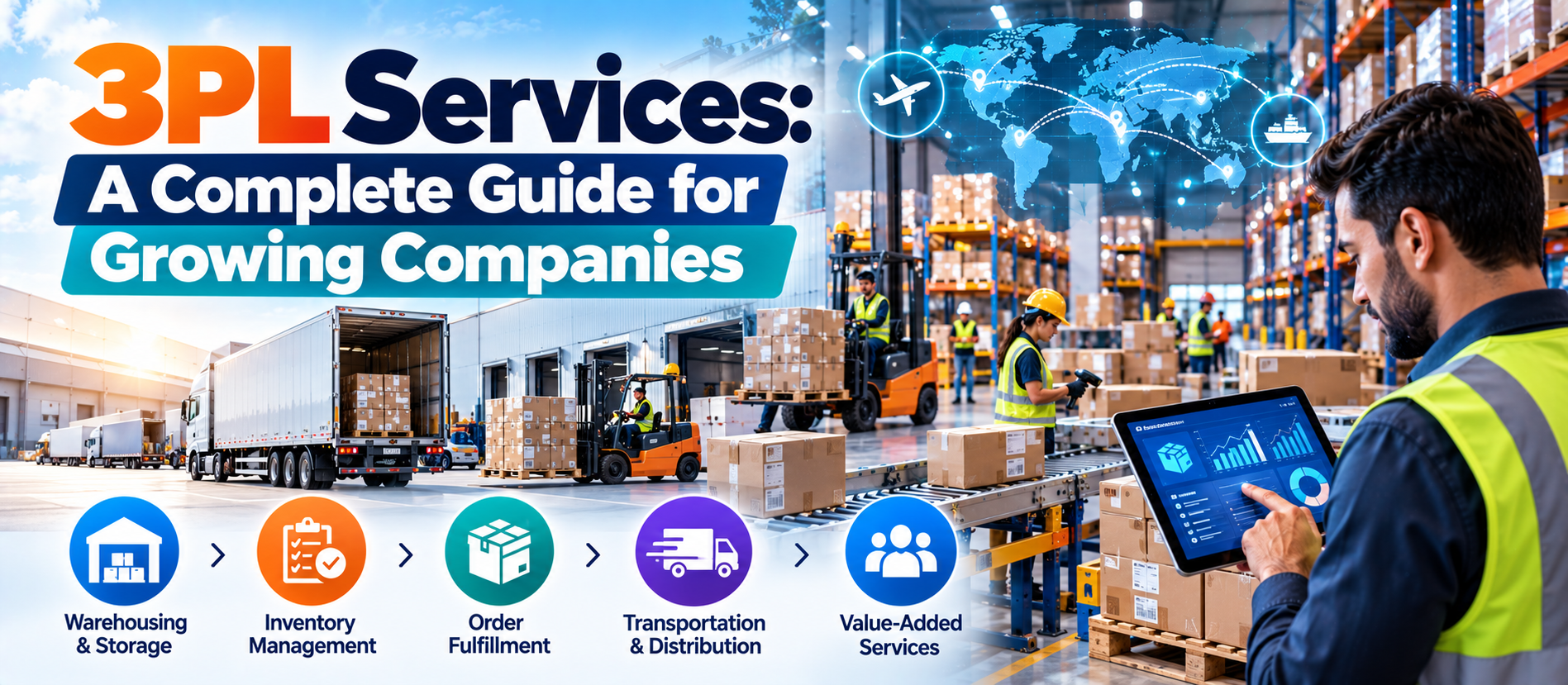
This is where 3PL services can make a major difference. Third-party logistics providers help businesses outsource selected logistics activities or manage a large part of the supply chain. These services can include warehousing, inventory management, order fulfillment, transportation, shipping, returns, and related technology.
For a growing company, the value of a 3PL is not simply about moving boxes. A good provider can give the business access to logistics infrastructure, trained teams, technology, transportation networks, and operational expertise without requiring the company to build everything internally.
Current industry research also shows that 3PL relationships are becoming more strategic. Armstrong & Associates estimates that the global 3PL market reached about $1.3 trillion in 2025 and expects continued growth in 2026–2027. Its 2026 research highlights the convergence of AI, cloud infrastructure, e-commerce fulfillment, and specialized logistics services.
What Are 3PL Services?
Third-party logistics (3PL) means outsourcing logistics activities to an external company that specializes in supply chain operations.
Depending on the contract, a 3PL provider may manage one logistics function or several connected functions. For example, an online retailer may use a 3PL for storage, picking and packing, shipping, and returns. A manufacturer may use a 3PL for warehousing, transportation, distribution, and inventory coordination.
The key idea is flexibility. A company does not have to own warehouses, employ a large logistics team, or build a nationwide delivery network before expanding.
Why Growing Companies Use 3PL Services
Small and mid-sized companies often reach a point where their existing logistics model stops working efficiently. A warehouse that was suitable for 500 orders a month may become difficult to manage when order volume reaches 5,000 or 50,000 orders.
Growing companies usually consider 3PL services for several reasons:
- They need more warehouse capacity.
- They want to expand into new regions.
- They need faster order fulfillment.
- They want better inventory visibility.
- They need access to specialized logistics technology.
- They want to reduce fixed logistics costs.
- They need seasonal capacity without permanent infrastructure.
- They want internal teams to focus on sales, products, customers, and strategy.
In India, the role of 3PL is especially visible in warehousing. CBRE reported that 3PL and engineering/manufacturing companies were the leading drivers of industrial and logistics leasing activity in India during H1 2026, with 3PL accounting for 31% of absorption.
Core 3PL Services
1. Warehousing
Warehousing is one of the most common 3PL services. The provider stores products in a warehouse and manages the movement of inventory inside the facility.
Services can include receiving, put-away, storage, stock checks, picking, packing, labeling, and dispatch preparation.
Shared or multi-client warehouses can also give growing businesses access to professional facilities without requiring them to lease and operate a complete warehouse alone.
2. Inventory Management
Inventory problems can directly affect cash flow and customer satisfaction. Too much inventory ties up capital. Too little inventory creates stockouts and missed sales.
A 3PL can support inventory tracking through warehouse management systems and connected reporting. Businesses can monitor stock levels, movement, aging inventory, order status, and other operational data.
3. Order Fulfillment
Order fulfillment covers the process from receiving an order to preparing it for shipment.
A typical workflow includes:
- Order received from the sales channel.
- Inventory availability confirmed.
- Product picked from storage.
- Items packed according to requirements.
- Shipping label generated.
- Order handed to the carrier.
- Tracking information shared with the customer.
For e-commerce businesses, reliable fulfillment can have a direct effect on customer experience and repeat purchases.
4. Transportation Management
Many 3PL providers coordinate transportation between suppliers, warehouses, distribution centers, stores, and customers.
Depending on the provider, transportation services can include freight planning, carrier coordination, shipment scheduling, route planning, freight tracking, and delivery management.
5. Last-Mile Delivery Support
The final stage of delivery is often the most visible part of the customer experience. 3PL partners can help businesses coordinate last-mile carriers and delivery networks.
This can be particularly useful for companies expanding into new cities or regions where they do not yet have their own logistics infrastructure.
6. Reverse Logistics and Returns
Returns require more than simply receiving a product back. A business may need inspection, sorting, restocking, repair, repackaging, replacement, or disposal.
A 3PL can create a structured reverse-logistics process so returns do not become a hidden operational burden.
7. Value-Added Services
Some 3PL providers offer services beyond standard storage and shipping. These may include kitting, bundling, relabeling, quality checks, product customization, promotional packaging, and light assembly.
These services can help businesses respond to customer or channel requirements without building a separate operational facility.
How 3PL Services Help Companies Scale
Flexible Warehouse Capacity
Growth is rarely perfectly predictable. A company may experience sudden demand during festivals, product launches, promotions, or seasonal periods.
Building permanent warehouse capacity for the highest possible demand can leave expensive space unused during slower periods. A 3PL model can provide more flexibility because warehouse resources can be adjusted as volumes change.
Faster Geographic Expansion
Opening a new market often requires more than marketing. The business needs inventory close enough to customers to meet delivery expectations.
Instead of creating a new logistics operation from scratch in every market, a company can use an established 3PL network. This can shorten the operational setup period and reduce infrastructure requirements.
Indian logistics research also points to increasing demand outside traditional Tier-I markets. Recent reporting shows 3PL operators expanding toward Tier-II and Tier-III cities as businesses seek distribution centers closer to consumption markets.
Lower Infrastructure Investment
Running logistics internally may require warehouses, equipment, software, vehicles, supervisors, warehouse workers, maintenance, security, utilities, and compliance processes.
3PL outsourcing changes the cost structure. Instead of investing heavily in every capability, the business can pay for agreed services and capacity.
This does not automatically mean outsourcing is cheaper in every situation. The correct comparison should include total cost, service quality, scalability, technology, internal labor, inventory losses, and management time.
Access to Specialized Expertise
Logistics is a specialized discipline. It involves transportation planning, warehouse operations, inventory control, carrier management, safety, compliance, technology, and performance measurement.
A professional 3PL team already works with these processes. That experience can reduce the learning curve for a growing company.
3PL Technology and Visibility
Modern 3PL services are increasingly technology-driven. The relationship is no longer limited to warehouse space and transportation.
Depending on the provider, technology may include:
- Warehouse Management Systems (WMS)
- Transportation Management Systems (TMS)
- Real-time shipment tracking
- Inventory dashboards
- Order management integrations
- Electronic data exchange
- Barcode and scanning systems
- API integrations
- Analytics and reporting
- Exception alerts
Technology is also becoming important for AI-enabled logistics. The latest 3PL research from NTT DATA, Penske Logistics, and the University of Tennessee reports that AI is moving into operational use, with transportation planning and routing among the areas showing strong reported value. The same research emphasizes data quality and system integration as important foundations for scaling AI.
Benefits of 3PL Services for Growing Companies
- Scalability: Increase or reduce logistics capacity as demand changes.
- Cost flexibility: Reduce the need for large upfront infrastructure investments.
- Faster fulfillment: Use established warehouse and transportation processes.
- Better visibility: Access operational data through logistics technology.
- Geographic reach: Expand into new markets without building every facility internally.
- Operational expertise: Work with specialists who understand logistics processes.
- Focus on core business: Let internal teams spend more time on products, customers, sales, and growth.
- Improved resilience: Build more flexible logistics options for disruptions.
- Seasonal flexibility: Handle peaks without permanently overbuilding capacity.
- Better customer experience: Improve order accuracy, delivery coordination, and returns.
3PL vs In-House Logistics
| Factor3PL Model In-House Model | ||
| Infrastructure | Shared or outsourced infrastructure | Company-owned or leased infrastructure |
| Scalability | Usually more flexible | Requires internal expansion |
| Expertise | Specialist logistics team | Built internally |
| Technology | Provider technology may be available | Company funds and manages systems |
| Control | Shared through contracts and SLAs | Direct operational control |
| Investment | Lower upfront infrastructure requirement | Higher infrastructure investment may be required |
| Management | External partner management required | Internal management required |
The best choice depends on the business model. Companies with highly specialized logistics requirements may prefer more internal control. Companies that value flexibility and faster scaling may benefit from a 3PL partnership. A hybrid model can also work well.
How to Choose the Right 3PL Provider
Choosing a 3PL provider should be treated as a strategic decision. The cheapest quotation is not always the lowest-cost solution.
1. Define Your Logistics Requirements
Start with clear information about order volume, SKU count, warehouse locations, product characteristics, delivery regions, seasonal peaks, return rates, and service expectations.
2. Check Industry Experience
A provider experienced with your product category may already understand your operational challenges. Food, pharmaceuticals, electronics, apparel, automotive parts, and oversized products can have very different logistics requirements.
3. Evaluate Technology
Ask how the provider handles inventory data, order integrations, shipment tracking, reporting, alerts, and APIs. Technology should support your business rather than create another disconnected system.
4. Review Service-Level Agreements
Define measurable expectations. Important metrics may include order accuracy, inventory accuracy, on-time shipment, delivery performance, response time, return processing time, and damage rates.
5. Understand Pricing
3PL pricing can include storage charges, receiving fees, pick-and-pack fees, shipping costs, returns processing, technology fees, special handling, and other charges.
Ask for a complete pricing model. Compare the expected total cost under normal, high-volume, and seasonal scenarios.
6. Review Business Continuity and Security
Logistics technology and data are part of the supply chain. Ask about cybersecurity, access controls, backups, disaster recovery, business continuity, and incident response.
ASCM's 2026 supply chain trends research specifically highlights cybersecurity as an important consideration for 3PL operations because connected logistics networks can create systemic points of failure.
Key 3PL KPIs to Track
A successful partnership needs measurable performance. Consider tracking:
- Order accuracy rate
- Inventory accuracy rate
- On-time shipment rate
- On-time delivery rate
- Order cycle time
- Pick-and-pack accuracy
- Return processing time
- Damage rate
- Cost per order
- Cost per shipment
- Warehouse utilization
- Stoc kout rate
- Customer complaint rate
Use these KPIs in regular business reviews. A strong 3PL relationship should become more efficient over time, not simply continue operating at the same level.
Common 3PL Mistakes to Avoid
- Choosing only on price: A low initial rate can become expensive if service quality is poor.
- Ignoring integrations: Manual data transfer can create errors and delays.
- Failing to define SLAs: Expectations should be measurable.
- Not planning for peak demand: Confirm capacity before seasonal spikes.
- Overlooking returns: Reverse logistics can become a major cost center.
- Ignoring data quality: Poor inventory or order data reduces the value of automation and analytics.
- Failing to review performance: Use regular reviews and improvement plans.
- Choosing a provider without scalability: The 3PL should be able to support future growth.
How to Build a Successful 3PL Partnership
A 3PL provider should not be treated as a black-box vendor. The strongest partnerships have shared goals, transparent data, regular communication, and continuous improvement.
Start with a detailed transition plan. Map current processes. Confirm inventory data. Test integrations. Define responsibilities. Establish escalation contacts. Run pilot shipments where possible. Then measure results against agreed KPIs.
Regular business reviews can focus on service quality, cost trends, capacity, upcoming demand, technology improvements, and risk. The 2026 3PL research highlights the growing importance of strategic collaboration, visibility, customization, customer experience, and cost optimization in shipper-provider relationships.
3PL Services and AI Search, AEO, GEO, and Digital Visibility
For logistics companies and businesses selling 3PL-related services, digital visibility is becoming increasingly important.
SEO helps a company appear for searches such as “3PL services,” “3PL warehousing,” “third-party logistics provider,” and “e-commerce fulfillment services.”
AEO helps content answer direct questions clearly. Pages should explain what 3PL means, how it works, what it costs, and when businesses should use it.
GEO and AI Search Optimization focus on making information easy for generative search systems to understand and cite. Clear definitions, structured sections, concise answers, useful comparisons, original insights, and trustworthy evidence can improve content quality for these environments.
For growing logistics brands, a useful content strategy can include service pages, industry-specific guides, comparison pages, case studies, FAQs, warehouse guides, fulfillment guides, and supply chain education.
A Practical 90-Day 3PL Implementation Plan
Days 1–30: Assess
- Document current logistics processes.
- Measure order, inventory, shipping, and return volumes.
- Identify major operational problems.
- Calculate current logistics costs.
- Define required service levels.
- Shortlist potential providers.
Days 31–60: Design and Test
- Compare proposals and total costs.
- Confirm warehouse and transportation capabilities.
- Review technology integrations.
- Finalize SLAs and KPIs.
- Plan inventory migration.
- Test order and data flows.
Days 61–90: Launch and Optimize
- Move agreed inventory or operations.
- Monitor first shipments closely.
- Track KPIs daily during the launch period.
- Resolve exceptions quickly.
- Review customer feedback.
- Run a formal performance review.
- Create a continuous-improvement roadmap.
Frequently Asked Questions About 3PL Services
What does 3PL stand for?
3PL stands for third-party logistics. It means outsourcing logistics activities such as warehousing, fulfillment, transportation, inventory management, and returns to a specialized external provider.
Are 3PL services only for e-commerce companies?
No. E-commerce is an important 3PL market, but manufacturers, retailers, distributors, healthcare companies, consumer goods businesses, and other organizations can use 3PL services.
Can a small business use a 3PL provider?
Yes. A small business can use a 3PL to access warehouse capacity, fulfillment operations, transportation networks, and logistics technology without building the entire infrastructure internally.
Is using a 3PL always cheaper?
No. The value of a 3PL should be evaluated using total cost and business outcomes. Consider labor, infrastructure, technology, shipping, management time, errors, inventory losses, scalability, and service quality.
What should a company ask a 3PL provider?
Ask about warehouse locations, capacity, technology, integrations, pricing, SLAs, industry experience, peak-season capacity, returns, security, business continuity, reporting, and scalability.
What is the difference between 3PL and 4PL?
A 3PL usually performs logistics operations such as warehousing and transportation. A 4PL typically has a broader coordination role and may manage multiple logistics providers and supply chain relationships on behalf of the client.
Conclusion
3PL services can give growing companies a practical way to scale logistics without building every capability internally. The right partner can provide warehousing, fulfillment, transportation, inventory management, technology, and operational expertise.
💡 Key Insight
The most important point is to choose a 3PL based on business requirements rather than price alone. A successful partnership should improve scalability, visibility, customer experience, resilience, and cost control.
As supply chains become more connected and data-driven, the role of 3PL providers is also changing. AI, cloud systems, digital visibility, automation, and strategic collaboration are becoming important parts of modern logistics. Current industry research shows that 3PL partnerships are increasingly moving beyond basic execution toward long-term supply chain value.
For growing companies, the goal is simple: build a logistics model that can handle today's demand while remaining flexible enough for tomorrow's growth.
About Digiifrog: Digiifrog helps businesses improve their digital presence through practical digital marketing, SEO, AI Search, AEO, GEO, content marketing, and technology-focused strategies. Visit www.digiifrog.com to explore more business growth resources.
Sources and Further Reading
- Armstrong & Associates — 2026 3PL market and customer relationship research.
- NTT DATA / Penske Logistics / University of Tennessee — 2026 Third-Party Logistics Study.
- CBRE India — India Industrial & Logistics Market Snapshot H1 2026.
- ASCM — Top 10 Supply Chain Trends in 2026.
Ready to Grow?
Talk to us about a strategy tailored to your brand — we will help you stand out in search, AI discovery and social.
Comments (0)
Log in to leave a comment.