📋 Quick Summary
In this article:
AEO vs SEO: The Main Difference
Why SEO Still Matters in the AI Search Era
SEO Fundamentals That Support AI Discovery
How AEO Changes Content Strategy
The Role of Content Structure in AEO
A Practical Answer-First Content Structure
Focus Keyword: AEO vs SEO
💡 Key Insight
The discussion around AEO vs SEO has become increasingly important as people use traditional search engines, AI-powered search experiences, conversational assistants and generative answers to discover information. Businesses now want to know whether they should continue investing in SEO, move toward AEO, or combine both approaches.
The practical answer is that SEO and AEO are closely connected. SEO focuses on improving a website's discoverability, accessibility, relevance and visibility in search. AEO, or Answer Engine Optimization, is commonly used to describe work aimed at making information clear, useful and easy to surface in answer-oriented and AI-driven search experiences.
Google's current guidance makes an important distinction: from Google's perspective, optimization for generative AI search remains part of SEO because AI features are rooted in its core Search ranking and quality systems. Google specifically identifies AEO and GEO as industry terms rather than separate sets of special requirements.
Designfo helps businesses build connected digital growth strategies through SEO, content marketing, website optimization, AEO, GEO and AI Search Optimization.
What Is SEO?
SEO, or Search Engine Optimization, is the process of improving a website so search engines can discover, crawl, understand and evaluate its content effectively. The ultimate goal is not simply to rank for keywords. Good SEO should help relevant users find useful information and create a better website experience.
Core Areas of SEO
- Keyword and search-intent research
- Technical SEO
- Crawlability and indexability
- Internal linking and site architecture
- Helpful, original content
- On-page optimization
- Page experience and usability
- Structured data where appropriate
- Authority and trust signals
Google describes SEO as activities that help search engines discover and understand content, while emphasizing that SEO works best when applied to helpful, people-first content.
What Is AEO?
AEO, or Answer Engine Optimization, is a term commonly used to describe optimization for answer-focused discovery experiences. Instead of focusing only on a list of search results, the strategy considers how a page can provide clear, direct and trustworthy information that may support an answer.
AEO often focuses on:
- Clear answers to real customer questions
- Well-organized headings and sections
- Concise explanations supported by detail
- Accurate facts and evidence
- FAQ and comparison content where genuinely useful
- Clear entity and business information
- Original expertise and first-hand experience
However, AEO does not replace the need for SEO fundamentals. If search or AI systems cannot reliably discover, crawl or index a page, even excellent answers may have limited opportunities to appear.
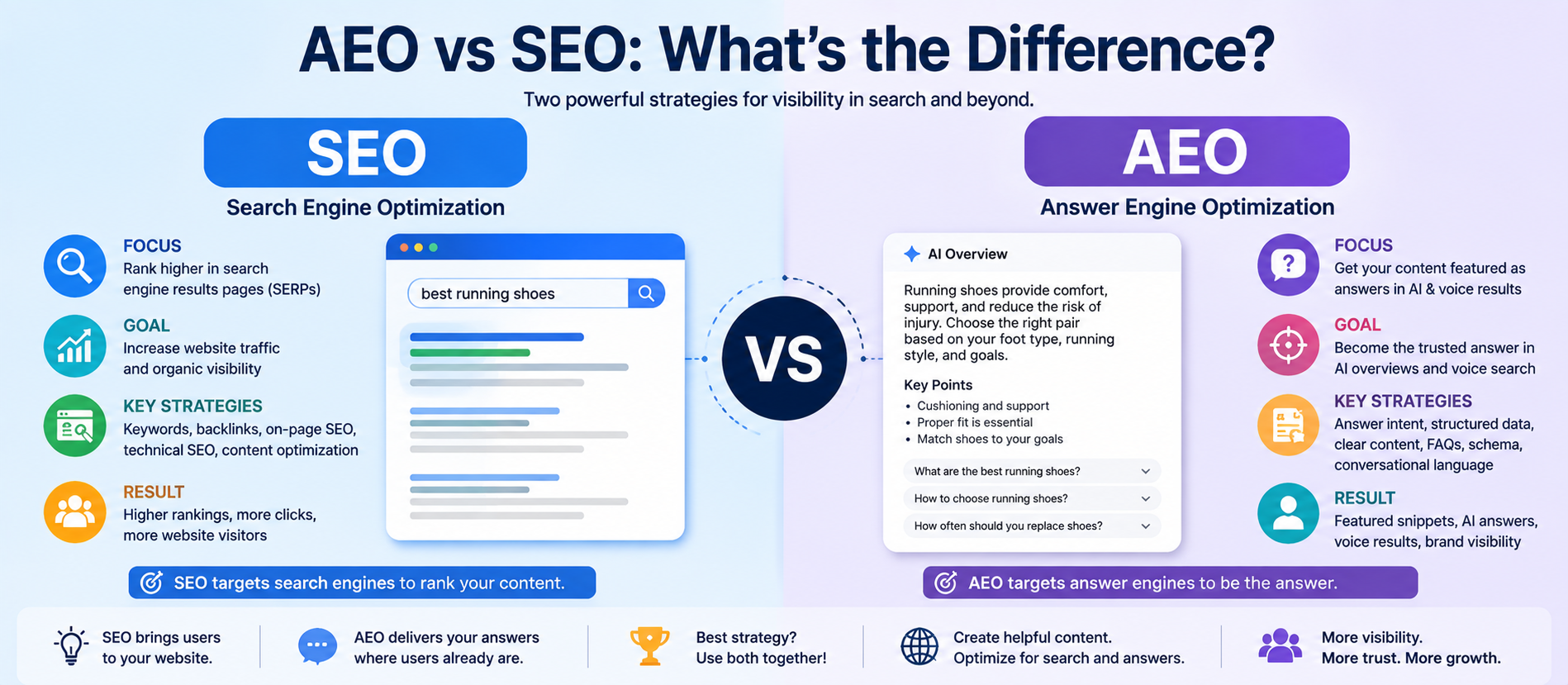
AEO vs SEO: The Main Difference
| Area SEO AEO | ||
| Primary Focus | Improve discovery and visibility in search experiences | Make useful information easier to surface in answer-oriented experiences |
| User Behavior | Queries, keywords and search intent | Questions, conversational requests and direct information needs |
| Content Style | Comprehensive, relevant and search-accessible content | Clear, structured and directly answerable content |
| Technical Foundation | Crawling, indexing, internal linking and page experience | Depends on a strong underlying SEO foundation |
| Measurement | Impressions, clicks, rankings, traffic and conversions | Answer visibility, citations, referenced pages and downstream engagement where measurable |
The difference is therefore best understood as a difference in emphasis rather than a complete separation. SEO builds the discoverability and technical foundation, while AEO emphasizes how clearly and usefully information can address questions.
Why SEO Still Matters in the AI Search Era
A common misconception is that AI search makes SEO obsolete. Google's official guidance says the opposite: SEO best practices continue to matter for generative AI features because those experiences use Google's Search index and core ranking and quality systems to retrieve relevant information.
Bing provides similar guidance. Its current webmaster guidelines state that SEO fundamentals supporting crawl efficiency, indexing accuracy, content clarity, authority and trust also support visibility across Bing, Copilot and AI-powered search experiences.
SEO Fundamentals That Support AI Discovery
- Allow important pages to be crawled.
- Create clear internal links.
- Maintain logical site architecture.
- Publish accurate and original content.
- Use descriptive headings.
- Provide important information in textual form.
- Improve page speed and user experience.
- Keep structured data accurate and consistent with visible content.
How AEO Changes Content Strategy
Traditional keyword research remains valuable, but content strategy can expand beyond short keyword phrases. Businesses should also study the questions customers ask before, during and after making a decision.
For Example
A traditional SEO target may be:
“digital marketing agency for small businesses”
An answer-focused strategy may also address questions such as:
- What services should a small business expect from a digital marketing agency?
- How much should a small business spend on digital marketing?
- Which marketing channel is best for local lead generation?
- How can a company measure digital marketing ROI?
The goal is not to create a separate low-value page for every possible variation of a question. Google's guidance specifically warns against producing large numbers of pages primarily to manipulate rankings or generative responses.
The Role of Content Structure in AEO
Well-structured content can improve human readability and help systems interpret the main topic and supporting details. Useful structure may include descriptive headings, concise introductory answers, comparison tables, steps and FAQs.
Bing's current AI guidance recommends clear headings, concise sections, tables and FAQ-style content to make information easier to understand and reference in AI-generated answers. It also recommends supporting claims with evidence and keeping content fresh and accurate.
A Practical Answer-First Content Structure
- State the question or problem clearly.
- Give a direct answer.
- Explain the answer in greater depth.
- Add examples, steps or comparisons.
- Support important claims with evidence where appropriate.
- Help the reader understand the next action.
AEO vs SEO vs GEO
SEO traditionally focuses on improving visibility and discoverability across search experiences. AEO focuses on clear answers and answer-oriented discovery. GEO, or Generative Engine Optimization, is commonly used for efforts aimed at improving visibility in generative AI experiences.
In practice, these categories overlap significantly. Google explicitly states that, for Google Search, optimizing for generative AI search is still optimizing for Search and therefore remains SEO. Google recommends prioritizing foundational SEO and warns against relying on supposed AEO or GEO “hacks.”
Bing also recognizes GEO as a term for content eligibility in AI grounding and citation experiences while stating that SEO best practices continue to support long-term visibility across Bing, Copilot and AI-powered search.
How to Combine SEO and AEO
The strongest strategy is usually an integrated one.
Step 1: Build the Technical SEO Foundation
- Ensure important pages are crawlable and indexable.
- Use a logical website structure.
- Create useful internal links.
- Improve mobile usability and page experience.
- Reduce unnecessary duplicate content.
Step 2: Research Search Intent and Customer Questions
Study traditional keywords alongside questions from customer calls, emails, sales conversations, support requests, reviews and on-site search behavior.
Step 3: Create Original, Expert-Led Content
Go beyond generic summaries. Add first-hand experience, original research, practical examples, unique analysis or subject expertise.
Step 4: Make Answers Clear
Use descriptive headings and direct explanations. Avoid hiding important information behind unnecessary marketing language.
Step 5: Support Important Claims
Where accuracy matters, use reliable evidence, data, examples and appropriate citations.
Step 6: Keep Information Current
Review important pages regularly and update them when the underlying facts, products, services or recommendations materially change.
Structured Data: Useful but Not a Magic AEO Solution
Structured data can help search engines understand certain types of page information when implemented correctly. However, there is no special schema markup required simply to appear in Google's AI Overviews or AI Mode.
Google states that structured data should match visible page content and that there is no additional special markup required for AI features.
Therefore, use structured data where it accurately represents the page and follows relevant guidelines. Do not add markup solely because a third party promises guaranteed AI visibility.
How to Measure SEO and AEO Performance
SEO measurement can include:
- Organic impressions
- Organic clicks
- Qualified traffic
- Conversions
- Indexed pages
- Technical crawl and indexing health
Answer and AI visibility may require additional measurement approaches. Bing Webmaster Tools now provides AI Performance reporting that can show cited pages, citation activity and grounding queries across supported AI experiences such as Microsoft Copilot and AI-generated Bing summaries.
When evaluating AI visibility, remember that a citation is not the same as a click, ranking or conversion. Bing explicitly notes that citation counts show visible references in AI answers and do not represent traffic or engagement.
Common AEO and SEO Mistakes
- Believing AEO completely replaces SEO.
- Creating hundreds of thin pages for question variations.
- Repeating keywords unnaturally.
- Publishing generic AI-generated summaries without original value.
- Ignoring crawlability and indexing.
- Using misleading structured data.
- Chasing citations instead of helping users.
- Assuming third-party AEO or GEO tools can guarantee visibility.
- Failing to update outdated business information.
Google warns that third-party SEO, AEO and GEO services cannot guarantee performance and recommends evaluating advice against official guidance and using first-party tools such as Google Search Console for direct search data.
When Should a Business Focus More on SEO?
Prioritize the SEO foundation when your website has problems with:
- Indexing and crawlability
- Technical errors
- Weak site architecture
- Poor internal linking
- Slow or difficult page experiences
- Unclear content topics
- Missing service or product information
Without these basics, answer-oriented content may still struggle to become discoverable.
When Should a Business Add More AEO Focus?
Add stronger AEO practices when your audience frequently asks detailed questions and your business has expertise that can provide useful answers. This is especially valuable for:
- B2B services
- Professional services
- Software and technology companies
- Healthcare and education publishers with appropriate expertise and review processes
- Ecommerce brands with detailed product information
- Local businesses answering common customer questions
The key is to improve the usefulness and clarity of existing information, not simply add “AI-friendly” labels to pages.
How Designfo Helps With SEO, AEO and AI Search Optimization
Designfo helps businesses build integrated digital strategies designed for discoverability, trust and conversion.
- SEO Strategy and Technical SEO
- Keyword and Search Intent Research
- AEO and Question-Based Content Strategy
- GEO and AI Search Optimization
- Website Structure and Internal Linking
- Content Marketing and Authority Building
- Conversion-Focused Website Design
- Marketing Automation and Digital Growth Strategy
Frequently Asked Questions
What is the main difference between AEO and SEO?
SEO focuses broadly on improving a site's visibility and discoverability in search, while AEO emphasizes presenting information in a clear, useful format that can support direct answers and answer-oriented discovery experiences.
Does AEO replace SEO?
No. AEO generally depends on strong SEO fundamentals such as crawlability, indexing, useful content and clear site structure.
Is AEO important for AI search?
Clear, accurate and well-structured information can support visibility in AI-powered experiences. However, Google states that foundational SEO remains the basis for success in its generative AI search features.
Do I need special schema for AI Overviews?
No. Google states that there is no special schema markup required to appear in AI Overviews or AI Mode. Existing SEO best practices and accurate structured data remain useful.
What is GEO?
GEO stands for Generative Engine Optimization, an industry term for work focused on improving visibility in generative AI experiences. The exact implementation depends on the platform, but strong SEO, original content and technical accessibility remain important foundations.
Conclusion: AEO and SEO Work Better Together
The debate around AEO vs SEO should not be viewed as a choice between two completely separate strategies. SEO provides the technical and content foundation that helps websites become discoverable, while AEO emphasizes clarity, direct answers and usefulness in answer-oriented search experiences.
For modern businesses, the strongest approach is to combine SEO, AEO, GEO and AI Search Optimization around one core principle: create genuinely useful, accurate and original information that is technically accessible and easy for people to understand.
Search technology will continue to evolve, but the long-term foundation remains consistent: strong technical accessibility, clear information, real expertise, trustworthy content and a positive user experience.
Designfo
Website: www.designfo.in
Ready to Grow?
Talk to us about a strategy tailored to your brand — we will help you stand out in search, AI discovery and social.
Comments (0)
Log in to leave a comment.