📋 Quick Summary
In this article:
What Are Artificial Intelligence and Augmented Reality?
How AI Makes Augmented Reality Smarter
AI-Powered AR in Education
Retail, E-Commerce, and Virtual Try-On
Manufacturing and Industry 4.0
Field Service and Remote Assistance
AI and AR for Navigation and Smart Cities
Entertainment, Gaming, and Social Experiences
Architecture, Construction, and Real Estate
AI and AR in Automotive and Mobility
AI-Powered AR Training
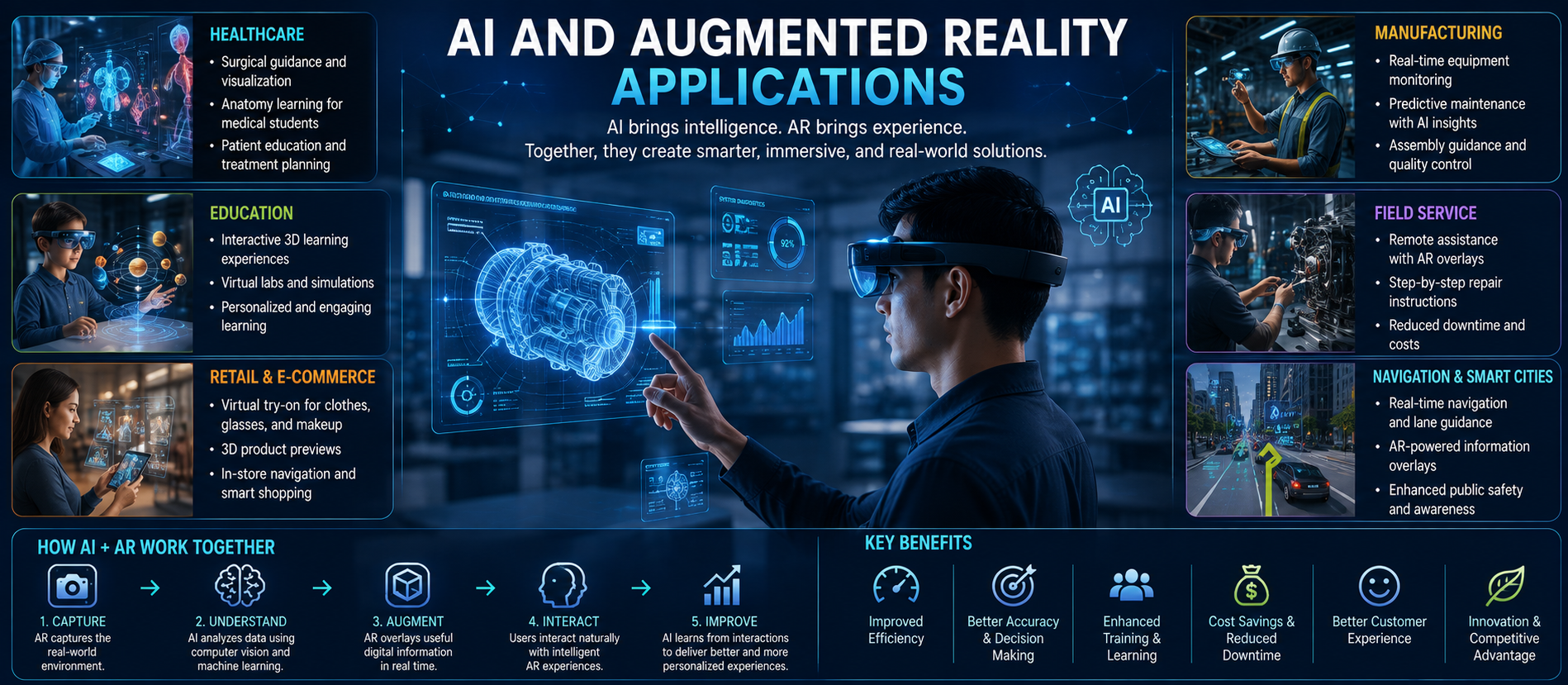
AI and augmented reality applications are changing the way people learn, work, shop, receive services, and interact with digital information. Augmented reality, or AR, adds digital content to a view of the physical world. Artificial intelligence adds the ability to recognize patterns, interpret images and language, personalize experiences, generate content, and support decisions.
When AI and AR work together, digital experiences can become more context-aware and interactive. A system can identify an object, understand a user's request, analyze a real-world scene, and place relevant instructions or visual information into the user's field of view.
This combination is moving beyond entertainment. AI-powered AR is being explored and deployed across healthcare, education, retail, manufacturing, field service, navigation, architecture, training, and enterprise operations. The greatest value often comes from giving people the right information at the right moment while they remain connected to the physical task in front of them.
This WordPress-ready article is prepared for Digiifrog (www.digiifrog.com) with SEO, AEO, GEO, and AI Search optimization.
What Are Artificial Intelligence and Augmented Reality?
💡 Key Insight
Artificial intelligence refers to technologies that can perform tasks such as recognizing patterns, interpreting data, generating content, making predictions, and supporting decisions. Machine learning, computer vision, natural language processing, and generative AI are important areas within the broader AI ecosystem.
Augmented reality overlays digital information onto the physical environment. AR can be experienced through smartphones, tablets, smart glasses, headsets, vehicle displays, and other connected devices.
IBM describes AR applications across education, gaming, healthcare, manufacturing, and navigation, including interactive 3D learning models, surgical planning, industrial guidance, digital twins, and wayfinding. The addition of AI can make these experiences more intelligent and adaptive.
How AI Makes Augmented Reality Smarter
Traditional AR can display predefined digital objects at a selected location. AI expands what an AR system can understand and do.
- Computer vision: Helps recognize objects, surfaces, people, and environmental features.
- Natural language processing: Allows users to interact through voice or conversational commands.
- Machine learning: Helps predict user needs and personalize experiences.
- Generative AI: Can generate explanations, instructions, summaries, and other contextual content.
- Spatial intelligence: Helps digital content interact more accurately with physical environments.
- Recommendation systems: Suggest relevant products, actions, or information.
For example, a maintenance worker could look at a machine through an AR device. Computer vision could help identify the equipment, AI could retrieve the relevant maintenance information, and AR could display step-by-step guidance in the worker's field of view.
AI and AR in Healthcare
Healthcare is one of the most promising areas for intelligent immersive technology. AR can visualize anatomy, medical images, procedures, and instructions in three dimensions. AI can analyze medical data, assist image interpretation, and provide context.
Potential applications include:
- Medical and surgical training.
- Patient-specific anatomical visualization.
- Surgical planning and guidance.
- Rehabilitation and physical therapy.
- Remote assistance and collaboration.
- Patient education using interactive 3D models.
AI-powered XR is also being used for immersive clinical training, allowing professionals to practice complex scenarios without exposing patients to training risk. Healthcare applications require especially careful validation because inaccurate AI outputs or misleading visual overlays could create serious safety concerns.
AI-Powered AR in Education
AR can turn abstract concepts into interactive visual experiences. Students can explore a 3D model of the solar system, examine a virtual molecule, or interact with an anatomical structure in their physical environment.
AI can personalize the learning experience by adapting explanations, identifying knowledge gaps, and answering questions. An AI tutor could potentially recognize what a learner is viewing and provide contextual guidance.
Useful applications include:
- Interactive science and engineering lessons.
- Medical and technical education.
- Language learning with AI-driven guidance.
- Historical and cultural experiences.
- Vocational and skills training.
- Personalized educational content.
The goal is not to replace teachers with headsets or AI. Effective systems should support educators and provide meaningful learning experiences rather than using immersive technology only for novelty.
Retail, E-Commerce, and Virtual Try-On
Retail is a highly visible application of AI and AR. Customers can use AR to visualize furniture in a room, preview cosmetic products, or explore how an item may look before purchasing.
AI can improve these experiences through personalization, image analysis, product recommendations, and conversational assistance. IBM notes that AI-assisted search and AI-enhanced AR can help customers research products and virtually try products in categories such as fashion, beauty, and home decor.
Examples include:
- Virtual clothing and accessory try-ons.
- Cosmetic visualization.
- Furniture and interior design previews.
- AI-powered visual product search.
- Interactive product information.
- Personalized shopping assistance.
For businesses, the objective should be practical: reduce uncertainty, improve product discovery, and help customers make more informed purchasing decisions.
Manufacturing and Industry 4.0
Manufacturing environments contain complex equipment, procedures, and safety requirements. AI and AR can provide contextual support directly within the worker's environment.
IEEE Digital Reality describes how computer vision and AR can recognize real-world objects and guide trainees or workers through actions involving specific tools, buttons, or equipment.
Applications can include:
- Step-by-step assembly instructions.
- Equipment identification.
- Quality inspection support.
- Predictive maintenance information.
- Remote expert assistance.
- Safety and hazard visualization.
- Digital twins and process visualization.
A technician does not always need to search through a paper manual. An intelligent AR interface can potentially surface relevant information while the person is looking at the equipment, provided the system is accurate, secure, and appropriately validated.
Field Service and Remote Assistance
Field technicians frequently work in environments where expert knowledge is not immediately available. AI-powered AR can support remote assistance by combining live video, object recognition, documentation retrieval, and visual annotations.
An experienced engineer could guide a technician by marking components within the shared view. AI could help retrieve equipment records or summarize troubleshooting steps. This can reduce the time required to locate information and may improve consistency across distributed teams.
Important use cases include telecommunications, utilities, energy, construction, transportation, and industrial maintenance.
AI and AR for Navigation and Smart Cities
AR can make navigation more visual by placing directional information within a user's view. AI can analyze location, environmental conditions, traffic data, and user preferences to improve contextual guidance.
Potential applications include:
- Indoor navigation in airports and hospitals.
- Tourism and points-of-interest information.
- Accessible wayfinding support.
- Vehicle and pedestrian navigation.
- Emergency response visualization.
- Urban planning and infrastructure analysis.
In smart-city environments, AI may analyze large datasets while AR provides a more intuitive way for planners or field workers to visualize information in physical space.
Entertainment, Gaming, and Social Experiences
Gaming and entertainment introduced many consumers to AR. AI can make digital characters, environments, and interactions more responsive. Computer vision can recognize faces and surroundings, while generative AI may enable more dynamic content.
Social platforms have also combined computer vision, AI, and AR filters. Future experiences may include more interactive characters, adaptive stories, and shared mixed-reality environments.
However, immersive entertainment must also consider privacy, user safety, deceptive synthetic media, and appropriate use of biometric or camera data.
Architecture, Construction, and Real Estate
AI and AR can help architects, construction professionals, and property developers visualize projects before or during construction. A digital building model can be overlaid onto a physical location to support planning and communication.
Potential applications include:
- Visualizing proposed buildings on-site.
- Comparing construction work with digital plans.
- Identifying possible deviations.
- Interactive property walkthroughs.
- Interior design visualization.
- Remote project collaboration.
AI can analyze project data, detect patterns, and help prioritize information, while AR makes selected information easier to understand spatially.
AI and AR in Automotive and Mobility
⚠ Watch Out
In vehicles, augmented displays can present navigation, warnings, and contextual driving information. AI can contribute by interpreting sensor data and supporting intelligent driver-assistance systems.
Other mobility applications include vehicle maintenance, technician training, warehouse logistics, route optimization, and fleet operations.
Because transportation is safety-sensitive, visual information must be designed carefully. Excessive or poorly timed AR content can distract users rather than help them.
AI-Powered AR Training
One of the strongest enterprise applications is hands-on training. Instead of learning only from documents or videos, workers can practice procedures within a simulated or real-world context.
Recent enterprise XR deployments have highlighted healthcare, manufacturing, and technical training, with AI-powered interaction supporting contextual search and conversational assistance.
AR training can support:
- Onboarding new employees.
- Equipment operation.
- Technical assembly.
- Safety procedures.
- Emergency response preparation.
- High-risk task practice.
The best training systems should include performance measurement, clear safety controls, and human expert review rather than assuming that immersion alone produces effective learning.
Computer Vision: The Bridge Between AI and AR
Computer vision is one of the most important technologies connecting AI and AR. It helps systems interpret visual information from cameras and sensors.
Capabilities may include:
- Object detection.
- Image classification.
- Pose estimation.
- Surface recognition.
- Text recognition.
- Scene understanding.
- Depth and spatial estimation.
These capabilities help AR systems place information more accurately and understand what is happening in the user's environment. Performance can vary according to lighting, camera quality, object similarity, environmental complexity, and the quality of the underlying AI model.
The Role of Generative AI in Augmented Reality
Generative AI can make AR experiences more conversational and dynamic. Instead of requiring every instruction or explanation to be manually written, a system may generate context-specific content based on approved knowledge sources.
Possible uses include:
- Explaining equipment or objects.
- Generating personalized learning guidance.
- Creating conversational AI assistants.
- Producing interactive product information.
- Summarizing technical documentation.
- Supporting multilingual experiences.
Generative AI also introduces risks such as hallucinations and inaccurate information. High-impact AR systems should use reliable data sources, evaluation methods, access controls, and appropriate human oversight.
Benefits of AI and Augmented Reality
- Contextual information: Digital guidance can appear where and when it is needed.
- Better visualization: Complex data and objects become easier to understand spatially.
- Improved training: Learners can practice skills interactively.
- Higher productivity: Workers may spend less time searching for information.
- Personalization: AI can adapt content to users and situations.
- Remote collaboration: Experts can support people from different locations.
- Better customer experiences: AR can help customers visualize and explore products.
Challenges and Risks
Privacy
AR devices can collect video, audio, location, spatial, and behavioral data. Organizations must establish clear rules for collection, storage, access, and retention.
Accuracy
Incorrect object recognition or inaccurate AI-generated instructions can create operational or safety risks.
Cybersecurity
Connected headsets and AR applications can create additional attack surfaces. Identity management, software security, access controls, and secure updates are important.
Cost and Infrastructure
Enterprise AR may require specialized devices, software integration, content development, connectivity, and employee training.
User Experience
Heavy devices, poor battery life, visual clutter, latency, and uncomfortable interfaces can reduce adoption.
Ethical Use
Organizations must consider surveillance, biometric data, accessibility, bias, and the potential misuse of immersive technologies.
How Businesses Can Implement AI and AR Successfully
- Start with a clear problem: Identify a measurable operational, customer, or training challenge.
- Choose the right device: A smartphone may be sufficient for some applications; others may require specialized hardware.
- Prepare reliable data: AI and AR systems depend on accurate information and suitable content.
- Build a pilot: Test with a focused group before large-scale deployment.
- Measure outcomes: Track training time, errors, task completion, customer engagement, or other relevant metrics.
- Design for security and privacy: Include governance from the beginning.
- Keep humans in control: Define when expert review or override is required.
- Scale gradually: Expand successful use cases based on evidence.
The Future of AI and Augmented Reality
The future of AI and AR will likely involve lighter devices, better computer vision, more natural voice interfaces, improved spatial computing, multimodal AI, and stronger connections between digital knowledge and physical environments.
AI agents may eventually help users complete multi-step tasks by understanding goals, retrieving information, and coordinating approved tools. Combined with AR, this could create interfaces that guide people through complex real-world work.
The most successful systems will not simply add digital graphics to a user's view. They will deliver relevant information without overwhelming the user, protect sensitive data, and demonstrate measurable value.
SEO, AEO, GEO, and AI Search Strategy
Technology businesses publishing content about AI and augmented reality applications should focus on clear explanations of real use cases, benefits, limitations, and implementation requirements.
For SEO, use descriptive headings and topic-focused keywords. For AEO, provide concise answers to common questions. For GEO and AI Search optimization, create well-structured, original, evidence-based content that explains concepts and relationships clearly.
Content should distinguish between experimental concepts and proven applications. Regular updates are important because AI, AR hardware, standards, and enterprise use cases continue to evolve.
Frequently Asked Questions
What is AI-powered augmented reality?
AI-powered augmented reality combines AR's ability to overlay digital information on the physical world with AI capabilities such as computer vision, natural language processing, prediction, personalization, and generative content.
How is AI used in AR?
AI can recognize objects, understand scenes, process voice commands, personalize information, generate explanations, and help determine which content should appear in an AR experience.
Which industries use AI and AR?
Important applications exist in healthcare, education, retail, manufacturing, field service, navigation, entertainment, architecture, construction, automotive, and enterprise training.
Can AI and AR improve employee training?
Yes. AI-powered AR can provide contextual instructions, immersive practice, conversational assistance, and feedback. Results depend on the quality of the training design and technology implementation.
What are the main risks?
Key risks include privacy concerns, inaccurate AI outputs, cybersecurity issues, device limitations, high implementation costs, visual distraction, and misuse of collected data.
Conclusion
AI and augmented reality applications are creating a more intelligent connection between digital systems and the physical world. AI can help systems understand what users are seeing and doing, while AR can present useful information in a spatial and intuitive way.
From healthcare and education to retail, manufacturing, field service, and navigation, the technology can improve visualization, training, decision support, and customer experiences. However, successful implementation requires more than advanced hardware. Organizations need reliable data, accurate models, strong cybersecurity, privacy protection, thoughtful user experience, and appropriate human oversight.
The future opportunity lies in solving real problems. Businesses that combine AI and AR with clear operational goals may create experiences that are not only impressive but genuinely useful.
For businesses exploring AI solutions, automation, SEO, AEO, GEO, and AI Search optimization, Digiifrog can support technology-focused digital strategies. Visit www.digiifrog.com.
Quick Answer: What Are AI and Augmented Reality Applications?
AI and augmented reality applications combine intelligent technologies such as computer vision, machine learning, natural language processing, and generative AI with digital overlays in the physical world. Major applications include healthcare, education, retail, manufacturing, field service, navigation, entertainment, architecture, and workforce training.
Important Note
This article is for general educational purposes. AI and AR technologies, regulations, hardware capabilities, and industry practices evolve rapidly. Organizations should evaluate technical, security, privacy, and sector-specific requirements before deploying high-impact systems.
Ready to Grow?
Talk to us about a strategy tailored to your brand — we will help you stand out in search, AI discovery and social.


Comments (0)
Log in to leave a comment.