📋 Quick Summary
In this article:
Quick Answer: What Is the Best Way for a B2B Company to Integrate AI?
1. Start with Business Goals, Not AI Tools
2. Prioritize High-Value AI Use Cases
Common B2B AI use cases include:
3. Separate Quick Wins from Strategic Transformation
4. Redesign Workflows Instead of Adding AI on Top
5. Build a Strong Data Foundation
6. Use Retrieval and Grounding for Business Knowledge
7. Choose the Right AI Architecture
8. Create Clear AI Governance
9. Build AI Security into the Strategy
10. Define Human Oversight
💡 Key Insight
Artificial intelligence is becoming an important part of the B2B technology landscape. Companies are using AI to improve customer service, sales, marketing, software development, operations, analytics, finance, and internal knowledge management.
However, buying an AI tool is not the same as building an AI strategy.
⚠ Watch Out
Many B2B companies start with experimentation. Teams test chatbots, content tools, AI assistants, or automation platforms. Some pilots create useful results. Others remain isolated experiments that never become part of the core business.
The difference often comes down to integration.
A successful AI initiative connects technology with a real business problem, reliable data, existing workflows, responsible governance, employee adoption, and measurable outcomes.
This guide explains practical AI integration strategies for B2B companies. It is written in clear, direct language and structured for SEO, AEO, GEO, and AI Search Optimization.
Digiifrog creates clear, structured, and search-friendly content for B2B businesses, technology companies, SaaS brands, and digital growth strategies.
Quick Answer: What Is the Best Way for a B2B Company to Integrate AI?
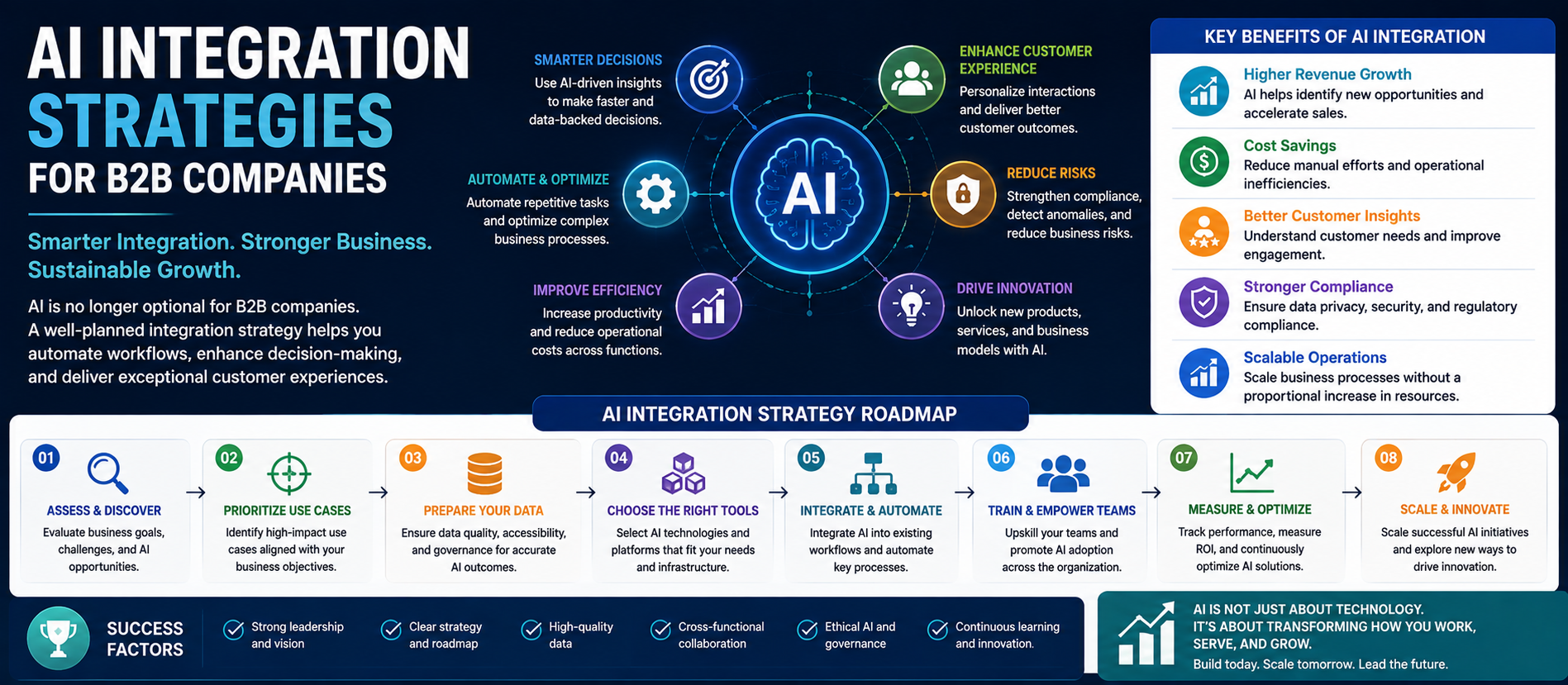
The best approach is to start with a clear business problem, select high-value use cases, assess data and technical readiness, build governance and security controls, integrate AI into existing workflows, train employees, measure results, and scale successful use cases gradually.
AI should support a business objective. It should not be adopted only because competitors are using it.
Recent McKinsey research also shows why workflow design matters. Organizations are using AI more widely, but enterprise-wide value remains difficult to achieve. Companies seeing stronger results are more likely to redesign workflows, scale successful practices, manage risks, and connect AI with broader business transformation.
1. Start with Business Goals, Not AI Tools
The first step in AI integration is identifying the business outcome you want to improve.
A weak approach starts with a question such as, “Which AI tool should we buy?”
A stronger approach starts with questions such as:
- Where are employees spending too much time?
- Which customer problems take too long to resolve?
- Where do repetitive processes create errors?
- Which decisions require faster access to information?
- Which growth opportunities are difficult to scale with current resources?
For example, a sales team may spend too much time researching prospects. An AI solution could help gather account information and prepare first drafts of outreach. The business objective is not “use AI.” The objective is to reduce research time and improve sales productivity.
This distinction is important because it makes success easier to measure.
2. Prioritize High-Value AI Use Cases
B2B companies should not attempt to automate everything at once. A use-case portfolio helps leaders compare opportunities.
Evaluate each potential use case using factors such as:
- Business value.
- Implementation difficulty.
- Data availability.
- Security risk.
- Expected adoption.
- Time to measurable value.
Common B2B AI use cases include:
- Sales research and account intelligence.
- Lead qualification.
- Customer support assistance.
- Knowledge search.
- Document summarization.
- Proposal and response drafting.
- Marketing content operations.
- Demand forecasting.
- Financial analysis.
- Software engineering assistance.
- IT operations.
A useful first project is usually valuable enough to matter but narrow enough to control.
3. Separate Quick Wins from Strategic Transformation
Not every AI project has the same purpose.
Quick wins may improve a single task. Examples include document summarization or internal knowledge search.
Strategic transformation may redesign an entire workflow. For example, an AI-enabled service operation could classify incoming requests, retrieve relevant knowledge, prepare a response, route exceptions, and provide agents with recommendations.
Both are useful. Quick wins can build confidence and experience. Larger transformation projects can create more significant value.
The mistake is expecting a small pilot to automatically transform the business.
4. Redesign Workflows Instead of Adding AI on Top
One of the most important AI integration strategies is workflow redesign.
If a business simply adds AI to an inefficient process, it may automate confusion.
Instead, map the current process:
- What triggers the work?
- What information is required?
- Which steps are repetitive?
- Where are decisions made?
- Where do errors occur?
- Which steps require human judgment?
Then decide how AI should participate.
McKinsey's AI research found workflow redesign to be strongly associated with organizations' ability to generate bottom-line impact from generative AI. This supports a simple lesson for B2B leaders: meaningful AI value often requires changing how work is done, not merely adding an assistant to the old process.
5. Build a Strong Data Foundation
AI quality depends heavily on the quality, relevance, and accessibility of information.
Before deploying AI, companies should understand:
- Where important data is stored.
- Who owns the data.
- Whether the data is accurate.
- Which information is outdated.
- What data is sensitive.
- Who is allowed to access it.
For internal AI assistants, companies often need to connect documents, knowledge bases, CRM systems, product information, and other approved sources.
However, more data is not always better. The goal is to provide the right information with appropriate permissions.
6. Use Retrieval and Grounding for Business Knowledge
General AI models may not know a company's current products, policies, pricing, or internal procedures.
A B2B AI system can be more useful when it is connected to approved business knowledge.
This can allow the system to retrieve relevant information before generating a response.
Good implementation practices include:
- Using authoritative source documents.
- Maintaining content ownership.
- Removing outdated information.
- Applying access permissions.
- Showing sources when useful.
- Testing responses against known facts.
This approach can reduce unsupported answers and improve relevance, although no AI system should be assumed to be error-free.
7. Choose the Right AI Architecture
B2B companies do not need to build every AI capability from scratch.
Depending on the use case, options may include:
- AI features inside existing software.
- Third-party AI applications.
- API-based integrations.
- Custom applications.
- Private or controlled model deployments.
- AI agents connected to approved tools.
The right architecture depends on the sensitivity of the work, required integrations, budget, internal skills, and performance requirements.
For many businesses, the most practical strategy is to use existing platforms for common tasks and build custom integrations only where the business needs a unique workflow or competitive advantage.
8. Create Clear AI Governance
AI integration requires ownership.
Without governance, different teams may adopt different tools, use inconsistent data, and expose sensitive information.
A practical governance model should define:
- Who approves AI use cases.
- Which tools are approved.
- What data can be used.
- Which use cases require human review.
- How risks are assessed.
- How performance is monitored.
- How incidents are reported.
NIST's AI Risk Management Framework is designed to help organizations incorporate trustworthiness considerations into the design, development, use, and evaluation of AI systems. Its generative AI profile provides additional guidance for risks that may be introduced or intensified by generative AI.
9. Build AI Security into the Strategy
AI systems can access valuable data and connected business tools. This creates new security considerations.
Businesses should review:
- Identity and authentication.
- Role-based permissions.
- Data handling.
- Third-party access.
- Prompt and instruction security.
- Logging and monitoring.
- Tool permissions for AI agents.
An AI agent that can read data is different from an agent that can change a CRM record, approve a payment, or send a customer communication.
Higher-impact actions generally require stronger controls and clear accountability.
10. Define Human Oversight
AI should not always operate independently.
A useful approach is to classify activities by risk.
Low-risk activities may include:
- Summarizing internal documents.
- Creating first drafts.
- Organizing information.
Higher-risk activities may include:
- Financial decisions.
- Legal conclusions.
- Customer commitments.
- Changes to important records.
- Actions involving sensitive data.
Higher-risk use cases may require review, approval, audit logs, or limits on what the AI can do.
11. Integrate AI with Existing Systems
AI creates more value when it can work within existing business systems.
Relevant integrations may include:
- CRM platforms.
- ERP systems.
- Help desk software.
- Knowledge bases.
- Communication tools.
- Data warehouses.
- Project management systems.
However, every connection creates additional complexity. Start with the systems that directly support the selected use case.
For example, a sales AI assistant may need CRM data and approved product information. It may not need access to every file in the company.
12. Use AI Agents Carefully
AI agents are becoming a major area of B2B experimentation. An agent may perform multiple steps, use connected tools, and work toward a defined goal.
This can create significant efficiency, but it also increases the need for controls.
A safe agent strategy should define:
- The agent's purpose.
- The information it can access.
- The tools it can use.
- The actions it can take.
- Approval requirements.
- Stop conditions.
- Escalation procedures.
McKinsey's 2025 survey found that many organizations were experimenting with AI agents, while most remained early in scaling AI and capturing enterprise-level value. The practical lesson is to test agents against real business workflows before expanding them broadly.
13. Create a Cross-Functional AI Team
AI integration should not belong only to IT.
A successful project often requires input from:
- Business leaders.
- Subject-matter experts.
- IT teams.
- Data specialists.
- Security teams.
- Legal and compliance professionals where appropriate.
- End users.
A central AI team can provide standards and governance, while business units identify practical use cases and own adoption.
This hybrid model can balance consistency with speed.
14. Train Employees for AI Adoption
Technology does not create value unless people know how and when to use it.
Training should go beyond basic prompting.
Employees may need to understand:
- The approved AI tools.
- What data they can share.
- How to verify outputs.
- When human judgment is required.
- How to report problems.
- How AI changes their workflow.
Employees should also understand that AI can produce inaccurate or incomplete output. Verification remains important.
15. Measure ROI from the Beginning
Every significant AI initiative should have a baseline.
Before implementation, measure the current process where possible.
Potential metrics include:
- Time required to complete a task.
- Cost per transaction.
- Error rate.
- Customer response time.
- Conversion rate.
- Revenue generated.
- Employee productivity.
- Customer satisfaction.
After deployment, compare the results with the baseline.
Do not measure only usage. A frequently used AI tool may still fail to create business value.
16. Track Both Efficiency and Growth
Many companies start AI programs with cost reduction goals. Efficiency is important, but it should not be the only objective.
AI can also support:
- Faster innovation.
- Better customer experiences.
- New services.
- Improved personalization.
- Faster product development.
- New revenue opportunities.
McKinsey's 2025 survey found that high-performing organizations often pursue growth and innovation alongside efficiency. This suggests that the strongest AI strategy may look beyond short-term automation savings.
17. Start with a Pilot, Then Scale
A controlled pilot helps a business test technical performance, user adoption, risk, and business value.
A practical pilot process can include:
- Select one defined workflow.
- Define a baseline and target outcome.
- Prepare approved data sources.
- Set security and governance rules.
- Train a small user group.
- Test quality and edge cases.
- Measure results.
- Improve the workflow before scaling.
Scaling should happen when the company has evidence that the use case works and a repeatable method for deploying it elsewhere.
18. Avoid Tool Sprawl
AI adoption can create a new version of software sprawl. Different departments may purchase overlapping tools without shared standards.
To reduce this problem:
- Maintain an approved tool inventory.
- Review duplicate capabilities.
- Define procurement requirements.
- Centralize high-risk decisions.
- Reuse common platforms where practical.
The goal is not to block innovation. The goal is to avoid unnecessary cost, security gaps, and disconnected workflows.
19. Build Monitoring and Continuous Improvement
AI performance can change over time because business information, user behavior, data sources, and models change.
Companies should monitor:
- Output quality.
- Business results.
- User adoption.
- Failure patterns.
- Security events.
- Unexpected costs.
Feedback from users is especially valuable. Employees often discover edge cases that are not visible during initial testing.
20. Optimize AI Content and Digital Visibility
B2B companies should also consider how AI changes customer discovery.
Prospects increasingly use traditional search, answer engines, and AI-powered tools to research products and services.
A strong content strategy should therefore support:
SEO: Create useful content for traditional search engines.
AEO: Answer important customer questions directly.
GEO: Provide clear context that generative systems can understand.
AI Search Optimization: Use structured, factual, readable information that clearly explains products, services, use cases, and expertise.
Useful B2B content may include:
- Detailed service pages.
- Product use cases.
- Implementation guides.
- Comparison pages.
- Technical documentation.
- Case studies.
- Frequently asked questions.
AI Integration Strategy Framework
| Stage Main Question Recommended Action | ||
| Business Strategy | What problem matters most? | Define a measurable business objective. |
| Use-Case Selection | Where can AI create value? | Prioritize by value, feasibility, and risk. |
| Data Readiness | What information is required? | Prepare accurate, approved, and permissioned data. |
| Architecture | How should AI connect to systems? | Choose the simplest secure solution that meets the need. |
| Governance | Who owns decisions and risk? | Define policies, roles, approvals, and accountability. |
| Pilot | Does the solution work in practice? | Test with a controlled user group. |
| Measurement | Did AI create value? | Compare results with a baseline. |
| Scaling | Can the model be repeated? | Standardize successful practices and expand gradually. |
Common AI Integration Mistakes to Avoid
Starting with Technology Instead of a Problem
A tool-first strategy can create experiments with no clear business value.
Ignoring Data Quality
AI connected to outdated or unreliable information can produce unreliable results.
Automating Without Redesigning the Workflow
AI should simplify work, not add another layer of complexity.
Giving AI Too Much Access
Access should match the specific job the system needs to perform.
Ignoring Employee Adoption
People need training, guidance, and clear reasons to change how they work.
Measuring Activity Instead of Value
Track business outcomes, not only prompts, logins, or AI usage.
Scaling Too Quickly
Test high-impact use cases before giving AI broad authority across business systems.
Frequently Asked Questions
What is AI integration in B2B?
AI integration means connecting artificial intelligence capabilities with business processes, data, software systems, and employee workflows to achieve a specific business outcome.
Where should a B2B company start with AI?
Start with a clearly defined business problem that has measurable value, manageable risk, and enough reliable data to support the solution.
How can B2B companies measure AI ROI?
Measure results against a baseline. Depending on the use case, track time saved, cost reduction, error reduction, revenue, conversion, customer satisfaction, or other relevant outcomes.
Should every B2B company build custom AI?
No. Many companies can gain value from AI capabilities built into existing software or from secure third-party tools. Custom development is most useful when the company needs a unique workflow or integration.
What are the main risks of AI integration?
Common risks include inaccurate output, data exposure, security weaknesses, excessive permissions, regulatory concerns, poor adoption, unexpected costs, and weak governance.
What is the role of AI agents in B2B?
AI agents can perform multi-step work using defined instructions and connected tools. They can support workflows such as research, service operations, IT tasks, and internal processes, but they require appropriate permissions, monitoring, and human oversight.
Conclusion
Successful AI integration strategies for B2B companies are built around business value.
The strongest approach begins with a real problem. It selects practical use cases, prepares the necessary data, redesigns workflows, applies governance and security controls, trains employees, and measures results.
AI is not a single project. It is an evolving business capability.
Some use cases will create quick efficiency gains. Others may transform how a company serves customers, develops products, or manages operations. The businesses most likely to succeed will learn from pilots, build repeatable processes, and scale what creates measurable value.
In 2026 and beyond, the competitive advantage will come not from simply using AI, but from integrating AI responsibly into the workflows that matter most.
Disclaimer: This article is for general educational and informational purposes. AI capabilities, security requirements, regulations, and technology options can change. Businesses should evaluate their own data, risks, legal obligations, security needs, and strategic goals before deploying AI systems.
Digiifrog
Website: www.digiifrog.com
Ready to Grow?
Talk to us about a strategy tailored to your brand — we will help you stand out in search, AI discovery and social.
Comments (0)
Log in to leave a comment.