📋 Quick Summary
In this article:
What Is AI-Powered Analytics?
Why AI-Powered Analytics Matters for Business Growth
1. AI Analytics Improves Sales Forecasting
2. AI-Powered Customer Analytics
3. Predictive Analytics for Customer Retention
4. AI Analytics Improves Marketing Performance
5. AI-Powered Lead Scoring
6. AI Analytics for Pricing Decisions
7. Demand Forecasting and Inventory Management
8. AI Analytics for Supply Chain Management
9. Financial Analytics and Cash Flow Forecasting
10. AI-Powered Business Intelligence
Business growth increasingly depends on how effectively an organization can understand its data and turn that information into action. Sales transactions, customer interactions, website behavior, marketing campaigns, financial records, operational systems, support conversations, and supply-chain activities generate enormous amounts of information every day. Traditional reporting can describe what happened, but modern AI-powered analytics can help businesses understand why it happened, predict what may happen next, and identify actions that can improve performance.
💡 Key Insight
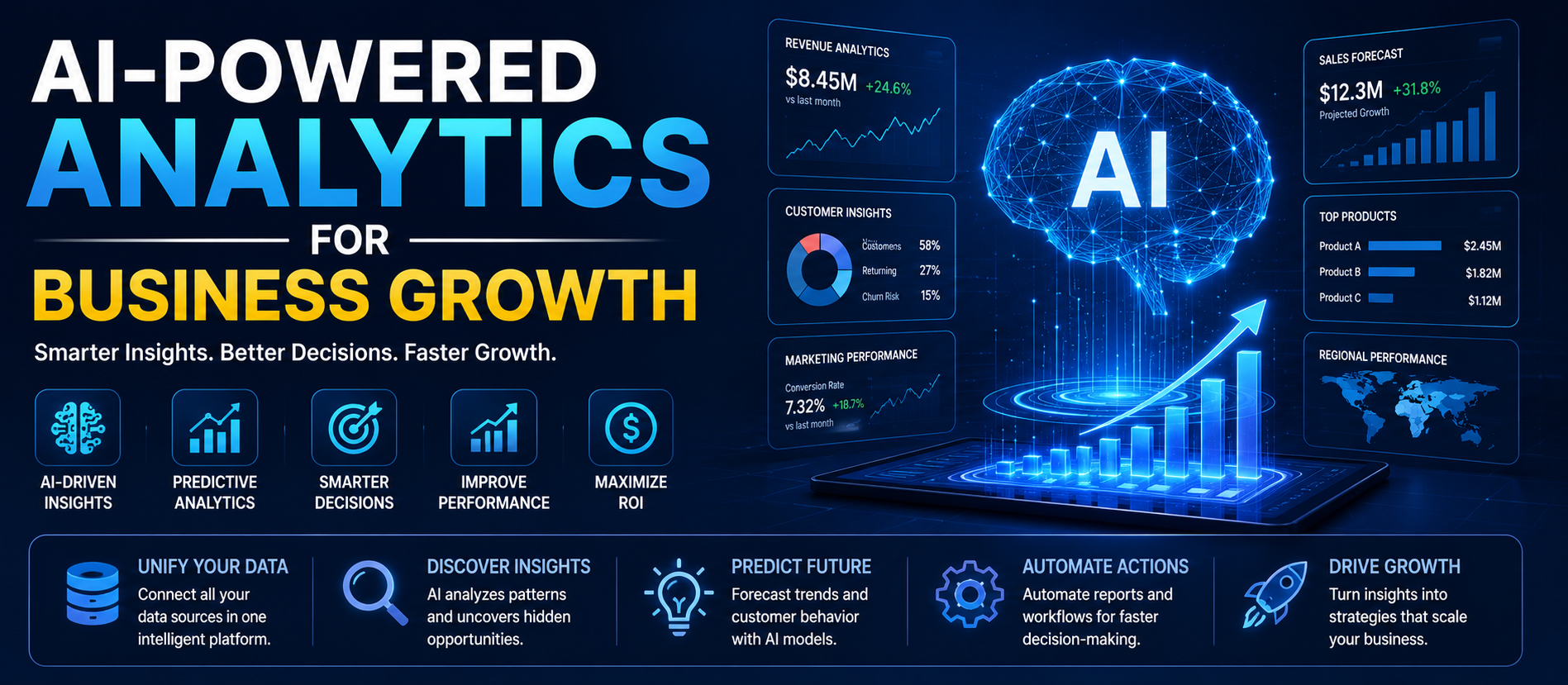
AI-powered analytics for business growth combines artificial intelligence, machine learning, data analytics, automation, business intelligence, and predictive modeling to create faster and more actionable insights. Instead of requiring managers to manually examine large spreadsheets and dashboards, intelligent analytics systems can identify patterns, detect anomalies, generate forecasts, segment customers, recommend actions, and help decision-makers focus on the most important opportunities.
For small businesses, growing companies, and large enterprises, AI-powered analytics can support revenue growth, customer retention, operational efficiency, marketing performance, financial planning, risk management, and strategic decision-making. The key is not simply adopting an AI analytics tool, but building a reliable data and decision-making process around measurable business objectives.
This WordPress-ready HTML article is prepared for Digiifrog (www.digiifrog.com) with a strong focus on SEO, AEO, GEO, and AI Search optimization.
What Is AI-Powered Analytics?
AI-powered analytics refers to the use of artificial intelligence and machine learning techniques to analyze business data and generate insights, predictions, recommendations, or automated actions. Traditional business intelligence often focuses on historical reporting, while AI-powered analytics can extend analysis into predictive and prescriptive decision-making.
- Descriptive analytics: What happened?
- Diagnostic analytics: Why did it happen?
- Predictive analytics: What is likely to happen?
- Prescriptive analytics: What action may produce a better outcome?
- Automated analytics: What can the system monitor and act on automatically?
AI can analyze structured information such as sales records and financial transactions as well as selected forms of unstructured information such as text, customer feedback, documents, and support conversations.
Why AI-Powered Analytics Matters for Business Growth
Business growth depends on making decisions at the right time. A company may have strong data but still miss opportunities if employees cannot interpret it quickly enough.
AI-powered analytics can reduce the distance between data collection and business action. It can highlight unusual changes, identify high-value customers, predict demand, and help teams prioritize resources.
- Faster decision-making
- Better revenue forecasting
- Improved customer understanding
- More efficient marketing
- Reduced operational waste
- Earlier risk detection
- Improved resource allocation
- Personalized customer experiences
- More accurate business planning
1. AI Analytics Improves Sales Forecasting
Sales forecasting is essential for business planning. Companies need to estimate future revenue, manage inventory, allocate staff, plan cash flow, and set realistic targets.
Traditional forecasts may rely heavily on historical averages and sales-team judgment. AI-powered models can analyze historical sales, seasonality, customer behavior, pipeline activity, product demand, and other relevant signals to identify patterns.
Forecasts should not be treated as guaranteed outcomes. They are decision-support tools and should be reviewed against changing market conditions and data quality.
2. AI-Powered Customer Analytics
Understanding customers is one of the most important applications of AI analytics. Businesses can analyze purchase history, engagement, support interactions, website activity, and other signals to identify customer segments and behavioral patterns.
This can help answer questions such as:
- Which customers are most valuable?
- Which customers may be at risk of leaving?
- Which products are frequently purchased together?
- Which customer segments respond to specific offers?
- Which accounts show strong expansion potential?
3. Predictive Analytics for Customer Retention
Customer acquisition can be expensive, making retention an important growth strategy. AI can analyze engagement and behavioral signals to identify customers who may be becoming less active.
Businesses can then prioritize customer-success actions, targeted communication, training, service improvements, or retention offers where appropriate.
⚠ Watch Out
Predictive models should be monitored carefully to avoid unfair or inaccurate assumptions about customers.
4. AI Analytics Improves Marketing Performance
Marketing teams manage multiple channels, campaigns, audiences, content formats, and conversion points. AI-powered analytics can help identify which activities contribute to engagement, qualified leads, conversions, and revenue.
- Campaign performance analysis
- Audience segmentation
- Customer journey analysis
- Conversion prediction
- Content performance
- Lead scoring
- Marketing attribution support
- Budget optimization
The goal should be to connect marketing metrics with meaningful business outcomes rather than optimizing only for impressions or clicks.
5. AI-Powered Lead Scoring
Sales teams often have more leads than they can immediately contact. AI-based lead scoring can analyze characteristics and engagement signals to help prioritize prospects.
Potential signals can include company attributes, website activity, content engagement, previous interactions, product interest, and historical conversion patterns.
Lead scoring should complement sales judgment rather than automatically determine customer value without oversight.
6. AI Analytics for Pricing Decisions
Pricing affects revenue, profitability, customer acquisition, and competitive positioning. Analytics can help businesses understand how price changes influence demand and customer behavior.
AI models can support scenario analysis and identify patterns in purchasing behavior, although pricing decisions should also consider market conditions, customer relationships, brand positioning, and business strategy.
7. Demand Forecasting and Inventory Management
For businesses that sell physical products, demand forecasting can directly affect profitability. Overstocking can tie up capital, while stock shortages can lead to lost sales and dissatisfied customers.
AI analytics can combine historical sales, seasonal patterns, product performance, and other relevant signals to improve demand planning.
8. AI Analytics for Supply Chain Management
Supply chains generate data from suppliers, purchase orders, logistics, inventory, shipments, and customer demand. AI-powered analytics can help organizations identify delays, unusual patterns, demand changes, and potential operational risks.
- Supplier performance analysis
- Demand forecasting
- Inventory optimization
- Delivery monitoring
- Risk detection
- Logistics analysis
9. Financial Analytics and Cash Flow Forecasting
Financial visibility is essential for growth. AI-powered analytics can analyze historical revenue, expenses, receivables, payables, and cash-flow patterns to support financial forecasting.
Finance teams can use intelligent analytics to identify unusual transactions, monitor budget variance, and prepare scenario models. Professional financial oversight remains important for accounting, tax, regulatory, and high-impact financial decisions.
10. AI-Powered Business Intelligence
Modern business intelligence platforms increasingly include natural-language interfaces and AI-assisted insights. Managers may be able to ask questions in ordinary language rather than manually constructing every report.
For example, an executive could ask which sales region experienced the largest decline and then request a breakdown by product, customer segment, and sales representative.
Natural-language analytics can make data more accessible, but organizations should validate AI-generated answers against authoritative business data.
11. Real-Time Analytics for Faster Decisions
Historical reports are useful, but some decisions require near-real-time information. Businesses may need to monitor website conversions, transactions, customer-service queues, inventory levels, application performance, or operational events.
Real-time analytics can provide alerts when important metrics move outside expected ranges.
12. Anomaly Detection
AI can help identify unusual patterns that may be difficult to detect manually. Anomalies can include unexpected spending, sudden changes in demand, unusual website behavior, abnormal transaction activity, or operational performance deviations.
Early detection can allow teams to investigate potential problems before they become larger business issues.
13. AI Analytics for Customer Experience
Customer experience data can come from surveys, support tickets, reviews, chat interactions, call summaries, website behavior, and customer-success activities.
AI analytics can help identify recurring complaints, sentiment patterns, service bottlenecks, and areas where customers experience friction.
These insights can support improvements to products, onboarding, support processes, and communication.
14. AI Analytics for Operational Efficiency
Operations teams can use analytics to understand where time, money, and resources are being consumed. AI can identify bottlenecks and patterns across workflows.
- Process duration analysis
- Resource utilization
- Workload forecasting
- Service-level monitoring
- Operational anomaly detection
- Automation opportunities
Analytics becomes more valuable when insights are connected to practical process improvements.
15. AI-Powered Employee and Workforce Analytics
Workforce analytics can help businesses understand staffing requirements, workload patterns, training needs, and operational capacity. However, employee analytics involves significant privacy and ethical considerations.
Organizations should use appropriate governance, transparency, access controls, and legal review when analyzing employee-related information.
16. AI Analytics for Risk Management
Businesses face financial, operational, cybersecurity, supply-chain, and market risks. Analytics can help identify patterns that may indicate increased exposure.
Risk models can support monitoring and prioritization, but they should be combined with human expertise and appropriate controls.
17. AI-Powered Analytics for Small Businesses
AI analytics is not limited to large enterprises. Small businesses can use cloud-based analytics tools, CRM insights, marketing dashboards, financial reporting, and AI assistants to gain visibility without building large data teams.
Small businesses should start with a few high-value questions rather than trying to analyze everything at once.
18. AI Analytics for B2B Companies
B2B companies can use AI analytics to understand accounts, sales pipelines, marketing performance, customer retention, service delivery, and revenue opportunities.
Account-level analytics can help identify expansion opportunities and risks across key customers.
19. AI Analytics and Account-Based Marketing
Account-Based Marketing focuses on selected high-value business accounts. AI analytics can help identify account engagement patterns, stakeholder activity, content interests, and potential buying signals.
Marketing and sales teams can use these insights to coordinate account-specific strategies.
20. AI Analytics and Personalization
Personalization can improve relevance when it is based on accurate information and appropriate customer preferences. AI can help segment customers and recommend relevant products, content, or communication.
Businesses should avoid excessive personalization that feels intrusive or relies on sensitive information without appropriate permission.
21. AI Analytics and Automation
The real power of analytics appears when insights can trigger appropriate actions. For example, a system could detect a high-value lead, update the CRM, notify a sales representative, and start a relevant workflow.
Analytics and automation should be designed together so that useful insights lead to measurable business actions.
22. AI Agents and Analytics
AI agents can potentially monitor analytics dashboards, investigate predefined conditions, summarize findings, and perform approved follow-up actions.
For example, an analytics agent could identify an unusual decline in conversions, compare recent performance with historical patterns, prepare a summary, and create an investigation task.
Agentic workflows require clear permissions, monitoring, auditability, and human escalation for important decisions.
23. Data Quality Is the Foundation of AI Analytics
AI analytics cannot compensate for consistently inaccurate or incomplete data. Duplicate records, missing fields, inconsistent definitions, outdated information, and disconnected systems can reduce analytical accuracy.
Data Quality Practices
- Define common data standards
- Remove duplicate records
- Validate important fields
- Document data definitions
- Monitor data freshness
- Control data access
- Track data lineage
- Establish ownership
24. Building a Modern Analytics Data Architecture
A scalable analytics environment may connect CRM, ERP, marketing platforms, financial systems, websites, applications, customer-support systems, and external data sources.
Cloud data warehouses, data lakes, integration platforms, APIs, and analytics tools can help organizations bring information together for analysis.
The architecture should be designed according to business needs rather than technology trends alone.
25. AI Analytics and Cloud Computing
Cloud computing provides scalable infrastructure for data storage, processing, analytics, and AI workloads. Businesses can access sophisticated analytics services without building every component internally.
Cloud analytics can also make it easier to scale processing as data volumes grow.
26. AI Analytics and Data Visualization
Visualization remains important because business users need to understand analytical findings quickly. Dashboards can show trends, comparisons, targets, anomalies, and key performance indicators.
AI can help recommend relevant visualizations or summarize trends, but the underlying definitions and data should remain transparent.
27. Predictive Analytics vs Traditional Reporting
Traditional reporting primarily explains historical performance. Predictive analytics extends the process by estimating future outcomes based on available data.
For example, a report might show that sales declined last quarter, while a predictive model might estimate which customer segments or regions are most likely to decline next quarter.
Predictive models are only as reliable as the data, assumptions, and changing conditions behind them.
28. Prescriptive Analytics for Business Decisions
Prescriptive analytics goes beyond predicting an outcome by evaluating potential actions. A model may compare different scenarios and estimate how changes could affect business performance.
This can support inventory planning, staffing, pricing, marketing allocation, and resource management.
29. How to Implement AI-Powered Analytics
- Define a specific business objective.
- Identify the data required.
- Assess data quality.
- Map existing systems.
- Choose appropriate analytics technology.
- Build a focused pilot project.
- Validate results with domain experts.
- Connect insights to business workflows.
- Monitor model and data performance.
- Scale successful use cases.
30. Common AI Analytics Mistakes
Starting With Technology Instead of a Business Problem
Buying an AI analytics platform without defining the decision it should improve can create unnecessary complexity.
Ignoring Data Quality
Weak data produces weak insights.
Over-Automating Decisions
High-impact decisions may require human review even when AI provides useful recommendations.
Measuring Activity Instead of Outcomes
The goal should be business improvement, not simply generating more dashboards.
Ignoring Change Management
Employees need training and clear explanations of how analytics will support their work.
31. Measuring the ROI of AI Analytics
AI analytics investments should be connected to measurable outcomes where possible.
- Revenue growth
- Higher conversion rates
- Improved customer retention
- Lower customer acquisition cost
- Reduced operational costs
- Improved forecasting accuracy
- Faster decision-making
- Reduced process time
- Lower inventory waste
- Improved customer satisfaction
ROI should account for software, infrastructure, implementation, data preparation, training, governance, and ongoing maintenance costs.
32. AI Analytics Governance and Responsible Use
Businesses should establish governance for AI analytics, particularly when models influence customers, employees, finances, pricing, or other high-impact decisions.
- Define data ownership
- Control access
- Document important models
- Monitor accuracy
- Review potential bias
- Protect sensitive information
- Maintain audit records
- Establish human oversight
33. AI Analytics, SEO, AEO, GEO and AI Search
AI-powered analytics can also improve digital marketing and search strategy. Businesses can analyze search traffic, content engagement, conversion behavior, customer questions, and landing-page performance to identify opportunities.
SEO helps businesses attract relevant organic traffic. AEO focuses on answering user questions clearly. GEO helps content become useful for generative search experiences, while AI Search optimization emphasizes structured, authoritative, context-rich information.
Analytics can help identify which topics, questions, services, and content formats are most valuable to audiences, allowing businesses to continuously improve their digital presence.
34. The Future of AI-Powered Business Analytics
The future of business analytics will increasingly involve conversational interfaces, predictive intelligence, automated insights, AI agents, real-time data, and decision-support systems.
Instead of opening a dashboard and searching manually for changes, executives may increasingly receive proactive summaries explaining important developments and potential causes.
Analytics systems may also become more integrated with operational workflows, allowing approved actions to happen automatically after specific conditions are detected.
35. Key AI Analytics Trends for Business Growth
- Natural-language analytics
- Predictive forecasting
- Prescriptive recommendations
- AI-powered anomaly detection
- Real-time analytics
- AI agents for business intelligence
- Automated reporting
- Cloud-native analytics
- Unified customer intelligence
- Embedded analytics
- Automated data preparation
- Decision intelligence
Frequently Asked Questions About AI-Powered Analytics
What is AI-powered analytics?
AI-powered analytics uses artificial intelligence and machine learning to analyze business data, identify patterns, generate predictions, detect anomalies, recommend actions, and support decision-making.
How can AI analytics help business growth?
AI analytics can support growth by improving sales forecasting, customer retention, marketing performance, personalization, operational efficiency, financial planning, risk management, and resource allocation.
Can small businesses use AI-powered analytics?
Yes. Cloud-based business intelligence, CRM analytics, marketing analytics, financial dashboards, and AI assistants make advanced analytics increasingly accessible to small businesses.
What data is needed for AI analytics?
The required data depends on the business problem. It may include sales, customer, marketing, financial, operational, website, product, or support information. Data quality and relevance are more important than simply collecting large volumes of information.
What is predictive analytics?
Predictive analytics uses historical and current data to estimate future outcomes or probabilities. It can support demand forecasting, customer retention, sales forecasting, risk analysis, and other business decisions.
Can AI analytics replace business managers?
No. AI analytics can provide insights and recommendations, but business leaders remain responsible for strategy, context, judgment, ethics, and decisions.
How does AI analytics differ from business intelligence?
Traditional business intelligence often focuses on reporting and visualization, while AI-powered analytics can add predictive modeling, anomaly detection, natural-language interaction, recommendations, and automated insights.
What is the biggest challenge in AI analytics?
One of the biggest challenges is establishing reliable, well-governed data. Other challenges include integration, skills, security, model monitoring, user adoption, and connecting analytics to measurable business outcomes.
Conclusion
AI-powered analytics for business growth is becoming an important part of modern decision-making. By combining business intelligence, machine learning, predictive analytics, automation, and reliable data, organizations can move beyond simply reporting what happened and begin identifying what may happen next and which actions deserve attention.
The strongest analytics strategies begin with business questions. Companies should identify the decisions they want to improve, build reliable data foundations, select appropriate technologies, test focused use cases, and connect insights to operational workflows.
AI should not be treated as a replacement for business judgment. Instead, it can act as a powerful decision-support layer that helps employees discover patterns, prioritize opportunities, detect risks, and work more efficiently.
As AI agents, cloud analytics, real-time data, and natural-language interfaces continue to develop, business analytics will become increasingly proactive. Organizations that build trustworthy data systems and combine them with thoughtful AI governance will be better positioned to make faster decisions and pursue sustainable growth.
For businesses looking to implement AI-powered analytics, business intelligence, automation, intelligent websites, digital transformation strategies, and modern data-driven solutions, Digiifrog can help develop practical strategies. Visit www.digiifrog.com to learn more.
Quick Answer: How Can AI-Powered Analytics Drive Business Growth?
AI-powered analytics can drive business growth by improving sales forecasting, identifying high-value customers, predicting churn, optimizing marketing, detecting operational problems, supporting pricing and demand decisions, improving financial planning, personalizing customer experiences, and automating data-driven workflows. The greatest value comes when reliable data, AI models, human expertise, and measurable business objectives are connected into one decision-making system.
Ready to Grow?
Talk to us about a strategy tailored to your brand — we will help you stand out in search, AI discovery and social.


Comments (0)
Log in to leave a comment.