📋 Quick Summary
In this article:
What Is AI-Powered Search?
How AI-Powered Search Works
From Keywords to Conversations
Why AI Search Is Changing User Behavior
Multimodal Search Will Become More Important
Personalized and Context-Aware Discovery
Search Is Moving Toward Actions, Not Just Answers
What AI-Powered Search Means for SEO
AEO: Optimizing for Direct Answers
GEO and Generative AI Search Optimization
Why Original Content Matters More
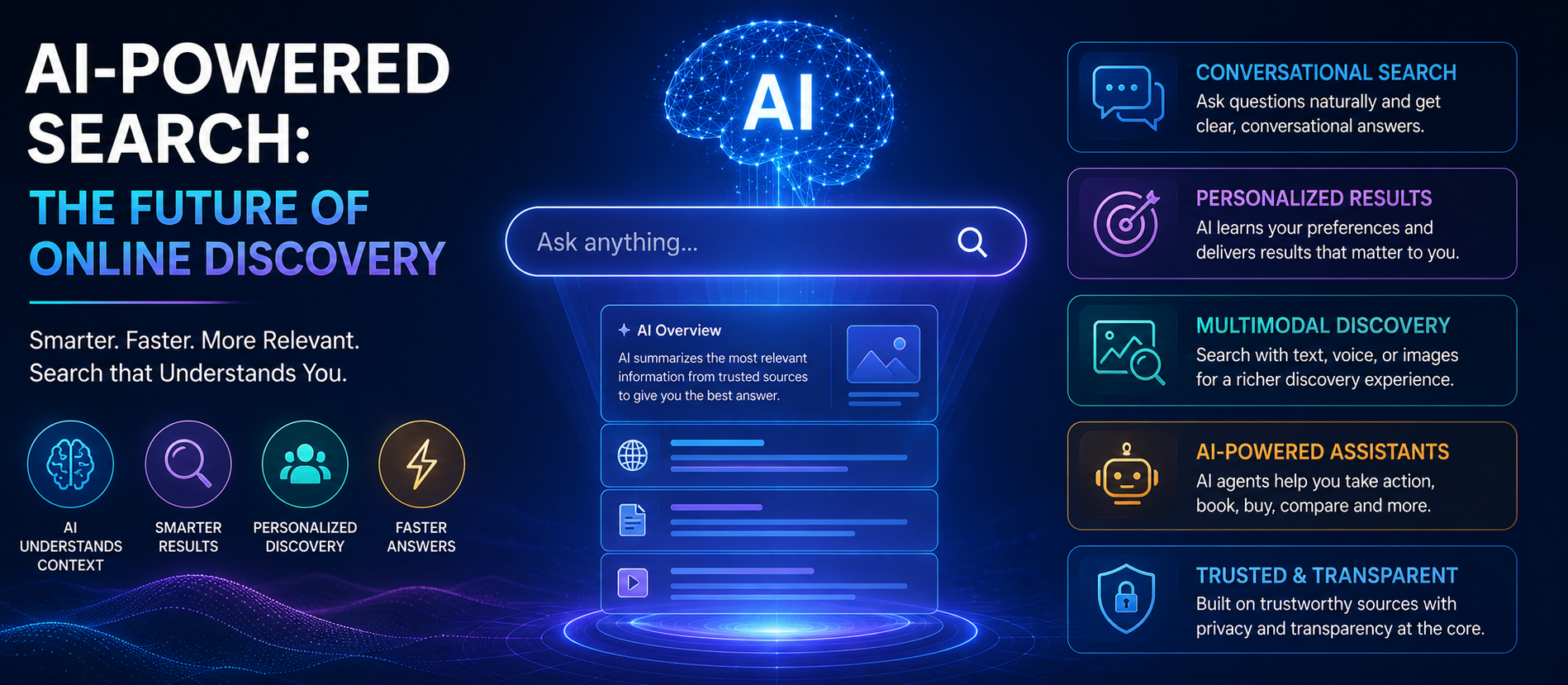
AI-powered search is changing how people discover information, products, businesses, services, and answers online. Traditional search was largely built around keywords and ranked lists of web pages. Modern AI search adds conversational interaction, reasoning, multimodal input, synthesized answers, follow-up questions, and deeper exploration.
Instead of entering a short phrase and opening many results manually, users can ask detailed questions, refine requests through conversation, compare options, upload images, and receive AI-generated responses connected to useful web sources.
💡 Key Insight
Google's current AI experiences, including AI Overviews and AI Mode, show this shift toward more conversational and complex discovery. Google's 2026 guidance also confirms that foundational SEO remains important for generative AI search, while unique, helpful, people-first content remains central.
This WordPress-ready HTML article is prepared for Digiifrog (www.digiifrog.com) with SEO, AEO, GEO, and AI Search optimization.
What Is AI-Powered Search?
AI-powered search uses artificial intelligence to understand user intent, retrieve relevant information, analyze relationships between sources, and generate useful responses. Depending on the platform, it can combine search indexes, large language models, retrieval systems, machine learning, personalization, and multimodal technologies.
Traditional search often returns a ranked list. AI search can interpret the question and organize information into a direct response while still giving users links to explore further. The experience is increasingly conversational, allowing users to ask follow-up questions without repeating the full context.
How AI-Powered Search Works
- Intent understanding: AI interprets what the user is actually trying to achieve.
- Information retrieval: Relevant pages, documents, products, or other data are retrieved.
- Query expansion: Complex questions may be divided into related subtopics.
- Ranking: Systems evaluate relevance, quality, freshness, and other signals.
- Answer generation: AI synthesizes retrieved information into a useful response.
- Conversation: Users can ask follow-up questions and refine their search.
Google explains that generative search can use retrieval-augmented generation and query fan-out to retrieve relevant, up-to-date information for complex questions. This means AI search is not simply a model guessing an answer; retrieval and web information remain important parts of the process.
From Keywords to Conversations
One of the biggest changes is the move from short keyword queries toward natural questions. Users can explain a problem, add context, specify constraints, and refine the request.
Instead of searching for “best CRM software,” a user may ask: “Which CRM is best for a small service business with five salespeople, a limited budget, and a need for WhatsApp integration?”
This query contains several requirements. AI-powered search can break the question into related topics and help organize a response around the user's actual decision.
AI Overviews and AI Mode
AI-generated search experiences are changing how users interact with results. AI Overviews are designed to provide an AI-generated snapshot that helps users understand information from multiple sources and then explore supporting links.
AI Mode expands the experience through deeper reasoning, follow-up questions, and complex exploration. Google's documentation explains that AI Mode can divide a question into subtopics and search for related information simultaneously.
For publishers and businesses, this creates new discovery opportunities. A page may be found through traditional rankings, an AI-generated overview, a conversational follow-up, an image-related search, a local result, or another generative pathway.
Why AI Search Is Changing User Behavior
AI-powered search is especially useful when a question requires comparison, planning, explanation, research, or several steps. Users can ask longer and more specific questions because the interface is designed to understand context.
- Asking complex questions in natural language.
- Comparing multiple products or services.
- Requesting recommendations with specific constraints.
- Planning trips, projects, purchases, and workflows.
- Uploading images and asking visual questions.
- Using voice for conversational discovery.
- Asking follow-up questions to refine an answer.
As conversational search grows, users may think less about finding the perfect keyword and more about clearly describing what they need.
Multimodal Search Will Become More Important
The future of discovery will not be limited to typing. AI systems can increasingly work with text, images, voice, video, and other forms of information.
A user may photograph a product, ask what it is, compare similar options, and continue with questions about price, availability, compatibility, or reviews. A traveler may combine an image and voice query to research a destination. A business may search technical documents and visual information together.
This makes useful visual content increasingly important. Businesses should support textual information with high-quality images and videos when those assets genuinely improve understanding.
Personalized and Context-Aware Discovery
Traditional search generally begins with a query. AI-powered discovery can potentially use more context, such as previous questions, preferences, location, task requirements, and conversation history when users permit it.
Personalization can make discovery more efficient, but it also increases the importance of privacy, transparency, user controls, and responsible data handling. Users should understand what information is being used and have appropriate control over personalized experiences.
Search Is Moving Toward Actions, Not Just Answers
The next stage of AI-powered search may go beyond finding information. Agentic systems can potentially help users compare options, gather details, prepare plans, or navigate multi-step workflows.
This does not mean every search will become fully autonomous. Important actions require appropriate permissions, verification, security, and human control. However, discovery interfaces are gradually becoming more capable of helping users move from a question toward an outcome.
What AI-Powered Search Means for SEO
AI search does not make SEO irrelevant. Google's current documentation states that the same foundational SEO practices remain relevant for AI features such as AI Overviews and AI Mode.
- Create helpful, reliable, people-first content.
- Make important information crawlable and indexable.
- Use clear structure and descriptive headings.
- Build useful internal links.
- Provide relevant text, images, and videos.
- Maintain a good page experience across devices.
- Ensure structured data matches visible content.
- Keep business and product information accurate and current.
The important change is that websites should think beyond a single keyword and ranking position. Content should explain topics clearly, answer related questions, demonstrate expertise, and provide information valuable enough for users to explore further.
AEO: Optimizing for Direct Answers
Answer Engine Optimization (AEO) is commonly used to describe optimization for answer-oriented search experiences. AEO encourages content that answers questions clearly and directly.
- Place a concise answer near the relevant question.
- Use descriptive headings that match user intent.
- Define important terms clearly.
- Use lists and steps when they improve understanding.
- Add relevant FAQ sections.
- Support important claims with trustworthy evidence.
- Expand beyond the short answer with useful context.
⚠ Watch Out
Publishers should avoid treating AEO as a collection of mechanical tricks. Useful SEO practices and high-quality content remain more important than supposed AI-search shortcuts.
GEO and Generative AI Search Optimization
Generative Engine Optimization (GEO) is another term used to describe efforts to improve visibility in AI-generated discovery experiences. The strongest approach is still to create original, reliable content that clearly communicates expertise and provides value beyond generic summaries.
Google's 2026 guidance emphasizes unique, non-commodity, people-first content and strong technical SEO as the foundation for visibility in generative search features.
For creators, this means adding information that a generic AI response cannot easily duplicate, including firsthand experience, original research, case studies, expert analysis, unique data, practical examples, and clear editorial judgment.
Why Original Content Matters More
As AI makes it easier to produce large amounts of generic content, originality becomes more valuable. Thousands of pages can explain a basic concept, but fewer can provide genuine experience, proprietary research, tested processes, detailed examples, or useful expert interpretation.
- What information can we provide that competitors cannot easily copy?
- What firsthand experience do we have?
- Can we publish original data or research?
- Can we explain a difficult topic more clearly?
- Can we include real examples or case studies?
- Does this page genuinely solve the user's problem?
The Future of Content Discovery for Businesses
Businesses can no longer think of search visibility as only a list of blue links. A potential customer may discover a brand through an AI-generated answer, a supporting citation, an image, a local result, a product comparison, a video, or a conversational follow-up.
This requires a broader digital presence. Businesses should maintain accurate websites, useful content, clear brand information, strong technical foundations, current business data, and content that demonstrates real expertise.
The goal is not to publish a page for every possible AI query. Large volumes of low-value pages can create quality problems. Organizations should focus on the questions and decisions that matter most to their audience.
AI Search and Local Discovery
AI-powered search can also influence how people find local businesses. Users may ask highly specific questions such as: “Which web design agency near me specializes in AI automation for small businesses?”
This makes accurate business information, service descriptions, location details, customer trust signals, and helpful website content increasingly important. Local businesses should maintain consistent information and clearly explain what they do and who they serve.
Challenges and Risks of AI-Powered Search
AI-powered search is not perfect. AI-generated answers can contain mistakes, omit context, misunderstand questions, or rely on incomplete information.
- Accuracy and hallucinations.
- Outdated information.
- Source quality and attribution.
- Bias in data or recommendations.
- Privacy and personalization concerns.
- Overreliance on AI summaries.
- Reduced visibility for some publishers.
- Manipulation attempts and low-quality AI content.
For important decisions involving health, law, finance, safety, or other high-impact areas, users should verify information through qualified and authoritative sources.
How Businesses Should Prepare for AI Search
- Audit important pages: Make sure they answer clear user questions.
- Improve quality: Remove generic filler and add original value.
- Strengthen technical SEO: Ensure important pages can be crawled and indexed.
- Use clear structure: Organize content with meaningful headings.
- Update information: Keep services, products, policies, and business details current.
- Add useful media: Use images and videos where they improve understanding.
- Build authority: Demonstrate experience, expertise, and trustworthiness.
- Monitor performance: Use available analytics and adapt as search behavior changes.
Common Mistakes to Avoid
- Publishing large quantities of generic AI-generated pages.
- Chasing unverified AEO or GEO hacks.
- Ignoring traditional technical SEO.
- Creating content only around exact keyword matches.
- Using structured data that does not match visible content.
- Neglecting images, video, local information, or product data when relevant.
- Failing to verify facts before publishing.
- Assuming AI search will completely replace traditional search.
Frequently Asked Questions About AI-Powered Search
What is AI-powered search?
AI-powered search uses artificial intelligence to understand questions, retrieve relevant information, and provide synthesized answers, recommendations, or conversational follow-up options.
Will AI replace traditional search engines?
AI is transforming search rather than simply replacing it. Search indexes, ranking systems, web pages, and direct links remain important information sources for many AI search experiences.
What is the difference between AI search and traditional search?
Traditional search primarily returns ranked results, while AI search can understand more context, combine information, generate summaries, support follow-up questions, and work with multiple types of input.
Is SEO still important in AI search?
Yes. Google's current guidance states that foundational SEO practices remain relevant for AI features such as AI Overviews and AI Mode.
How can a website prepare for AI search?
Create useful and original content, maintain strong technical SEO, keep information current, use clear page structure, provide a good user experience, and demonstrate genuine expertise and trustworthiness.
Conclusion
AI-powered search is redefining online discovery by making search more conversational, contextual, multimodal, and increasingly action-oriented. Users can ask more complex questions, explore topics through follow-up conversations, compare options, and discover information through AI-generated responses connected to the wider web.
For businesses and publishers, the future is not about abandoning SEO for a completely separate optimization system. The strongest strategy is to combine proven SEO fundamentals with original content, clear answers, technical accessibility, trustworthy information, and a better understanding of how users discover information across AI-powered experiences.
As AI search continues to evolve, the businesses most likely to succeed will focus on one core principle: create information that is genuinely useful enough for people to trust, explore, and act upon.
For businesses looking for modern website development, AI solutions, automation, SEO, AEO, GEO, and AI Search optimization, Digiifrog can help. Visit www.digiifrog.com.
Quick Answer: What Is the Future of AI-Powered Search?
The future of AI-powered search is more conversational, contextual, multimodal, and personalized. Users will increasingly ask detailed questions, receive AI-generated responses supported by web information, explore topics through follow-up conversations, and use search systems that help move from discovering information toward completing tasks. For websites, strong SEO foundations, original content, technical accessibility, clear answers, and genuine expertise will remain essential.
Important Note
AI search features, policies, interfaces, and optimization guidance continue to evolve. Review current official documentation from search platforms before making major technical or marketing decisions.
Ready to Grow?
Talk to us about a strategy tailored to your brand — we will help you stand out in search, AI discovery and social.
Comments (0)
Log in to leave a comment.