📋 Quick Summary
In this article:
What Is AI-Powered Underwriting?
Why Insurance Underwriting Is Changing
How AI-Powered Underwriting Works
1. Data Collection
2. Data Extraction
3. Data Validation
4. Risk Scoring
5. Exception Detection
6. Human Review
Major Benefits of AI-Powered Underwriting
1. Faster Processing
2. Lower Administrative Work
Introduction
Insurance underwriting has traditionally depended on experienced professionals reviewing applications, financial information, medical records, property details, claims histories, risk characteristics, and other evidence before deciding whether a risk fits a carrier's appetite and what price or terms may be appropriate. Artificial intelligence is changing this workflow by helping insurers process information faster, identify patterns, automate repetitive analysis, and support more consistent risk assessment.
AI-powered underwriting does not necessarily mean that a machine independently makes every insurance decision. In many modern workflows, artificial intelligence acts as an assistant: extracting information from documents, validating data, identifying missing details, ranking risk signals, detecting anomalies, generating summaries, and recommending next steps for human underwriters. The National Association of Insurance Commissioners (NAIC) says AI is already used in insurance for underwriting, pricing, claims, customer service, marketing, and fraud detection. citeturn0search1
NAIC also notes that accelerated underwriting can use external data, predictive models, and machine-learning techniques to reduce the time required for some life insurance applications from weeks to hours, although applicants with insufficient data may still require traditional underwriting. citeturn0search2
This WordPress-ready guide from Digiifrog explains how AI-powered underwriting works, its benefits, challenges, applications, governance requirements, and future direction. It is optimized for SEO, AEO, GEO, and AI Search Optimization.
Website: www.digiifrog.com
What Is AI-Powered Underwriting?
AI-powered underwriting refers to the use of artificial intelligence, machine learning, predictive analytics, natural language processing, computer vision, and automated decision-support systems to assist with insurance risk assessment.
Traditional underwriting often requires underwriters to gather information from multiple documents and systems. AI can help consolidate that information into a structured risk profile. Instead of replacing the underwriter, the technology can reduce manual work and allow professionals to focus on exceptions, complex cases, judgment-intensive decisions, and customer or broker relationships.
Why Insurance Underwriting Is Changing
Insurance companies operate in a data-rich environment. Applications, claims histories, property records, medical information, telematics, financial information, images, documents, and external datasets can all contribute to risk assessment.
At the same time, customers increasingly expect digital experiences and faster decisions. NAIC identifies consumer demand for fast, convenient digital services as one factor contributing to the adoption of AI in insurance. citeturn0search1
AI can help insurers respond to these expectations while handling growing volumes of information.
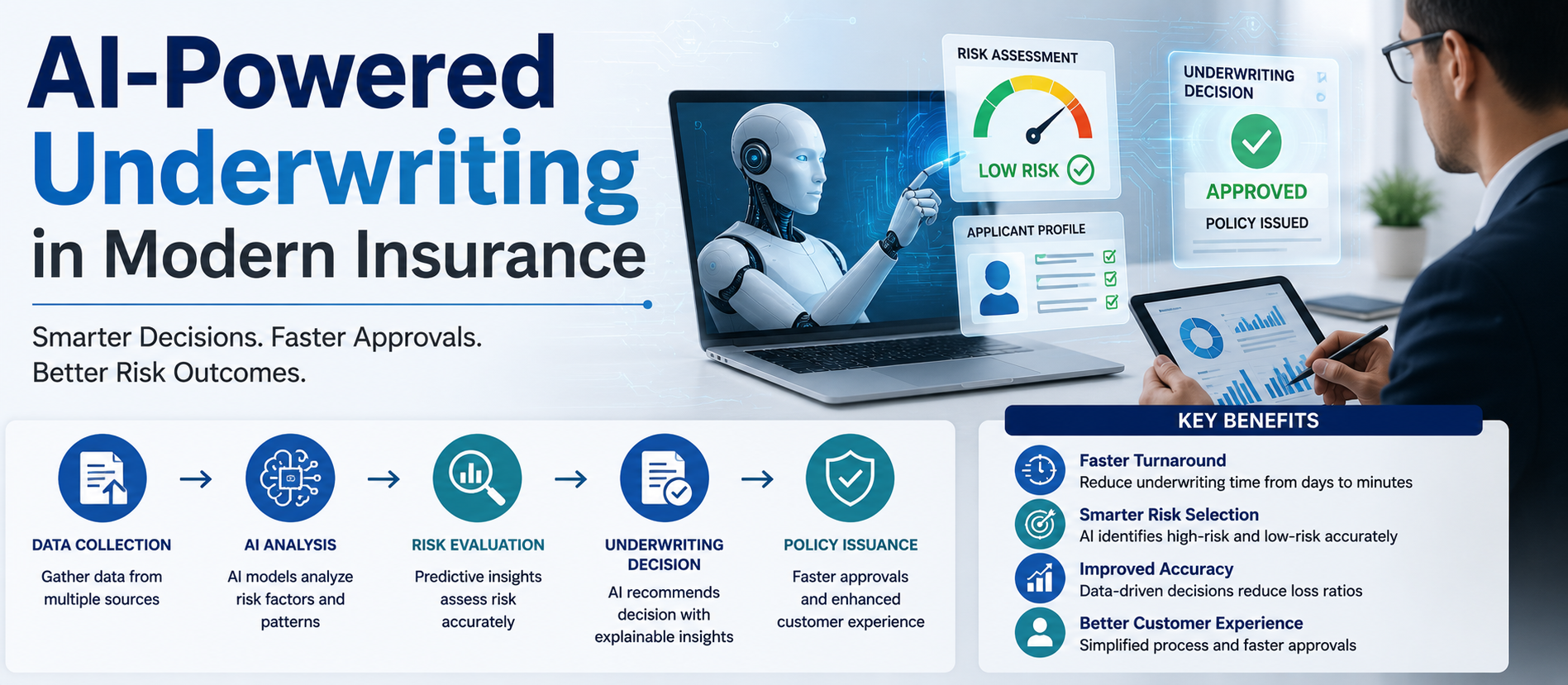
How AI-Powered Underwriting Works
1. Data Collection
The process begins by collecting relevant application and risk information. Data can come from forms, documents, databases, images, connected devices, historical claims, and permitted third-party sources.
2. Data Extraction
Natural language processing and document intelligence can extract names, dates, values, addresses, financial information, medical information, property characteristics, and other structured fields from unstructured documents.
3. Data Validation
AI systems can compare application information against available records and identify missing, contradictory, or unusual data. This can reduce manual rechecking.
4. Risk Scoring
Predictive models can evaluate multiple variables and generate risk indicators or scores. These outputs may help an insurer determine whether an application falls within an underwriting appetite or requires additional review.
5. Exception Detection
Rather than treating every application identically, AI can identify cases that need human attention. Examples include unusual claims histories, inconsistent documents, high-risk property characteristics, missing information, or results outside model confidence thresholds.
6. Human Review
Experienced underwriters can review the AI-generated analysis, investigate exceptions, request additional information, and make or approve decisions according to the insurer's governance framework and applicable regulations.
Major Benefits of AI-Powered Underwriting
1. Faster Processing
One of the clearest benefits is speed. Automated data extraction and analysis can reduce the amount of time spent manually reviewing repetitive information. Accelerated life underwriting is an example: NAIC reports that digital data and predictive models can shorten some application processes from weeks to hours. citeturn0search2
2. Lower Administrative Work
Underwriters often spend substantial time collecting information, checking documents, entering data, and preparing summaries. AI can automate portions of this work and allow professionals to spend more time on complex risk analysis.
3. Consistent Risk Assessment
A properly governed model can apply the same analytical rules across large volumes of applications. This may reduce certain forms of inconsistency caused by repetitive manual processing, although models themselves can introduce other forms of bias if their data or design is flawed.
4. Better Use of Large Data Sets
Human teams cannot easily analyze thousands of variables simultaneously. Machine-learning systems can identify relationships and patterns across large datasets, potentially revealing risk signals that deserve further underwriting attention.
5. Improved Customer Experience
Faster underwriting can reduce waiting periods and make digital insurance applications more convenient. Applicants may receive quicker requests for missing information and faster decisions when their risk can be assessed confidently.
6. Improved Fraud Detection
AI can identify unusual patterns, duplicate information, suspicious documents, or inconsistencies that may warrant investigation. NAIC identifies fraud detection as one of the areas where insurers are using AI. citeturn0search1
7. Better Underwriter Productivity
AI can act as a research and analysis assistant. Instead of replacing expertise, it can help underwriters reach relevant information faster and focus their attention on the cases where judgment matters most.
AI Underwriting Across Insurance Lines
Life Insurance
Life insurers can use accelerated underwriting to evaluate applicants using digital application data, external sources, predictive models, and analytics. Some applicants may qualify for streamlined processing, while others may require traditional medical underwriting. citeturn0search2
Health Insurance
AI can assist with risk analysis, document processing, claims histories, utilization patterns, and administrative workflows. Because health insurance involves highly sensitive information and complex regulatory requirements, data governance and fairness are particularly important.
Auto Insurance
AI can analyze driving-related information, vehicle characteristics, claims history, photographs, telematics, and other permitted data to support underwriting and pricing workflows.
Property Insurance
Computer vision can analyze property photographs or satellite and aerial imagery to identify characteristics such as roof condition, construction features, vegetation, or potential hazards. AI can then help organize these observations for underwriting review.
Commercial Insurance
Commercial underwriting can involve financial statements, industry classifications, property information, claims history, loss runs, contracts, cyber controls, and many other documents. AI can extract and summarize this information to help underwriters evaluate complex submissions.
AI-Powered Document Intelligence
One of the most practical applications of AI in underwriting is document processing. Commercial submissions may contain dozens or hundreds of pages. AI systems can identify relevant fields, summarize key information, compare documents, and flag inconsistencies.
For example, a commercial underwriter could receive an application, financial statements, property schedules, loss runs, inspection reports, and supplemental questionnaires. An AI system can organize these materials into a structured submission package before the human underwriter begins detailed review.
Predictive Analytics in Underwriting
Predictive analytics uses historical and current data to estimate the likelihood of future outcomes. In insurance, predictive models can support risk classification, pricing, claims forecasting, fraud detection, and underwriting decisions.
The quality of the output depends heavily on the quality of the data, model design, validation, assumptions, and governance. A sophisticated model cannot compensate for unreliable or inappropriate input data.
AI and Human Underwriters: Collaboration Instead of Replacement
The strongest operating model for many insurers is likely to combine machine efficiency with human judgment. AI is good at processing large amounts of information quickly, while experienced underwriters can interpret unusual circumstances, understand business context, challenge model outputs, and apply professional judgment.
A practical workflow can therefore look like:
- AI gathers and structures information.
- AI identifies risk signals and missing information.
- AI produces a preliminary assessment.
- Underwriter reviews the analysis.
- Underwriter investigates exceptions.
- Human judgment is applied where required.
- The decision is documented and audited.
AI Underwriting and Fairness
💡 Key Insight
One of the most important challenges is preventing unfair discrimination. A model can produce discriminatory outcomes even when protected characteristics are not explicitly included if other variables act as proxies for those characteristics or if historical training data contains structural bias.
NAIC guidance emphasizes that AI-supported insurance decisions must comply with applicable insurance laws and regulations and highlights governance, data quality, transparency, and unfair-discrimination concerns. citeturn0search1turn0search2
Insurers therefore need processes for testing outcomes, documenting model behavior, investigating anomalies, and addressing potential unfair impacts.
Data Privacy and Security
AI underwriting can involve highly sensitive information. Depending on the insurance line, data can include health information, financial information, location data, driving behavior, property information, or business records.
Insurers need strong controls around data collection, permissions, storage, access, retention, vendor management, cybersecurity, and appropriate use. Third-party AI models and data providers also require careful oversight.
Explainability and Transparency
When an AI model influences an insurance decision, stakeholders may need to understand why the result occurred. A model that produces an unexplained score can be difficult for underwriters, regulators, brokers, and customers to challenge or validate.
Explainability does not always require exposing proprietary algorithms. It can involve documenting the relevant data sources, model purpose, major factors influencing a decision, validation results, limitations, and human review procedures.
AI Governance in Modern Insurance
AI governance is becoming a core insurance-management responsibility. NAIC's current AI work includes a Model Bulletin adopted in December 2023, expectations around governance and compliance, and an AI Systems Evaluation Tool being piloted by participating states during 2025–2026. citeturn0search1
NAIC's 2026 issue brief also emphasizes that AI does not remove insurers' legal obligations: existing insurance laws continue to apply when decisions are supported by algorithms, AI systems, or third-party vendors. citeturn0search25
Key Elements of a Responsible AI Underwriting Program
- Clear ownership and accountability.
- Documented AI use cases.
- Approved data sources.
- Data-quality controls.
- Model validation and testing.
- Fairness and discrimination testing.
- Human oversight.
- Audit trails and decision records.
- Third-party vendor governance.
- Cybersecurity controls.
- Monitoring for model drift.
- Incident-response procedures.
- Regular compliance reviews.
Challenges of AI-Powered Underwriting
Data Quality
Bad, incomplete, outdated, or biased data can produce unreliable underwriting results.
Model Drift
Risk patterns can change over time. A model that performs well today may become less accurate as markets, customer behavior, technology, climate conditions, or claims patterns evolve.
Regulatory Complexity
Insurance regulation varies across jurisdictions and insurance lines. AI governance must therefore account for the laws and supervisory expectations applicable to each market.
Legacy Technology
Many insurers still operate systems built over decades. Integrating AI with legacy platforms can be more difficult than building a model itself.
Third-Party Risk
External data providers, model vendors, cloud platforms, and technology partners can introduce additional risks. NAIC's current work specifically addresses oversight of third-party data and models used by insurers. citeturn0search1
How Insurers Can Implement AI Underwriting Successfully
- Start with a clearly defined underwriting problem.
- Map the current workflow.
- Identify high-volume manual tasks.
- Audit available data.
- Establish governance before deployment.
- Build a measurable pilot.
- Keep human review for high-impact decisions.
- Test accuracy and fairness.
- Monitor production performance.
- Document decisions and model changes.
- Expand only after measurable results are demonstrated.
Future of AI-Powered Underwriting
The next generation of underwriting is likely to become more continuous, connected, and automated. Instead of relying primarily on information collected at the beginning of a policy, insurers may increasingly use permitted real-time or frequently refreshed data to understand changing risk.
Generative AI can also become an underwriting assistant that reads submissions, explains policy information, prepares risk summaries, drafts questions, and helps underwriters navigate large document sets. Agentic systems could eventually coordinate multiple steps of the underwriting workflow, although autonomous systems create additional governance, accountability, security, and accumulation-risk challenges.
Recent industry research is increasingly examining how AI agents could affect insurance pricing, underwriting, risk monitoring, and coverage design. This suggests that underwriting itself may evolve alongside the risks created by increasingly autonomous AI systems.
AI-Powered Underwriting Checklist
- Define the business objective.
- Identify approved data sources.
- Validate data quality.
- Document the model's purpose.
- Test for unfair discrimination.
- Establish human oversight.
- Maintain audit trails.
- Monitor model performance.
- Review third-party AI providers.
- Protect sensitive information.
- Update models when risk patterns change.
- Maintain regulatory documentation.
Frequently Asked Questions
What is AI-powered underwriting?
It is the use of artificial intelligence, machine learning, predictive analytics, and related technologies to assist insurers in evaluating risk, processing applications, and supporting underwriting decisions.
Does AI completely replace insurance underwriters?
Not necessarily. Many workflows use AI as decision support while human underwriters handle complex cases, exceptions, judgment-intensive decisions, and oversight.
How does AI make underwriting faster?
AI can extract information from documents, validate data, identify missing fields, summarize submissions, and prioritize applications, reducing repetitive manual work.
What is accelerated underwriting?
Accelerated underwriting uses external data, analytics, predictive models, and digital processes to streamline certain underwriting pathways. Some applicants may still require traditional underwriting.
Can AI underwriting be biased?
Yes. Bias can enter through training data, variables, model design, proxy characteristics, or operational processes. Insurers need testing and governance to identify and address unfair outcomes.
Is AI underwriting regulated?
AI-supported insurance decisions remain subject to applicable insurance laws and regulations. In the United States, state insurance regulators are actively developing and using AI oversight frameworks and evaluation tools.
What data can AI use for insurance underwriting?
It depends on the insurance line, jurisdiction, policy, and approved data sources. Potential inputs can include application information, claims history, property data, medical information, financial information, telematics, images, and other permitted data.
What is human-in-the-loop underwriting?
It is an approach in which AI performs analysis or recommendations while a human professional reviews, challenges, approves, or overrides the output when appropriate.
What are the biggest risks of AI underwriting?
Major risks include inaccurate data, unfair discrimination, lack of explainability, cybersecurity threats, model drift, third-party dependency, regulatory non-compliance, and inappropriate automation.
Conclusion
AI-powered underwriting is moving insurance toward faster, more data-driven, and increasingly automated risk assessment. Its greatest value is not simply replacing manual work. The deeper opportunity is to combine machine-scale analysis with professional underwriting expertise, allowing insurers to process information faster while concentrating human attention on complex risks.
Success will depend on more than model accuracy. Insurers must build strong data governance, fairness testing, cybersecurity, explainability, human oversight, third-party controls, and ongoing model monitoring into the underwriting process. Current NAIC work demonstrates that regulatory oversight is evolving alongside the technology. citeturn0search1turn0search4
For insurers, the future belongs to AI systems that are not only fast and accurate but also transparent, auditable, secure, and accountable. For customers, that can mean faster applications and more responsive service—provided innovation remains aligned with fair treatment and applicable insurance rules.
Digiifrog
Website: www.digiifrog.com
Insurance regulation, underwriting practices, permissible data sources, privacy requirements, and AI governance rules vary by country, state, insurer, and insurance product. This article is educational and is not personalized insurance, legal, regulatory, or financial advice. Organizations should obtain appropriate professional advice before deploying AI in regulated underwriting workflows.
Ready to Grow?
Talk to us about a strategy tailored to your brand — we will help you stand out in search, AI discovery and social.


Comments (0)
Log in to leave a comment.