📋 Quick Summary
In this article:
What Is AI Search Optimization?
Why AI Search Optimization Matters for Businesses
AI Search Optimization vs Traditional SEO
1. Build a Strong Technical SEO Foundation
2. Create Unique, Helpful, People-First Content
High-Value Content Should Include
3. Understand Conversational Search Intent
4. Build Topic Clusters and Content Depth
5. Strengthen Your Brand Entity
6. Demonstrate Experience, Expertise, Authority, and Trust
7. Optimize Content for AEO
8. Use GEO as a Content and Authority Strategy
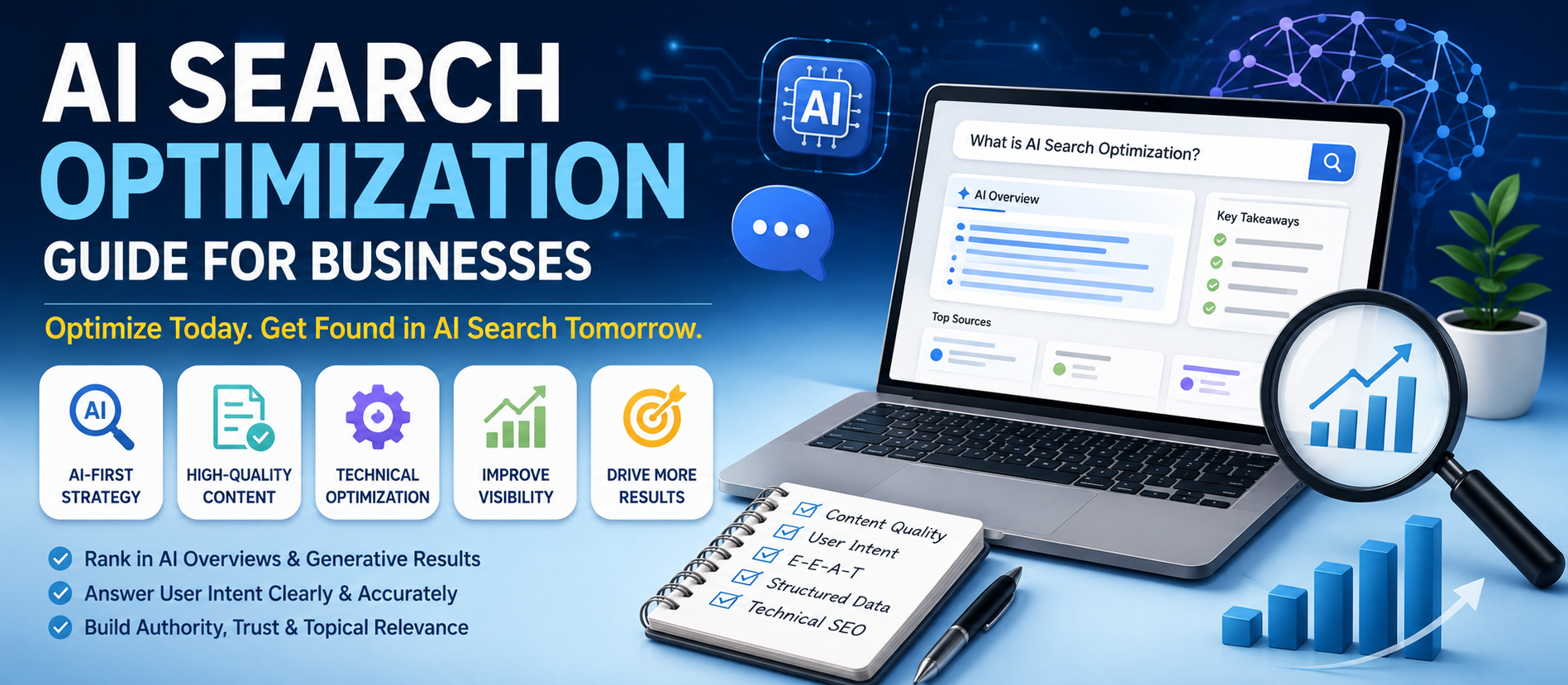
Search is changing rapidly. Customers are no longer relying only on traditional keyword searches and lists of blue links. People increasingly use conversational and generative search experiences to research companies, compare products, understand services, solve problems, and make purchasing decisions. For businesses, this creates a new opportunity: becoming visible wherever potential customers ask questions, including AI-powered search experiences.
💡 Key Insight
AI Search Optimization is the process of making a business website, brand information, and content easier for modern AI-powered search systems to understand, evaluate, and surface when relevant. It should not be treated as a replacement for traditional SEO. Google's current guidance says established SEO fundamentals remain relevant to generative AI search, making technical accessibility, useful content, and strong search foundations essential.
This guide explains a practical AI Search Optimization strategy combining SEO, AEO, GEO, helpful content, entity clarity, structured information, and authority.
Company: Designfo
Website: www.designfo.in
Contact: +91 9831037463
What Is AI Search Optimization?
AI Search Optimization is a broader approach to search visibility that considers how AI-powered systems discover, interpret, summarize, compare, and reference information from websites and other online sources.
Traditional SEO often focuses on ranking for individual keywords. AI search can involve longer questions, follow-up queries, comparisons, and synthesized answers. Therefore, businesses should create content that answers real customer needs while clearly communicating their expertise, products, services, and business identity.
Why AI Search Optimization Matters for Businesses
AI-powered search can change the path between discovery and conversion. A customer may ask an AI system for a shortlist of providers instead of opening many websites. They may request a comparison, ask for recommendations, or continue with several follow-up questions.
- Increase visibility across emerging AI search experiences.
- Improve discovery of products and services.
- Build stronger topical authority.
- Answer complex customer questions effectively.
- Support traditional organic search performance.
- Strengthen brand trust and recognition.
AI Search Optimization vs Traditional SEO
SEO remains the foundation, while AI Search Optimization expands the focus toward conversational intent, entities, context, authority, and user satisfaction.
- SEO: Keywords, rankings, technical performance, links, and organic traffic.
- AI Search Optimization: Questions, context, brand entities, topical authority, useful answers, and visibility in AI-generated experiences.
Businesses should not abandon conventional SEO. Instead, they should build AI search strategies on top of strong SEO fundamentals.
1. Build a Strong Technical SEO Foundation
AI systems still need access to your website. A technically confusing website can make excellent content difficult to discover or process.
- Make important pages crawlable.
- Ensure appropriate pages can be indexed.
- Use clean internal linking.
- Maintain logical URL structures.
- Fix broken links and major crawl issues.
- Use canonical URLs correctly.
- Ensure mobile usability.
- Improve page performance.
Technical SEO is not an optional layer. If search systems cannot reliably access and understand important pages, content optimization becomes much less effective.
2. Create Unique, Helpful, People-First Content
The most important principle in AI Search Optimization is usefulness. Businesses should not create hundreds of pages simply because AI makes content production faster.
High-value content should add something meaningful beyond information that is already available everywhere.
High-Value Content Should Include
- Original insights
- Practical experience
- Specific examples
- Case studies
- Expert commentary
- Useful data
- Clear explanations
- Actionable recommendations
AI can assist with research and editing, but human expertise should guide accuracy and quality.
3. Understand Conversational Search Intent
AI search encourages users to ask longer and more natural questions. Instead of targeting only a phrase such as marketing automation, businesses should understand the questions behind that topic.
For example:
- What is marketing automation?
- How does marketing automation help small businesses?
- Which workflows improve lead conversion?
- How much does marketing automation cost?
- How can marketing automation integrate with a CRM?
This helps your website serve informational, commercial, and transactional intent.
4. Build Topic Clusters and Content Depth
One article rarely establishes complete authority on a competitive subject. Create a pillar page supported by related resources that explore important subtopics in greater depth.
A business focused on AI Search Optimization could create supporting content about:
- AI Search Optimization fundamentals
- AI Overviews and AI-powered search
- AEO strategy
- GEO strategy
- Entity SEO
- Structured data
- Digital PR
- AI-friendly content strategy
- Measuring AI search visibility
Use internal links to connect related pages and clarify topical relationships.
5. Strengthen Your Brand Entity
AI systems need to understand what a business is, what it offers, where it operates, and how different online references relate to the same organization.
Maintain consistent information across:
- Business website
- About page
- Contact page
- Professional profiles
- Business directories
- Social profiles
- Industry publications
- Review platforms
⚠ Watch Out
Clearly explain your services, expertise, locations, and differentiators. Avoid conflicting information.
6. Demonstrate Experience, Expertise, Authority, and Trust
Strong AI Search Optimization is not only about technical formatting. Trust matters. Your content should demonstrate why your business is qualified to discuss a subject.
- Show author information where appropriate.
- Explain relevant professional experience.
- Publish original case studies.
- Show real examples and outcomes.
- Keep business information transparent.
- Correct outdated information.
- Use credible references when appropriate.
7. Optimize Content for AEO
Answer Engine Optimization (AEO) focuses on making content effective for answer-oriented search experiences. Create clear answers to common customer questions, followed by deeper explanations.
- Answer important questions directly.
- Use descriptive headings.
- Provide concise definitions.
- Use numbered steps for processes.
- Use bullet points for comparisons.
- Follow short answers with useful detail.
The goal is clarity and usefulness rather than artificial formatting designed to manipulate an AI system.
8. Use GEO as a Content and Authority Strategy
Generative Engine Optimization (GEO) is commonly used for efforts focused on visibility in generative search experiences. Instead of chasing shortcuts, businesses should focus on the fundamentals that make their brand valuable as a source.
- Publish original expertise.
- Build strong topical coverage.
- Make important facts clear.
- Earn relevant third-party recognition.
- Maintain consistent brand information.
- Create useful multimedia content.
There is no reliable shortcut that guarantees inclusion in AI-generated answers.
9. Use Structured Data Correctly
Structured data helps search systems understand what a page represents. Depending on the business, relevant schema types may include Organization, LocalBusiness, Article, Product, and Breadcrumb.
Structured data should accurately match visible page content. It should be treated as a machine-readable clarity layer, not a guaranteed ranking or AI recommendation technique.
10. Optimize Images, Video, and Other Content Formats
AI search is becoming increasingly multimodal. Businesses should not limit their optimization strategy to text.
- Original product images
- Explainer videos
- Demonstration videos
- Infographics
- Charts and diagrams
- Instructional screenshots
Use visuals when they genuinely improve understanding and accessibility.
11. Optimize Local and eCommerce Content
AI Search Optimization should match the business model. A local company needs strong location information, service areas, reviews, and local content. An eCommerce business needs accurate product information, useful descriptions, images, reviews, and shopping data.
Build pages around real customer questions rather than producing repetitive location or product variations.
12. Build Authority Through Digital PR
AI search visibility can benefit from a credible presence beyond your own website. Digital PR can help businesses earn legitimate mentions in relevant publications, interviews, podcasts, industry resources, conferences, and professional communities.
Focus on relevance and credibility.
13. Make Your Website Easy to Understand
Clear website architecture benefits users, search engines, and AI systems. Organize your website around meaningful categories and services.
- Home
- About
- Services
- Individual service pages
- Useful industry or location pages
- Case studies
- Resources or blog
- Contact
Use descriptive navigation and logical internal links.
14. Use AI Responsibly for Content Production
AI can make content workflows more efficient, but every AI-assisted workflow should include human review.
- Research the customer's actual problem.
- Develop an original content angle.
- Use AI for assistance where useful.
- Add expert insights and real examples.
- Fact-check important claims.
- Edit for accuracy and brand voice.
- Publish only when the page provides genuine value.
The objective is to produce better content more efficiently.
15. Measure AI Search Visibility
Measurement is essential because AI search behavior continues to evolve. Track traditional SEO metrics alongside emerging visibility signals.
- Organic impressions
- Organic clicks
- Search queries
- Engagement
- Conversions
- Branded search growth
- Referral traffic
- AI-search visibility where reporting is available
Also measure qualified leads, sales, enquiries, and revenue.
16. Create a 90-Day AI Search Optimization Plan
Days 1–30: Audit and Foundation
- Audit crawlability and indexability.
- Review important pages for quality and originality.
- Identify thin or duplicate content.
- Check internal linking.
- Review business and organization information.
- Identify important customer questions.
Days 31–60: Content and Authority
- Improve pillar pages.
- Build supporting topic clusters.
- Add useful FAQs.
- Publish original case studies.
- Improve author and business information.
- Create useful images and videos.
Days 61–90: Measurement and Expansion
- Monitor Search Console performance.
- Improve pages with strong impressions but weak engagement.
- Expand successful topic clusters.
- Strengthen internal links.
- Develop digital PR opportunities.
- Review conversions and qualified leads.
Common AI Search Optimization Mistakes
- Creating large numbers of low-value AI-generated pages.
- Keyword stuffing.
- Writing only for search engines.
- Using fake reviews or artificial mentions.
- Publishing unsupported claims.
- Ignoring technical SEO.
- Creating unnecessary pages for every query variation.
- Assuming one AI tactic guarantees recommendations.
- Ignoring human readers.
- Failing to measure business outcomes.
AI Search Optimization Checklist
- Website is crawlable and indexable.
- Important pages provide unique value.
- Business entity information is consistent.
- Service and product pages answer real questions.
- Content demonstrates experience and expertise.
- Internal links connect related topics.
- Structured data matches visible content.
- Images and videos add meaningful value.
- Content is reviewed and updated.
- AI-assisted content receives human quality control.
- Search performance is monitored regularly.
How Designfo Helps Businesses with AI Search Optimization
Designfo helps businesses prepare for the changing search landscape through integrated digital growth strategies. Instead of treating AI search as a separate trick, we can combine AI Search Optimization with technical SEO, content strategy, AEO, GEO, digital PR, website development, marketing automation, analytics, and conversion optimization.
Designfo Digital Growth Services
- AI Search Optimization
- SEO and Technical SEO
- Answer Engine Optimization (AEO)
- Generative Engine Optimization (GEO)
- Content Strategy
- Digital PR
- Website Design and Development
- Marketing Automation
- Local SEO
- Conversion Rate Optimization
Frequently Asked Questions
What is AI Search Optimization?
AI Search Optimization is the practice of improving a website's content, technical structure, business information, and authority so AI-powered search systems can better understand and surface it when relevant.
Is AI Search Optimization the same as SEO?
Not exactly. AI Search Optimization expands the visibility strategy for AI-powered experiences, while traditional SEO remains a core foundation.
What are AEO and GEO?
AEO commonly means Answer Engine Optimization, while GEO commonly means Generative Engine Optimization. Both focus on making content useful for answer-oriented and generative search experiences.
Does AI-generated content hurt SEO?
AI assistance itself is not automatically harmful. The important issue is whether the final content is useful, accurate, original, and compliant with search quality and spam guidelines. Large amounts of low-value content can create problems.
Can businesses guarantee that an AI will recommend them?
No. No legitimate AI Search Optimization strategy can guarantee that a particular AI system will recommend a business. The practical goal is to build a trustworthy and authoritative digital presence that systems can understand and evaluate.
Does structured data guarantee AI search visibility?
No. Structured data can improve machine-readable clarity, but it does not guarantee rankings, rich results, or inclusion in AI-generated responses.
Conclusion
AI Search Optimization is not about discovering a secret formula for appearing in every AI-generated answer. It is about building a digital presence that is genuinely useful, technically accessible, authoritative, accurate, and easy to understand.
The strongest strategy begins with traditional SEO fundamentals and expands into conversational content, entity clarity, structured information, digital authority, multimedia, AEO, GEO, and AI-focused measurement. Businesses should focus on what customers actually need rather than creating content solely to influence an algorithm.
As AI-powered search continues to evolve, the brands best positioned for long-term visibility will be those that consistently demonstrate expertise, provide original value, maintain strong technical foundations, and build trust across the wider web.
Company: Designfo
Website: www.designfo.in
Contact: +91 9831037463
Ready to Grow?
Talk to us about a strategy tailored to your brand — we will help you stand out in search, AI discovery and social.

Comments (0)
Log in to leave a comment.