📋 Quick Summary
In this article:
What Is Artificial Intelligence?
Simple example of deep learning
AI vs Deep Learning: The Core Difference
AI vs Deep Learning Comparison Table
How AI and Deep Learning Fit Together
Key Difference 1: Scope
Key Difference 2: How Systems Learn
Key Difference 3: Data Requirements
Key Difference 4: Feature Engineering
💡 Key Insight
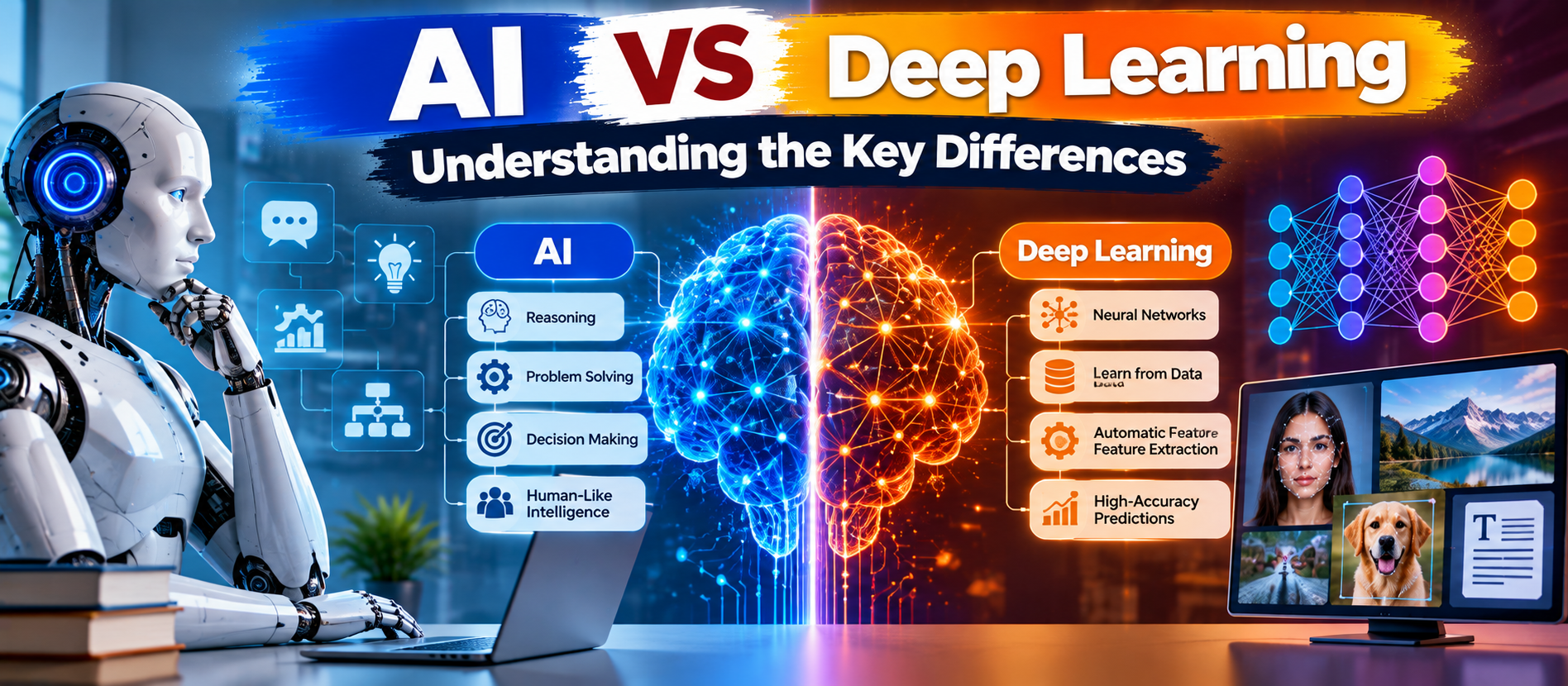
Artificial intelligence and deep learning are closely related, but they are not the same thing. AI is the broader field. Deep learning is one of the methods used to build AI systems. Machine learning sits between them as another important layer: machine learning is a subset of AI, while deep learning is a subset of machine learning.
This relationship is easy to remember:
Artificial Intelligence → Machine Learning → Deep Learning → Deep Neural Networks
IBM, Google Cloud, and other technical references describe this nested relationship consistently. AI is the broadest concept, machine learning is a major approach within AI, and deep learning uses multilayer neural networks to learn complex patterns from data.
Understanding the difference matters because businesses often use these terms as if they mean the same thing. They do not. An AI system does not have to use deep learning. A deep learning system is an AI system, but AI also includes approaches that are not deep neural networks.
This guide explains the difference in clear language. It also covers how the technologies work, where they are used, their strengths and limitations, business examples, and how to think about AI and deep learning when planning a technology strategy.
What Is Artificial Intelligence?
Artificial intelligence, or AI, is the broad field of creating computer systems that can perform tasks associated with human intelligence. These tasks can include understanding language, recognizing patterns, making predictions, solving problems, generating content, and supporting decisions.
AI is therefore a broad category rather than one specific technology.
Modern AI can use many different approaches. These may include rule-based systems, search and optimization methods, machine learning, neural networks, natural language processing, computer vision, and generative AI.
IBM describes AI as technology that enables computers and machines to simulate learning, comprehension, problem-solving, decision-making, creativity, and autonomy.
Simple example of AI
Imagine a customer-service system that follows a set of carefully designed rules.
If a customer asks about a refund, the system checks the order status and returns the appropriate response.
This can be considered an AI application even if the system does not use deep learning.
The key idea is that AI describes the overall capability or field, not a single algorithm.
What Is Machine Learning?
Machine learning, or ML, is a subset of AI. Instead of writing every rule manually, developers train models to learn patterns from data and use those patterns to make predictions or decisions on new data.
Common machine learning approaches include linear regression, logistic regression, decision trees, random forests, support vector machines, clustering, and neural networks.
For example, a bank might train a machine learning model to identify transactions that look unusual.
The model learns from historical data. It then estimates whether a new transaction resembles legitimate or suspicious activity.
Machine learning can work very well with structured business data, especially when the problem is clearly defined.
What Is Deep Learning?
Deep learning is a specialized subset of machine learning. It uses neural networks with multiple layers to learn complex representations and patterns from data.
The word deep refers to the depth of the neural network. Modern deep learning systems can contain many layers and very large numbers of adjustable parameters.
Deep learning is especially useful for complex data such as images, audio, video, natural language, and other high-dimensional information. Google Cloud describes deep learning as machine learning based on artificial neural networks, while IBM notes that deep learning automates much of the feature-extraction process that traditionally required human-designed features.
Simple example of deep learning
Suppose you want a computer to recognize cats in photographs.
A traditional approach might require people to design useful features such as edges, shapes, textures, or other visual characteristics.
A deep learning model can learn useful representations directly from large amounts of training data. Early layers may learn simple patterns. Later layers can combine those patterns into more complex representations.
The model does not need a person to manually define every visual feature.
AI vs Deep Learning: The Core Difference
The simplest distinction is this:
AI is the broad field. Deep learning is a specific machine learning approach used to build certain AI systems.
That means asking “AI or deep learning?” is not always the right question. Deep learning is already part of the larger AI landscape.
A better question is:
What kind of AI problem are you trying to solve, and is deep learning an appropriate method for that problem?
AI vs Deep Learning Comparison Table
| Factor Artificial Intelligence Deep Learning | ||
| Scope | Broad field | Subset of machine learning and AI |
| Main idea | Build systems that perform intelligent tasks | Learn complex patterns using multilayer neural networks |
| Methods | Rules, search, ML, neural networks, optimization and more | Deep neural networks and related training methods |
| Data needs | Depends on the approach | Often benefits from large datasets |
| Feature engineering | May or may not be required | Often learns representations automatically |
| Compute needs | Varies widely | Often high for large models |
| Typical strengths | Broad problem solving and automation | Complex pattern recognition |
| Examples | Rule systems, predictive models, assistants, planning systems | Computer vision, speech recognition, language models, generative systems |
How AI and Deep Learning Fit Together
Think of AI as a large toolbox.
Inside that toolbox are many methods.
Machine learning is one major section of the toolbox. Deep learning is a specialized section inside machine learning.
Another useful analogy is transportation.
AI is like the entire transportation industry.
Machine learning is like one major type of transportation.
Deep learning is like a specialized technology within that type.
The analogy is not technically exact, but it helps explain why the terms should not be treated as competitors.
Key Difference 1: Scope
The biggest difference is scope.
AI covers a very large set of concepts and techniques. It includes systems that can reason, plan, recognize patterns, understand language, generate content, or automate decisions.
Deep learning is narrower. It specifically refers to machine learning based on deep neural networks.
This means every deep learning application can be discussed as AI, but not every AI application is deep learning.
Key Difference 2: How Systems Learn
AI does not require one specific learning method.
Some AI systems can use predefined rules. Others use statistical methods. Others use machine learning. Some modern systems combine multiple techniques.
Deep learning learns by adjusting parameters within neural networks during training.
Training involves presenting data to the model, measuring errors or another objective, and updating the model's parameters to improve performance.
Backpropagation and gradient-based optimization are important techniques in modern neural-network training.
Key Difference 3: Data Requirements
AI systems can operate with very different amounts and types of data.
A rule-based AI system may require a knowledge base and carefully written rules rather than millions of examples.
Deep learning generally benefits from large datasets, especially when the problem involves complex images, language, speech, or other unstructured information.
This does not mean every deep learning project needs enormous data. The amount required depends on the task, architecture, training strategy, transfer learning, and quality of the available data.
Still, data scale is an important consideration when planning deep learning systems.
Key Difference 4: Feature Engineering
Traditional machine learning often relies more heavily on feature engineering.
Feature engineering means transforming raw data into useful variables that a model can learn from.
For example, a house-price model might use variables such as floor area, number of bedrooms, age, and location.
Deep learning can learn representations from relatively raw inputs. In image recognition, the network can learn increasingly complex patterns through its layers rather than relying entirely on manually engineered visual features.
This ability is one reason deep learning became so important for unstructured data.
Key Difference 5: Computing Requirements
Not every AI system requires large amounts of computing power.
A simple rules engine may run on modest hardware. A traditional machine learning model may also have relatively low inference requirements.
Large deep learning models can be much more demanding.
Training complex neural networks may require powerful GPUs or other accelerators, substantial memory, distributed systems, and significant engineering resources.
IBM notes that deep learning requires substantial data and computational resources, which is one reason cloud computing has become an important part of the deep learning ecosystem.
Key Difference 6: Explainability
Explainability can be different across AI approaches.
A simple rule-based system can often explain its output directly:
“If condition A is true and condition B is true, produce result C.”
Some traditional machine learning models can also be easier to inspect than very large neural networks.
Deep neural networks can be harder to interpret because decisions emerge from many interacting parameters and layers.
This does not mean deep learning is impossible to explain. Researchers and engineers use interpretability and explainability methods to understand model behavior. But explaining a complex neural network can be more difficult than explaining a small rule set.
Key Difference 7: Types of Problems
AI can address a broad range of problems.
Deep learning is particularly strong when the problem involves complex patterns in large datasets.
Common deep learning applications include:
- Image classification
- Object detection
- Speech recognition
- Natural language processing
- Machine translation
- Text generation
- Recommendation systems
- Fraud detection
- Medical image analysis
- Robotics perception
Deep learning powers many modern computer vision, speech, language, and generative AI systems.
Traditional AI Without Deep Learning
It is useful to understand that AI existed long before today's deep learning boom.
Earlier AI research included symbolic reasoning, expert systems, search algorithms, planning systems, knowledge representation, and rule-based approaches.
These methods can still be useful.
For example, if a company needs a system that applies a small number of transparent business rules, a rule-based approach may be simpler to develop and maintain than a neural network.
The best technology depends on the problem.
Deep Learning and Generative AI
Generative AI is another term that is often confused with deep learning.
Generative AI refers to systems designed to generate new content such as text, images, audio, video, or code.
Many modern generative AI systems use deep learning.
Large language models, for example, are based on neural-network architectures and are trained to process and generate language.
This creates another useful hierarchy:
AI → Machine Learning → Deep Learning → Modern Neural Network Architectures → Many Generative AI Systems
The hierarchy is simplified, because modern AI systems can combine multiple techniques. Still, it is a useful starting point for understanding the terminology.
Real-World Examples of AI vs Deep Learning
Example 1: Customer support
A simple customer-support system could use predefined rules to route questions.
A more advanced system could use machine learning to classify customer requests.
A deep learning system could process natural language and generate a context-aware response.
All three can be part of an AI strategy.
Example 2: Fraud detection
A bank could use rules such as “flag transactions above a defined threshold.”
It could also use traditional machine learning to identify patterns in structured transaction data.
Deep learning could be useful when the organization needs to model more complex relationships across large datasets.
Example 3: Image recognition
A rule-based approach might struggle with the huge variation found in real-world photographs.
A deep neural network can learn visual representations from many training examples and classify new images.
Example 4: Voice assistants
A modern voice assistant can combine several AI components, including speech recognition, natural language processing, machine learning, deep learning, search, and response generation.
This illustrates an important point: real AI products are often systems made of multiple technologies rather than one algorithm.
Advantages of Artificial Intelligence
- Broad range of possible approaches
- Can solve rule-based and learning-based problems
- Can automate repetitive decisions
- Can support human decision-making
- Can work with many types of data
- Can combine multiple technologies
AI is a broad problem-solving framework. This gives organizations flexibility when choosing technical methods.
Advantages of Deep Learning
- Strong performance on complex pattern-recognition tasks
- Works well with images, audio, text, and other unstructured data
- Can learn representations automatically
- Scales effectively with large datasets and computing resources
- Supports many modern computer vision and language applications
- Can model highly complex relationships
Deep learning's flexibility is a major strength, but it comes with trade-offs.
Limitations of Artificial Intelligence
AI is too broad to have one universal limitation. Different AI approaches have different weaknesses.
Common challenges include:
- Poor-quality input data
- Bias in data or system design
- Incorrect predictions
- Integration complexity
- Security risks
- Privacy concerns
- Difficulty defining success
- Need for human oversight
AI systems are only as reliable as the data, objectives, architecture, evaluation, and controls surrounding them.
Limitations of Deep Learning
Deep learning has several important challenges.
Large data requirements
Many deep learning systems benefit from substantial amounts of high-quality training data.
High computing costs
Training large models can require expensive hardware and infrastructure.
Complexity
Designing, training, evaluating, and deploying deep neural networks can require specialized skills.
Interpretability
It can be difficult to explain exactly why a complex network produced a particular output.
Overfitting and generalization problems
A model can perform well on training data but perform poorly on new real-world data if the training process and evaluation are not designed correctly.
Operational challenges
Production systems need monitoring, data pipelines, model evaluation, security, versioning, and ongoing maintenance.
When Should a Business Use AI?
A business should think about AI when it has a clear problem that can benefit from automation, prediction, classification, generation, or decision support.
Examples include:
- Customer-service automation
- Demand forecasting
- Fraud detection
- Document processing
- Marketing personalization
- Workflow automation
- Recommendation systems
- Business intelligence
The first step should be the business problem, not the technology label.
When Should a Business Consider Deep Learning?
Deep learning may be appropriate when the problem involves complex patterns and large or rich datasets, especially images, speech, natural language, video, or other unstructured inputs.
It can also make sense when existing approaches do not provide the required accuracy and the organization has enough data, compute, expertise, and operational capacity.
For a simple prediction problem with structured data, deep learning may be unnecessary.
AI vs Deep Learning: Which One Is Better?
There is no general “better” choice because AI and deep learning are not direct alternatives.
Deep learning is one way to implement AI.
The right approach depends on:
- The business problem
- Data availability
- Data quality
- Required accuracy
- Latency requirements
- Interpretability needs
- Budget
- Available technical expertise
- Security and privacy requirements
- Deployment environment
A simple model that solves the problem reliably can be more practical than a complex deep learning system.
AI vs Deep Learning for Beginners
If you are new to the subject, remember these four statements:
- AI is the broadest concept.
- Machine learning is a subset of AI.
- Deep learning is a subset of machine learning.
- Deep learning uses multilayer neural networks to learn complex patterns.
Once these relationships are clear, many other AI terms become easier to understand.
AI, Machine Learning, Deep Learning, and Neural Networks
These four terms are often presented together.
Artificial Intelligence
The broad field of creating systems that perform tasks associated with intelligence.
Machine Learning
A subset of AI in which systems learn patterns from data to make predictions or decisions.
Neural Networks
Machine learning models made from interconnected computational nodes arranged in layers.
Deep Learning
Machine learning based on neural networks with multiple layers that can learn complex representations.
IBM and Google Cloud both use this nested relationship when explaining the terminology.
How Deep Learning Learns Features
One of deep learning's important characteristics is hierarchical representation learning.
Consider an image-recognition model.
Earlier layers may learn simple visual patterns such as edges.
Middle layers may combine those patterns into shapes.
Later layers may combine shapes into larger structures associated with objects.
This is a simplified explanation. Real architectures can be much more complex.
The important idea is that the network can learn useful internal representations from data instead of relying entirely on manually designed features.
Why Deep Learning Became So Important
Deep learning existed for decades, but its practical impact grew dramatically as several conditions improved.
- More digital data became available.
- GPUs and specialized hardware became more capable.
- Training methods improved.
- Neural network architectures improved.
- Cloud computing made large-scale infrastructure more accessible.
- Organizations gained access to larger datasets and better engineering tools.
IBM notes that deep learning became dominant across many AI subfields as data and computing resources expanded.
AI and Deep Learning in 2026
In today's AI landscape, deep learning is central to many advanced systems. It supports major developments in language, computer vision, speech, recommendation, robotics, and generative AI.
At the same time, businesses should not assume that every AI project needs a large neural network.
Modern AI strategy is increasingly about choosing the right model and workflow for the job.
For one task, a small predictive model may be enough. For another, a foundation model or deep neural network may be appropriate. For another, deterministic rules may be safer and easier to maintain.
This practical distinction can prevent unnecessary complexity and cost.
How to Explain AI vs Deep Learning in One Sentence
Artificial intelligence is the broad field of building systems that perform intelligent tasks, while deep learning is a machine learning technique that uses multilayer neural networks to learn complex patterns from data.
That sentence captures the main relationship.
❓ Frequently Asked Questions
Is deep learning the same as AI?▾
No. Deep learning is a subset of machine learning, and machine learning is a subset of AI.
Which is bigger, AI or deep learning?▾
AI is broader. Deep learning is one specialized approach within the AI field.
Is machine learning part of AI?▾
Yes. Machine learning is a major subset of artificial intelligence.
Are neural networks and deep learning the same?▾
Not exactly. Neural networks are models used in machine learning. Deep learning generally refers to neural networks with multiple layers that learn complex representations.
Does all AI use deep learning?▾
No. AI can use rules, search, optimization, traditional machine learning, neural networks, and other approaches.
Why is deep learning good for images?▾
Deep neural networks can learn hierarchical visual representations from large collections of images. This makes them well suited to many computer-vision tasks.
Does deep learning require a lot of data?▾
Deep learning often benefits from large amounts of data, especially for complex tasks. The actual requirement varies by model, task, transfer learning approach, and data quality.
Is deep learning more expensive than traditional AI?▾
It can be. Training and operating large deep learning models may require more computing resources, specialized hardware, engineering expertise, and data infrastructure.
Can a small business use deep learning?▾
Yes. A small business may use an existing deep-learning-powered service or API without training its own model. Building and training a large model from scratch is a different and much more resource-intensive project.
Is generative AI the same as deep learning?▾
No. Generative AI describes systems that generate content. Many modern generative AI systems are powered by deep learning, but the terms describe different aspects of the technology.
AI vs Deep Learning: Quick Checklist
- Start with the business problem.
- Identify the type of data involved.
- Check data quality and availability.
- Define the required accuracy.
- Consider interpretability requirements.
- Estimate infrastructure and operating costs.
- Compare simple models with complex models.
- Evaluate security and privacy risks.
- Test the system on realistic data.
- Monitor performance after deployment.
Conclusion
AI and deep learning are connected, but they describe different levels of technology. AI is the broad field. Machine learning is a major subset of AI. Deep learning is a specialized subset of machine learning based on multilayer neural networks.
The difference is important because technology decisions should be driven by the problem, not by fashionable terminology.
If a task can be solved with simple rules, a rule-based system may be appropriate. If structured data supports a clear prediction problem, traditional machine learning may work well. If the problem involves complex patterns in images, language, speech, video, or other high-dimensional data, deep learning may be a strong option.
The most useful AI strategy is therefore not to choose the most complicated technology. It is to choose the technology that solves the problem reliably, responsibly, and economically.
As AI continues to evolve, understanding the relationship between AI, machine learning, deep learning, neural networks, and generative AI will help professionals make better technology decisions.
About Digiifrog
Digiifrog provides practical insights into AI, digital marketing, automation, SEO, AI Search, GEO, and modern business technology. Explore more resources and digital solutions at www.digiifrog.com.
Ready to Grow?
Talk to us about a strategy tailored to your brand — we will help you stand out in search, AI discovery and social.

Comments (0)
Log in to leave a comment.