📋 Quick Summary
In this article:
Why Does Artificial Intelligence Need Regulation?
The European Union: A Comprehensive Risk-Based Model
The EU Risk-Based Approach
The United States: A Decentralized and Innovation-Focused Approach
What This Means for Businesses
China: Rules for Specific AI Technologies and Services
India: Developing an AI Governance Framework
Other Global Approaches to AI Governance
Artificial intelligence regulations around the world are evolving rapidly as governments attempt to balance innovation with safety, privacy, transparency, accountability, competition, and national security. AI is now used in healthcare, finance, education, employment, transportation, cybersecurity, government services, and consumer products. As its influence expands, the question is no longer whether AI will be governed, but how different countries will choose to govern it.
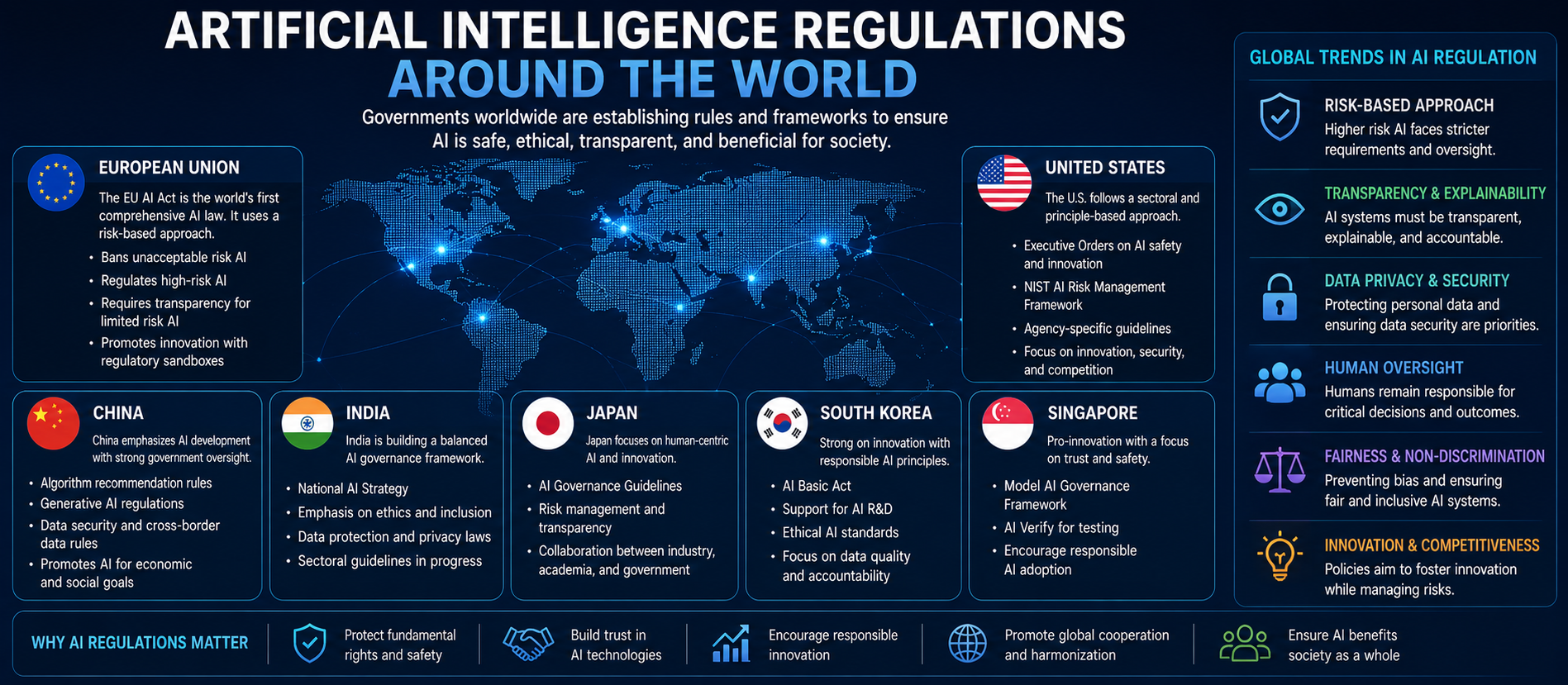
There is no single global AI law. Instead, a complex international landscape is emerging. The European Union has adopted a broad risk-based framework, the United States is pursuing a more decentralized and innovation-focused federal approach, China has introduced rules for specific AI services and technologies, and countries such as India are developing governance structures alongside existing digital and sectoral laws.
This article explains the major approaches shaping global AI regulation and what businesses should understand when developing, deploying, or using AI systems.
Why Does Artificial Intelligence Need Regulation?
AI can create significant benefits, but it can also introduce risks. An AI system may produce inaccurate information, discriminate unfairly, expose personal data, enable fraud, generate deceptive synthetic content, or make unreliable recommendations in high-impact situations.
AI regulation generally attempts to address several core issues:
- Safety: Preventing systems from causing unacceptable harm.
- Privacy: Protecting personal and sensitive information.
- Transparency: Helping people understand when and how AI is being used.
- Accountability: Identifying who is responsible for AI-related decisions and failures.
- Fairness: Reducing unlawful discrimination and harmful bias.
- Security: Protecting AI systems from misuse and cyber threats.
- Innovation: Avoiding unnecessary barriers to useful technological development.
The challenge is that AI evolves faster than many traditional regulatory systems. Governments therefore use different combinations of legislation, sector-specific rules, standards, guidance, regulatory sandboxes, procurement requirements, and enforcement mechanisms.
The European Union: A Comprehensive Risk-Based Model
The European Union's AI Act is one of the world's most comprehensive legal frameworks specifically designed for artificial intelligence. It uses a risk-based approach, meaning that obligations generally become more demanding as the potential risk associated with an AI system increases.
The framework addresses prohibited AI practices, high-risk AI systems, transparency obligations, general-purpose AI models, governance, and enforcement. It also applies on a staged timetable rather than placing every obligation into effect at the same time.
Key EU AI Act Timeline
The AI Act entered into force on 1 August 2024. Prohibitions on certain AI practices and AI literacy-related provisions began applying on 2 February 2025. Governance rules and obligations for general-purpose AI models became applicable from 2 August 2025.
As of August 2026, the EU's transparency obligations are applicable. Following the 2026 AI Omnibus changes, rules for certain high-risk AI systems are scheduled to apply from 2 December 2027, while high-risk AI systems embedded in certain regulated products are scheduled from 2 August 2028.
The EU Risk-Based Approach
The EU framework is often described through several categories:
- Unacceptable risk: Certain prohibited AI practices.
- High risk: Systems used in specified sensitive or high-impact contexts, subject to stronger obligations.
- Transparency risk: Systems that trigger specific disclosure and transparency requirements.
- Lower-risk systems: Applications that generally face fewer AI-specific obligations, although other laws may still apply.
💡 Key Insight
The EU approach demonstrates an important global trend: the same AI technology may face different obligations depending on how and where it is used.
The United States: A Decentralized and Innovation-Focused Approach
The United States does not currently operate under one comprehensive federal AI statute comparable to the EU AI Act. Instead, AI governance is shaped by executive policy, existing consumer protection and civil rights laws, sector-specific rules, federal agency activity, state laws, and court decisions.
In January 2025, the federal government issued an executive order focused on removing barriers to American AI leadership and directed the development of an AI Action Plan. In July 2025, the White House released America's AI Action Plan, organized around accelerating innovation, building AI infrastructure, and international diplomacy and security.
Federal policy continued to emphasize a national framework intended to reduce inconsistent and overly burdensome state-level regulation. However, the legal environment remains dynamic, and individual states may continue to influence AI governance through laws involving consumer protection, employment, privacy, automated decision-making, deepfakes, and related issues.
What This Means for Businesses
Organizations operating in the United States often need to evaluate multiple legal layers rather than checking compliance against a single AI law. The relevant requirements may depend on industry, location, data practices, customers, and the specific function performed by the AI system.
China: Rules for Specific AI Technologies and Services
China has developed a regulatory approach that includes rules targeting particular AI technologies and online services. This approach includes governance measures affecting recommendation algorithms, deep synthesis technologies, and generative AI services.
In 2026, Chinese authorities also issued implementation guidelines concerning the standardized and innovative development of AI agents. The guidelines emphasize safety, security, standardization, and application across multiple economic and social scenarios.
China's approach illustrates another major regulatory pattern: rather than relying only on one broad AI law, governments can introduce targeted rules as specific technologies and use cases become important.
India: Developing an AI Governance Framework
India's AI governance environment is developing alongside the country's broader digital, privacy, cybersecurity, consumer protection, and sectoral regulatory frameworks. Rather than relying on a single AI law identical to the EU model, India has continued to develop policy and institutional mechanisms for AI governance.
In 2026, India's Ministry of Electronics and Information Technology listed the constitution of an AI Governance and Economic Group, reflecting continued government activity around AI governance and economic development.
For organizations operating in India, responsible AI governance should therefore be viewed alongside applicable requirements involving data protection, information technology, consumer rights, intellectual property, cybersecurity, and sector-specific obligations.
Other Global Approaches to AI Governance
Many other countries and regions are developing AI governance strategies. Their approaches may differ, but common themes are emerging.
United Kingdom
The United Kingdom has promoted a principles-based and regulator-led approach in which existing institutions can address AI risks within their areas of responsibility. This model focuses on using established regulators while adapting governance to technological change.
Canada
Canada continues to consider how AI should be governed alongside privacy, consumer protection, human rights, and innovation objectives. Businesses should monitor both federal and provincial developments.
Japan and South Korea
These technology-driven economies are balancing AI innovation with governance, safety, intellectual property, and international competitiveness. Guidance, standards, industry collaboration, and sector-specific regulation can all play important roles.
International Organizations
Global AI governance is also influenced by organizations that develop principles, standards, technical guidance, and international cooperation frameworks. These efforts matter because AI systems, cloud services, data flows, and digital platforms frequently operate across national borders.
Common Themes in Global AI Regulation
Although legal systems differ, several themes appear repeatedly around the world.
1. Risk-Based Regulation
Higher-impact uses of AI generally attract greater scrutiny. AI used for entertainment may be treated differently from AI used in employment, healthcare, finance, law enforcement, or critical infrastructure.
2. Transparency
Governments increasingly focus on whether people should know when they are interacting with AI or viewing AI-generated or manipulated content. Transparency rules can include disclosure, labeling, documentation, or other information requirements.
3. Human Oversight
High-impact decisions may require meaningful human involvement, escalation procedures, and the ability to review or challenge automated outcomes.
4. Data Governance
AI regulation increasingly intersects with privacy law. Organizations must consider where training and operational data come from, whether they contain personal information, and whether they are collected and processed lawfully.
5. Documentation and Accountability
Businesses may need to maintain records describing an AI system's purpose, capabilities, limitations, data, testing, risk controls, and governance processes.
6. AI Safety and Security
As AI becomes integrated into critical systems, cybersecurity and misuse prevention become central regulatory concerns. Secure development, access controls, monitoring, incident response, and vulnerability management are increasingly important.
Generative AI, Deepfakes, and Transparency Rules
Generative AI has created new regulatory challenges because it can produce realistic text, images, audio, video, and software at scale. Governments are increasingly concerned about deceptive synthetic media, impersonation, fraud, election-related misinformation, and non-consensual intimate content.
The EU's 2026 transparency guidance explains obligations involving interactive AI systems and AI-generated or manipulated content. China has also developed targeted rules covering deep synthesis and generative AI services.
For businesses, a practical lesson is clear: organizations should understand when users need to be informed that they are interacting with AI and when synthetic or manipulated content may require labeling or disclosure.
How AI Regulation Affects Global Businesses
A company can develop an AI product in one country, host it in another, train it using globally sourced data, and serve customers across multiple jurisdictions. This creates significant compliance complexity.
⚠ Watch Out
Businesses should avoid asking only, “Is our AI legal?” A better approach is to ask:
- Where are our users located?
- Which countries regulate our AI use case?
- What type of AI system are we providing or deploying?
- Does the system make or influence high-impact decisions?
- What data does it collect, process, or generate?
- Are users informed about important AI interactions?
- What human oversight and escalation procedures exist?
- How is the system tested and monitored after deployment?
A Practical AI Compliance Framework
Step 1: Create an AI Inventory
Document every significant AI system used by the organization, including internally developed tools and third-party services.
Step 2: Classify the Use Case
Identify whether the AI is used in a low-impact environment or a sensitive area such as employment, healthcare, education, finance, security, or critical infrastructure.
Step 3: Assess Data and Privacy Risks
Review training data, user inputs, outputs, retention practices, data transfers, and access controls.
Step 4: Test for Reliability and Harm
Evaluate accuracy, robustness, bias, security, misuse scenarios, and known limitations before and after deployment.
Step 5: Establish Human Oversight
Define who can review AI outputs, override automated actions, investigate incidents, and make final decisions.
Step 6: Monitor Regulatory Change
AI law is changing quickly. Compliance should be treated as an ongoing governance process rather than a one-time project.
The Future of Global AI Regulation
AI regulation will likely become more sophisticated rather than simply more restrictive. Governments are under pressure to encourage innovation while managing genuine risks.
Future regulatory developments may increasingly focus on:
- Advanced and general-purpose AI models.
- AI agents capable of taking actions across digital systems.
- Deepfakes and synthetic media.
- AI safety testing and evaluation.
- Cybersecurity and misuse prevention.
- Transparency and content provenance.
- Cross-border data and AI services.
- Sector-specific high-impact AI applications.
- International standards and regulatory cooperation.
One of the biggest challenges will be interoperability. If every jurisdiction creates completely different technical and legal requirements, global businesses may face substantial complexity. International standards and common governance practices may therefore become increasingly important.
SEO, AEO, GEO, and AI Search Strategy for AI Regulation Content
AI regulation is a rapidly changing subject, making freshness and source quality especially important for SEO, AEO, GEO, and AI Search optimization.
High-quality content should use clear headings, direct answers, accurate dates, jurisdiction-specific explanations, FAQs, and regular updates. Businesses should avoid presenting evolving policy proposals as settled law and should clearly distinguish laws, regulations, executive actions, guidance, standards, and voluntary frameworks.
For generative search and answer engines, well-structured content that explains the relationship between countries, regulators, AI systems, risks, and legal obligations can improve clarity and usefulness.
Frequently Asked Questions
Is there one global AI law?
No. AI is governed through different laws, regulations, standards, guidance, and sector-specific requirements across jurisdictions.
Which region has the most comprehensive AI-specific law?
The European Union's AI Act is one of the broadest comprehensive legal frameworks specifically focused on artificial intelligence.
Does the United States have a single federal AI law?
No comprehensive federal AI law equivalent to the EU AI Act currently governs all AI systems. The U.S. approach involves federal policy, agency authority, existing laws, sector-specific rules, state laws, and court decisions.
Why do AI regulations differ between countries?
Countries have different legal systems, policy priorities, economic goals, privacy traditions, national security concerns, and approaches to technological innovation.
What should a global business do first?
Start with an AI inventory, identify relevant jurisdictions and use cases, assess risks and data practices, establish human oversight, document controls, and continuously monitor regulatory developments.
Conclusion
Artificial intelligence regulations around the world are creating a new global governance landscape. The European Union has adopted a comprehensive risk-based legal framework. The United States is pursuing a more decentralized and innovation-focused approach. China continues to regulate important AI technologies and services through targeted measures, while India and many other countries are developing governance systems that interact with existing digital and sectoral laws.
For businesses, AI compliance cannot be treated as a single checkbox. The legal obligations may depend on the technology, the use case, the data involved, the sector, and the countries in which an organization operates.
The most effective long-term strategy is to build responsible AI governance into product development and business operations from the beginning. Organizations should maintain clear inventories, assess risks, document systems, protect data, test for reliability, provide appropriate human oversight, and stay informed as laws evolve.
For businesses looking to build stronger digital strategies around AI, automation, SEO, AEO, GEO, and AI Search optimization, Digiifrog can help. Visit www.digiifrog.com.
Quick Answer: How Are Countries Regulating Artificial Intelligence?
Countries are regulating AI through different approaches, including comprehensive AI laws, risk-based frameworks, sector-specific rules, privacy and consumer protection laws, transparency requirements, technical standards, and government guidance. The EU AI Act is a major comprehensive model, while the United States uses a more decentralized framework and China has developed targeted rules for specific AI technologies and services.
Important Note
This article is for general educational and informational purposes and does not constitute legal advice. AI regulations change rapidly, and businesses should obtain current professional legal advice for specific products, jurisdictions, and compliance obligations.
Ready to Grow?
Talk to us about a strategy tailored to your brand — we will help you stand out in search, AI discovery and social.


Comments (0)
Log in to leave a comment.