📋 Quick Summary
In this article:
Why AR Is Important in Education
Key Applications of AR in Learning
1. Science Education
2. Mathematics
3. History and Geography
4. Language Learning
5. Technical and Vocational Training
Frequently Asked Questions (AEO Section)
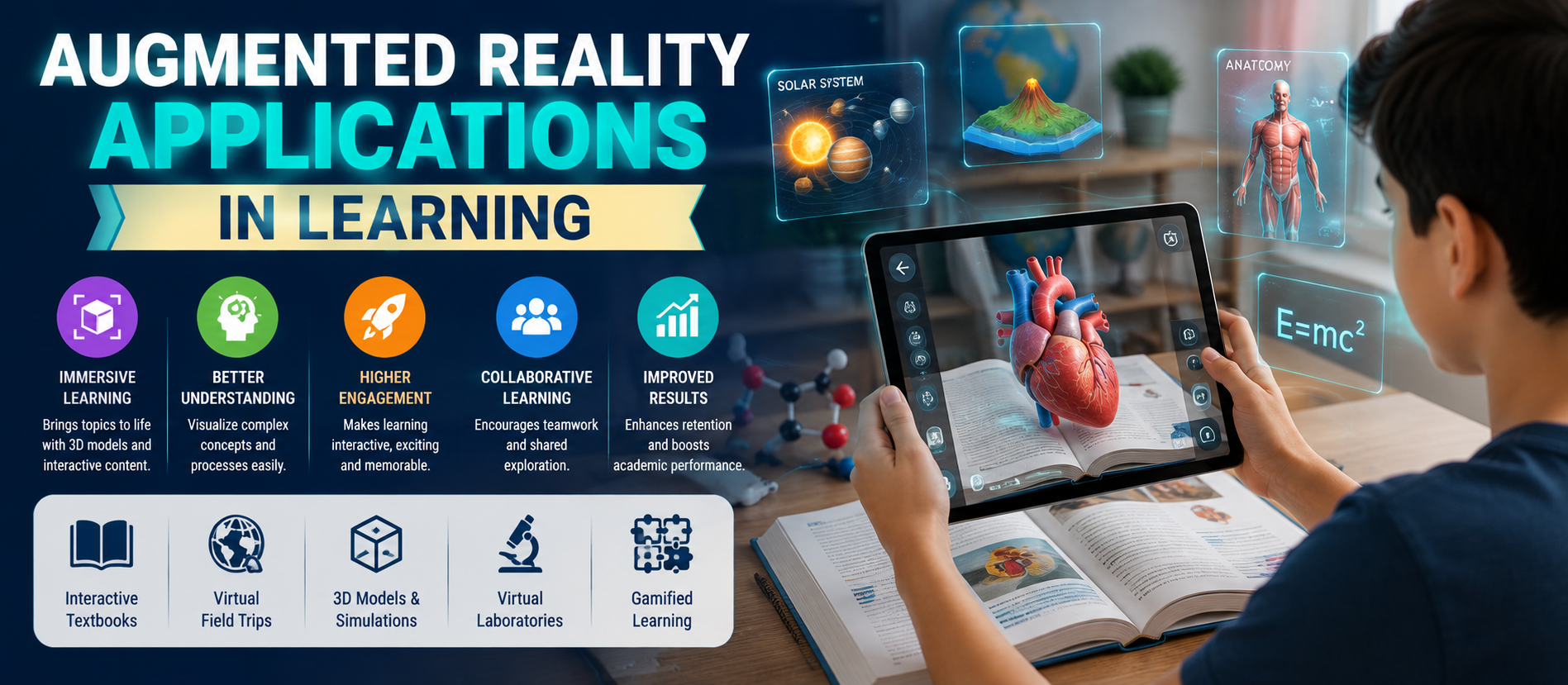
Augmented Reality (AR) is transforming modern education by blending digital content with the physical world. Instead of relying solely on textbooks and static presentations, students can interact with 3D models, animations, simulations, and real-time visual information through smartphones, tablets, AR glasses, and other smart devices. This immersive learning approach increases engagement, improves knowledge retention, and makes complex concepts easier to understand.
Website: www.digiifrog.com
Brand: Digiifrog – Education, AI, Technology & Digital Growth Insights
What Is Augmented Reality?
Augmented Reality overlays digital information such as 3D objects, images, audio, videos, and interactive content onto the real-world environment, creating engaging and immersive educational experiences.
Why AR Is Important in Education
- Improves student engagement.
- Supports experiential learning.
- Enhances visualization of complex topics.
- Encourages collaboration and creativity.
- Makes learning more interactive.
Key Applications of AR in Learning
1. Science Education
Students can explore human anatomy, molecules, planets, and laboratory simulations using interactive 3D models.
2. Mathematics
AR helps visualize geometric shapes, graphs, measurements, and mathematical concepts.
3. History and Geography
Historical landmarks, ancient civilizations, and world maps become interactive learning experiences.
4. Language Learning
Interactive vocabulary cards, pronunciation guides, and contextual visual learning improve language acquisition.
5. Technical and Vocational Training
Engineering, healthcare, and industrial training benefit from safe, realistic simulations.
Benefits of AR
- Higher knowledge retention.
- Better classroom participation.
- Personalized learning experiences.
- Safe hands-on practice.
- Improved collaboration.
Challenges
- Device and infrastructure costs.
- Teacher training requirements.
- Content development.
- Privacy and security concerns.
- Technology accessibility.
Future Trends
Artificial Intelligence, cloud computing, 5G connectivity, wearable devices, and mixed reality will make AR-powered learning even more immersive and accessible.
Frequently Asked Questions (AEO Section)
What is Augmented Reality in education?
It is the use of AR technology to overlay digital learning content onto the real world, creating interactive educational experiences.
How does AR improve learning?
AR increases engagement, enhances visualization, encourages active participation, and improves knowledge retention.
Which subjects benefit from AR?
Science, mathematics, history, geography, medicine, engineering, language learning, and vocational education all benefit from AR applications.
Conclusion
Augmented Reality is redefining education by making learning more interactive, engaging, and practical. As AR technologies become more affordable and widely available, they will play an increasingly important role in preparing students for the future.
For more education, AI, SEO, AEO, GEO, and technology insights, visit www.digiifrog.com.
Ready to Grow?
Talk to us about a strategy tailored to your brand — we will help you stand out in search, AI discovery and social.


Comments (0)
Log in to leave a comment.