📋 Quick Summary
In this article:
The Six Levels of Driving Automation
Why Artificial Intelligence Is Essential
The AI Technology Stack Inside an Autonomous Vehicle
1. Perception
2. Sensor Fusion
3. Localization and Mapping
4. Prediction
5. Planning and Decision-Making
6. Vehicle Control
Machine Learning and Computer Vision
Autonomous vehicles and artificial intelligence are reshaping the future of transportation. From advanced driver-assistance features to robotaxis and highly automated delivery systems, AI is becoming a critical technology for helping vehicles perceive their surroundings, understand complex road situations, predict possible movements, plan routes, and control steering, braking, and acceleration.
Automated driving technology is being tested and deployed in limited environments, supported by advances in machine learning, sensors, computing, simulation, and safety engineering.
However, autonomous driving is also one of the most difficult real-world applications of AI. A vehicle must operate in an unpredictable environment involving pedestrians, cyclists, other drivers, changing weather, road construction, unusual objects, and countless rare situations.
What Are Autonomous Vehicles?
An autonomous vehicle is a vehicle capable of performing some or all driving tasks with automated technology. Automation exists on a spectrum. Many vehicles available today include driver-assistance features, while more advanced automated driving systems are designed to take responsibility for the driving task under defined conditions.
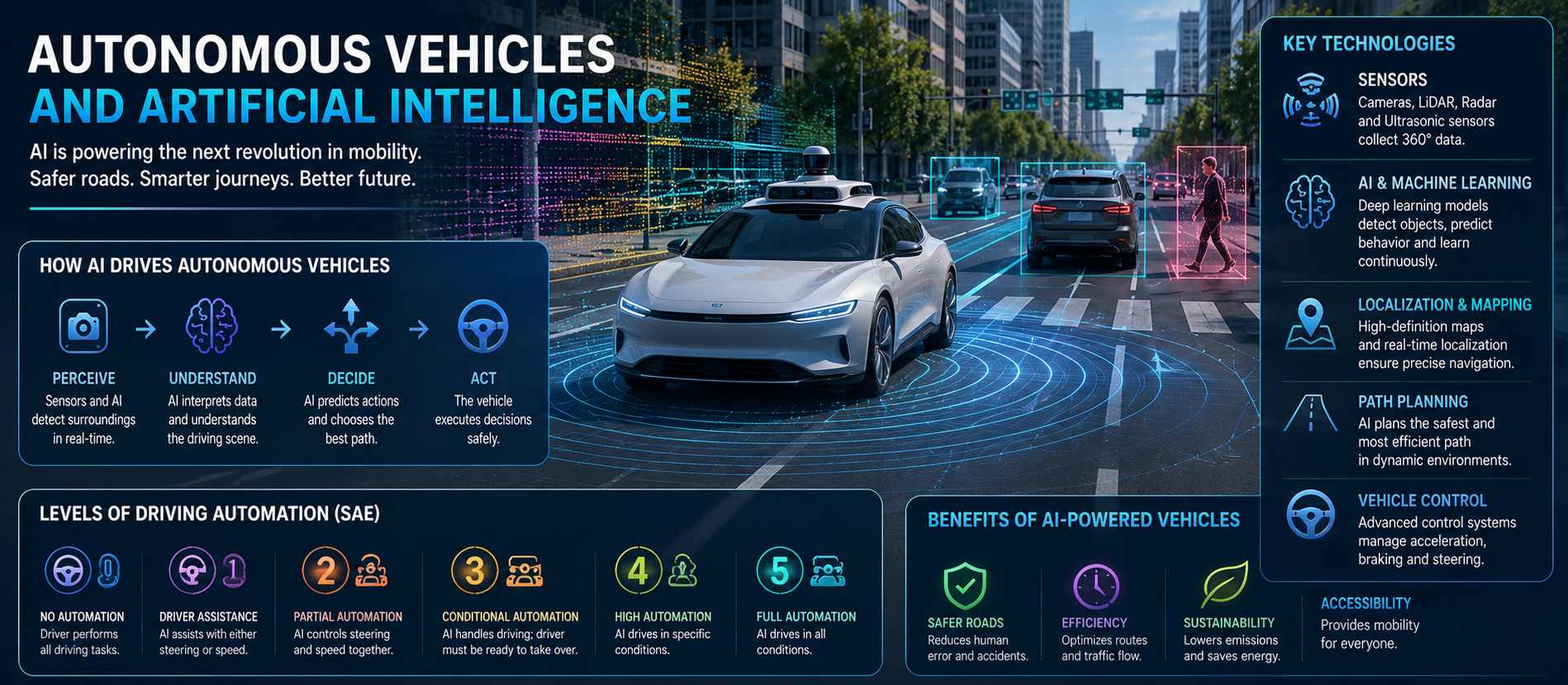
The National Highway Traffic Safety Administration uses the SAE framework of six automation levels, from Level 0 to Level 5. At Levels 0 through 2, the human driver remains responsible for driving and monitoring. At Level 3, the system can perform the driving task when engaged, but a driver must be available to take over when requested. Level 4 automation can operate without a human driver within limited conditions or service areas, while Level 5 describes full automation under all conditions and on all roadways.
The Six Levels of Driving Automation
- Level 0: No sustained driving automation. The driver performs the driving task, although warning or emergency safety features may assist.
- Level 1: Driver assistance with either steering or acceleration/braking.
- Level 2: Assistance with both steering and acceleration/braking, while the driver remains responsible for monitoring.
- Level 3: Conditional automation in which the system performs driving tasks when engaged, but the driver must be available to take over.
- Level 4: High automation within defined operational conditions or limited service areas.
- Level 5: Full automation capable of operating under all conditions and on all roadways.
💡 Key Insight
Understanding these levels is important because advanced driver assistance is not the same as a fully autonomous vehicle. A Level 2 system, for example, may control steering and speed but still requires the driver to remain attentive and responsible.
Why Artificial Intelligence Is Essential
Traditional software follows predefined instructions. Autonomous driving requires systems that can process large amounts of changing information and make decisions in environments that cannot be reduced to a simple list of rules.
AI and machine learning support several critical capabilities:
- Recognizing vehicles, pedestrians, cyclists, and road signs.
- Understanding lanes, intersections, and road boundaries.
- Estimating the motion of nearby objects.
- Predicting what other road users may do next.
- Planning safe driving paths.
- Responding to unusual or rapidly changing conditions.
- Improving systems through data, testing, and validation.
NHTSA research describes AI and machine learning as technologies used in automated-driving development for functions including perception, object detection, classification, decision strategy, and path planning.
The AI Technology Stack Inside an Autonomous Vehicle
An autonomous vehicle can be understood as a series of connected layers. Information enters through sensors, AI helps interpret the environment, planning software determines a safe action, and control systems operate the vehicle.
1. Perception
Perception is the vehicle's ability to understand its surroundings. Cameras can capture visual information, radar can help measure distance and motion, and other sensors such as lidar may provide detailed three-dimensional information. AI models process sensor data to identify objects and understand the driving scene.
2. Sensor Fusion
No single sensor is perfect in every condition. Sensor fusion combines information from multiple sensors to create a more reliable picture of the environment. This redundancy can be important when lighting, weather, reflections, or other conditions affect individual sensors.
3. Localization and Mapping
The vehicle must estimate where it is and understand its position relative to roads, lanes, and other geographic features. Localization may combine satellite positioning, onboard sensors, maps, and AI-based interpretation of the surrounding environment.
4. Prediction
Safe driving requires more than detecting an object. The system must estimate what may happen next. A pedestrian near a crosswalk may enter the road. A vehicle may change lanes. A cyclist may turn unexpectedly. AI prediction models help evaluate possible future movements.
5. Planning and Decision-Making
The planning layer determines how the vehicle should respond. It may evaluate speed, lane position, following distance, traffic rules, obstacles, and predicted movements to select a safe path.
6. Vehicle Control
Finally, control systems convert the planned action into steering, braking, and acceleration. This layer must respond accurately and reliably while working with the vehicle's physical systems.
Machine Learning and Computer Vision
Computer vision helps vehicles identify cars, pedestrians, cyclists, traffic lights, signs, lanes, and other objects. Real roads remain difficult because lighting, weather, occlusion, construction, and unusual situations can change how objects appear.
How Autonomous Vehicles Learn
AI systems are developed using large collections of driving data, carefully labeled examples, simulations, testing scenarios, and engineering feedback. Training may help a model recognize patterns, while validation checks whether the system performs reliably across different situations.
Modern development increasingly combines real-world data with simulation. Simulated environments can reproduce rare or dangerous scenarios without exposing people to unnecessary risk. Developers can test unusual intersections, extreme weather, sudden obstacles, and other edge cases repeatedly.
SAE's 2026 technical work on AI and machine-learning systems in ground vehicles highlights the importance of verification and validation across the development life cycle, including challenges related to AI/ML components, data processes, synthetic data, and generative development artifacts.
Potential Benefits of AI-Powered Autonomous Vehicles
Improved Road Safety
Human error contributes to many crashes. Automated systems may eventually reduce certain risks by maintaining attention to defined tasks, detecting hazards quickly, and avoiding behaviors such as distraction or fatigue. However, safety claims must be evaluated through careful testing and real-world evidence rather than assumptions.
Greater Mobility
Autonomous transportation could improve mobility for people who cannot easily drive because of age, disability, or other circumstances. In suitable operating environments, automated services may create additional transportation options.
More Efficient Transportation
AI may improve route planning, fleet utilization, logistics, and specialized transportation operations.
Safety Is the Central Challenge
Autonomous vehicles operate in safety-critical environments. A small error in perception, prediction, software, hardware, communication, or control can have serious consequences.
Important safety challenges include:
- Detecting objects accurately in difficult weather or lighting.
- Handling rare and unexpected edge cases.
- Understanding unusual human behavior.
- Managing sensor or hardware failures.
- Preventing unsafe software behavior.
- Maintaining cybersecurity.
- Providing safe fallback behavior when systems cannot continue.
- Testing and validating AI models at sufficient scale.
Recent SAE guidance identifies technical, operational, and regulatory challenges associated with AI in ground vehicles, while emphasizing the need to manage trade-offs among safety, environmental, security, cost, and other system requirements.
Cybersecurity and Autonomous Vehicles
Connected vehicles create cybersecurity risks that must be managed through secure software, authentication, secure updates, monitoring, vulnerability management, and incident-response planning.
Regulation and Standards
Autonomous vehicles require evolving rules for safety, testing, software, AI validation, cybersecurity, data, and accountability. NHTSA continues to oversee automated vehicle safety and crash reporting, while 2026 regulatory work has included assessment of ADS safety performance and modernization of standards for vehicles designed to operate without human drivers.
What the Future May Look Like
The future of autonomous mobility is likely to develop gradually rather than through a single moment when every car becomes self-driving. Different levels of automation may expand across specific use cases.
- More advanced driver-assistance systems in consumer vehicles.
- Level 4 autonomous services in defined urban or regional areas.
- Autonomous freight on suitable routes.
- Automated delivery and logistics vehicles.
- AI-based traffic and fleet management.
- Greater use of simulation and digital twins for testing.
- Improved sensor technology and onboard computing.
- Stronger safety, cybersecurity, and AI governance standards.
Full Level 5 automation remains an extremely ambitious engineering goal because a system would need to handle virtually every environment and condition that a capable human driver can manage.
Frequently Asked Questions
What is the role of AI in autonomous vehicles?
AI helps autonomous vehicles perceive their environment, recognize objects, predict movements, plan driving paths, and support decision-making and vehicle control.
Are fully autonomous cars available to consumers?
Automation varies by level. According to current NHTSA consumer guidance, higher Levels 3 through 5 are not generally available as consumer-purchased technologies, while lower-level driver-assistance systems are available.
What sensors do autonomous vehicles use?
Depending on the vehicle and system design, autonomous vehicles may use cameras, radar, lidar, positioning technologies, and other sensors. Sensor fusion combines information from multiple sources.
Will autonomous vehicles be safer than human drivers?
Autonomous technology has the potential to improve safety, but performance must be demonstrated through testing, validation, operational monitoring, and real-world evidence. Safety should not be assumed simply because a system uses AI.
What is the biggest challenge for autonomous vehicles?
One of the biggest challenges is safely handling the enormous variety of real-world situations, including rare events, difficult weather, unpredictable human behavior, sensor limitations, and system failures.
Conclusion
Autonomous vehicles and artificial intelligence represent one of the most ambitious technology transformations of modern transportation. AI gives vehicles the ability to interpret complex environments, predict possible events, plan actions, and automate parts of the driving task.
Yet autonomous driving is not simply an AI problem. It is also a challenge involving safety engineering, sensors, software, cybersecurity, human factors, regulation, infrastructure, testing, and public trust.
The future will likely arrive in stages, with increasingly capable assistance systems and highly automated services operating first in environments where the technology can be carefully designed, tested, and monitored. The long-term potential is significant, but responsible deployment will depend on rigorous validation and continued attention to safety.
For businesses exploring AI, automation, intelligent systems, SEO, AEO, GEO, and AI Search optimization, Digiifrog can help build a stronger digital strategy. Visit www.digiifrog.com.
Quick Answer: How Does AI Power Autonomous Vehicles?
AI powers autonomous vehicles by processing sensor data, recognizing objects, understanding the driving environment, predicting the behavior of nearby road users, planning safe paths, and supporting steering, braking, and acceleration. The technology combines machine learning, computer vision, sensor fusion, mapping, prediction, planning, and control, supported by extensive testing and safety validation.
Important Note
Autonomous vehicle technology, regulations, and safety standards continue to evolve. Review current official guidance before making major decisions.
Ready to Grow?
Talk to us about a strategy tailored to your brand — we will help you stand out in search, AI discovery and social.

Comments (0)
Log in to leave a comment.