📋 Quick Summary
In this article:
Important Elements of Online Branding
1. Builds Brand Recognition
2. Creates Trust and Credibility
3. Helps Companies Stand Out From Competitors
4. Improves Website Performance and Conversion Potential
A Strong Branded Website Should Include
5. Strengthens SEO and Organic Visibility
6. Supports AEO and Question-Based Discovery
7. Improves GEO and AI Search Readiness
8. Creates Consistency Across Digital Channels
Focus Keyword: Benefits of Online Branding for Companies
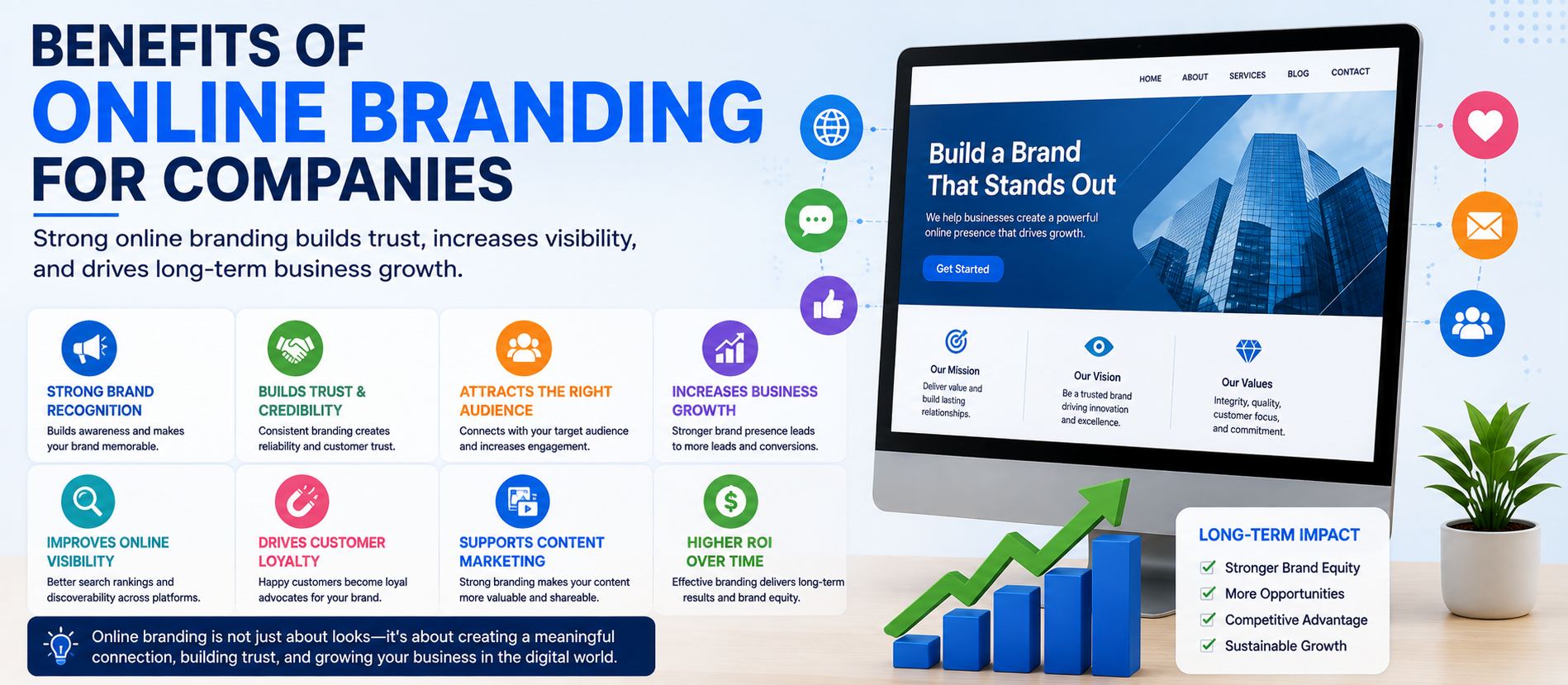
The benefits of online branding for companies go far beyond having an attractive logo or an active social media profile. In today's digital environment, customers often discover, research, compare, and evaluate businesses online before making contact. Your website, search presence, content, social channels, reviews, visual identity, and messaging all contribute to the way people understand your company.
A strong online branding strategy helps businesses create a recognizable identity, communicate their value clearly, build trust, and remain visible across multiple digital touchpoints. For startups, small businesses, and established companies alike, branding can turn scattered marketing activity into a more consistent customer experience.
Designfo helps companies strengthen their digital presence through branding, website design, digital marketing, SEO, content strategy, marketing automation, AEO, GEO, and AI Search Optimization.
What Is Online Branding?
Online branding is the process of creating and managing how a company is represented across digital channels. It includes both visual and non-visual elements.
Important Elements of Online Branding
- Brand name and logo
- Website design and user experience
- Brand colors and typography
- Brand voice and messaging
- Social media presence
- Search engine visibility
- Content and thought leadership
- Online reviews and reputation
- Email communication
- Customer experience across digital channels
The goal is consistency. A customer should receive a similar understanding of your company whether they find you through Google, social media, an email campaign, a recommendation, or your website.
1. Builds Brand Recognition
One of the biggest benefits of online branding is recognition. When companies use consistent messaging and visual identity, customers can begin to recognize the brand more easily over time.
Consistency does not mean every page or social post must look identical. Instead, the business should maintain recognizable elements such as tone, visual style, values, and positioning.
For example, a company that consistently communicates expertise, reliability, and practical solutions can reinforce those qualities across its website, articles, social media, case studies, and customer communications.
2. Creates Trust and Credibility
Customers often research companies before contacting them. An outdated website, unclear messaging, inconsistent company information, or weak digital presence can create uncertainty.
A professional online brand can help reduce that uncertainty by presenting:
- Clear company information
- Professional website design
- Real customer stories
- Case studies and examples of work
- Expert content
- Easy-to-find contact information
- Consistent business messaging
💡 Key Insight
Trust also depends on substance. Helpful, reliable, people-first content and clear information about who created or represents the business can support credibility. Google similarly emphasizes helpful content, trust, expertise, and a satisfying page experience as important quality concepts for websites.
3. Helps Companies Stand Out From Competitors
In competitive markets, products and services may appear similar. Branding helps a company explain why customers should remember or choose it.
A clear brand position can answer questions such as:
- Who do we serve?
- What problem do we solve?
- Why are we different?
- What experience can customers expect?
- What values guide our work?
The stronger these answers are, the easier it becomes to create focused marketing messages and relevant website content.
4. Improves Website Performance and Conversion Potential
A website is often one of the most important assets in an online branding strategy. It should do more than display information. It should guide visitors toward understanding the company and taking an appropriate next step.
A Strong Branded Website Should Include
- A clear value proposition
- Consistent visual identity
- Simple navigation
- Useful and readable content
- Clear calls to action
- Mobile-friendly design
- Fast and reliable performance
- Trust-building information
When design, content, and business positioning work together, visitors can more easily understand what the company offers and why it may be relevant to them.
5. Strengthens SEO and Organic Visibility
Online branding and SEO are closely connected. Strong brands create useful content, clear business information, recognizable expertise, and focused website architecture.
Google recommends creating helpful, reliable, people-first content and using language that people would naturally use when looking for relevant information. SEO can support discovery when it helps search engines understand useful content rather than trying to manipulate rankings.
A practical branded SEO strategy may include:
- Clear service and product pages
- Original educational content
- Relevant keywords in natural context
- Logical internal linking
- Accurate company information
- Useful images and media
- Strong technical website foundations
6. Supports AEO and Question-Based Discovery
Customers increasingly search using complete questions. They may ask how a service works, which company is suitable, what a product costs, or how to solve a specific problem.
Answer Engine Optimization (AEO) focuses on making useful answers easy to find and understand. Companies can improve content by identifying genuine customer questions and answering them clearly.
Useful AEO Content Formats
- Frequently asked questions
- How-to guides
- Comparison pages
- Service explanations
- Step-by-step resources
- Original research and insights
The priority should remain usefulness. Creating pages simply to target every possible question can lead to thin, repetitive content rather than genuine brand authority.
7. Improves GEO and AI Search Readiness
The rise of AI-powered search has increased the importance of clear, trustworthy digital information. For GEO and AI Search Optimization, companies should focus on the same fundamentals that make a brand useful online: accurate information, original expertise, clear positioning, accessible content, and a strong technical foundation.
Google's 2026 guidance describes foundational SEO as the best formula for success in the AI Search era because AI features continue to use core search and quality systems.
Rather than relying on artificial “AI optimization hacks,” companies should make their website genuinely useful and easy to understand.
8. Creates Consistency Across Digital Channels
Customers may interact with a company several times before making a decision. They might first see a social post, later search for the company, visit the website, download a guide, and eventually receive an email.
A consistent digital brand identity helps connect these experiences.
Create a Brand Consistency Framework
- Define your target audience.
- Clarify your core value proposition.
- Document brand voice and messaging.
- Create basic visual guidelines.
- Use consistent service and company descriptions.
- Review all major customer touchpoints regularly.
9. Makes Marketing More Efficient
Without clear branding, every new campaign may begin from zero. Teams may debate messaging, visual direction, target audience, and positioning repeatedly.
A documented brand foundation can make marketing more efficient by providing reusable guidelines for:
- Website copy
- Social media campaigns
- Email marketing
- Paid advertising
- Sales presentations
- Content creation
- Customer communication
This does not eliminate creativity. Instead, it gives creativity a clear strategic direction.
10. Supports Better Customer Relationships
People are more likely to remember businesses that communicate clearly and consistently. Online branding can support relationship building by creating useful content and maintaining a recognizable voice.
Companies can strengthen customer relationships through:
- Helpful educational content
- Clear onboarding communication
- Relevant email campaigns
- Responsive customer support
- Transparent policies
- Consistent social communication
Strong branding should not promise an experience that the company cannot deliver. The best digital brands align marketing claims with the real customer experience.
11. Helps Build Authority Through Content
Content is one of the most scalable ways to demonstrate expertise. A company can publish guides, insights, case studies, videos, research, and practical resources that answer audience questions.
Google's people-first content guidance encourages original information, substantial value, clear expertise, and content that helps visitors achieve their goals.
Content That Can Strengthen Brand Authority
- Industry guides
- Original research
- Case studies
- Expert interviews
- Product education
- Problem-solving tutorials
- Customer success stories
12. Improves Business Discoverability With Structured Information
Search systems benefit from clear information about an organization. Google supports Organization structured data to help it understand administrative details and disambiguate an organization in search results. Recommended properties can include relevant business information such as the organization's name, alternate name, address, telephone number, URL, and logo.
Structured data should always represent visible, accurate page content and should not be used to mislead users. Correct implementation may make a page eligible for certain search features, but Google does not guarantee that a rich result will appear.
How to Build a Strong Online Branding Strategy
Step 1: Define Your Brand Foundation
Identify your audience, business goals, values, positioning, and differentiators.
Step 2: Create a Consistent Digital Identity
Develop visual and messaging guidelines that can be used across the website, social media, advertising, and customer communications.
Step 3: Build a High-Quality Website
Create clear navigation, useful content, mobile-friendly pages, and focused conversion paths.
Step 4: Publish Helpful Content
Create resources that solve genuine customer problems and demonstrate relevant expertise.
Step 5: Optimize for Search and AI Discovery
Strengthen technical SEO, content structure, internal linking, business information, and useful multimedia. Build for people first while making information accessible to search systems.
Step 6: Maintain Consistency
Regularly review your website, social profiles, ads, and content to ensure the company message remains accurate and aligned.
Common Online Branding Mistakes to Avoid
- Using inconsistent logos, colors, or messaging.
- Making broad claims without evidence.
- Copying competitors instead of defining a unique position.
- Publishing large volumes of generic content.
- Ignoring website performance and mobile usability.
- Providing outdated company information.
- Creating separate low-value pages for every possible AI query.
- Focusing only on visual design while ignoring customer experience.
How Designfo Helps Companies Build Stronger Online Brands
Designfo provides digital solutions designed to help businesses create a stronger and more consistent online presence.
- Brand Identity and Graphic Design
- Professional Website Design
- Responsive Web Development
- SEO and Technical SEO
- Content Marketing
- Digital Marketing
- Marketing Automation
- AEO, GEO, and AI Search Optimization
- Conversion-Focused Digital Strategy
Frequently Asked Questions
What are the main benefits of online branding for companies?
Online branding can improve recognition, trust, customer consistency, search visibility, content authority, marketing efficiency, and long-term customer relationships.
Why is online branding important for small businesses?
Small businesses often compete with larger companies for attention. A clear brand identity and useful digital presence can help them communicate their value and build recognition with the right audience.
How does online branding help SEO?
Branding supports the creation of clear business information, useful content, recognizable expertise, and consistent messaging. SEO can then help search systems discover and understand that information.
What is the connection between branding and AI Search?
AI-powered discovery depends on accessible, useful, and trustworthy information. Companies can improve readiness by maintaining accurate brand information, demonstrating expertise, and following strong SEO and content fundamentals.
How long does it take to build a strong online brand?
There is no fixed timeline. Visual identity can be established relatively quickly, but recognition and trust usually grow through consistent delivery, useful content, customer experience, and long-term visibility.
Conclusion
The benefits of online branding for companies extend across marketing, sales, customer experience, and long-term growth. A strong digital brand helps people recognize your company, understand what you offer, trust your expertise, and remember you when they are ready to make a decision.
The most effective strategy is not to chase every new platform or trend. Start with a clear brand position, build a useful website, create consistent messaging, publish original content, and maintain accurate information across your digital presence.
By combining online branding with SEO, AEO, GEO, and AI Search Optimization, companies can build a digital presence designed for both current customer behavior and the evolving ways people discover businesses online.
Designfo
Website: www.designfo.in
Ready to Grow?
Talk to us about a strategy tailored to your brand — we will help you stand out in search, AI discovery and social.
Comments (0)
Log in to leave a comment.