📋 Quick Summary
In this article:
What Is a Professional Recruitment Agency?
Why Businesses Use Professional Recruitment Agencies
1. Recruitment Agencies Save Valuable Time
2. Agencies Provide Access to a Larger Talent Pool
3. Recruitment Agencies Can Reach Passive Candidates
4. Specialized Recruitment Expertise
5. Better Candidate Screening
6. Faster Time to Hire
7. Recruitment Agencies Help With Specialized Roles
8. Executive Search for Leadership Positions
9. Recruitment Agencies Reduce Administrative Work
10. Improved Hiring Process Structure
Finding the right employees has become one of the most important challenges for businesses of every size. Companies need skilled professionals who can contribute quickly, fit the organization, and support long-term growth. At the same time, recruitment can require significant time and resources. Writing job descriptions, publishing vacancies, reviewing applications, conducting interviews, checking qualifications, coordinating candidates, and negotiating offers can become a demanding process for internal teams.
In 2026, recruitment is also being transformed by artificial intelligence, applicant tracking systems, data analytics, remote work, specialized talent platforms, and digital interviewing. However, technology does not eliminate the importance of human judgment. Successful recruitment still depends on understanding business requirements, evaluating candidates accurately, communicating clearly, and creating a positive experience for both employers and applicants.
This WordPress-ready HTML article is prepared for Digiifrog (www.digiifrog.com) with a strong focus on SEO, AEO, GEO, and AI Search optimization.
What Is a Professional Recruitment Agency?
A professional recruitment agency is an external organization that helps employers find and hire suitable candidates. Recruitment agencies may specialize in particular industries, job categories, seniority levels, or geographic markets.
Recruitment services can include:
- Workforce requirement analysis
- Job description development
- Candidate sourcing
- Resume and application screening
- Candidate qualification
- Interview coordination
- Skills assessment
- Reference checking
- Offer coordination
- Temporary and contract staffing
- Executive search
- Recruitment process outsourcing
Why Businesses Use Professional Recruitment Agencies
Recruitment is more than filling an empty position. A poor hiring decision can affect productivity, team morale, customer service, project delivery, and operating costs. Professional recruiters can help organizations create a more structured hiring process and access candidates who may not be reached through ordinary job advertisements.
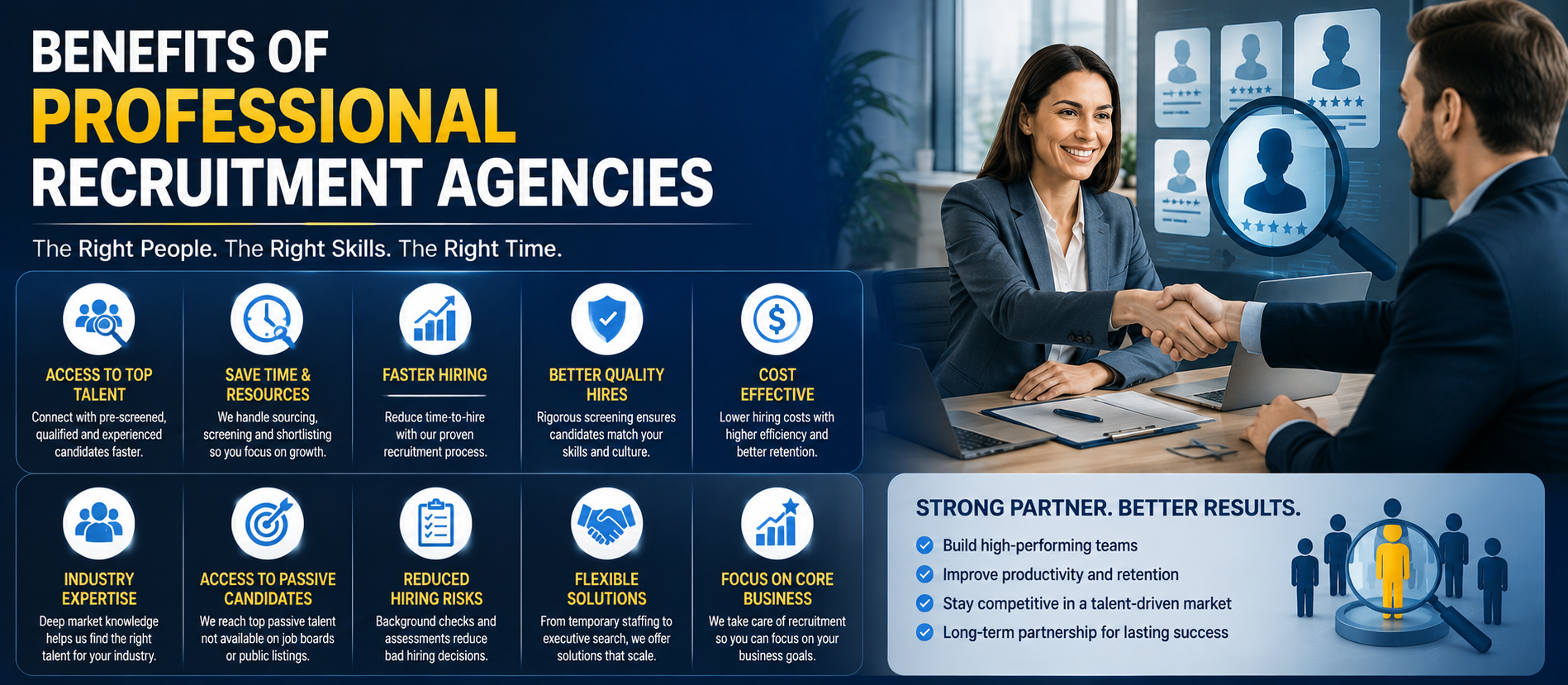
The major benefits include faster hiring, broader candidate reach, specialized expertise, reduced administrative workload, improved screening, access to passive candidates, and greater flexibility.
1. Recruitment Agencies Save Valuable Time
Recruiting can consume many hours of internal employee time. Hiring managers may have to review hundreds of applications while continuing their normal responsibilities.
A recruitment agency can take responsibility for much of the initial sourcing and screening process. This allows internal managers to spend more time interviewing qualified candidates and evaluating their suitability for the organization.
Time savings can be especially valuable when a company needs to fill multiple positions or recruit for specialized roles.
2. Agencies Provide Access to a Larger Talent Pool
⚠ Watch Out
Professional recruiters often maintain candidate databases, professional networks, referral relationships, industry contacts, and sourcing channels. This can give businesses access to candidates who may never respond to a standard job advertisement.
For difficult-to-fill positions, broader candidate access can significantly improve the chances of finding suitable talent.
3. Recruitment Agencies Can Reach Passive Candidates
Not every qualified professional is actively searching for a job. Experienced candidates may already be employed and may only consider a new opportunity if it is particularly relevant.
Recruiters can approach suitable passive candidates and introduce opportunities that match their experience and career goals. This can expand the available talent pool beyond active job seekers.
4. Specialized Recruitment Expertise
Recruitment agencies often develop expertise in particular industries or job functions. A technology recruiter, for example, may understand common technical roles, skills, certifications, development environments, and hiring challenges.
Specialized knowledge can help recruiters identify relevant candidates more efficiently and communicate job requirements more accurately.
5. Better Candidate Screening
Initial screening can become difficult when a company receives a large number of applications. Recruiters can evaluate resumes, experience, qualifications, availability, salary expectations, and other relevant criteria before presenting shortlisted candidates.
💡 Key Insight
Effective screening does not mean eliminating candidates solely through automated filters. Human review remains important for understanding career progression, transferable skills, context, and potential.
6. Faster Time to Hire
Open positions can create operational pressure. Existing employees may need to cover additional work, projects can be delayed, and customer service can suffer if critical roles remain vacant.
Recruitment agencies can accelerate the hiring process by maintaining candidate pipelines and managing sourcing activities while the employer focuses on final selection.
7. Recruitment Agencies Help With Specialized Roles
Some positions are difficult to recruit internally because the organization does not regularly hire for them. Examples include cybersecurity specialists, senior software engineers, data scientists, specialized finance professionals, healthcare specialists, and senior executives.
Specialist recruitment agencies can bring relevant market knowledge and candidate networks to these searches.
8. Executive Search for Leadership Positions
Leadership hiring requires careful evaluation because senior executives can influence strategy, culture, operations, and long-term performance.
Executive search firms can conduct targeted research, confidential outreach, candidate assessment, and leadership searches for difficult-to-fill senior positions.
9. Recruitment Agencies Reduce Administrative Work
Recruitment involves scheduling, candidate communication, documentation, follow-ups, interview coordination, and status updates. These tasks can consume considerable administrative time.
External recruitment support can reduce this workload and allow internal HR teams to focus on employee development, retention, workforce planning, and organizational initiatives.
10. Improved Hiring Process Structure
Professional agencies typically use defined recruitment workflows. These may include job analysis, sourcing, screening, candidate evaluation, interviews, reference checks, and offer management.
A structured process can reduce inconsistency and make recruitment easier to manage and measure.
11. Better Understanding of the Employment Market
Recruiters work with candidates and employers across the employment market. This can give them practical knowledge about candidate availability, common compensation expectations, skill shortages, and hiring trends.
Market information can help employers set realistic expectations and adjust job requirements when necessary.
12. Support for Competitive Compensation Planning
Compensation expectations can vary by role, location, experience, industry, and demand. Recruitment professionals can provide useful market context based on their current recruitment activity.
Businesses should combine recruiter input with reliable compensation data and their own financial strategy before finalizing offers.
13. Geographic Recruitment Support
Companies expanding into new cities or countries may not understand local hiring markets. Recruitment agencies with regional expertise can help identify candidates and provide knowledge about local employment practices.
International recruitment may also involve additional legal, tax, immigration, and compliance requirements. Businesses should obtain appropriate professional advice for these matters.
14. Support for Remote and Hybrid Hiring
Remote and hybrid work have expanded the geographic scope of recruitment. Companies can now hire talent from locations that were previously difficult to access.
Recruitment agencies can help organizations identify candidates who are comfortable with remote collaboration and who have the technical and communication skills required for distributed work.
15. Flexible Staffing Solutions
Not every business needs permanent employees for every position. Some projects require temporary specialists, contractors, seasonal workers, or interim managers.
Recruitment agencies can provide flexible staffing solutions that allow businesses to adjust workforce capacity according to demand.
- Temporary staffing
- Contract staffing
- Seasonal recruitment
- Interim professionals
- Project-based hiring
- Temp-to-permanent hiring
16. Recruitment Agencies Can Support Business Growth
Growth often creates hiring pressure. A company expanding its sales team, opening new locations, launching products, or entering new markets may need to recruit many employees within a short period.
A recruitment partner can provide additional sourcing capacity and help the organization scale hiring without immediately expanding its internal recruitment team.
17. Better Candidate Experience
Candidate experience influences an employer's reputation. Slow communication, unclear interview processes, and inconsistent updates can discourage strong candidates.
Professional recruiters can manage communication and keep candidates informed throughout the process. A positive experience can also strengthen the employer brand even when a candidate is not ultimately hired.
18. Recruitment Agencies Support Employer Branding
Recruiters often act as representatives of the employer during the hiring process. They can communicate the company's culture, role expectations, career opportunities, and values to candidates.
Businesses should ensure that recruiters have accurate information about the organization so that the employer brand is represented consistently.
19. Improved Recruitment Metrics
Professional recruitment processes can be measured through useful metrics.
- Time to hire
- Time to fill
- Candidate response rate
- Interview-to-offer ratio
- Offer acceptance rate
- Cost per hire
- Source of hire
- Quality of hire
- Retention after hiring
Tracking these metrics can help businesses identify bottlenecks and improve recruitment performance over time.
20. Recruitment Technology and Applicant Tracking Systems
Modern recruitment agencies use technology to organize candidate information, track applications, schedule interviews, automate communication, and maintain recruitment pipelines.
Applicant tracking systems can improve organization and visibility, although technology should be configured carefully to avoid unnecessary filtering or poor candidate experiences.
21. AI-Powered Recruitment
Artificial intelligence is increasingly being used in recruitment for tasks such as resume organization, candidate matching, job description assistance, interview scheduling, communication, and recruitment analytics.
AI can improve efficiency, but hiring decisions require careful oversight. Automated systems can reproduce bias or make incorrect assumptions if the underlying data, criteria, or implementation is poor.
22. AI-Assisted Candidate Matching
AI systems can compare job requirements with candidate profiles and identify potentially relevant matches. This can help recruiters prioritize their research.
However, candidate matching should not be treated as a complete assessment of suitability. Experience, communication, motivation, cultural fit, transferable skills, and career context require human evaluation.
23. Recruitment Analytics
Recruitment analytics can help businesses understand which sourcing channels produce strong candidates, how long hiring processes take, where candidates drop out, and which roles are difficult to fill.
Data-driven recruitment can help organizations allocate recruitment budgets more effectively and improve workforce planning.
24. Diversity and Fair Hiring Practices
A structured recruitment process can help organizations establish consistent evaluation criteria. Businesses should ensure that recruitment systems and practices comply with applicable employment laws and support fair treatment of candidates.
AI-based hiring tools require particular attention because automated systems can introduce or amplify bias. Human review, appropriate testing, documentation, and governance are important.
25. Recruitment Agencies Can Reduce Hiring Risk
A poor hiring decision can create significant costs through lost productivity, training expenses, management time, employee turnover, and disrupted projects.
Recruitment agencies can reduce some recruitment risks by improving sourcing, screening, communication, and process structure. They cannot guarantee a perfect hire, so employers should maintain appropriate interviews, assessments, references, and final decision-making.
26. Recruitment for High-Growth Startups
Startups often need to recruit quickly while building teams with limited internal HR resources. Recruitment agencies can provide additional sourcing capacity and help founders focus on product development, customers, fundraising, and strategy.
Specialized recruiters can be particularly useful for difficult technical, sales, product, and leadership roles.
27. Recruitment for Small and Medium-Sized Businesses
Small and medium-sized businesses may not have dedicated recruitment specialists. An external agency can provide access to professional recruitment capabilities without requiring a permanent internal hiring department.
This can be useful when the business has occasional hiring needs or suddenly needs to recruit multiple employees.
28. Recruitment for Large Enterprises
Large organizations often manage high-volume recruitment across multiple locations and departments. Recruitment agencies can supplement internal talent acquisition teams with specialized sourcing, regional hiring, executive search, or project-based recruitment support.
29. How to Choose a Professional Recruitment Agency
Industry Expertise
Look for an agency that understands your industry and the roles you need to fill.
Candidate Network
Ask how the agency sources candidates and whether it has access to relevant talent communities.
Recruitment Process
Understand how candidates are sourced, screened, evaluated, and presented.
Technology
Consider whether the agency uses appropriate recruitment technology, analytics, and communication systems.
Communication
Clear communication is essential. Establish who will manage the account, how often updates will be provided, and how quickly questions will be answered.
Pricing Model
Understand the fee structure, replacement terms, payment conditions, and any additional services before signing an agreement.
30. Questions to Ask Before Hiring a Recruitment Agency
- How much experience do you have in our industry?
- How do you source candidates?
- How do you screen applicants?
- How quickly can you begin the search?
- What recruitment metrics do you provide?
- Who will manage our account?
- How do you handle confidential searches?
- What are your replacement or guarantee terms?
- How do you use recruitment technology and AI?
- How do you protect candidate and employer data?
31. Recruitment Agency Fees and Cost Considerations
Recruitment fees vary according to the role, seniority, location, service model, and complexity of the search. Some agencies charge a percentage of the successful candidate's compensation, while others may use fixed fees, retained search models, contract staffing margins, or other structures.
Businesses should evaluate the total value of the service rather than focusing only on the headline fee. A more expensive agency may provide better access to specialized candidates and reduce the time required to fill a critical role.
32. Recruitment Agencies and Employer Compliance
Hiring involves legal and regulatory considerations that vary by jurisdiction. Recruitment agencies can support administrative processes, but employers remain responsible for understanding their legal obligations.
Organizations should consider employment law, data privacy, worker classification, background checks, immigration requirements, accessibility, and other applicable regulations. Professional legal advice should be obtained for complex compliance questions.
33. Recruitment, SEO, AEO, GEO and AI Search
Recruitment agencies also need strong digital visibility to attract both employers and candidates. SEO helps agencies appear in traditional search results. AEO focuses on answering hiring and career questions directly. GEO helps content become useful for generative search experiences, while AI Search optimization emphasizes structured, trustworthy, context-rich information.
A recruitment agency website should clearly explain industries served, recruitment specialties, hiring models, candidate services, geographic coverage, employer benefits, FAQs, case studies, and recruitment processes.
34. Future of Professional Recruitment Agencies
The recruitment industry will increasingly combine human expertise with AI, automation, analytics, remote collaboration, and global talent networks.
Recruiters are likely to spend less time on repetitive administrative work and more time on candidate relationships, employer consultation, market intelligence, interviewing, assessment, negotiation, and strategic workforce planning.
AI may help identify patterns and potential matches, but human recruiters will remain important for context, judgment, communication, trust, and relationship management.
35. Key Recruitment Trends for 2026
- AI-assisted candidate sourcing
- Automated recruitment administration
- Data-driven talent acquisition
- Remote and global recruitment
- Specialized technical recruiting
- Flexible contract staffing
- Skills-based hiring
- Candidate experience optimization
- Recruitment analytics
- AI governance in hiring
- Employer branding
- Strategic workforce planning
Frequently Asked Questions About Professional Recruitment Agencies
What are the main benefits of using a professional recruitment agency?
The main benefits include saving time, accessing a broader candidate pool, reaching passive candidates, gaining specialist recruitment expertise, improving screening, accelerating hiring, reducing administrative work, and supporting flexible staffing.
Are recruitment agencies useful for small businesses?
Yes. Small businesses can use recruitment agencies when they lack internal hiring resources, need specialized talent, or need to fill multiple positions quickly.
Can recruitment agencies find passive candidates?
Yes. Recruiters can use professional networks, databases, referrals, direct outreach, and specialized sourcing techniques to contact qualified professionals who are not actively applying for jobs.
How does AI affect recruitment agencies?
AI can assist with candidate sourcing, resume organization, matching, scheduling, communication, analytics, and administrative tasks. Human oversight remains important for fair and accurate hiring decisions.
How do recruitment agencies charge employers?
Pricing varies. Agencies may use contingency fees, retained search fees, fixed fees, contract staffing models, or other arrangements depending on the service and role.
Can recruitment agencies help with remote hiring?
Yes. Recruitment agencies can help businesses identify remote and hybrid candidates across broader geographic markets, subject to applicable employment and compliance requirements.
How long does recruitment through an agency take?
Timing depends on the role, candidate availability, industry, location, seniority, and employer decision-making process. Specialist or senior searches can take longer than common roles.
What should businesses look for in a recruitment agency?
Businesses should evaluate industry expertise, candidate sourcing capabilities, recruitment processes, communication, technology, data security, pricing, references, and the agency's understanding of the organization's hiring needs.
Conclusion
Professional recruitment agencies can provide significant value to businesses that need to hire efficiently, access specialized talent, reduce administrative workload, or scale their workforce. By combining candidate networks, recruitment expertise, structured processes, technology, and human judgment, agencies can help organizations improve the hiring experience for both employers and candidates.
The greatest benefit is not simply receiving resumes. A strong recruitment partner understands the business requirement, identifies relevant talent, screens candidates thoughtfully, communicates clearly, and helps move qualified candidates through the hiring process.
As AI and automation transform recruitment, the role of professional recruiters is likely to become more strategic. Technology can accelerate sourcing and administration, while human professionals focus on relationships, context, assessment, employer consultation, and complex hiring decisions.
For businesses looking to improve recruitment, workforce planning, AI-powered hiring workflows, digital transformation, business automation, and modern technology solutions, Digiifrog can help develop practical strategies. Visit www.digiifrog.com to learn more.
Quick Answer: What Are the Benefits of Professional Recruitment Agencies?
Professional recruitment agencies help businesses save hiring time, access wider talent pools, reach passive candidates, improve candidate screening, recruit specialized professionals, reduce administrative workload, support flexible staffing, accelerate hiring, and gain recruitment market expertise. Modern agencies also use analytics, applicant tracking systems, automation, and AI-assisted tools while maintaining human oversight for important hiring decisions.
Ready to Grow?
Talk to us about a strategy tailored to your brand — we will help you stand out in search, AI discovery and social.


Comments (0)
Log in to leave a comment.