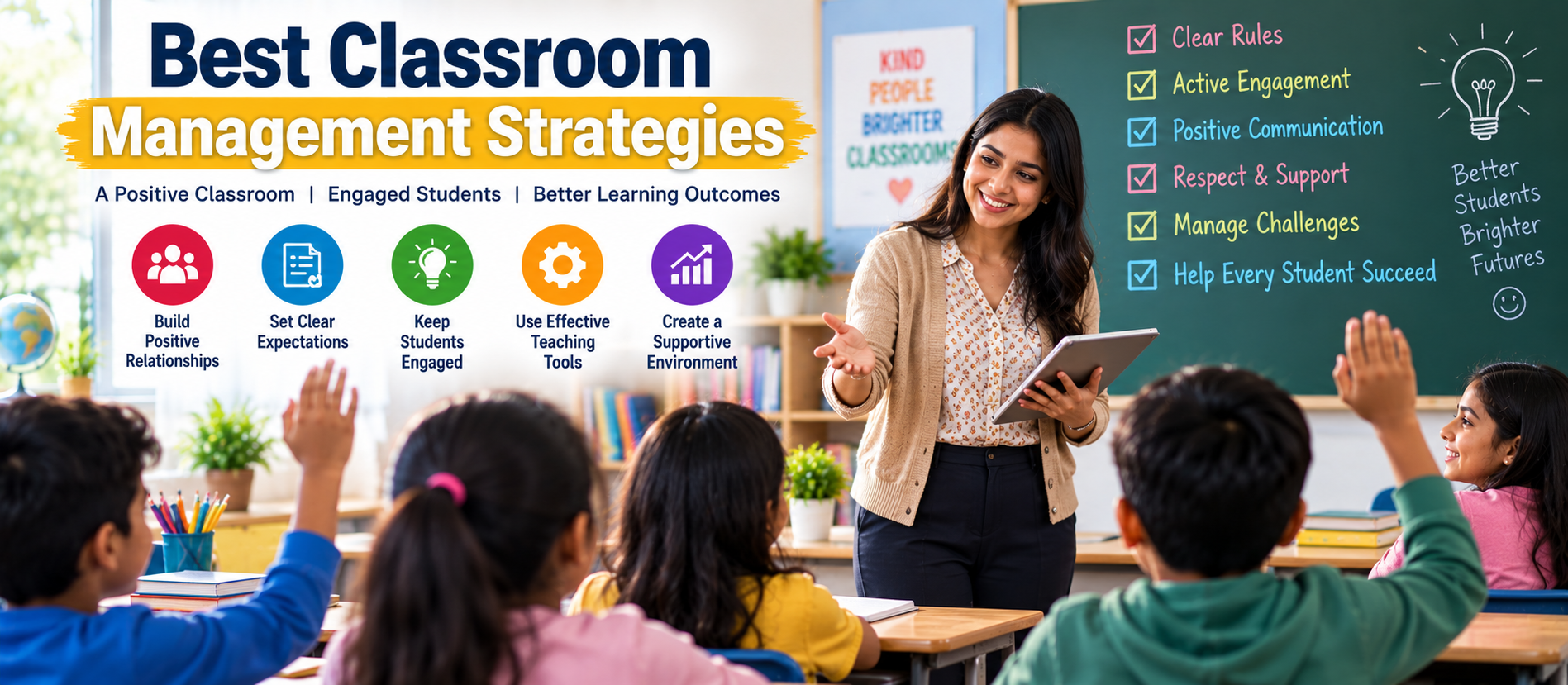
📋 Quick Summary
In this article:
Why Classroom Management Matters
1. Set Clear Classroom Expectations
2. Teach Routines Explicitly
3. Build Positive Teacher-Student Relationships
4. Use Positive Reinforcement
5. Create Engaging Lessons
6. Give Clear and Concise Instructions
7. Use Effective Classroom Seating
8. Manage Transitions Carefully
9. Monitor the Classroom Actively
10. Address Misbehavior Calmly and Consistently
Quick Answer: The best classroom management strategies create clear expectations, consistent routines, positive teacher-student relationships, active learning, fair consequences, and regular feedback. Effective classroom management is not about controlling every student. It is about creating a safe, organized, and engaging environment where students understand what to do and can focus on learning.
Good classroom management helps teachers spend less time dealing with disruptions and more time teaching. It also helps students feel secure because they know the rules, routines, and learning goals.
What Is Classroom Management?
Classroom management is the process of creating and maintaining an environment that supports learning. It includes classroom rules, routines, student behavior, lesson organization, communication, relationships, and responses to problems.
Strong classroom management does not mean that a classroom must always be silent. Students can discuss ideas, work in groups, ask questions, and move around when the activity requires it. The goal is productive behavior and focused learning.
Why Classroom Management Matters
A well-managed classroom gives students a predictable learning environment. Clear routines reduce confusion. Positive relationships can increase trust. Engaging lessons can reduce unnecessary off-task behavior.
Classroom management also protects teaching time. When procedures are clear, teachers do not need to repeat the same instructions throughout the day. Students gradually learn how to enter the classroom, start work, ask for help, transition between activities, and finish tasks.
1. Set Clear Classroom Expectations
Students need to know what behavior is expected. Rules should be short, clear, and easy to remember.
💡 Key Insight
Instead of creating a long list of rules, focus on a few important expectations. For example:
- Respect people and property.
- Listen when someone is speaking.
- Be ready to learn.
- Complete assigned work.
- Ask for help when you need it.
Explain what each expectation looks like in real situations. “Be respectful” can mean using appropriate language, allowing others to speak, and handling classroom materials carefully.
2. Teach Routines Explicitly
Do not assume students automatically know classroom procedures. Teach routines just as you teach academic content.
Show students how to enter the room, collect materials, submit work, use technology, move into groups, ask questions, and leave the classroom. Practice important routines until they become familiar.
Clear routines are especially useful at the beginning of a school term. They can also be retaught when a class returns from a long break or when a new procedure is introduced.
3. Build Positive Teacher-Student Relationships
Students are more likely to respond positively when they feel that their teacher knows them and treats them fairly. A strong relationship does not require becoming a student's friend. It requires respect, consistency, attention, and genuine interest.
Learn students' names. Listen to their questions. Notice effort. Give specific encouragement. Make time for brief positive interactions that are not connected to discipline.
A simple “I noticed you kept working even when that problem was difficult” can be more meaningful than general praise.
4. Use Positive Reinforcement
Positive reinforcement means recognizing behavior that supports learning. It can be verbal praise, feedback, classroom recognition, privileges, or other age-appropriate methods.
Be specific. Instead of saying “Good job,” explain what was effective: “Your group started the activity quickly and everyone had a role.” This helps students understand which behavior should continue.
Positive reinforcement should not become constant rewards for basic behavior. The long-term goal is for students to develop responsibility and self-management.
5. Create Engaging Lessons
Lesson design is an important part of classroom management. Students who are actively thinking, discussing, creating, solving problems, or practicing skills have fewer opportunities to become unnecessarily disengaged.
Use a mix of activities. Short explanations can be followed by questions, pair work, demonstrations, practice tasks, group activities, or reflection.
Give students clear learning goals. When learners understand what they are expected to achieve, it becomes easier to keep them focused.
6. Give Clear and Concise Instructions
Long instructions can create confusion. Give directions in small steps. Use simple language. Check that students understand what they need to do.
For a multi-step task, write the steps where students can see them. For example:
- Read the question.
- Discuss your answer with a partner.
- Write two supporting points.
- Submit your response.
Visual instructions can reduce the number of times a teacher needs to repeat directions.
7. Use Effective Classroom Seating
Seating can influence communication, movement, collaboration, and attention. There is no single seating arrangement that works for every class.
Rows may work well for individual tests or focused instruction. Groups can support collaboration. A semicircle can make discussion easier. Flexible seating can support different activities when appropriate.
Consider the lesson objective before choosing a seating arrangement. Also consider accessibility and the needs of individual learners.
8. Manage Transitions Carefully
Transitions are common moments for noise, confusion, and lost learning time. Plan them before the lesson begins.
⚠ Watch Out
Tell students what will happen next. Give a time limit. Use a consistent signal when students need to stop, move, or listen. Prepare materials before the transition whenever possible.
A simple routine such as “When the timer ends, return materials and face the board” can make transitions smoother.
9. Monitor the Classroom Actively
Teachers should not remain in one place throughout the lesson. Move around the classroom when appropriate. Look at student work. Check for understanding. Notice signs of confusion or disengagement.
Active monitoring allows teachers to address small problems before they become larger disruptions. It also communicates that the teacher is aware of what is happening across the room.
10. Address Misbehavior Calmly and Consistently
Disruptions should be addressed without unnecessary escalation. Use a calm voice. Focus on the behavior rather than attacking the student's character.
For minor problems, a non-verbal signal, proximity, brief reminder, or private conversation may be enough. For repeated or serious behavior, follow the school's established procedures.
Consistency matters. Students should understand that expectations apply fairly across the classroom.
11. Avoid Public Shaming
Correcting behavior does not require humiliating a student. Public embarrassment can damage trust and may increase conflict.
When possible, speak privately about repeated or sensitive behavior. Describe what happened, explain the expected behavior, and discuss the next step.
The goal of discipline should be to restore productive behavior and support learning, not simply to punish.
12. Use Restorative Conversations
When a student's behavior affects another person, a restorative conversation can help address the impact. Ask questions such as:
- What happened?
- Who was affected?
- What could have been done differently?
- What needs to happen next?
The exact approach should match the student's age, the situation, and the school's policies. Serious incidents may require additional support from school leadership or other professionals.
13. Encourage Student Responsibility
Classroom management becomes stronger when students take part in maintaining the learning environment. Give students appropriate responsibilities such as organizing materials, leading parts of activities, managing group roles, or reflecting on classroom routines.
Student responsibility should grow gradually. Clear boundaries are still important, but students can learn to make better choices instead of depending on the teacher to control every action.
14. Use Group Work with Clear Roles
Group activities can improve collaboration, but poorly structured group work can create noise and confusion. Give each group a clear task and time limit.
Roles can include discussion leader, note-taker, timekeeper, researcher, or presenter. Change roles over time so that students develop different skills.
Explain what successful group behavior looks like before the activity starts.
15. Use Technology with Clear Rules
Digital devices can support learning, but they can also create distractions. Establish simple rules for phones, tablets, laptops, and classroom software.
Tell students when devices should be used, what websites or applications are allowed, and what they should do when the activity ends.
Technology rules should support the learning objective rather than become a separate source of conflict.
16. Give Regular Feedback
Feedback helps students understand their progress. It also gives teachers information about whether their instructional approach is working.
Good feedback should be clear and actionable. Tell students what they did well and what they can improve. Avoid giving feedback that is so general that students do not know what to change.
17. Differentiate Classroom Management
Students do not all respond to the same strategy. Age, learning needs, communication styles, prior experiences, and classroom context can affect behavior.
Use flexible approaches while keeping core expectations consistent. Some students may benefit from visual schedules. Others may need shorter instructions, additional check-ins, movement opportunities, or structured choices.
When a behavior continues, ask what may be causing it. The answer may involve task difficulty, unclear instructions, peer dynamics, unmet learning needs, or another factor.
18. Communicate with Families When Needed
Family communication can support student success when it is respectful and focused on solutions. Do not contact families only when there is a problem. Positive updates can build a stronger partnership.
When discussing a concern, describe specific observations rather than making broad judgments about a student's character. Explain what has been tried and discuss practical next steps.
19. Reflect on Your Own Practice
Classroom management improves through reflection. After a difficult lesson, ask:
- Were the instructions clear?
- Was the activity appropriate for the class?
- Did students have enough opportunities to participate?
- Did the transition take too long?
- Was my response to behavior consistent?
- What can I change next time?
Small changes can produce meaningful improvements over time.
20. Build a Predictable Classroom Culture
The strongest classroom management systems are not based on constant correction. They are built around predictable routines, respectful relationships, meaningful learning, and consistent expectations.
Students should know what the classroom values. They should know what happens when problems occur. They should also know that mistakes are opportunities to learn and improve.
Simple Classroom Management Framework
| AreaPractical StrategyExpected Benefit | ||
| Expectations | Use a short list of clear rules | Less confusion |
| Routines | Teach and practice procedures | Smoother daily activities |
| Relationships | Use respectful communication | Greater trust |
| Lessons | Use active learning | Higher engagement |
| Transitions | Use signals and time limits | Less lost time |
| Behavior | Respond calmly and consistently | Fewer unnecessary conflicts |
| Feedback | Give specific, actionable feedback | Better student awareness |
| Reflection | Review what worked after lessons | Continuous improvement |
Classroom Management in Online and Hybrid Learning
Classroom management also matters in online and hybrid environments. Teachers need clear rules for participation, chat use, microphones, cameras, assignments, deadlines, and digital collaboration.
Online lessons should have predictable structures. Start with the learning goal. Explain the activity. Give students a clear task. Use short interaction periods. Check understanding regularly.
Digital learning also benefits from clear communication. Students should know where to find resources, how to submit work, and how to ask for help.
How AI Can Support Classroom Management
AI tools can assist teachers with lesson planning, activity ideas, differentiated resources, question generation, and administrative tasks. Some systems can also help organize learning data.
AI should be used carefully. Teachers should verify generated content, protect student information, and follow school policies. AI can support classroom management, but it cannot replace the teacher's understanding of students and classroom context.
Frequently Asked Questions
What is the most important classroom management strategy?
Clear expectations and consistent routines are a strong starting point. Students need to know what is expected and how daily classroom activities work.
How can teachers reduce classroom disruptions?
Use clear routines, engaging lessons, active monitoring, concise instructions, and calm responses to behavior. Also look for the reason behind repeated disruptions.
How can new teachers improve classroom management?
Start with a few clear rules and routines. Teach procedures explicitly. Plan transitions. Build relationships. Reflect after each lesson and make small improvements.
Should teachers use rewards for good behavior?
Appropriate recognition can reinforce useful behavior. However, students should gradually develop internal responsibility rather than depending entirely on rewards.
How can classroom management improve student engagement?
Clear expectations reduce confusion, while active lessons give students meaningful ways to participate. A respectful classroom climate can also make students more comfortable asking questions and sharing ideas.
Key Takeaways
- Set a small number of clear classroom expectations.
- Teach routines instead of assuming students know them.
- Build respectful teacher-student relationships.
- Design engaging lessons with active participation.
- Use clear instructions and well-planned transitions.
- Address behavior calmly and consistently.
- Avoid public shaming and focus on restoring productive behavior.
- Give students appropriate responsibility.
- Use technology with clear expectations.
- Reflect regularly and adjust your approach.
Final Thoughts
Effective classroom management is a continuous process. It combines structure with flexibility. Teachers need clear expectations, but they also need to understand that students have different needs and circumstances.
The goal is not to create a classroom where no one ever makes a mistake. The goal is to create a learning environment where students understand expectations, feel respected, stay engaged, and learn how to manage their own behavior.
Start with a few practical changes. Make routines clear. Improve transitions. Strengthen relationships. Design more active lessons. Respond to problems calmly. Then use reflection and feedback to improve your approach.
Digiifrog: Explore digital marketing, web development, content strategy, and AI-focused business solutions at www.digiifrog.com.
Ready to Grow?
Talk to us about a strategy tailored to your brand — we will help you stand out in search, AI discovery and social.

Comments (0)
Log in to leave a comment.