📋 Quick Summary
In this article:
Quick Answer: What Makes a Commercial Real Estate Market Strong?
What Is Commercial Real Estate?
Key Factors in the Best Commercial Real Estate Markets
1. Population Growth
2. Job Growth and Employment Diversity
3. Business Growth
4. Infrastructure and Transportation
5. Supply and Demand
6. Tenant Demand
Best Commercial Real Estate Sectors to Consider
Industrial and Logistics Real Estate
Choosing the best commercial real estate market requires careful research. A successful market is not always the largest or most famous city. Strong commercial real estate opportunities usually depend on business growth, employment, population trends, tenant demand, infrastructure, property supply, and local economic conditions.
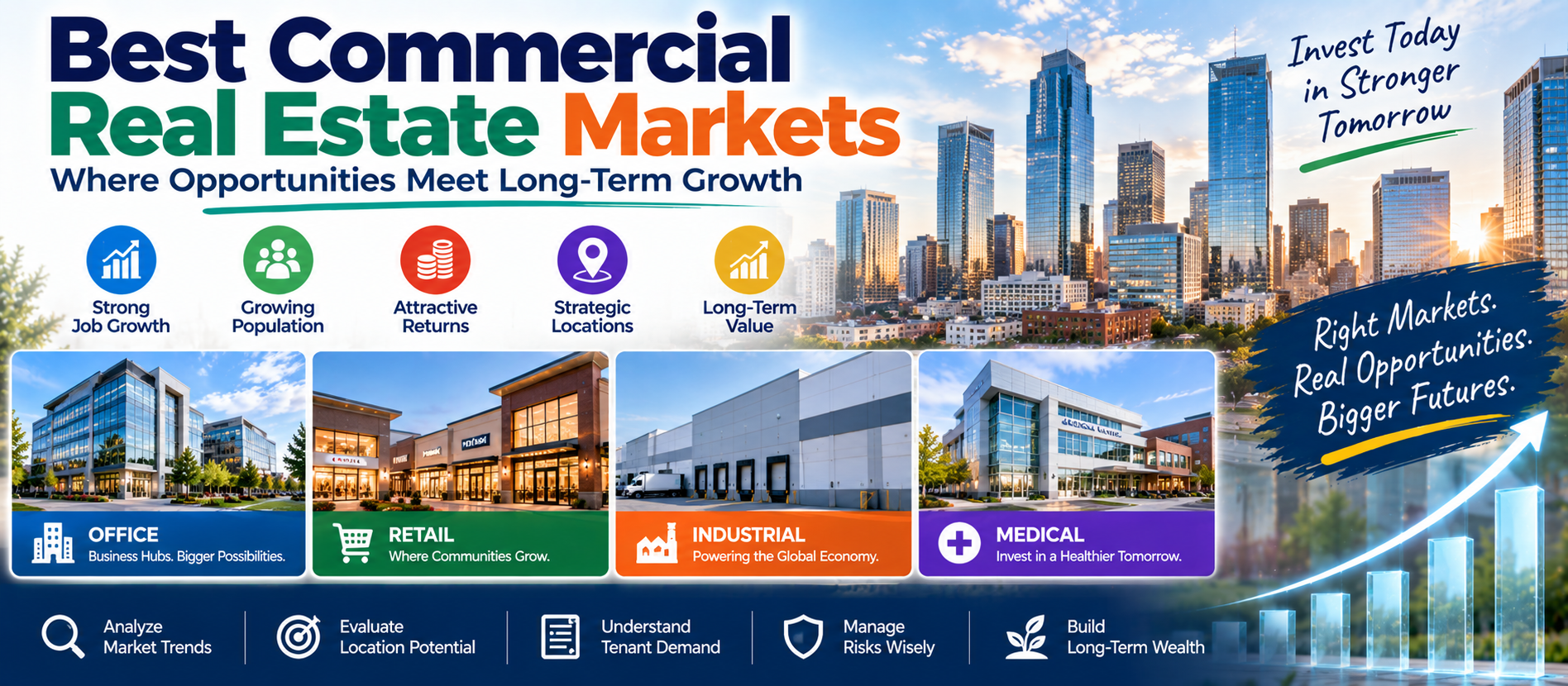
Commercial real estate includes office buildings, retail spaces, warehouses, industrial facilities, medical properties, mixed-use developments, and larger multifamily assets. Each sector has different demand drivers. Therefore, the best market for an industrial property may not be the best market for an office or retail investment.
This guide explains how to identify the best commercial real estate markets, what investors should analyze, and how to choose a location that matches their investment strategy.
Quick Answer: What Makes a Commercial Real Estate Market Strong?
A strong commercial real estate market generally has healthy economic activity, employment growth, sustainable tenant demand, reliable infrastructure, and a balanced level of property supply.
However, there is no single market that is best for every investor. The right location depends on your budget, property type, risk tolerance, financing strategy, and long-term goals.
What Is Commercial Real Estate?
Commercial real estate, also known as CRE, refers to property used primarily for business or income-producing purposes.
Major commercial property types include:
- Office properties: Buildings used by companies and professional organizations.
- Retail properties: Stores, restaurants, shopping centers, and customer-facing spaces.
- Industrial properties: Warehouses, manufacturing facilities, and logistics centers.
- Medical properties: Clinics, healthcare offices, and specialized facilities.
- Multifamily properties: Larger apartment communities that may be analyzed as commercial investments.
- Mixed-use properties: Buildings that combine residential, office, retail, or entertainment uses.
Why Market Selection Matters
A good building in the wrong location can struggle to attract tenants. For example, an industrial property may perform poorly without strong transportation access. A retail property may struggle if population growth and consumer activity are weak.
The market surrounding a property can influence:
- Rental income potential.
- Tenant demand.
- Vacancy risk.
- Operating costs.
- Property value.
- Financing opportunities.
- Future resale potential.
Investors should study both the individual property and the local market before making a decision.
Key Factors in the Best Commercial Real Estate Markets
1. Population Growth
Population growth can increase demand for commercial services. More residents may create additional needs for retail stores, healthcare, housing, logistics, and local businesses.
Population growth alone is not enough. Investors should also examine household income, employment opportunities, migration patterns, and long-term economic stability.
2. Job Growth and Employment Diversity
Employment growth can support commercial property demand. New jobs may increase demand for office space, housing, restaurants, retail, and business services.
Employment diversity is also important. A market that depends on only one industry may face greater risk during an industry slowdown. Cities with multiple strong industries may offer better economic stability.
3. Business Growth
New businesses and expanding companies can create demand for commercial space.
Investors should look for:
- Business formation.
- Corporate expansion.
- Startup activity.
- Growing industries.
- Local business investment.
4. Infrastructure and Transportation
Infrastructure plays a major role in commercial real estate performance.
💡 Key Insight
Important infrastructure includes highways, airports, rail networks, ports, public transportation, utilities, and reliable internet connectivity.
Industrial and logistics properties are especially dependent on transportation access. Retail properties often benefit from visibility, traffic, and easy customer access.
5. Supply and Demand
Strong demand does not always mean a market is a good investment opportunity. Investors must also consider new construction and competing properties.
Research:
- Current property inventory.
- Vacancy rates.
- New construction projects.
- Rental trends.
- Future development plans.
Too much new supply can create competition and place pressure on rental income.
6. Tenant Demand
Commercial property performance depends heavily on tenants. Investors should identify the likely tenant and determine whether that tenant base is growing.
For example, warehouses need logistics or distribution demand. Medical offices need suitable healthcare demand. Retail spaces need businesses that can attract customers.
Best Commercial Real Estate Sectors to Consider
Industrial and Logistics Real Estate
Industrial real estate includes warehouses, manufacturing facilities, and distribution centers.
Important demand factors include transportation access, supply chain activity, manufacturing growth, and proximity to major population centers.
Investors should also evaluate building features such as loading capacity, access roads, building layout, and functionality.
Retail Real Estate
Retail properties can include shopping centers, restaurants, standalone stores, and mixed-use spaces.
Strong retail locations often have population density, customer traffic, visibility, convenient access, and sustainable local demand.
Investors should carefully study consumer behavior and local competition before investing.
Office Real Estate
Office performance can vary significantly between cities and neighborhoods.
Important factors include local employment, major industries, transportation access, building quality, amenities, and tenant preferences.
Investors should avoid assuming that national office trends apply equally to every local market.
Medical Properties
Medical commercial properties may include clinics, healthcare offices, and specialized treatment facilities.
Demand may be influenced by population demographics, healthcare networks, community needs, and local medical services.
Multifamily Commercial Assets
Larger apartment properties may be evaluated using commercial investment methods.
Investors should study employment, population growth, household formation, rental affordability, operating costs, and new apartment construction.
How to Choose the Best Commercial Real Estate Market
Step 1: Define Your Investment Strategy
Before selecting a city, decide what you want to achieve.
Ask yourself:
- What property type do I want to own?
- How much capital can I invest?
- How much risk can I manage?
- Do I want income, appreciation, or both?
- How long do I plan to hold the property?
Your investment strategy should guide your market selection.
Step 2: Study Economic Growth
Research whether the region is gaining or losing residents, jobs, and businesses.
Important indicators include employment growth, population trends, industry development, infrastructure investment, and business expansion.
Step 3: Analyze Local Submarkets
A strong city can contain weak neighborhoods, while a growing district may offer opportunities inside an average city.
Compare local areas based on tenant demand, vacancy rates, rental levels, development activity, competition, and transportation access.
Step 4: Study Competition
Ask how many similar properties exist nearby and whether new developments are under construction.
Heavy competition can make it harder to attract tenants or increase rents.
Established Markets vs. Emerging Markets
Established Markets
Established markets usually have mature infrastructure, large business communities, and well-developed commercial districts.
Advantages may include more market data, stronger tenant demand, professional service networks, and potentially greater liquidity.
However, acquisition prices and competition may also be higher.
Emerging Markets
Emerging markets may experience new business investment, population growth, or major infrastructure development.
They can offer opportunities, but growth should be supported by real economic and tenant demand. Investors should not assume that every fast-growing location will produce strong returns.
Primary, Secondary, and Smaller Markets
Large metropolitan areas receive significant attention, but secondary and smaller markets can also offer opportunities.
Primary markets may provide broad tenant demand and strong infrastructure.
Secondary markets may offer lower acquisition costs and growing populations or industries.
Smaller markets may have less competition, but they can also have fewer tenants and buyers.
The best choice depends on your property type and investment strategy.
Rental Income Is Not the Only Number That Matters
High rent does not automatically mean high profit.
Investors should compare rental income with:
- Purchase price.
- Property taxes.
- Insurance.
- Maintenance costs.
- Management fees.
- Loan payments.
- Vacancy risk.
- Capital improvements.
A market with lower rental rates may sometimes offer a better relationship between property cost and income.
Understanding Vacancy Risk
Vacancy is a major commercial real estate risk. When a commercial tenant leaves, finding a replacement can take time, especially for specialized properties.
Before investing, ask:
- Who is the likely tenant?
- How many potential tenants operate in the area?
- How long do similar spaces remain vacant?
- How much new supply is coming to the market?
Location Is More Important Than National Rankings
National rankings can be useful for broad research, but commercial real estate is highly local.
A metropolitan area may have a growing industrial district while another part of the same city has weak office demand or excess retail supply.
Investors should move from broad regional research to city, neighborhood, and property-level analysis.
Important Geographic Factors to Compare
- Population trends.
- Employment growth.
- Major industries.
- Business activity.
- Infrastructure.
- Transportation access.
- Property taxes.
- Insurance costs.
- Local regulations.
- Construction activity.
These factors can vary significantly from one location to another.
Common Mistakes to Avoid
Following Popular Rankings Without Research
A market may appear attractive in a ranking but still be unsuitable for your property type or budget.
Ignoring Property Type Differences
A strong industrial market does not automatically mean office or retail properties will perform well.
Focusing Only on Population Growth
Population growth should be analyzed alongside jobs, income, infrastructure, supply, and tenant demand.
Ignoring New Construction
Future property supply can affect occupancy and rental growth.
Underestimating Regulations and Costs
Zoning, taxes, insurance, building requirements, and operating expenses can significantly affect investment performance.
A Simple Commercial Real Estate Market Scorecard
| Factor Question to Ask | |
| Population | Is the local population growing? |
| Employment | Are jobs increasing and industries diversified? |
| Tenant Demand | Who needs this type of property? |
| Vacancy | How much competing space is available? |
| New Supply | How much construction is planned? |
| Infrastructure | Does the location have strong transportation and utilities? |
| Costs | What are taxes, insurance, and maintenance expenses? |
| Regulations | Do local rules support the investment strategy? |
Due Diligence Before Buying
After selecting a market, investors must carefully evaluate the individual property.
Important due diligence may include:
- Building inspections.
- Lease review.
- Tenant analysis.
- Income verification.
- Operating expense review.
- Zoning review.
- Title and legal review.
- Financing analysis.
Commercial real estate transactions can be complex. Qualified legal, financial, tax, engineering, and real estate professionals can provide important guidance.
SEO, AEO, GEO, and AI Search Optimization
This article is designed to answer questions about best commercial real estate markets using clear and direct language.
For SEO, relevant topics include commercial real estate investment markets, best cities for commercial property, and how to choose a commercial real estate market.
For AEO, this guide directly answers common questions about choosing strong commercial markets, evaluating property sectors, and comparing locations.
For GEO and AI Search optimization, the article highlights geographic factors such as population, employment, infrastructure, local regulations, property supply, operating costs, and tenant demand.
Frequently Asked Questions
What makes a commercial real estate market attractive?
A strong market usually has healthy economic activity, employment growth, tenant demand, reliable infrastructure, and a balanced level of property supply.
Which commercial real estate sector is best?
No single sector is best everywhere. Industrial, retail, office, medical, and multifamily properties have different demand drivers and risks.
How do I choose a commercial real estate market?
Define your investment strategy and compare population, employment, tenant demand, vacancy, new construction, infrastructure, costs, and local regulations.
Are emerging markets good for commercial real estate?
Emerging markets can offer opportunities, but they may also involve greater uncertainty. Investors should confirm that growth is supported by sustainable economic and tenant demand.
Why is location important in commercial real estate?
Location affects tenant demand, transportation access, visibility, operating costs, competition, and future resale potential.
Final Thoughts
The best commercial real estate markets are those where a specific property type matches real and sustainable local demand.
Investors should study population trends, employment, industries, infrastructure, vacancy, property supply, operating costs, regulations, and tenant demand before choosing a market.
A disciplined approach starts with broad regional research and moves toward detailed local analysis.
Commercial real estate can create income and long-term growth opportunities, but every investment carries risk. Careful due diligence and realistic financial analysis are necessary before making a purchase.
For more useful information about real estate, business, technology, SEO, AEO, GEO, and AI Search optimization, visit www.digiifrog.com.
Disclaimer
This article provides general educational information only and is not financial, investment, legal, tax, mortgage, or real estate advice. Commercial real estate investments involve risk, and results depend on location, financing, tenant demand, operating costs, regulations, and market conditions. Consult qualified professionals before making investment decisions.
Ready to Grow?
Talk to us about a strategy tailored to your brand — we will help you stand out in search, AI discovery and social.


Comments (0)
Log in to leave a comment.