📋 Quick Summary
In this article:
Why Small Businesses Need Digital Marketing Tools
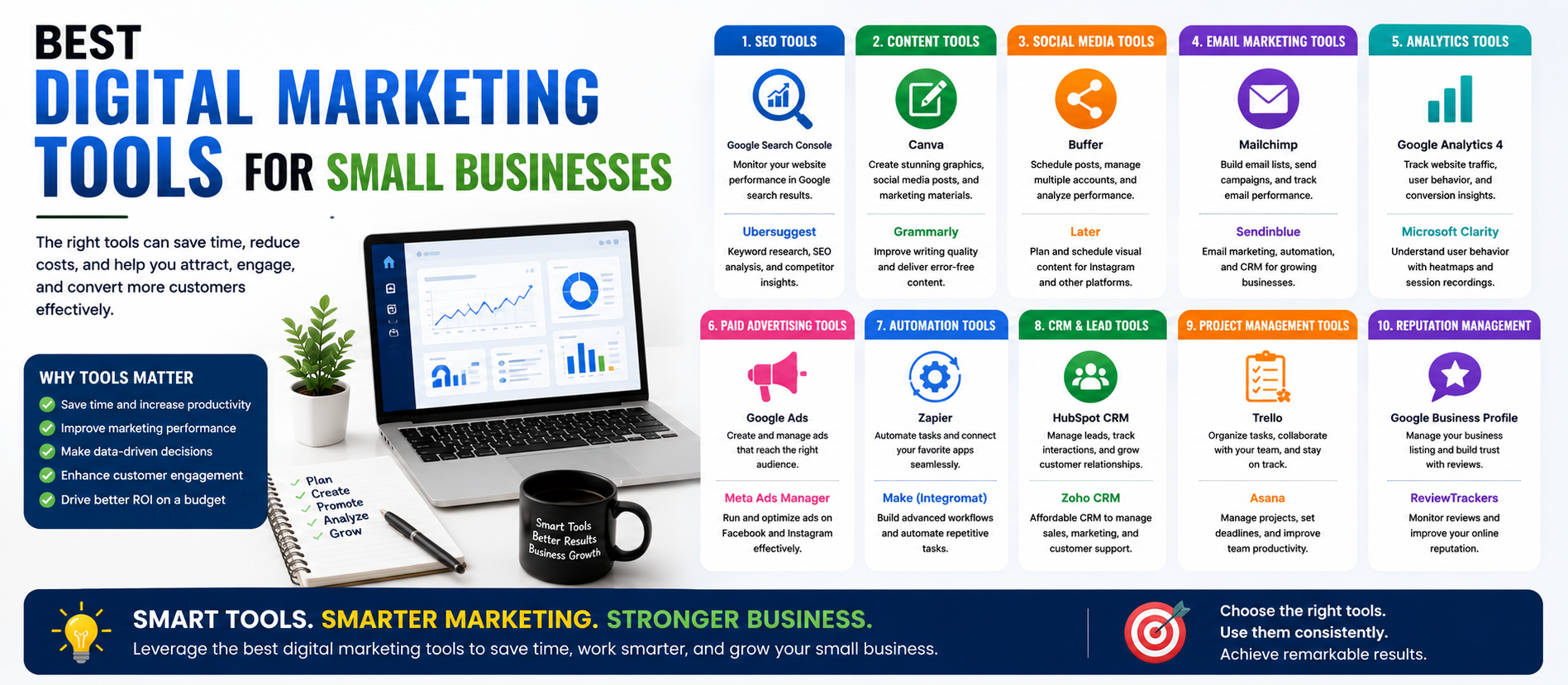
1. Google Analytics 4 (GA4)
2. Google Search Console
3. ChatGPT and AI Content Assistants
4. Canva
5. Semrush
6. Ahrefs
7. HubSpot CRM
8. Mailchimp
9. Buffer
10. Hootsuite
11. Grammarly
In 2026, digital marketing has become more competitive, data-driven, and AI-powered than ever before. Small businesses can no longer rely solely on word-of-mouth referrals or traditional advertising methods to generate consistent growth. Instead, they must leverage modern digital marketing tools that help attract customers, improve visibility, automate repetitive tasks, and increase revenue.
The good news is that today's digital marketing ecosystem offers powerful tools for businesses of every size. Whether you are managing a local business, eCommerce store, startup, consultancy, or service-based company, the right marketing tools can significantly improve your efficiency and results.
This comprehensive guide explores the best digital marketing tools for small businesses in 2026 while covering SEO, AEO, GEO, AI Search Optimization, content marketing, social media management, analytics, email marketing, automation, and customer relationship management.
Why Small Businesses Need Digital Marketing Tools
Modern consumers research products online, compare options, read reviews, watch videos, and often interact with AI-powered search platforms before making buying decisions. Managing all these touchpoints manually is nearly impossible.
Digital marketing tools help businesses streamline operations, improve customer experiences, monitor performance, generate leads, and scale growth efficiently.
Benefits include:
- Improved productivity
- Better customer targeting
- Enhanced online visibility
- Data-driven decision making
- Automated marketing workflows
- Higher conversion rates
- Reduced marketing costs
1. Google Analytics 4 (GA4)
Analytics remains the foundation of successful marketing. Google Analytics 4 helps businesses understand visitor behavior, traffic sources, conversions, and customer journeys.
Key Features:
- Website traffic tracking
- Conversion measurement
- Audience insights
- Cross-device reporting
- AI-powered predictive metrics
Small businesses can use GA4 to identify which marketing channels generate the highest ROI.
2. Google Search Console
💡 Key Insight
Search visibility remains essential in 2026. Google Search Console helps businesses monitor organic search performance, keyword rankings, indexing status, and technical SEO issues.
Benefits include:
- Search performance monitoring
- Indexing diagnostics
- Technical SEO insights
- Mobile usability reports
- Core Web Vitals tracking
3. ChatGPT and AI Content Assistants
Artificial intelligence has transformed content creation. AI tools help businesses generate ideas, create drafts, optimize content structures, improve customer communication, and support content research.
When combined with human expertise, AI tools significantly improve efficiency while maintaining quality.
4. Canva
Visual content remains critical for marketing success. Canva enables small businesses to create professional graphics, presentations, social media posts, advertisements, infographics, and marketing materials without advanced design skills.
Popular use cases include:
- Facebook creatives
- Instagram posts
- YouTube thumbnails
- Business presentations
- Marketing brochures
5. Semrush
Semrush continues to be one of the most comprehensive digital marketing platforms available. It provides SEO, content marketing, keyword research, competitive analysis, and advertising intelligence.
Small businesses can use Semrush to discover new opportunities and monitor competitors effectively.
6. Ahrefs
Ahrefs remains a leading SEO platform focused on backlinks, keyword research, content opportunities, and website audits.
Key advantages include:
- Backlink analysis
- Keyword research
- Content gap analysis
- Competitor monitoring
- SEO audits
7. HubSpot CRM
Customer relationship management is essential for growing businesses. HubSpot CRM helps manage leads, contacts, sales pipelines, and customer communications from a centralized platform.
Benefits include improved lead tracking, sales visibility, and customer engagement.
8. Mailchimp
Email marketing continues delivering exceptional returns on investment. Mailchimp helps businesses build email lists, automate campaigns, segment audiences, and track performance.
Effective email marketing supports customer retention and long-term growth.
9. Buffer
Social media management can be time-consuming. Buffer simplifies scheduling, publishing, and monitoring social content across multiple platforms.
Features include:
- Content scheduling
- Performance analytics
- Multi-platform publishing
- Team collaboration
10. Hootsuite
Hootsuite offers comprehensive social media management capabilities. Businesses can manage conversations, monitor brand mentions, schedule posts, and analyze engagement from a single dashboard.
11. Grammarly
High-quality communication remains essential. Grammarly helps businesses improve grammar, clarity, readability, and professionalism across emails, blog posts, landing pages, and social media content.
12. Notion
Content planning and team collaboration are easier with Notion. Businesses use it to manage projects, content calendars, SOPs, workflows, and marketing strategies.
13. Trello
Trello provides simple project management functionality. Marketing teams can organize campaigns, track progress, assign tasks, and maintain productivity.
14. Zapier
Automation has become increasingly important. Zapier connects hundreds of applications and automates repetitive workflows without coding.
Examples include:
- Lead capture automation
- Email notifications
- CRM synchronization
- Social publishing workflows
15. Hotjar
Understanding website behavior is crucial. Hotjar provides heatmaps, user recordings, surveys, and feedback tools that reveal how visitors interact with websites.
These insights help improve conversion rates and user experiences.
16. Yoast SEO
For WordPress users, Yoast SEO remains a valuable plugin for optimizing content, metadata, readability, and technical SEO elements.
17. Rank Math
Rank Math offers advanced SEO functionality including schema markup, AI-assisted optimization, keyword tracking, and technical SEO improvements.
18. Google Business Profile
Local businesses should prioritize Google Business Profile optimization. It improves local visibility, review management, map rankings, and customer discovery.
Local SEO remains one of the highest ROI strategies for small businesses.
19. Loom
Loom enables businesses to create quick video explanations, tutorials, client updates, and internal communications. Video communication often improves clarity and engagement.
20. AI Search Optimization Tools
As AI search platforms become more influential, businesses need tools that help optimize content for AI-generated responses.
Modern AI Search Optimization focuses on:
- Structured content
- Authority building
- Entity optimization
- Topical relevance
- Trust signals
- Answer-focused content
The Growing Importance of AEO
Answer Engine Optimization (AEO) is becoming increasingly important because users want direct answers rather than browsing multiple websites.
Businesses should create content that clearly answers common customer questions while utilizing FAQ structures, schema markup, and concise explanations.
The Rise of GEO
Generative Engine Optimization (GEO) focuses on helping AI systems understand, trust, and reference business content.
Successful GEO strategies emphasize:
- Expert content creation
- Brand authority
- Reliable information
- Comprehensive topic coverage
- Strong online reputation
Building the Ideal Marketing Stack
A typical small business marketing stack in 2026 may include:
- Google Analytics 4 for analytics
- Google Search Console for SEO monitoring
- ChatGPT for content assistance
- Canva for design
- Semrush or Ahrefs for SEO research
- HubSpot CRM for customer management
- Mailchimp for email marketing
- Buffer or Hootsuite for social media
- Zapier for automation
- Hotjar for conversion optimization
Future Trends in Digital Marketing Tools
The future of digital marketing tools will be heavily influenced by artificial intelligence, predictive analytics, automation, personalization, conversational interfaces, and AI-powered search experiences.
Businesses that adopt emerging technologies early often gain substantial competitive advantages.
Conclusion
Digital marketing success in 2026 requires more than creativity alone. Small businesses need the right combination of technology, strategy, data, and execution.
Tools such as Google Analytics, Search Console, Canva, Semrush, Ahrefs, HubSpot, Mailchimp, Buffer, Zapier, and AI-powered platforms help organizations improve efficiency and achieve sustainable growth.
As SEO evolves into AI Search Optimization, AEO, and GEO, businesses must adapt their strategies to remain visible in both traditional and AI-powered discovery systems.
Digiifrog helps businesses navigate this evolving landscape through advanced SEO, AEO, GEO, AI Search Optimization, content marketing, and performance-driven digital marketing solutions.
Website: www.digiifrog.com
Whether you are a startup, local business, or growing brand, Digiifrog can help you build a stronger digital presence and achieve measurable business growth in 2026 and beyond.
Ready to Grow?
Talk to us about a strategy tailored to your brand — we will help you stand out in search, AI discovery and social.
Comments (0)
Log in to leave a comment.