📋 Quick Summary
In this article:
1. Start With the Official Syllabus
2. Understand the Exam Pattern
3. Set a Realistic Preparation Timeline
4. Create a Weekly Study Plan
5. Choose Study Materials Carefully
6. Build Strong Concepts
7. Use Active Learning
8. Solve Previous-Year Question Papers
9. Take Regular Mock Tests
10. Maintain a Mistake Notebook
11. Improve Accuracy Before Speed
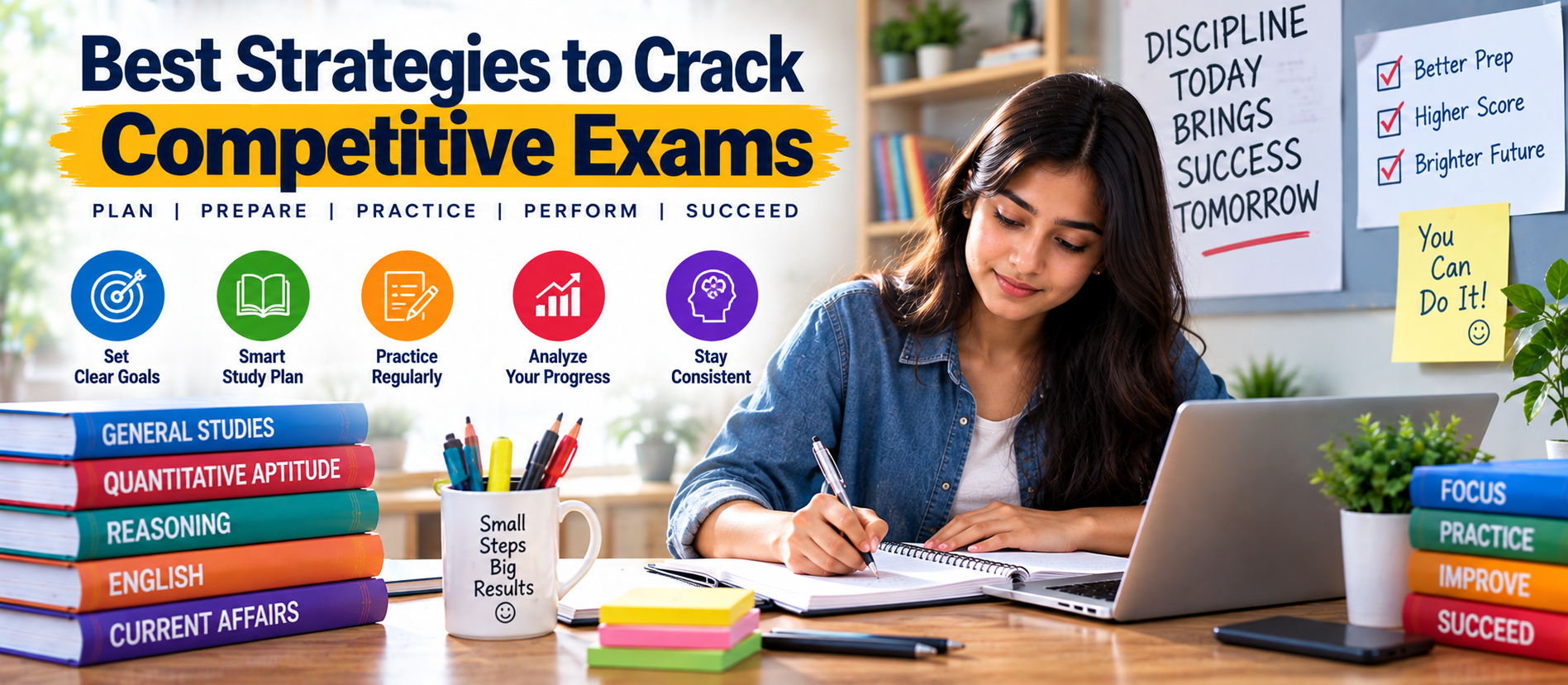
Quick Answer: The best strategies to crack competitive exams include understanding the official syllabus, creating a realistic study plan, building strong concepts, solving previous-year papers, taking mock tests, analyzing mistakes, revising regularly, and improving time management. Success depends on consistent and focused preparation, not simply studying for long hours.
Competitive exams can be challenging because they combine a large syllabus with limited time and strong competition. Many students work hard but do not see the expected improvement because their study method is not organized. A clear preparation system can make the process more manageable.
Why a Strategy Matters
Competitive exams test more than memory. Depending on the examination, candidates may need knowledge, reasoning, calculation, reading ability, accuracy, speed, decision-making, and the ability to remain focused under pressure.
A useful preparation cycle is simple: understand, learn, practice, test, analyze, revise, and repeat. This approach helps you identify weak areas instead of studying everything in the same way.
1. Start With the Official Syllabus
The official syllabus should be the foundation of your preparation. Divide it into subjects, units, and smaller topics. Then identify topics that are strong, average, weak, or completely unfamiliar to you.
This gives you a realistic picture of your preparation. It also prevents you from spending most of your time on topics you already know well.
2. Understand the Exam Pattern
Check the latest official information about the number of questions, marks, duration, sections, question types, negative marking, and stages of the exam.
Knowing the pattern changes how you practice. For example, an exam with negative marking requires careful attempt selection. An exam with multiple stages requires a longer preparation plan.
Do not rely only on old videos or social media posts for important examination rules. Verify dates, eligibility, syllabus changes, and instructions from the official source.
3. Set a Realistic Preparation Timeline
Divide your preparation into phases. The first phase can focus on concepts. The next phase can focus on practice. Later, move toward mock tests and intensive revision.
4. Create a Weekly Study Plan
Plan weekly outcomes instead of only counting study hours. For example, set targets such as completing two mathematics topics, revising one reasoning unit, solving practice sets, and taking a mock test.
Keep some flexible time. Difficult topics may require more time than expected. A flexible plan can absorb these changes without disrupting your entire schedule.
5. Choose Study Materials Carefully
Too many resources can create confusion. Choose a limited set of reliable books, courses, question banks, and test series.
- One main learning resource per subject.
- Previous-year question papers.
- A reliable practice source.
- Mock tests.
- Your own short revision notes.
Do not change resources constantly. Complete useful material before adding more.
6. Build Strong Concepts
Conceptual understanding is important because competitive exams can present familiar ideas in unfamiliar ways.
For each topic, first understand the basic idea. Learn the rules or formulas. Study examples. Then solve questions without looking at the solution.
If you cannot explain a concept in simple words, review it again before moving to difficult questions.
7. Use Active Learning
Active learning requires you to recall and use information. It is more useful than repeatedly reading the same page without testing yourself.
- Explain a topic from memory.
- Solve questions before checking answers.
- Create short summaries.
- Use flashcards for facts and formulas.
- Teach difficult concepts to someone else.
- Test yourself after completing a topic.
8. Solve Previous-Year Question Papers
After solving a paper, analyze your answers. Separate questions into correct, slow, incorrect because of concepts, incorrect because of careless errors, and unanswered because of time pressure.
This analysis is often more valuable than the score itself.
9. Take Regular Mock Tests
Mock tests help you practice the real exam experience. They can improve time allocation, question selection, concentration, and confidence.
Start with topic or sectional tests during early preparation. Add full-length tests as your syllabus coverage improves.
Always analyze your mock tests. Check your score, accuracy, time spent, unanswered questions, and repeated mistakes.
10. Maintain a Mistake Notebook
Record important mistakes and write why they happened. Useful categories include concept errors, calculation errors, memory errors, careless mistakes, reading mistakes, and time-management problems.
Review the notebook regularly. The purpose is not to collect mistakes. The purpose is to stop repeating them.
11. Improve Accuracy Before Speed
Many students try to solve questions faster before they can solve them correctly. This can increase careless errors.
First build accuracy. Once a question type becomes reliable, introduce timed practice. Gradually reduce the time while maintaining accuracy.
For exams with negative marking, understand the marking rules and practice sensible question selection.
12. Develop Time Management Skills
Time management should be practiced before exam day. Use a timer during question sets and mock tests.
⚠ Watch Out
Learn which questions you can solve quickly and which ones require more time. If the examination allows flexible question selection, avoid getting stuck on a single difficult question.
Use your mock tests to experiment with section order and time allocation.
13. Use Spaced Revision
Do not wait until the final week to revise everything. Review important information at regular intervals.
- Learn the topic.
- Practice it soon after learning.
- Review it after a few days.
- Test yourself later.
- Include it in full-syllabus revision.
Repeated recall is especially useful for formulas, facts, definitions, vocabulary, and other information that can be forgotten over time.
14. Create Short Revision Notes
Revision notes should be shorter than your main study material. Include formulas, definitions, key facts, difficult concepts, common mistakes, and useful reminders.
Use headings, bullets, tables, and simple diagrams where useful. The goal is quick revision, not rewriting an entire textbook.
15. Balance Strong and Weak Subjects
Weak subjects need extra attention, but strong subjects also require regular practice. Otherwise, performance in strong areas can decline.
Divide your week between difficult topics, regular practice, and maintenance revision. If a topic remains difficult after repeated study, change your learning method. Try simpler examples, another explanation, or additional guided practice.
16. Practice Reading and Comprehension
Reading ability can affect performance in many competitive exams. Practice understanding questions quickly and accurately.
Read the question carefully. Identify what it is asking before solving it. In comprehension passages, base your answer on the information provided unless the question requires outside knowledge.
17. Prepare Current Affairs Strategically
If your exam includes current affairs, use a consistent study system. Do not attempt to memorize every news story.
Organize notes into categories relevant to your exam, such as national events, international events, economy, science, technology, awards, sports, appointments, and government initiatives.
Check the official syllabus to understand the expected scope and time period.
18. Protect Your Concentration
Digital distractions can reduce study quality. Turn off unnecessary notifications during focused sessions. Keep distracting apps away from your study environment when possible.
If you need a phone for educational content, prepare the required material before starting. This reduces unnecessary switching between apps.
19. Follow a Healthy Routine
Competitive exam preparation is a long process. Sleep, food, movement, and rest should be part of the plan.
Maintain a regular sleep routine when possible. Eat balanced meals and include physical activity. Take short breaks during long study sessions.
Do not make sleep deprivation a permanent study strategy. Good preparation needs sustained concentration.
20. Manage Exam Stress
Some stress is common during exam preparation. A structured routine can make it easier to manage.
Break large goals into smaller tasks. Track progress. Take planned breaks. Avoid comparing your preparation with every candidate you see online.
If stress becomes severe or significantly affects daily life, seek support from a trusted person or qualified professional.
Give your study method enough time to produce measurable results. Change it when your performance data shows a problem, not simply because someone else follows a different routine.
💡 Key Insight
However, AI output can contain errors. Verify important facts with trusted educational resources and official examination information.
Use AI as a learning assistant. Do not use it as a replacement for solving questions yourself.
- Topics completed.
- Questions solved.
- Accuracy percentage.
- Mock-test scores.
- Average time per question.
- Repeated mistakes.
- Revision cycles completed.
If your study hours increase but your test scores do not improve, review your method. You may need more practice, stronger concepts, better revision, or improved question selection.
Avoid rebuilding your entire preparation from the beginning. Use the final weeks to improve accuracy, speed, confidence, and exam execution.
25. Prepare for Exam Day
Check the official examination instructions before the test. Confirm reporting time, required documents, permitted items, and other rules.
During the exam, read instructions carefully. Follow the attempt strategy you practiced in mock tests. Do not let one difficult question disturb your overall pace.
Common Competitive Exam Preparation Mistakes
- Starting without understanding the syllabus.
- Ignoring the latest official notification.
- Collecting too many books and courses.
- Studying only comfortable subjects.
- Reading without solving enough questions.
- Taking mock tests without analyzing them.
- Trying to increase speed before accuracy.
- Leaving revision until the final days.
- Studying for very long hours without proper rest.
- Changing strategy too frequently.
- Depending on unverified online information.
Frequently Asked Questions
What is the best strategy to crack a competitive exam?
Start with the official syllabus and exam pattern. Build strong concepts, practice regularly, solve previous-year papers, take mock tests, analyze mistakes, revise repeatedly, and improve time management.
How many hours should I study every day?
There is no universal number. Study time depends on your exam date, current preparation, syllabus, and responsibilities. Focus on productive and consistent study.
Are previous-year question papers important?
Yes. They help you understand question styles, topic coverage, difficulty, and time requirements. They are useful for both practice and analysis.
When should I start mock tests?
You can begin with topic or sectional tests once you have enough material to practice. Add full-length tests as your syllabus coverage improves.
How can I improve exam speed?
Build accuracy first. Then use timed practice, repeated question types, mock tests, and better question selection to improve speed.
What should I do if I forget topics quickly?
Use active recall and spaced revision. Test yourself instead of only rereading. Keep short notes and review difficult topics regularly.
Should I use many books for one subject?
Usually, a small number of reliable resources is enough. Complete your main resource first and use additional sources only when you need another explanation or more practice.
Can AI help with competitive exam preparation?
Yes. AI can explain concepts, create practice questions, summarize notes, and help organize study tasks. Important facts and official exam information should still be verified independently.
Key Takeaways
- Start with the official syllabus and examination pattern.
- Create a realistic weekly study plan.
- Use a limited set of reliable resources.
- Understand concepts before depending on memorization.
- Practice questions regularly.
- Solve and analyze previous-year papers.
- Take mock tests and review mistakes.
- Build accuracy before focusing heavily on speed.
- Use spaced revision and short notes.
- Protect sleep, health, and concentration.
- Use AI as an assistant and verify important information.
- Measure progress through scores, accuracy, timing, and repeated errors.
Final Thoughts
Cracking a competitive exam is not only about studying harder. It is about studying with a system. Start with the syllabus. Understand the exam pattern. Build concepts. Practice questions. Analyze mistakes. Take mock tests. Revise regularly. Improve accuracy and then work on speed.
Your strategy should change as your preparation develops. Early preparation should focus on learning. The middle stage should focus on practice and correction. The final stage should focus on revision, testing, confidence, and exam execution.
Do not measure your preparation only by the number of hours you spend at your desk. Measure what you can remember, what you can solve, how accurately you can solve it, and how well you perform under time pressure.
With a realistic plan, reliable resources, regular testing, and consistent effort, competitive exam preparation can become a structured process rather than an endless cycle of stress.
Digiifrog: Explore digital marketing, web development, content strategy, and AI-focused business solutions at www.digiifrog.com.
Ready to Grow?
Talk to us about a strategy tailored to your brand — we will help you stand out in search, AI discovery and social.

Comments (0)
Log in to leave a comment.