📋 Quick Summary
In this article:
What Is Supply Chain Optimization?
Why Supply Chain Optimization Matters
1. Build a Reliable Demand Forecasting Process
2. Optimize Inventory Levels
3. Improve Supplier Selection and Management
4. Strengthen Supplier Collaboration
5. Use Total Cost of Ownership Instead of Price Alone
6. Increase End-to-End Supply Chain Visibility
7. Optimize Warehouse Operations
8. Improve Transportation and Logistics Planning
9. Reduce Lead Times
10. Standardize Supply Chain Processes
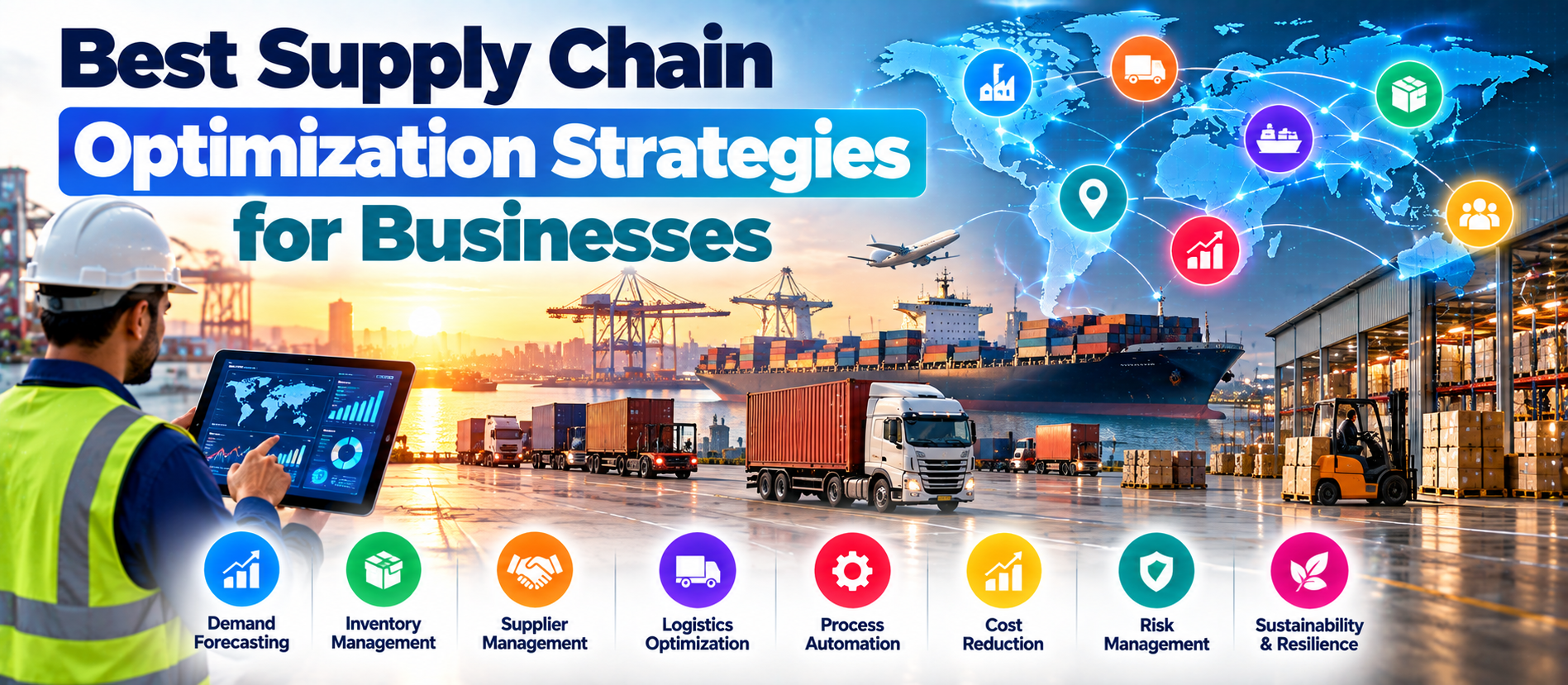
A strong supply chain helps a business deliver the right product, at the right time, at the right cost. A weak supply chain creates delays, excess inventory, stockouts, rising transportation costs, supplier problems, and unhappy customers.
That is why supply chain optimization has become a strategic business priority. Companies are no longer optimizing only for the lowest purchase price. They also need speed, visibility, resilience, flexibility, service quality, and better use of data.
In 2026, supply chain technology is moving toward more connected and intelligent operations. Gartner identifies agentic AI, physical AI, collaborative multi-agent systems, intelligent simulation, specialized AI models, and stronger trust and governance as major supply chain technology trends.
At the same time, businesses are dealing with changing demand, supplier risk, geopolitical uncertainty, labor constraints, transportation disruption, and increasing customer expectations. The best strategy is therefore not a single technology project. It is a coordinated improvement program across planning, procurement, inventory, production, warehousing, transportation, and customer delivery.
What Is Supply Chain Optimization?
Supply chain optimization is the process of improving the flow of products, information, money, and decisions from suppliers to customers while balancing cost, service, speed, inventory, capacity, and risk.
The goal is not simply to reduce cost. A business that cuts inventory too aggressively may reduce holding costs but increase stockouts. A company that chooses the cheapest supplier may increase disruption risk. A logistics team that always selects the lowest-cost transport option may create longer delivery times.
Effective optimization finds the right balance.
Why Supply Chain Optimization Matters
Supply chain performance affects almost every part of a business. Procurement affects input costs. Inventory affects working capital. Transportation affects delivery speed. Warehousing affects order accuracy. Supplier performance affects production. Customer delivery affects revenue and retention.
IBM describes supply chain planning as the coordination of demand forecasting, inventory, production, procurement, and resources so businesses can meet demand efficiently while remaining flexible when conditions change.
Optimization can help businesses:
- Reduce unnecessary operating costs
- Lower excess inventory
- Reduce stockouts
- Improve forecast accuracy
- Increase supplier reliability
- Improve warehouse productivity
- Reduce transportation waste
- Improve order fulfillment
- Increase supply chain visibility
- Respond faster to disruptions
- Improve working-capital efficiency
- Deliver a better customer experience
1. Build a Reliable Demand Forecasting Process
Demand forecasting is one of the foundations of supply chain optimization. If demand estimates are wrong, purchasing, production, inventory, staffing, and transportation decisions can also be wrong.
Businesses should combine historical sales with current market information. Useful inputs can include seasonality, promotions, customer behavior, product lifecycle, pricing changes, regional demand, economic indicators, and known business events.
Do not rely on one forecast for every product. High-volume products, seasonal products, new products, and slow-moving products often need different forecasting methods.
AI and machine learning can improve forecasting by analyzing large volumes of data and detecting patterns that are difficult to identify manually. IBM notes that AI-enabled planning can analyze real-time data, evaluate scenarios, identify potential shortages, and recommend adjustments to inventory or sourcing strategies.
2. Optimize Inventory Levels
Inventory is necessary, but excess inventory ties up cash and creates storage, insurance, handling, damage, and obsolescence costs.
Too little inventory creates another problem. Customers may face stockouts, production may stop, and urgent shipments may become necessary.
Businesses should optimize:
- Safety stock
- Reorder points
- Minimum and maximum inventory levels
- Economic order quantities
- Lead-time assumptions
- Service levels
- Slow-moving and obsolete inventory
- Inventory location
Inventory should also be segmented. An ABC analysis can help businesses focus attention on high-value or high-impact items. Critical components may require a different policy from low-value consumables.
3. Improve Supplier Selection and Management
A supply chain is only as reliable as its supplier network. Supplier optimization should therefore go beyond purchase price.
Evaluate suppliers using factors such as:
- Quality
- Delivery reliability
- Lead time
- Total cost
- Capacity
- Financial stability
- Geographic exposure
- Compliance
- Cybersecurity where relevant
- Innovation capability
- Business continuity planning
For critical materials, consider supplier diversification. A single-source strategy can be efficient in stable conditions but dangerous when disruption occurs.
Deloitte recommends broadening supply-chain resilience through stronger visibility, scenario planning, cross-functional collaboration, and supply-base diversification as trade conditions become more uncertain.
4. Strengthen Supplier Collaboration
Supplier relationships should not be treated only as transactional relationships.
Share useful forecasts, demand changes, production plans, quality expectations, and delivery requirements with strategic suppliers. Joint planning can reduce surprises and improve responsiveness.
Businesses can also establish supplier scorecards that measure on-time delivery, quality, responsiveness, cost performance, and issue resolution.
Regular supplier reviews help identify problems before they become major disruptions.
5. Use Total Cost of Ownership Instead of Price Alone
The cheapest supplier is not always the lowest-cost supplier.
Total cost of ownership can include purchase price, transportation, duties, quality failures, inspection, inventory carrying costs, payment terms, warranty issues, administrative work, and disruption costs.
For example, a supplier with a slightly higher unit price may provide shorter lead times and better quality. If that reduces safety stock and production interruptions, the overall business cost may be lower.
Procurement teams should therefore compare suppliers using total economic value rather than unit price alone.
6. Increase End-to-End Supply Chain Visibility
Visibility means knowing what is happening across the supply chain and identifying problems early.
Businesses should connect information from suppliers, purchasing, inventory, warehouses, transportation providers, production systems, sales channels, and customer orders where practical.
Useful visibility metrics include:
- Supplier order status
- Inventory by location
- Open purchase orders
- Shipment status
- Production progress
- Expected delivery dates
- Demand changes
- Potential shortages
Real-time or near-real-time monitoring is increasingly important. Deloitte highlights the value of platforms that monitor inventory, production, and disruptions and flag vulnerabilities for faster action.
7. Optimize Warehouse Operations
Warehouses can become major sources of cost and delay when layouts, picking methods, inventory locations, and workflows are poorly designed.
Warehouse optimization can include:
- Better slotting
- ABC-based product placement
- Barcode or RFID scanning
- Standard picking processes
- Cycle counting
- Warehouse management systems
- Automated replenishment
- Clear receiving and dispatch processes
- Labor planning
- Exception management
Place frequently picked products where workers can access them quickly. Reduce unnecessary movement. Standardize receiving, put-away, picking, packing, and dispatch.
8. Improve Transportation and Logistics Planning
Transportation can represent a significant portion of supply chain cost. Optimization should consider routes, carrier performance, shipment consolidation, delivery windows, fuel, load utilization, and service requirements.
Businesses can improve logistics by:
- Consolidating compatible shipments
- Optimizing delivery routes
- Improving truck or container utilization
- Using carrier scorecards
- Reducing expedited shipments
- Matching transport mode to customer needs
- Using shipment visibility tools
- Automating transport documentation
McKinsey reports that leading logistics organizations are applying AI and digital capabilities to transportation, warehouse, inventory, and exception-management decisions. Track-and-trace agents can detect route deviations, temperature issues, late deliveries, and potential theft events, allowing earlier intervention. citeturn0search5
9. Reduce Lead Times
Long lead times increase uncertainty. They can force companies to hold more safety stock and make it harder to respond to demand changes.
Break lead time into individual components:
- Supplier processing time
- Production time
- Quality inspection
- Order processing
- Transportation
- Customs or border processing
- Warehouse receiving
Then identify the largest delay. Improving one major bottleneck can often create more value than making small improvements everywhere.
10. Standardize Supply Chain Processes
Process variation creates errors. Two teams may handle the same purchasing or replenishment task differently. One warehouse may use a different process from another location.
💡 Key Insight
Create clear standard operating procedures for important workflows. Document who owns each step, what data is required, what approvals are needed, and what happens when an exception occurs.
Standardization also makes automation easier because software works best when processes are defined clearly.
11. Automate Repetitive Supply Chain Tasks
Automation can reduce manual data entry and speed up routine work.
Good candidates include:
- Purchase order creation
- Order confirmations
- Inventory alerts
- Invoice matching
- Shipment notifications
- Supplier reminders
- Data synchronization
- Routine reporting
- Exception alerts
Automation should not simply make a bad process faster. First simplify the workflow. Then automate it.
12. Apply AI to Supply Chain Decision-Making
AI is moving from analytics toward operational decision support and execution.
Potential applications include:
- Demand forecasting
- Inventory recommendations
- Supplier risk monitoring
- Contract analysis
- Route optimization
- Warehouse optimization
- Shipment exception management
- Procurement support
- Scenario analysis
- Predictive maintenance
Gartner’s 2026 supply-chain technology research highlights agentic AI and collaborative multi-agent systems as emerging capabilities that can plan, act, and coordinate across complex workflows.
KPMG similarly expects AI to become more deeply embedded in supply-chain planning, risk management, source-to-pay, and procurement platforms.
13. Use AI Agents for Multi-Step Workflows
Traditional automation usually follows predefined rules. AI agents can potentially interpret information, plan multiple steps, take approved actions, and adapt when conditions change.
For example, an AI procurement agent could monitor supplier performance, identify a potential delay, compare available alternatives, prepare an escalation, and request human approval before changing an order.
This requires strong controls. Agents should have clearly defined permissions, approved data sources, escalation rules, audit trails, and human oversight for high-impact decisions.
McKinsey reports that agentic AI can be embedded in procurement workflows such as supplier monitoring, invoice and purchase-order checks, and inventory decisions.
14. Build Supply Chain Resilience
Optimization without resilience can create a fragile supply chain.
Resilience means the business can absorb disruption, respond quickly, and recover without unacceptable damage.
Build resilience through:
- Supplier diversification
- Alternative transportation options
- Backup suppliers
- Critical-item safety stock
- Business continuity plans
- Scenario planning
- Supplier risk monitoring
- Geographic diversification
- Clear escalation procedures
KPMG’s 2026 US supply-chain survey reports that risk and resilience are major transformation priorities, with cybersecurity, multi-tier supplier exposure, shortages, and regulatory pressure among important concerns.
15. Map Multi-Tier Supplier Risk
Knowing your direct suppliers is not always enough. A critical supplier may depend on another company for a component, material, technology, or logistics service.
Build visibility into important supplier tiers where feasible. Prioritize deeper mapping for products and components that are difficult to replace.
Risk mapping can include geography, financial stability, capacity, transportation exposure, regulatory risk, cybersecurity, and dependency on single sources.
16. Improve Supply Chain Data Quality
Technology cannot compensate for unreliable data.
Common data problems include duplicate supplier records, incorrect product information, outdated lead times, missing inventory data, inconsistent units, and inaccurate demand history.
Create ownership for master data. Establish validation rules. Remove duplicates. Review critical fields regularly.
The OECD notes that AI-powered supply-chain and trade applications depend heavily on structured, machine-readable data and interoperable digital systems.
17. Connect Supply Chain Systems
Supply chain optimization becomes harder when systems operate in isolation.
Where practical, connect ERP, warehouse management, transportation management, procurement, CRM, e-commerce, finance, supplier portals, and analytics systems.
Integration reduces duplicate data entry and gives decision-makers a more complete view of operations.
18. Use Scenario Planning and Digital Simulation
Do not wait for a disruption to discover what will happen.
Scenario planning allows businesses to test questions such as:
- What happens if a supplier is unavailable for 30 days?
- What if demand rises by 25 percent?
- What if transportation costs increase?
- What if a warehouse loses capacity?
- What if a key route becomes unavailable?
- What if a tariff or regulation changes?
Intelligent simulation can help supply-chain teams compare possible responses before committing resources. Gartner lists intelligent simulation among its major 2026 supply-chain technology trends.
19. Measure Supply Chain Performance with the Right KPIs
A supply chain cannot be optimized if performance is not measured consistently.
| Area Useful KPI | |
| Customer service | On-time, in-full delivery |
| Inventory | Inventory turnover and days of inventory |
| Procurement | Purchase price variance and supplier performance |
| Warehouse | Pick accuracy and order cycle time |
| Transportation | Freight cost per unit and on-time delivery |
| Planning | Forecast accuracy and forecast bias |
| Supplier risk | Critical supplier exposure |
| Cash flow | Working capital tied to inventory |
Avoid optimizing one KPI at the expense of the entire system. For example, reducing inventory while service levels collapse is not successful optimization.
20. Create a Cross-Functional Supply Chain Team
Supply chain decisions affect many departments. Procurement may focus on price. Sales may focus on availability. Finance may focus on working capital. Operations may focus on capacity.
These goals can conflict.
A cross-functional team can align procurement, sales, finance, operations, logistics, technology, and customer service around shared business outcomes.
21. Adopt Sales and Operations Planning
Sales and operations planning, or S&OP, connects demand and supply decisions.
A practical S&OP process should review demand, supply capacity, inventory, constraints, risks, financial impact, and major decisions on a regular schedule.
This helps prevent departments from making isolated decisions that create downstream problems.
22. Improve Procurement and Contract Management
Procurement optimization should cover the full source-to-pay process.
Businesses can improve procurement through supplier segmentation, competitive sourcing, contract visibility, approval workflows, spend analysis, purchase-order compliance, and supplier performance management.
AI can also help review contracts, identify renewal dates, compare terms, detect potential leakage, and support supplier risk monitoring. IBM highlights AI-enabled contract management as an emerging way to improve efficiency, risk control, and supplier relationships.
23. Optimize the Supply Chain Network
Sometimes the problem is not a single warehouse, supplier, or transport route. The entire network may need redesign.
Review:
- Warehouse locations
- Supplier locations
- Manufacturing locations
- Customer geography
- Transportation lanes
- Inventory positioning
- Capacity constraints
- Service-level requirements
Network optimization can reveal that moving inventory closer to customers reduces transportation cost and delivery time, or that consolidating facilities improves utilization.
24. Use a Total Value Approach
The best supply chain strategy balances cost, service, risk, cash, speed, and growth.
For example, paying more for a supplier may be justified if it reduces disruption risk. Holding more safety stock may be justified for a critical component. Paying for faster transportation may be justified for a high-margin urgent product.
Optimization should therefore ask: What creates the best total business outcome?
Supply Chain Optimization: Technology Stack
| Technology Primary Use | |
| ERP | Core transactions and resource planning |
| WMS | Warehouse operations |
| TMS | Transportation planning and execution |
| Supply Chain Planning | Demand, inventory, and supply planning |
| Supplier Management | Supplier performance and risk |
| Analytics | Performance visibility and decision support |
| AI/ML | Forecasting, prediction, optimization, and anomaly detection |
| AI Agents | Multi-step decision support and approved execution |
| IoT | Real-time operational data |
Common Supply Chain Optimization Mistakes
- Focusing only on purchase price: Total cost and risk matter.
- Cutting inventory blindly: Service levels can suffer.
- Ignoring data quality: Bad data creates bad decisions.
- Automating broken processes: Technology will not fix unclear workflows.
- Using AI without governance: AI needs controls, permissions, and human oversight.
- Ignoring supplier tiers: Hidden dependencies can create major disruption.
- Optimizing departments separately: Local improvements can damage overall performance.
- Tracking too many KPIs: Teams need a focused performance model.
- Ignoring resilience: The lowest-cost network may not be the safest network.
A 90-Day Supply Chain Optimization Roadmap
Days 1–30: Diagnose
Map the end-to-end supply chain. Review demand, inventory, suppliers, procurement, warehouses, transportation, customer service, systems, data quality, and major risks. Identify the five largest performance gaps.
Days 31–60: Prioritize and Design
Estimate the value of each improvement. Select a small number of high-impact initiatives. Define process owners, KPIs, technology requirements, and implementation steps.
Days 61–90: Pilot and Measure
Launch one or two pilots. Examples include inventory optimization for a product category, supplier risk monitoring, shipment visibility, warehouse slotting, or automated procurement alerts. Measure the results before expanding.
How to Make Supply Chain Optimization Successful
Successful optimization combines four elements:
- Process: Define how work should happen.
- People: Give teams clear ownership and training.
- Data: Build reliable, connected information.
- Technology: Automate and improve decisions where technology creates measurable value.
Technology should support business objectives. Do not start with a tool. Start with a problem.
Supply Chain Optimization for AI Search, AEO, and GEO
Businesses researching supply chain solutions increasingly use AI assistants and conversational search. Content about supply chain optimization should therefore provide direct answers and structured information.
A strong AI Search Optimization strategy should use descriptive headings, concise definitions, comparison tables, practical examples, FAQs, clear terminology, and evidence-based statements.
For example:
What is the best supply chain optimization strategy?
The best strategy is usually a combination of accurate demand forecasting, inventory optimization, supplier management, end-to-end visibility, logistics optimization, process automation, data integration, resilience planning, and continuous performance measurement. AI can strengthen these capabilities when the business has reliable data and appropriate governance.
This direct structure helps search engines and AI systems understand the topic while also making the content easier for human readers.
Frequently Asked Questions
What is supply chain optimization?
Supply chain optimization is the process of improving supply, inventory, procurement, production, warehousing, transportation, and delivery decisions to balance cost, service, speed, cash, and risk.
What are the most important supply chain optimization strategies?
Key strategies include demand forecasting, inventory optimization, supplier management, visibility, warehouse optimization, transportation planning, automation, AI, data integration, resilience planning, scenario analysis, and KPI management.
How does AI improve supply chain optimization?
AI can improve forecasting, identify anomalies, predict disruptions, recommend inventory levels, monitor suppliers, optimize logistics, support procurement, and automate selected multi-step workflows.
How can a small business optimize its supply chain?
Small businesses should begin with basic visibility, accurate inventory records, supplier performance tracking, demand planning, process standardization, and simple automation. They should then add advanced analytics or AI where the business case is clear.
How do you measure supply chain optimization?
Useful measures include on-time delivery, inventory turnover, forecast accuracy, stockout rate, order cycle time, supplier performance, logistics cost, warehouse productivity, working capital, and customer service.
Is supply chain optimization only about reducing costs?
No. Effective optimization balances cost with service, resilience, speed, quality, working capital, flexibility, and growth.
What role will AI agents play in supply chains?
AI agents can support or execute approved multi-step workflows such as monitoring suppliers, tracking shipments, identifying exceptions, preparing actions, and coordinating decisions. Strong governance and human oversight are important for high-impact actions.
Conclusion
The best supply chain optimization strategies for businesses create a supply chain that is efficient, visible, resilient, and adaptable.
Start with the basics. Improve demand forecasting. Control inventory. Strengthen supplier relationships. Increase visibility. Optimize warehouses and transportation. Standardize processes. Improve data quality. Then use automation, analytics, AI, and AI agents where they can create measurable value.
The future supply chain will be more connected and more intelligent. Gartner, KPMG, IBM, Deloitte, and McKinsey all point toward greater use of AI, automation, visibility, simulation, and integrated decision-making.
But technology is only one part of the solution. Businesses also need strong processes, skilled people, reliable data, supplier collaboration, clear governance, and a culture of continuous improvement.
Digiifrog helps businesses improve digital operations, automation, AI Search visibility, SEO, and technology-driven growth. Visit www.digiifrog.com to explore practical digital and business solutions.
Research References
- Gartner, “Top Supply Chain Technology Trends for 2026.”
- IBM, “What is Supply Chain Planning?”
- McKinsey, “Creating Value from AI and Digital Capabilities in Logistics Operations,” 2026.
- McKinsey, “Redefining Procurement Performance in the Era of Agentic AI,” 2026.
- Deloitte, “Navigating Global Trade Shifts While Building Supply Chain Resilience,” 2026.
- KPMG, “Key Trends Impacting Supply Chains in 2026.”
- KPMG, “2026 US Supply Chain Survey.”
- OECD, “Strengthening Supply Chains through Efficiency, Resilience, AI and Environmental Performance,” 2026.
Ready to Grow?
Talk to us about a strategy tailored to your brand — we will help you stand out in search, AI discovery and social.

Comments (0)
Log in to leave a comment.