📋 Quick Summary
In this article:
Quick Answer: How Can You Maximize Savings Returns?
Start by Separating Savings Goals
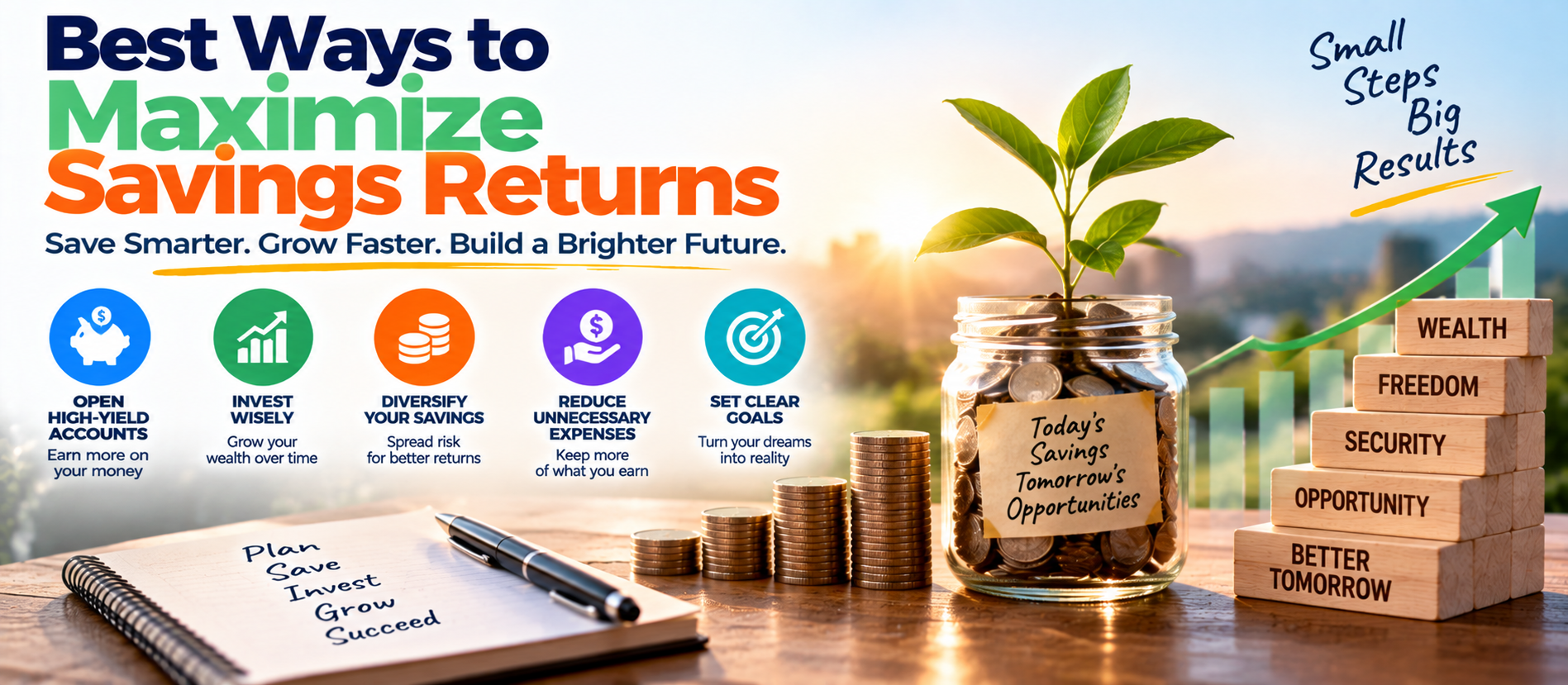
1. Compare Savings Account Interest Rates
2. Consider High-Yield Savings Accounts
3. Use the Power of Compound Interest
4. Automate Your Savings
5. Build an Emergency Fund First
6. Explore Term Deposits or Certificates
8. Pay Attention to Inflation
9. Reduce High-Interest Debt
10. Use Investments for Appropriate Long-Term Goals
11. Diversify Your Investments
💡 Key Insight
Saving money is an important financial habit, but where you keep your savings can also affect how your money grows. A traditional savings account may offer safety and easy access, while other savings and investment options may provide higher potential returns with different levels of risk.
The best strategy depends on your financial goals, time horizon, risk tolerance, liquidity needs, and local financial rules.
This guide explains the best ways to maximize savings returns using clear and practical language. It covers interest rates, high-yield savings accounts, term deposits, bonds, investment diversification, automation, inflation, and common mistakes.
Quick Answer: How Can You Maximize Savings Returns?
You can maximize savings returns by comparing interest rates and fees, matching your money to the right time horizon, reducing unnecessary costs, taking advantage of compounding, and considering appropriate investments for long-term goals.
Higher returns usually involve trade-offs. Some options provide greater safety and liquidity but lower growth potential, while others may offer higher potential returns with greater risk.
Start by Separating Savings Goals
One of the most useful steps is to avoid treating all your money as one large savings pool. Different goals may require different strategies.
You can divide your money into categories such as:
- Emergency savings: Money for unexpected expenses.
- Short-term savings: Money needed within the next few years.
- Medium-term goals: Money for planned future expenses.
- Long-term goals: Money intended for retirement or other distant objectives.
Money needed soon generally requires greater stability and liquidity. Money intended for long-term goals may have more time to recover from market volatility, although all investments involve risk.
1. Compare Savings Account Interest Rates
The simplest way to improve savings returns is to compare available savings accounts.
Interest rates can vary between banks and financial institutions. Before opening an account, review:
- Annual percentage yield or equivalent local measure.
- Minimum balance requirements.
- Monthly maintenance fees.
- Withdrawal restrictions.
- Deposit insurance or applicable protections.
- Whether the rate can change.
A higher advertised rate may not always produce the best result if the account includes high fees or difficult requirements.
2. Consider High-Yield Savings Accounts
High-yield savings accounts may offer higher interest rates than standard savings accounts. They can be useful for emergency funds and short-term goals when available in your location.
The main advantages may include:
- Easy access to funds.
- Interest on deposited money.
- Simple account management.
However, interest rates can change. Always review account terms and applicable deposit protections.
3. Use the Power of Compound Interest
Compound interest means you may earn interest on both your original savings and previously earned interest.
The effect of compounding becomes more meaningful when money remains invested or saved over longer periods.
Three factors can influence compounding:
- The amount you save.
- The rate of return or interest.
- The length of time your money remains invested.
Starting earlier can be valuable because time allows more opportunities for compounding. Even small, regular contributions can add up over a long period.
4. Automate Your Savings
Automation can make saving more consistent. You can schedule transfers from your income account to a dedicated savings or investment account.
For example, you may choose to transfer money after each paycheck or at the beginning of every month.
Automatic saving can help because it:
- Creates a regular habit.
- Reduces the temptation to spend available cash.
- Helps you make progress toward specific goals.
The amount should fit comfortably within your budget. Saving aggressively while relying on expensive debt may not always be an effective strategy.
5. Build an Emergency Fund First
Before taking additional investment risk, many people benefit from maintaining accessible emergency savings.
An emergency fund may help cover unexpected expenses such as:
- Urgent home repairs.
- Vehicle repairs.
- Temporary income loss.
- Unexpected travel.
- Essential medical or family expenses.
The appropriate amount depends on your income stability, household expenses, insurance coverage, and personal responsibilities.
Emergency savings are usually designed for accessibility rather than maximum returns.
6. Explore Term Deposits or Certificates
Term deposits and certificates of deposit, depending on your country, may offer a fixed interest rate for a specified period.
They may be useful for money that you do not expect to need immediately.
Before choosing one, review:
- The interest rate.
- The length of the term.
- Early withdrawal penalties.
- Applicable account protection.
A longer term does not automatically mean it is the best choice. Consider whether you may need access to the money before maturity.
8. Pay Attention to Inflation
Maximizing savings returns is not only about earning interest. It is also about protecting purchasing power.
If your savings earn less than the rate at which prices rise, the money may lose purchasing power over time.
For long-term goals, investors may consider assets with greater growth potential. However, these assets can also experience losses and volatility.
The right balance between safety and growth depends on when you need the money.
9. Reduce High-Interest Debt
Paying down expensive debt may sometimes improve your overall financial position more effectively than seeking a slightly higher savings rate.
For example, earning a modest return on savings while paying a much higher interest rate on debt can create a financial disadvantage.
Consider:
- The interest rate on your debt.
- The terms of repayment.
- Your emergency savings needs.
- Any fees or penalties.
Debt decisions can be complex, especially when mortgages, student loans, or tax considerations are involved.
10. Use Investments for Appropriate Long-Term Goals
Cash savings may be suitable for short-term needs, but long-term goals may require a strategy that includes investments.
Common investment categories include:
- Stock funds and ETFs.
- Bond funds and ETFs.
- Individual bonds.
- Other diversified investment products.
Investments can provide higher potential long-term returns than cash, but there is no guarantee. Market values can rise and fall, and investors can lose money.
11. Diversify Your Investments
Diversification means spreading money across different investments instead of depending heavily on one company, sector, or asset.
A diversified strategy may include exposure to:
- Different companies.
- Multiple industries.
- Different geographic regions.
- Stocks and bonds.
Diversification cannot eliminate losses or guarantee positive returns. However, it may reduce the impact of problems affecting one specific investment.
12. Use ETFs for Broad Market Exposure
Exchange-traded funds, or ETFs, can provide access to a group of securities through one investment product.
Depending on the ETF, investors may gain exposure to broad stock markets, bonds, international markets, or specific sectors.
Before investing, review:
- The ETF's investment objective.
- Its underlying holdings.
- Expense ratios and other costs.
- Market and concentration risks.
- Tax treatment in your location.
Owning several ETFs does not automatically create better diversification. Some funds may hold many of the same securities.
14. Keep Fees Low
Fees can reduce your returns over time. Even small recurring expenses may have a noticeable effect over many years.
Review potential costs such as:
- Account maintenance fees.
- Investment expense ratios.
- Trading costs.
- Advisory fees.
- Early withdrawal penalties.
Low cost does not always mean the best option, but unnecessary costs can reduce the amount of money that remains invested.
15. Avoid Chasing the Highest Return
A common mistake is moving money frequently in response to recent performance or temporary interest-rate changes.
An investment or product that performed well recently may not continue performing well in the future.
Instead of chasing short-term winners, focus on:
- Your financial goal.
- Your time horizon.
- Your risk tolerance.
- Costs and liquidity.
- A diversified long-term strategy where appropriate.
16. Review Your Savings Strategy Regularly
A savings strategy should not be forgotten after it is created.
Review your plan periodically and after major life changes, such as:
- A new job or income change.
- Marriage or family changes.
- A move to a new location.
- A major purchase.
- Changes in financial goals.
Reviewing your plan does not mean making frequent changes. It means checking whether your current strategy still matches your needs.
A Simple Framework for Maximizing Savings Returns
- Define your savings goals.
- Separate emergency money from long-term money.
- Compare interest rates, fees, and account terms.
- Automate regular contributions.
- Use compounding to your advantage.
- Consider debt costs before seeking higher returns.
- Choose investments based on time horizon and risk tolerance.
- Diversify appropriate long-term investments.
- Review your strategy periodically.
Common Mistakes That Can Reduce Savings Returns
Keeping All Money in One Low-Interest Account
Convenience can be useful, but keeping every dollar in one account may not match the needs of different financial goals.
Ignoring Fees
A high interest rate may lose its advantage if the account or investment has significant costs.
Taking Investment Risk With Emergency Money
Money needed quickly may lose value at the wrong time if placed in volatile investments.
Ignoring Inflation
Long-term financial planning should consider purchasing power, not just the balance shown in an account.
Chasing Short-Term Performance
Frequent changes based on headlines or recent returns can lead to poor decisions and unnecessary costs.
Not Saving Consistently
A strong rate of return cannot fully compensate for a lack of regular saving. Consistent contributions are an important part of building wealth.
How to Choose Between Saving and Investing
A useful question is: When will I need this money?
Money needed soon may require safety and easy access. Money intended for long-term goals may allow for more investment risk.
Other questions include:
- Can I afford to lose some of this money temporarily?
- Do I have an emergency reserve?
- What is my investment time horizon?
- How stable is my income?
- What are the tax and regulatory rules where I live?
The answers can help determine whether cash savings, fixed-income products, investments, or a combination may be appropriate.
Why Consistency Matters More Than Perfect Timing
Many people delay saving because they are waiting for the perfect interest rate, investment opportunity, or market condition.
However, consistent saving can be more practical than trying to predict every market movement.
Regular contributions may help build financial discipline and increase the amount of capital available for future growth.
Frequently Asked Questions
What is the best way to maximize savings returns?
The best approach depends on your goals and time horizon. Comparing rates and fees, using appropriate savings products, saving consistently, and considering diversified investments for suitable long-term goals can help improve overall results.
Should I keep all my savings in a high-yield savings account?
Not necessarily. A high-yield savings account may be useful for emergency and short-term funds, but long-term goals may have different requirements and risk considerations.
How does compound interest help savings grow?
Compounding allows earnings to generate additional earnings over time. The effect generally becomes more significant when money remains invested or saved for longer periods.
Are ETFs good for long-term savings?
Some diversified ETFs may be used for long-term investment goals, but ETFs involve market risk and can lose value. Suitability depends on the investor's goals and risk tolerance.
Should I pay off debt or save money?
The answer depends on factors such as debt interest rates, emergency savings, income stability, and financial goals. High-interest debt may deserve priority in many situations.
Final Thoughts
The best way to maximize savings returns is to match your money with the right financial strategy. Emergency money needs accessibility, short-term savings need stability, and long-term goals may require greater growth potential.
⚠ Watch Out
Compare rates and fees, save consistently, use compounding, manage expensive debt, and avoid unnecessary risks. For long-term goals, diversification and an appropriate investment strategy may help support future growth.
There is no single account or investment that is best for every person. Your financial goals, time horizon, risk tolerance, and local rules should guide your decisions.
For more educational content about personal finance, investing, business, technology, SEO, AEO, GEO, and AI Search optimization, visit www.digiifrog.com.
Disclaimer
This article is for educational purposes only and is not financial, investment, legal, or tax advice. All investments involve risk, including possible loss of principal. Consider consulting a qualified professional before making significant financial decisions.
Ready to Grow?
Talk to us about a strategy tailored to your brand — we will help you stand out in search, AI discovery and social.

Comments (0)
Log in to leave a comment.