📋 Quick Summary
In this article:
Why Fast-Growing Companies Struggle to Scale
1. Build Repeatable Business Processes
2. Automate Repetitive Work
3. Design a Scalable Technology Stack
4. Create a Strong Data Foundation
5. Build a Scalable Customer Acquisition System
6. Strengthen the Sales Process
7. Create a Scalable Customer Onboarding Process
8. Make Customer Support Scalable
9. Build a Scalable Team Structure
Introduction
Fast growth is exciting. More customers, higher revenue, new markets, and larger teams can create strong opportunities. But growth can also expose weaknesses that were easy to ignore when the company was smaller.
A process that worked for 20 customers may fail with 2,000. A founder who once approved every decision may become a bottleneck. A spreadsheet that tracked orders may become impossible to manage. A support team may struggle when customer requests double. Technology costs may rise faster than revenue.
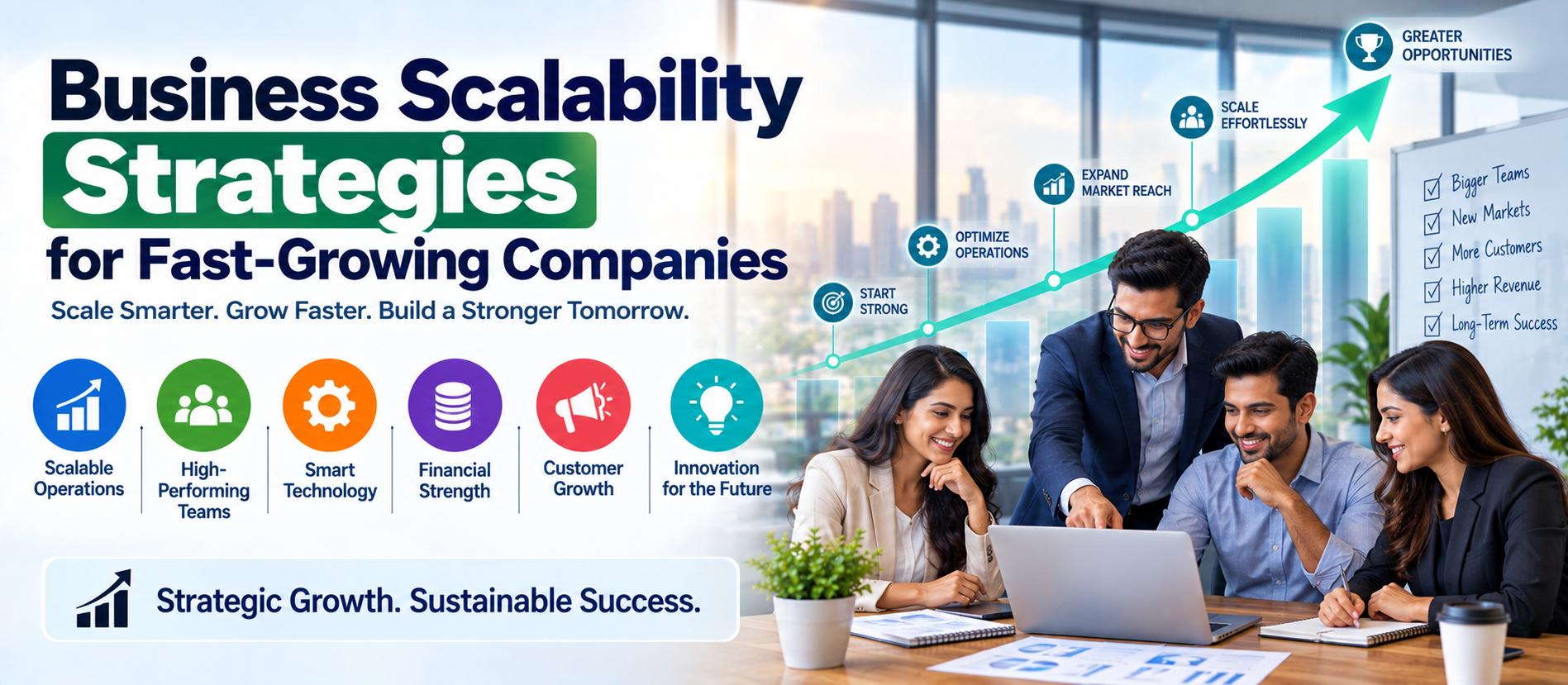
This is why growth and scalability are not the same thing. Growth increases the size of a business. Scalability is the ability to handle that growth without costs, complexity, and operational problems increasing at the same rate.
💡 Key Insight
Upwork's 2026 guide describes scaling as increasing revenue more efficiently, so costs and headcount do not rise at the same pace. It highlights systems, hiring, priorities, flexible talent, and AI as important elements of modern scaling. Upwork, 2026.
In 2026, technology is also changing how businesses scale. AI and automation can increase capacity, but they work best when supported by clean data, integrated systems, repeatable processes, and clear governance. McKinsey's 2026 technology research similarly emphasizes AI, data, product and platform operating models, and capability-led teams as parts of growth-oriented operating models. McKinsey, 2026.
This article explains practical business scalability strategies for fast-growing companies. The goal is simple: build a business that can serve more customers, generate more revenue, and enter new markets without creating unnecessary operational pressure.
What Is Business Scalability?
Business scalability is the ability of a company to increase revenue, customers, transactions, or output without increasing resources and costs at the same rate.
A scalable business usually has:
- Repeatable processes
- Clear roles and responsibilities
- Reliable technology
- Strong financial controls
- Efficient customer acquisition
- Automated repetitive work
- Good data and reporting
- Flexible capacity
- Documented knowledge
- A management structure that does not depend on one person
Scalability does not mean removing people. It means using people, processes, technology, and capital in a way that allows output to grow efficiently.
Why Fast-Growing Companies Struggle to Scale
Rapid growth creates complexity. More customers create more support requests. More orders create more operational work. More employees create more communication and management needs. More products create more inventory, technology, and reporting requirements.
Common scaling problems include:
- Too many manual processes
- Founder or leadership bottlenecks
- Unclear responsibilities
- Disconnected software systems
- Poor data quality
- Weak cash-flow planning
- Inconsistent customer experience
- Hiring faster than onboarding can support
- Technical debt
- Processes that work only because experienced employees know hidden steps
The solution is not always to hire more people. A scalable business first asks whether the work can be simplified, standardized, automated, delegated, or redesigned.
1. Build Repeatable Business Processes
Repeatability is one of the foundations of scalability.
If every employee handles the same task differently, growth will create inconsistent results. Document the important workflows and define the expected outcome for each one.
Start with high-volume processes such as:
- Lead qualification
- Sales handoffs
- Customer onboarding
- Order processing
- Procurement
- Invoice approval
- Customer support
- Employee onboarding
- Reporting
Use simple standard operating procedures. Explain who does what, when it happens, what information is required, and what happens when an exception occurs.
Good documentation reduces dependence on individual employees and makes training easier.
2. Automate Repetitive Work
Automation helps a growing business increase output without adding the same amount of manual work.
Useful automation areas include email workflows, lead routing, appointment scheduling, invoice processing, customer notifications, reporting, data synchronization, procurement approvals, and support ticket classification.
The key is to automate the right work. Start with repetitive tasks that are frequent, rule-based, and measurable.
Do not automate a broken process. Simplify the process first. Then automate it.
AI is expanding the scope of automation. Current enterprise research shows businesses are moving from isolated AI experiments toward more integrated AI and data operating models. Deloitte's 2026 India findings, for example, report substantial at-scale AI adoption across functions including strategy and operations, marketing and sales, product development, and supply chain. Deloitte India, 2026.
3. Design a Scalable Technology Stack
Technology should support growth rather than create new complexity.
A fast-growing company may use CRM, accounting, ERP, HR, marketing, customer support, project management, analytics, and communication tools. The problem starts when these systems do not share information.
Choose technology based on business needs, integration capability, security, scalability, usability, and total cost.
Use APIs or reliable integrations where appropriate. Reduce duplicate data entry. Create a clear source of truth for important business information.
Technology consolidation can also reduce unnecessary software costs. The goal is not to own the largest technology stack. The goal is to operate an effective one.
4. Create a Strong Data Foundation
Data becomes more important as a company grows.
Leadership needs accurate information about revenue, customers, costs, inventory, employee capacity, sales pipelines, service levels, and cash flow.
Define ownership for critical data. Standardize names, categories, customer records, product information, and reporting definitions.
⚠ Watch Out
Create dashboards that answer real business questions. Avoid building reports simply because the software makes them easy to create.
AI also depends on data quality. Recent research on scaling AI highlights clean, reliable data and connected workflows as important foundations for turning AI investment into business outcomes. PwC, 2026.
5. Build a Scalable Customer Acquisition System
Growth requires a repeatable way to attract and convert customers.
Do not depend on one marketing channel if the business can diversify responsibly. Test organic search, content marketing, referrals, partnerships, social media, paid advertising, events, email, and other relevant channels.
Track customer acquisition cost, conversion rates, sales cycle time, customer lifetime value, retention, and revenue by channel.
Marketing should be connected to sales and customer success. A scalable acquisition system should create predictable movement from awareness to purchase and then to retention.
6. Strengthen the Sales Process
Sales often becomes a bottleneck during rapid growth.
Document qualification rules, sales stages, follow-up expectations, proposal processes, pricing rules, and handoffs.
A CRM should provide a clear view of the pipeline. Automated reminders can reduce missed follow-ups. Templates can make routine communication faster while allowing salespeople to personalize important conversations.
Do not scale sales before understanding which customers are a good fit. Poor-fit customers can increase support costs and reduce retention.
7. Create a Scalable Customer Onboarding Process
Customer onboarding has a major effect on the early customer experience.
A manual onboarding process may work when there are only a few new customers each week. At higher volume, it can create delays and inconsistency.
Create a standard onboarding journey with clear milestones, automated messages, training resources, checklists, and ownership.
Use customer data to identify accounts that need human attention. Automation can handle routine steps while customer-facing teams focus on complex needs.
8. Make Customer Support Scalable
Customer support volume usually grows with the customer base.
Build a support system with a knowledge base, searchable help content, ticket categories, response standards, escalation rules, and clear ownership.
AI can help classify requests, summarize conversations, suggest answers, search internal knowledge, and identify recurring issues. Human agents should remain involved where judgment, empathy, or exception handling is important.
Track first-response time, resolution time, customer satisfaction, ticket volume, repeat contacts, and escalation rates.
9. Build a Scalable Team Structure
Hiring more people is not the same as building a scalable organization.
Define roles around outcomes and responsibilities. Employees should know what they own and how their work connects to company goals.
As teams grow, managers need clear spans of responsibility. Founders should gradually move from doing every important task to building leaders and systems that can operate independently.
Use a mix of full-time employees, contractors, specialists, and technology where appropriate. Flexible talent can provide access to specialized skills without requiring every capability to become a permanent internal function.
Upwork's 2026 research highlights growing demand for specialized and flexible talent as businesses adapt to AI and changing skill needs. Upwork, 2026.
10. Improve Employee Onboarding and Training
Fast hiring creates a new challenge: getting people productive quickly.
Create role-specific onboarding plans. Provide process documentation, training materials, system access, examples, and clear first-month goals.
A good knowledge base reduces the need for senior employees to answer the same questions repeatedly.
Continuous learning also matters. Technology and customer expectations change quickly, especially in businesses adopting AI.
11. Delegate Decisions With Clear Rules
Leadership bottlenecks can slow a growing business.
Define which decisions employees can make independently and which require approval.
For example, a team may have authority to approve a customer refund up to a defined amount. A department manager may approve certain purchases. Larger commitments may require executive approval.
Clear decision rights improve speed while maintaining control.
12. Protect Cash Flow as You Scale
Revenue growth can create cash-flow pressure.
A company may need to purchase inventory, hire employees, invest in technology, or spend more on marketing before customers pay for the resulting revenue.
Monitor accounts receivable, accounts payable, gross margin, operating expenses, cash conversion, and working capital.
Build financial forecasts using different growth scenarios. Plan for both strong growth and slower-than-expected demand.
13. Build Financial Controls Early
Financial processes that are informal at a small company can become risky at scale.
Use defined approval limits, separation of duties, regular reconciliations, expense policies, budget controls, and financial reporting.
Automate routine finance tasks where appropriate. Connect sales, procurement, inventory, payroll, and accounting data to reduce manual reconciliation.
14. Standardize Pricing and Packaging
Complex pricing can create operational problems.
Customers may receive inconsistent quotes. Sales teams may need repeated approval. Billing may become difficult.
Create clear pricing rules, discount limits, packages, service definitions, and approval processes.
Standardization does not mean every customer must receive the same offer. It means exceptions have clear rules and are easy to manage.
15. Build Operational Capacity Before It Becomes a Bottleneck
Growth can expose capacity limits in production, logistics, support, technology, or professional services.
Measure capacity against demand. Identify the processes that are already close to their limits.
Use capacity planning to decide when to add people, equipment, suppliers, locations, technology, or external partners.
Do not wait for customers to experience delays before increasing capacity.
16. Use Outsourcing Strategically
Outsourcing can help a company scale when an external provider can perform a repeatable activity efficiently.
Possible areas include payroll, bookkeeping, customer support, IT operations, logistics, content production, administrative work, and specialized technology services.
Outsourcing works best when the process has clear requirements, measurable service levels, data controls, and an accountable owner inside the company.
Do not outsource a process simply because it is difficult. First understand the process and define the expected outcome.
17. Build a Resilient Supplier Network
Fast growth can increase dependence on suppliers.
Review critical suppliers for capacity, reliability, quality, lead time, financial stability, and geographic risk.
For critical products or services, consider alternative suppliers where the economics and operational requirements make sense.
Document contingency plans for important supply disruptions.
18. Make the Business Less Dependent on the Founder
Founder dependence is a common scaling challenge.
If every important customer relationship, hiring decision, supplier negotiation, and operational decision requires the founder, growth eventually slows.
Transfer knowledge into systems. Develop managers. Document decisions. Create clear approval rules. Give leaders ownership of outcomes.
The founder's role can gradually shift toward strategy, capital allocation, culture, partnerships, and long-term growth.
19. Use Modular Products and Processes
Modularity makes change easier.
For products, this can mean reusable components or standardized service packages. For operations, it can mean workflows that can be repeated across locations, teams, or customer segments.
Modular systems reduce the need to redesign the entire business whenever a new customer, market, or product is added.
20. Build a Scalable Digital Customer Experience
Customers increasingly expect fast, consistent digital experiences.
Offer self-service where it makes sense. Use online ordering, account portals, automated notifications, searchable knowledge bases, digital documents, and simple payment processes.
Keep human support available for complex situations.
The scalable model is not “digital instead of human.” It is “digital for routine needs and human expertise for higher-value needs.”
21. Use AI as an Operating Capability
AI can support scalability across marketing, sales, customer service, finance, operations, product development, and internal knowledge management.
Examples include:
- Automated lead qualification
- AI-assisted customer support
- Document processing
- Demand forecasting
- Sales forecasting
- Meeting summaries
- Knowledge search
- Workflow orchestration
- Content production
- Data analysis
AI should be connected to measurable business outcomes. McKinsey's 2026 research reports that leading technology organizations are integrating AI and data into operating models rather than treating them only as isolated experiments. McKinsey, 2026.
At the same time, companies need governance. Access controls, data quality, security, monitoring, human oversight, and clear ownership become more important as AI becomes embedded in workflows.
22. Create a Scalable Management Dashboard
Leadership needs a simple view of business health.
Useful metrics may include:
| MetricWhy It Matters | |
| Revenue growth | Shows sales expansion |
| Gross margin | Shows economic quality of revenue |
| Customer acquisition cost | Shows the cost of acquiring customers |
| Customer retention | Shows whether customers continue to stay |
| Customer lifetime value | Shows long-term customer economics |
| Cash conversion | Shows how growth affects cash |
| Employee productivity | Shows output relative to capacity |
| Service levels | Shows operational performance |
| Automation rate | Shows how much repetitive work is system-driven |
Keep the dashboard focused. Executives need enough information to make decisions, not every available metric.
23. Build Cybersecurity and Compliance Into Growth
Security cannot be postponed until the business becomes large.
More customers, employees, suppliers, and software systems create more access points and more data.
Use strong authentication, role-based access, backups, monitoring, employee training, vendor reviews, and incident-response procedures.
Compliance requirements should be considered when entering new markets or industries.
24. Improve Scalability Through Process Metrics
Every important process should have a small set of measurable indicators.
For example, customer onboarding can track time to activation. Support can track response and resolution times. Sales can track conversion and cycle time. Finance can track invoice-processing time. Operations can track throughput and error rates.
Process metrics help managers identify bottlenecks before they become major problems.
25. Use Scenario Planning for Growth
Do not build one growth plan.
Create several scenarios, such as conservative growth, expected growth, and rapid growth. Estimate the staffing, technology, cash, facilities, suppliers, and management capacity required for each scenario.
This makes it easier to prepare before a capacity constraint appears.
26. Focus on Unit Economics
Revenue growth does not automatically create a healthy business.
Track the economics of acquiring and serving each customer or transaction. Important measures may include customer acquisition cost, gross margin, contribution margin, retention, support cost, fulfillment cost, and customer lifetime value.
Unit economics can reveal whether growth is creating value or simply increasing volume.
27. Create a Continuous Improvement Culture
Scalability is not a one-time project.
As the company grows, processes must evolve. Review important workflows regularly. Ask where customers wait, where employees repeat work, where errors occur, and where management approval slows decisions.
Run small experiments. Measure the result. Standardize successful improvements.
Continuous improvement helps the operating model keep pace with growth.
Common Business Scalability Mistakes
- Hiring faster instead of fixing inefficient processes.
- Adding software without integration planning.
- Keeping important knowledge inside one person's head.
- Scaling marketing before customer service and operations are ready.
- Ignoring cash flow because revenue is growing.
- Automating poor processes.
- Using AI without data and governance foundations.
- Building too many custom processes for individual customers.
- Measuring revenue but not margin or retention.
- Waiting for operational problems before investing in capacity.
A Practical 90-Day Business Scalability Plan
Days 1–30: Find the Bottlenecks
- Map the customer journey.
- Map the main internal workflows.
- Identify founder and manager bottlenecks.
- Review technology and integrations.
- Measure unit economics.
- Review cash flow and capacity.
Days 31–60: Build the Foundation
- Document the most important processes.
- Standardize roles and approval rules.
- Clean critical business data.
- Automate selected repetitive tasks.
- Improve customer onboarding and support.
- Create a focused management dashboard.
Days 61–90: Scale What Works
- Test new automation workflows.
- Strengthen team ownership.
- Improve technology integrations.
- Create capacity plans.
- Build contingency plans.
- Review results against the original baseline.
Business Scalability and SEO, AEO, GEO, and AI Search
Scalability content should also be structured for modern search.
For SEO, use a clear primary keyword, descriptive headings, related terms, internal links, and useful metadata.
For AEO, answer direct questions such as “What is business scalability?” and “How can a company scale without increasing costs at the same rate?” Give direct answers before adding detail.
For GEO, organize content around concepts, processes, examples, metrics, and implementation steps. This makes the information easier for generative search systems to interpret.
For AI Search optimization, use concise definitions, tables, lists, FAQs, clear entities, and reliable sources. Keep sentences direct. Separate facts from opinions and explain time-sensitive information with dates.
Frequently Asked Questions
What is business scalability?
Business scalability is the ability to increase revenue, customers, or output without increasing costs and resources at the same rate.
What is the difference between growth and scalability?
Growth means the business becomes larger. Scalability means the business can become larger efficiently, with systems and resources designed to handle additional volume.
How can a small business become scalable?
A small business can start by documenting repeatable processes, standardizing services, using reliable software, automating repetitive work, tracking unit economics, and building clear roles.
How does AI help businesses scale?
AI can automate repetitive tasks, support decision-making, analyze data, improve customer service, assist sales and marketing, and coordinate workflows. Its value depends on data quality, process design, governance, and the specific business use case.
Should a fast-growing company hire more employees or automate?
The answer depends on the work. Companies should identify whether the bottleneck comes from insufficient capacity, inefficient processes, or both. Automation is useful for repeatable work, while employees remain important for judgment, relationships, creativity, and complex decisions.
Why is cash flow important when scaling?
Rapid growth can require cash before the related revenue is collected. Inventory, hiring, marketing, technology, and expansion can increase working-capital needs.
What are the most important scalability metrics?
Useful metrics include revenue growth, gross margin, customer acquisition cost, retention, customer lifetime value, cash conversion, service levels, employee productivity, process cycle time, and automation rate.
Conclusion
Fast growth creates opportunity, but sustainable growth requires a strong operating foundation. The most practical business scalability strategies focus on repeatable processes, automation, reliable technology, clean data, strong teams, financial discipline, customer experience, and clear decision-making.
Companies should not try to scale everything at once. Start with the biggest bottlenecks. Measure the current process. Improve it. Automate where useful. Then expand the solution.
AI adds a new layer of scalability. It can help businesses increase capacity and improve decision-making without requiring every activity to grow through additional manual work. But AI should be connected to real business processes and supported by strong data, security, governance, and human oversight.
The goal of scalability is not simply to become bigger. It is to build a business that can handle more customers, more revenue, and more complexity while maintaining quality, financial health, and a strong customer experience.
Digiifrog helps businesses explore digital transformation, AI, automation, SEO, GEO, and modern technology strategies. Visit www.digiifrog.com to learn more.
Key Takeaways
- Growth and scalability are different.
- Document repeatable processes before expanding them.
- Automate repetitive work after simplifying the workflow.
- Build integrated technology and reliable data foundations.
- Create scalable sales, onboarding, and customer-support systems.
- Develop leaders and reduce founder dependence.
- Track cash flow and unit economics as revenue grows.
- Use AI where it creates measurable operational value.
- Plan capacity before bottlenecks affect customers.
- Improve the operating model continuously as the company grows.
Ready to Grow?
Talk to us about a strategy tailored to your brand — we will help you stand out in search, AI discovery and social.
Comments (0)
Log in to leave a comment.