📋 Quick Summary
In this article:
What Does “AI Evidence” Mean?
What Does the Bharatiya Sakshya Adhiniyam Say?
Section 61: Electronic records can have legal effect
Section 62: Proof of electronic records
Section 63: Conditions and certification
Is an AI-Generated Photo Automatically Evidence?
What About AI-Generated Videos and Deepfakes?
Can AI Help Authenticate Digital Evidence?
Why Metadata and Hash Values Matter
What Evidence Should Be Preserved?
Can ChatGPT or Another AI's Answer Be Submitted as Legal Evidence?
Introduction
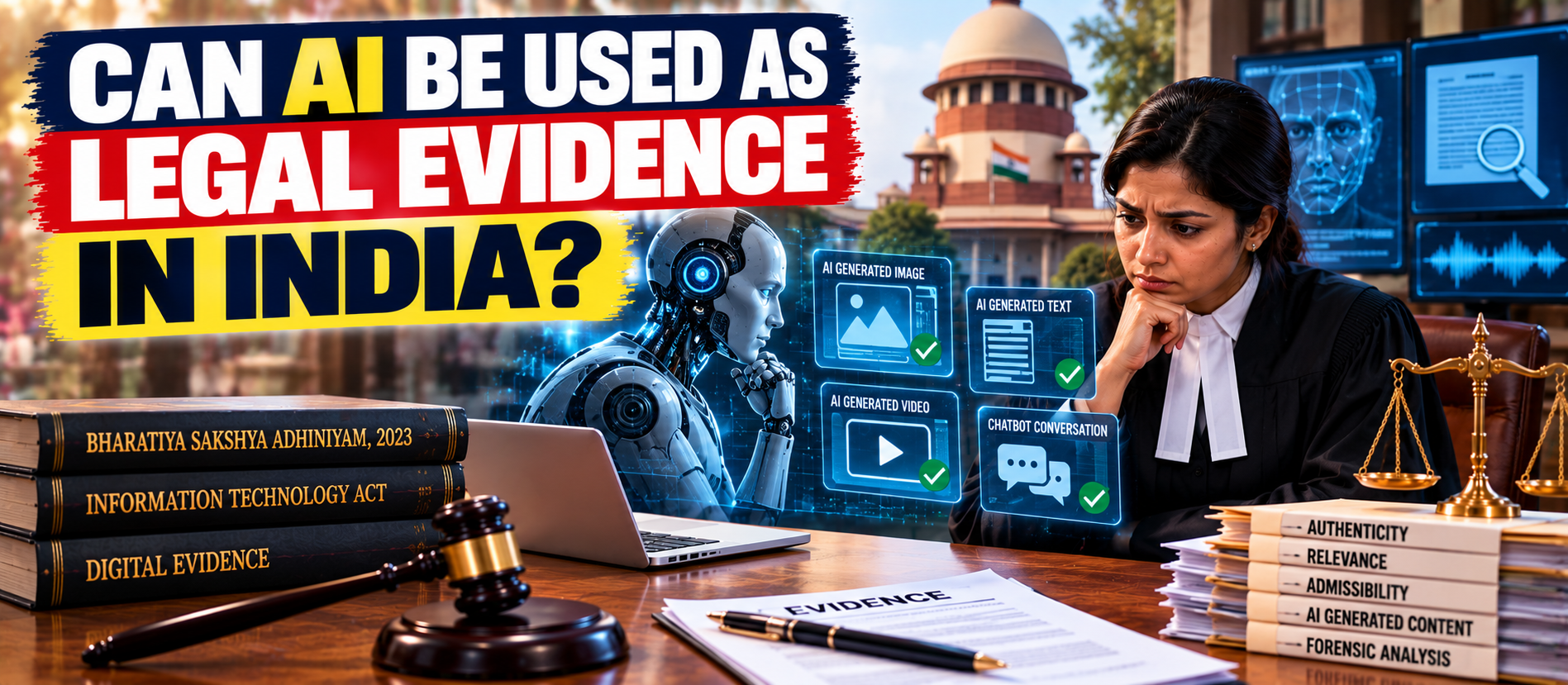
Artificial intelligence can create photographs, videos, audio recordings, documents and even realistic digital conversations. This creates an important legal question: Can AI-generated material be used as evidence in an Indian court?
The short answer is that there is no simple rule saying that every AI-generated file is either automatically admissible or automatically rejected. Indian evidence law focuses on questions such as relevance, authenticity, reliability, source and the statutory requirements for electronic records.
The Bharatiya Sakshya Adhiniyam, 2023 (BSA) is the current central evidence law and came into force on 1 July 2024. Section 61 provides that an electronic or digital record cannot be denied admissibility merely because it is electronic or digital, subject to Section 63. Section 62 deals with proof of electronic records through the Section 63 framework.
However, this does not mean that an AI-generated image, deep fake video or AI-written statement automatically proves the facts shown or described in it.
What Does “AI Evidence” Mean?
The phrase “AI evidence” can describe several very different things. The legal treatment can change depending on which type of material is being presented.
- AI-generated content: A photograph, video, audio clip or document created or substantially altered by an AI system.
- AI-assisted evidence: Genuine evidence that has been analysed, searched, transcribed or organised using AI.
- AI detection or forensic analysis: A technical opinion about whether a file has been manipulated or synthetically generated.
- AI-generated legal research: Text produced by an AI system to identify laws or cases. This is not the same thing as admissible factual evidence.
These categories should not be confused. AI-assisted analysis of genuine evidence is different from presenting synthetic content as a recording of a real event.
What Does the Bharatiya Sakshya Adhiniyam Say?
Section 61: Electronic records can have legal effect
Section 61 states that an electronic or digital record cannot be denied admissibility simply because it is electronic or digital. It gives such records the same legal effect, validity and enforceability as other documents, subject to Section 63.
This is important in a digital society. Emails, CCTV footage, mobile-phone records, computer files, digital photographs, messages and other electronic material can form part of a case.
Section 62: Proof of electronic records
Section 62 states that the contents of electronic records may be proved in accordance with Section 63. Therefore, a party cannot ignore the statutory procedure simply because the material is available as a digital file.
Section 63: Conditions and certification
Section 63 contains the specific framework for proving electronic records in the circumstances covered by the provision. The BSA schedule includes a certificate format that identifies the digital source or device and records information about how the electronic record was produced. It also provides for details such as device identifiers and hash values.
For a serious case, this means that preserving the original digital material and documenting its source can be extremely important.
Is an AI-Generated Photo Automatically Evidence?
No.
Suppose someone creates an AI-generated photograph showing a person at a location where they were allegedly not present. The image may be relevant to a dispute about digital manipulation, fraud or identity. But merely producing the image does not establish that the depicted event actually happened.
A court may consider the file's source, creator, alterations, metadata, independent verification and supporting evidence.
The distinction between admissibility and probative value is important. A court may admit a digital record for consideration and still decide that it is unreliable or entitled to little weight.
What About AI-Generated Videos and Deepfakes?
Deepfake technology makes the issue more difficult because a synthetic video can look like genuine CCTV footage or a real recording of a person.
⚠ Watch Out
Indian authorities have recognised the growing risk of morphed and fabricated digital content. A December 2025 Ministry of Law and Justice release noted that cases involving manipulated digital content can involve provisions of the Information Technology Act, 2000 and the Bharatiya Nyaya Sanhita, 2023, including provisions concerning identity theft, personation and electronic forgery.
If a deepfake is itself the subject of a criminal or civil dispute, the file can become relevant evidence to show that manipulation occurred. But if a fabricated video is presented as genuine proof of an event, the court can examine its authenticity and surrounding evidence.
Can AI Help Authenticate Digital Evidence?
AI and other forensic tools can assist investigators and experts in examining digital material. But an AI detector's output should not automatically be treated as conclusive proof; the method, reliability, underlying data and expert qualifications may need examination.
Section 39 of the BSA deals with expert opinions. It specifically states that when a court has to form an opinion on information transmitted or stored in a computer resource or another electronic or digital form, the opinion of an Examiner of Electronic Evidence referred to in Section 79A of the Information Technology Act, 2000 is a relevant fact.
Why Metadata and Hash Values Matter
Digital evidence can be copied and changed without obvious physical signs. Metadata can sometimes provide information about a file, while a cryptographic hash can help identify whether the digital content has changed after the hash was calculated.
The BSA's electronic-record certificate schedule expressly includes fields for device or source information and hash values.
A hash does not prove that an underlying event was real. It can help establish the integrity of the examined file; source and context still matter.
What Evidence Should Be Preserved?
If an AI-generated or allegedly manipulated file is involved in a legal dispute, preserve the evidence before editing or compressing it unnecessarily.
- Keep the original file.
- Record when and how you obtained it.
- Preserve the original device or storage source where possible.
- Save the URL or platform location if the file came from the internet.
- Keep relevant messages, emails and account information.
- Take screenshots showing surrounding context, not only the disputed image.
- Do not repeatedly re-save or edit the original file.
- Record relevant file metadata where available.
- Consider forensic examination when authenticity is disputed.
- Give the material to your lawyer or investigator with a clear timeline.
Can ChatGPT or Another AI's Answer Be Submitted as Legal Evidence?
An AI-generated answer generally should not be treated as an authoritative statement of Indian law merely because it was produced by a sophisticated AI system.
AI systems can make factual errors and can generate nonexistent cases, quotations or legal propositions. The Supreme Court's 2026 decision in Pooja Ramesh Singh v. Jammu and Kashmir Bank Ltd. addressed a case in which AI-generated or hallucinated case citations had entered judicial proceedings. The Court set aside the affected orders and stressed the need for verification of authorities.
The practical lesson is simple: verify every legal authority against an authentic source. AI can assist research but should not replace primary legal sources.
AI-Assisted Analysis vs AI-Generated Evidence
This distinction is becoming increasingly important.
Suppose a company has 50,000 genuine emails and uses an AI system to classify them or identify messages containing particular words. The underlying emails remain the evidence. The AI tool is being used as an analytical aid.
Now consider a person creating a synthetic email that never existed and presenting it as a genuine communication. The legal issue is completely different. The claimed source and authenticity of the document become central questions.
Courts can assess the underlying material rather than simply accepting an AI system's description of it.
What Courts Look For in Digital Evidence
- Relevance: Does the material relate to a fact in issue?
- Authenticity: Is it what the party says it is?
- Integrity: Has the file been altered?
- Source: Where did the material come from?
- Chain of custody: How was it collected, stored and transferred?
- Statutory compliance: Have the applicable BSA requirements been met?
- Corroboration: Is there independent evidence supporting the material?
- Expert evidence: Is technical examination necessary?
The Supreme Court has recognized that electronic video can be used as evidence when applicable statutory requirements are fulfilled; it has also said a video does not automatically need a witness-created transcript before its contents can be considered.
What If Someone Uses a Deep fake Against You?
Act quickly. Preserve the original file, the URL, account details, messages and surrounding context. Avoid publicly altering or reposting the material in a way that destroys useful evidence.
Depending on the conduct, a victim may report the matter to the platform, police or cybercrime authorities and seek legal advice. The applicable law depends on the facts.
Practical Checklist for Lawyers and Litigants
- Identify whether the material is original, AI-assisted or AI-generated.
- Preserve the original digital file.
- Document the source and acquisition process.
- Maintain relevant device and account information.
- Calculate and record hash values where appropriate.
- Follow the applicable electronic-evidence certification requirements.
- Obtain forensic examination when authenticity is genuinely disputed.
- Use expert evidence where a technical issue requires specialist opinion.
- Corroborate AI-related evidence with independent material.
- Verify every legal citation against an authoritative source.
Frequently Asked Questions
Can AI-generated evidence be admitted in an Indian court?
AI-generated material is not automatically admissible or automatically inadmissible merely because AI was involved. Its relevance, authenticity, integrity, source and compliance with the applicable electronic-evidence rules must be considered.
Are deepfake videos legal evidence?
A deepfake may be relevant evidence in a case about digital manipulation, but a fabricated video does not automatically prove the real-world event it depicts. Authentication and context are critical.
Does the BSA recognise electronic evidence?
Yes. Section 61 gives electronic or digital records legal effect subject to Section 63, and Section 62 addresses proof of electronic records.
Can an AI detector prove that a video is fake?
Not necessarily. An AI-detection result may be relevant, but its reliability, method and underlying data may need examination. Expert evidence can become important.
Can ChatGPT-generated legal research be filed in court?
AI-generated research should be independently verified before being relied upon. The Supreme Court has recently warned against relying on AI-generated or hallucinated legal authorities without verification.
Conclusion
AI is changing the nature of digital evidence in India, but it has not removed the basic principles of evidence law. An electronic record can have legal effect, yet the party relying on it may still need to establish its authenticity, integrity, source and statutory compliance.
The biggest challenge is the difference between digital evidence that records a real event and synthetic content that creates an artificial representation of an event. Courts can examine that difference through documentary evidence, technical analysis, expert opinion, witness evidence and the circumstances of the case.
For anyone handling AI-related evidence, the safest approach is to preserve the original material, document its source, avoid unnecessary editing, follow the BSA requirements and obtain qualified forensic or legal assistance when authenticity is disputed.
Legal Disclaimer: This article is for general educational and informational purposes only. It is not legal advice and does not create a lawyer-client relationship. The admissibility and evidentiary value of any AI-generated or AI-assisted material depend on the facts, the type of proceeding, applicable law, technical evidence and judicial assessment. Consult a qualified Indian lawyer or digital-forensics professional for a specific matter.
Sources and Legal References
- Bharatiya Sakshya Adhiniyam, 2023 — India Code, Sections 39 and 61–63.
- Information Technology Act, 2000 — including Section 79A concerning Examiner of Electronic Evidence.
- Supreme Court of India judgments concerning electronic and video evidence.
- Pooja Ramesh Singh v. Jammu and Kashmir Bank Ltd., Supreme Court of India, 2026.
- Ministry of Law and Justice / Press Information Bureau material on AI-based digital content in the judiciary.
Ready to Grow?
Talk to us about a strategy tailored to your brand — we will help you stand out in search, AI discovery and social.


Comments (0)
Log in to leave a comment.