📋 Quick Summary
In this article:
Why Cloud Security Is a Business Priority in 2026
1. Identity Becomes the New Security Perimeter
2. Zero Trust Adoption Continues to Grow
3. AI-Powered Cloud Security Expands
4. Cloud-Native Application Protection Platforms Gain Importance
5. Cloud Security Posture Management Remains Essential
6. Multi-Cloud Security Complexity Increases
7. API Security Becomes More Critical
8. Software Supply Chain Security Receives Greater Attention
9. DevSecOps and Shift-Left Security Become Standard Practices
10. Container and Kubernetes Security Remain Major Priorities
11. Data Security and Encryption Become More Advanced
Cloud computing is now a foundation of digital business, but expanding cloud adoption has also created new security risks. Organizations use public cloud, private cloud, hybrid cloud, multi-cloud environments, containers, APIs, SaaS applications, and AI-powered services to operate faster and scale globally. As cloud infrastructure becomes more complex, attackers increasingly target identities, misconfigurations, exposed data, software supply chains, and cloud workloads.
💡 Key Insight
This comprehensive WordPress-ready guide explores the most important cloud security trends businesses must watch in 2026. It explains emerging threats, modern security technologies, strategic priorities, and practical best practices organizations can use to strengthen cloud resilience. The content is optimized for SEO, AEO, GEO, and AI Search optimization.
Why Cloud Security Is a Business Priority in 2026
Businesses are moving critical applications, customer information, intellectual property, analytics platforms, and AI workloads to cloud environments. This transformation improves agility, but it also increases the number of identities, services, configurations, APIs, and third-party integrations that security teams must protect.
Cloud security is no longer only an IT responsibility. A major cloud breach can create financial losses, operational downtime, regulatory penalties, customer distrust, and long-term reputational damage. Business leaders must therefore treat cloud security as an essential part of enterprise risk management.
1. Identity Becomes the New Security Perimeter
Traditional network boundaries are disappearing as employees, contractors, applications, workloads, and automated services access cloud resources from different locations. Attackers increasingly target credentials, authentication tokens, API keys, service accounts, and excessive permissions.
Businesses should strengthen Identity and Access Management (IAM), enforce Multi-Factor Authentication (MFA), remove unused accounts, monitor privileged identities, and adopt least-privilege access policies.
2. Zero Trust Adoption Continues to Grow
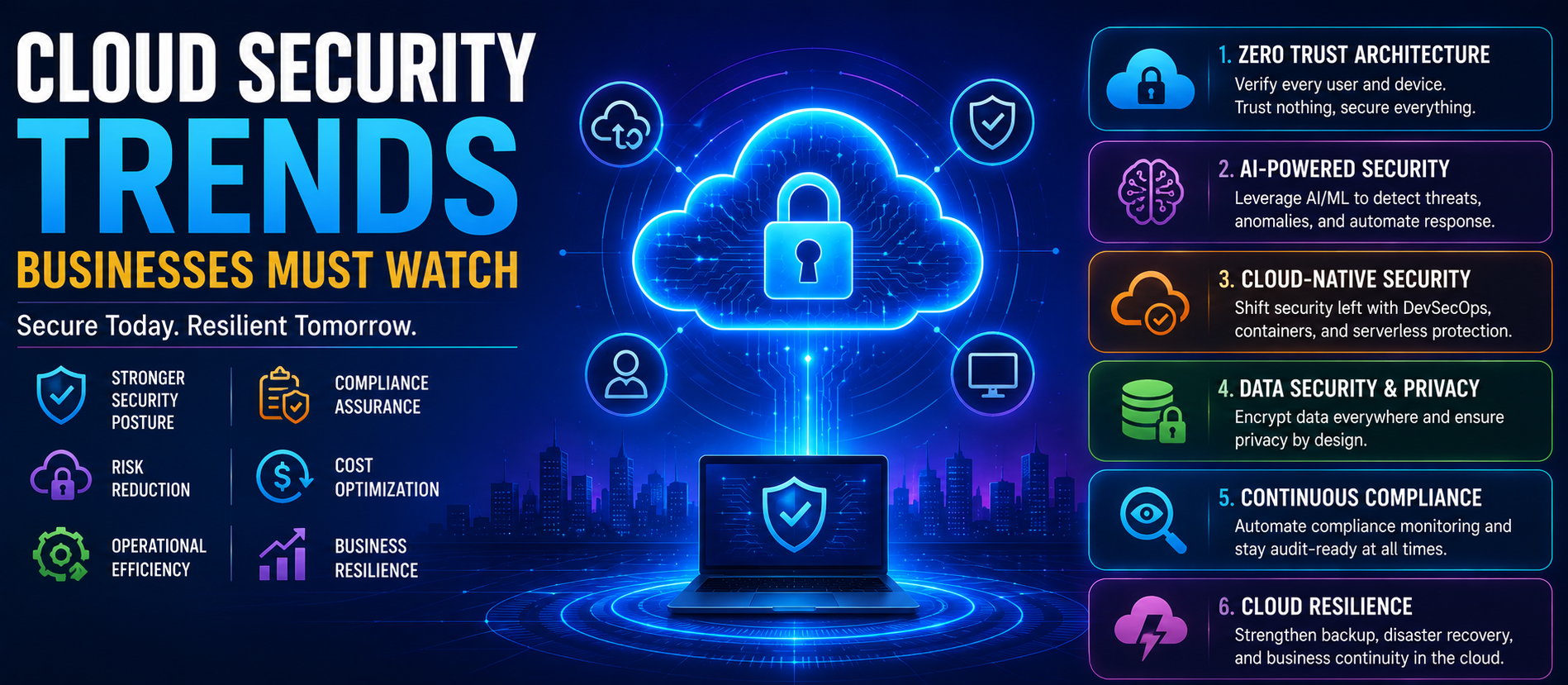
Zero Trust assumes that no user, device, workload, or network connection should be automatically trusted. Every access request should be verified according to identity, device health, location, risk, and business context.
Organizations should combine continuous authentication, micro-segmentation, least privilege, strong endpoint security, and real-time monitoring to build practical Zero Trust cloud architectures.
3. AI-Powered Cloud Security Expands
Artificial Intelligence and Machine Learning are transforming cloud defense. Security platforms can analyze large volumes of logs, identify unusual behavior, prioritize alerts, detect compromised accounts, and automate response workflows.
At the same time, attackers are using AI to create convincing phishing campaigns, automate reconnaissance, discover vulnerable cloud assets, and improve social engineering. Businesses must use AI responsibly while maintaining human oversight of important security decisions.
4. Cloud-Native Application Protection Platforms Gain Importance
Cloud-Native Application Protection Platforms (CNAPPs) combine multiple security capabilities into integrated platforms. These solutions can help organizations manage cloud posture, workload protection, identity risks, vulnerabilities, infrastructure-as-code issues, and application security.
Consolidated cloud security platforms can reduce tool fragmentation and provide security teams with improved visibility across complex environments.
5. Cloud Security Posture Management Remains Essential
Misconfigurations continue to expose cloud storage, databases, workloads, and services. Cloud Security Posture Management (CSPM) solutions continuously identify insecure configurations and compliance problems.
- Publicly exposed storage resources
- Overly permissive security groups
- Weak encryption configurations
- Unused cloud resources
- Excessive access permissions
- Compliance policy violations
6. Multi-Cloud Security Complexity Increases
Many organizations use multiple cloud providers to improve flexibility, resilience, and access to specialized services. However, every cloud platform has different identity models, security controls, logging systems, and configuration standards.
Businesses need centralized visibility, consistent security policies, unified monitoring, and skilled cloud security professionals to reduce multi-cloud risk.
7. API Security Becomes More Critical
APIs connect cloud applications, mobile services, business platforms, and third-party systems. Poorly protected APIs can expose sensitive information or provide attackers with unauthorized access.
Organizations should implement strong authentication, API gateways, rate limiting, input validation, continuous testing, inventory management, and real-time monitoring.
8. Software Supply Chain Security Receives Greater Attention
Modern cloud applications depend on open-source libraries, third-party services, containers, development tools, and external software providers. A compromise anywhere in the software supply chain can affect many organizations.
Businesses should evaluate vendors, scan dependencies, secure CI/CD pipelines, use Software Bills of Materials (SBOMs), protect code repositories, and verify software integrity.
9. DevSecOps and Shift-Left Security Become Standard Practices
Security teams can no longer wait until applications reach production before identifying vulnerabilities. DevSecOps integrates security throughout the software development lifecycle.
- Secure coding practices
- Automated vulnerability scanning
- Infrastructure-as-Code security testing
- Container image scanning
- Secrets management
- Continuous compliance checks
10. Container and Kubernetes Security Remain Major Priorities
Containers and Kubernetes support modern application development, but insecure configurations, vulnerable images, excessive privileges, and exposed management interfaces create security risks.
Businesses should scan container images, enforce runtime security, protect Kubernetes control planes, use network policies, manage secrets securely, and apply least-privilege permissions.
11. Data Security and Encryption Become More Advanced
Organizations store enormous amounts of sensitive information in cloud environments. Protecting data requires encryption at rest, encryption in transit, strong key management, data classification, access monitoring, and Data Loss Prevention (DLP).
Privacy-enhancing technologies, confidential computing, and advanced encryption techniques will become increasingly important as businesses process sensitive information using cloud and AI services.
12. Continuous Threat Exposure Management Gains Momentum
Traditional annual security assessments are no longer sufficient. Cloud environments change continuously as new resources, users, applications, and services are deployed.
Continuous Threat Exposure Management helps organizations identify vulnerabilities, attack paths, misconfigurations, exposed assets, and security weaknesses before attackers exploit them.
13. Security Automation and SOAR Adoption Increase
Security teams face thousands of alerts and increasingly complex environments. Security Orchestration, Automation, and Response (SOAR) platforms help automate repetitive tasks and accelerate incident response.
- Automatically enriching security alerts
- Blocking malicious IP addresses
- Disabling compromised accounts
- Isolating infected workloads
- Opening incident tickets
- Collecting forensic information
14. Ransomware Targets Cloud Environments
Ransomware groups increasingly target cloud storage, backups, virtual machines, administrative accounts, and SaaS platforms. Attackers may steal sensitive information before disrupting systems to increase extortion pressure.
Businesses should maintain immutable backups, secure privileged accounts, monitor unusual data transfers, segment critical workloads, and regularly test disaster recovery plans.
15. SaaS Security Posture Management Becomes More Important
Organizations rely heavily on SaaS applications for communication, customer management, productivity, finance, and collaboration. Misconfigurations, excessive permissions, risky integrations, and compromised accounts can expose sensitive business data.
SaaS Security Posture Management (SSPM) helps organizations continuously identify configuration weaknesses, risky permissions, and compliance problems across SaaS environments.
16. Cloud Detection and Response Evolves
Traditional endpoint tools may not provide enough visibility into cloud workloads, identities, containers, serverless functions, and control-plane activity. Cloud Detection and Response (CDR) technologies help security teams identify cloud-specific attack behavior.
Organizations should combine cloud logs, identity activity, workload telemetry, threat intelligence, and behavioral analytics to improve detection capabilities.
17. Human Error Remains a Major Cloud Security Risk
Even advanced security technologies cannot completely eliminate risks caused by mistakes, weak passwords, phishing attacks, insecure configurations, and poor access management.
Organizations should provide role-based cloud security training for developers, administrators, security teams, and business users. Regular phishing simulations and practical security exercises can strengthen awareness.
18. Cloud Compliance and Data Sovereignty Become More Complex
Businesses operating across multiple regions must understand where information is stored, processed, and transferred. Privacy regulations and industry standards create complex requirements for cloud governance.
Organizations should maintain data inventories, map regulatory requirements, implement automated compliance monitoring, and regularly audit cloud configurations.
19. Passwordless Authentication Expands
Password-based authentication remains vulnerable to phishing, credential reuse, and brute-force attacks. Passwordless authentication technologies such as passkeys, biometrics, and hardware security keys can provide stronger protection.
Businesses should gradually reduce dependence on passwords while strengthening identity verification and account recovery processes.
20. Cloud Security Skills Become More Valuable
The shortage of experienced cyber security professionals continues to challenge organizations. Cloud security requires expertise in identity management, networking, DevSecOps, containers, APIs, incident response, and compliance.
Businesses should invest in employee training, professional certifications, security automation, and managed security services where appropriate.
How Businesses Can Build a Strong Cloud Security Strategy
A successful cloud security program should combine technology, governance, skilled professionals, and continuous improvement.
- Maintain an accurate inventory of cloud assets.
- Implement Zero Trust principles.
- Require MFA for privileged and remote access.
- Use least-privilege permissions.
- Encrypt sensitive data.
- Deploy CSPM, CNAPP, EDR, XDR, and SIEM solutions where appropriate.
- Secure APIs and software development pipelines.
- Continuously monitor cloud activity.
- Maintain tested backups and incident response plans.
- Train employees and developers regularly.
- Assess third-party and supply-chain risks.
- Perform regular penetration testing and vulnerability assessments.
Common Cloud Security Mistakes Businesses Should Avoid
- Assuming the cloud provider handles all security responsibilities.
- Using excessive administrative permissions.
- Ignoring unused cloud accounts and resources.
- Failing to monitor cloud logs.
- Storing secrets directly in application code.
- Not testing backups and disaster recovery procedures.
- Allowing unmanaged SaaS applications.
- Neglecting employee security awareness.
- Using inconsistent security policies across multiple clouds.
- Failing to prepare for cloud-specific incident response.
The Shared Responsibility Model in Cloud Security
Businesses must understand that cloud security is a shared responsibility. Cloud providers secure the underlying infrastructure according to their service models, while customers remain responsible for areas such as identities, data, configurations, applications, access controls, and workload security.
Misunderstanding this model can create dangerous security gaps. Organizations should clearly document responsibilities and verify that internal teams understand which security controls they must manage.
The Role of Cloud Security Metrics
Organizations should measure cloud security performance using practical metrics that help leaders understand risk and improvement.
- Number of critical misconfigurations
- Mean Time to Detect (MTTD)
- Mean Time to Respond (MTTR)
- Percentage of privileged accounts protected by MFA
- Number of exposed cloud assets
- Patch and vulnerability remediation times
- Backup recovery success rates
- Security training completion rates
Cloud Security and AI Workloads
Businesses are rapidly deploying AI models, data pipelines, vector databases, APIs, and generative AI applications in cloud environments. These workloads introduce additional risks involving sensitive training data, model access, prompt injection, insecure APIs, excessive permissions, and data leakage.
Organizations should apply strong identity controls, data classification, monitoring, secure development practices, AI governance, and continuous risk assessments to AI-powered cloud environments.
Cloud Security Trends for Small and Medium-Sized Businesses
Small and medium-sized businesses may not have large cyber security teams, but they face many of the same cloud risks as large enterprises. Affordable cloud-native security tools, managed security services, MFA, automated backups, secure configuration templates, and employee training can significantly improve protection.
SMEs should prioritize identity security, email protection, backups, patch management, cloud configuration monitoring, and incident response planning.
How Cloud Security Supports Business Growth
Strong cloud security is not only about preventing attacks. It can also support faster digital transformation, improve customer confidence, simplify compliance, protect intellectual property, and enable organizations to adopt new technologies safely.
Businesses that build security into cloud strategy from the beginning can innovate faster while reducing operational and financial risk.
SEO, AEO, GEO & AI Search Optimization for Cloud Security Content
High-quality cloud security content should provide accurate definitions, practical guidance, clear headings, semantic keyword coverage, direct answers, and useful FAQ sections. Search engines and AI-powered answer systems increasingly prioritize content that demonstrates expertise, depth, clarity, and trustworthiness.
Businesses publishing cyber security content should regularly update articles, use descriptive headings, answer specific user questions, provide original insights, strengthen topical authority, and maintain accurate technical information.
AEO & GEO Optimized Frequently Asked Questions
What is the biggest cloud security trend in 2026?
Identity-first security is one of the most important cloud security trends because attackers increasingly target credentials, tokens, service accounts, and excessive permissions. Businesses should strengthen IAM, MFA, privileged access management, and Zero Trust controls.
What is CNAPP in cloud security?
A Cloud-Native Application Protection Platform combines multiple cloud security capabilities, including posture management, workload protection, vulnerability management, identity risk analysis, and application security visibility.
Why is Zero Trust important for cloud security?
Zero Trust reduces implicit trust by continuously verifying users, devices, workloads, and access requests. It helps protect distributed cloud environments where traditional network boundaries are no longer sufficient.
How does AI improve cloud security?
AI can analyze large volumes of security data, detect anomalies, identify compromised identities, prioritize threats, automate investigations, and accelerate incident response.
What is the most common cloud security risk?
Misconfigurations, weak identity controls, excessive permissions, exposed credentials, and insufficient monitoring remain among the most common cloud security risks.
How can small businesses improve cloud security?
Small businesses should enable MFA, maintain secure backups, use least-privilege access, monitor cloud configurations, update systems regularly, train employees, and prepare an incident response plan.
What is the difference between CSPM and SSPM?
CSPM focuses on identifying security and compliance weaknesses in cloud infrastructure, while SSPM focuses on configuration risks, permissions, and security posture across SaaS applications.
Are ransomware attacks targeting cloud environments?
Yes. Attackers increasingly target cloud identities, backups, storage systems, SaaS platforms, and workloads. Organizations need immutable backups, strong identity security, continuous monitoring, and tested recovery plans.
What cloud security skills are most important?
Important skills include IAM, cloud networking, Zero Trust, DevSecOps, container security, API security, incident response, threat detection, compliance, and cloud architecture.
How often should cloud security assessments be performed?
Organizations should continuously monitor cloud environments and perform formal vulnerability assessments, configuration reviews, penetration tests, and compliance audits regularly based on business risk and regulatory requirements.
Final Thoughts
Cloud security in 2026 requires continuous visibility, strong identity protection, automation, Zero Trust principles, secure software development, resilient backups, and skilled security professionals. Businesses cannot rely on traditional perimeter defenses to protect dynamic cloud environments.
Organizations that proactively monitor cloud risks, secure identities, adopt AI-powered detection, strengthen DevSecOps practices, manage multi-cloud complexity, and build cyber resilience will be better prepared for emerging threats.
The future of cloud security belongs to businesses that treat security as a continuous business process rather than a one-time technology project. By investing in modern cloud security strategies today, organizations can protect sensitive data, maintain customer trust, support compliance, and safely accelerate digital transformation.
For more expert insights on Cyber Security, Cloud Security, Digital Marketing, SEO, AEO, GEO, AI Search Optimization, Artificial Intelligence, and Digital Transformation, visit Digiifrog at www.digiifrog.com.
Ready to Grow?
Talk to us about a strategy tailored to your brand — we will help you stand out in search, AI discovery and social.


Comments (0)
Log in to leave a comment.