📋 Quick Summary
In this article:
1. Commercial Real Estate Is Moving Toward Selective Recovery
2. Office Real Estate Is Recovering, But Quality Matters More Than Ever
What tenants want from modern offices
3. Office-to-Residential and Other Conversions Will Continue
4. Industrial Real Estate Is Moving Toward Equilibrium
Industrial features gaining importance
5. Logistics and Supply Chain Real Estate Remain Important
6. Data Centers Are Reshaping Commercial Real Estate
7. Artificial Intelligence Is Becoming a Real Estate Demand Driver
8. Multifamily Real Estate Remains Resilient
9. Retail Real Estate Is More Resilient Than Expected
10. Grocery-Anchored Centers Are Getting Attention
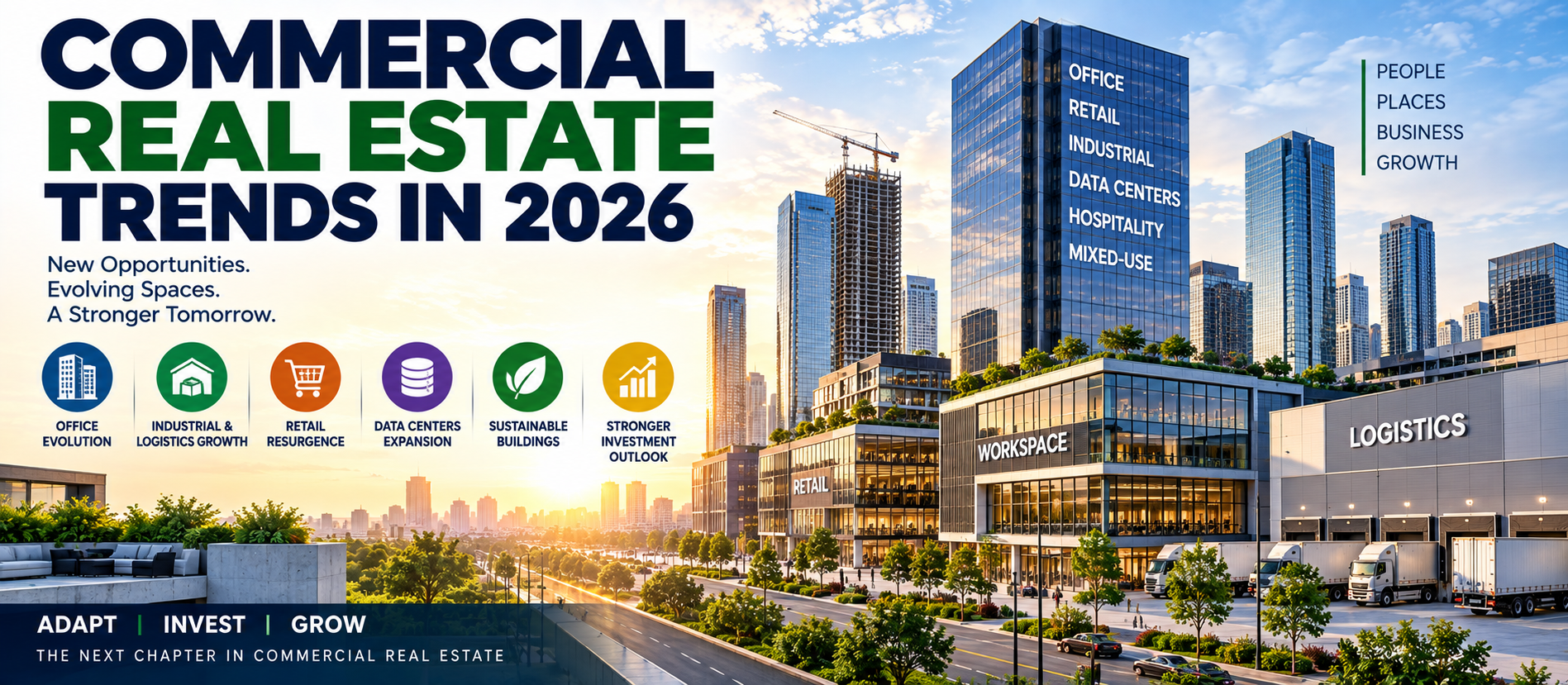
Commercial real estate is entering a new phase in 2026. The market is not moving in one direction. Different property types, locations, and asset qualities are producing very different results.
Office buildings are gradually stabilizing in many markets, but demand is concentrated in high-quality space. Industrial property is moving toward a healthier balance after several years of rapid construction. Retail remains more resilient than many expected, especially in grocery-anchored and service-focused locations. Multifamily demand remains supported by high housing costs and renter demand, although new supply is affecting rent growth in some markets.
💡 Key Insight
At the same time, data centers have become one of the most important growth areas in commercial real estate. Artificial intelligence is increasing demand for computing capacity, power, cooling, and specialized digital infrastructure. CBRE says data center demand continues to reach unprecedented levels, while preleasing for projects under construction is expected to reach about 80%.
Capital is also returning. CBRE forecasts U.S. commercial real estate investment activity to rise 16% in 2026 to about $562 billion. JLL reported that global cross-border commercial property investment increased 56% in the first half of 2026 to $71.8 billion. These figures point to improving investor activity, although borrowing costs remain an important constraint.
This guide explains the major commercial real estate trends in 2026 and what they mean for investors, landlords, developers, occupiers, and businesses.
1. Commercial Real Estate Is Moving Toward Selective Recovery
The 2026 market is better described as a selective recovery than a broad boom. Investment activity is improving, but investors are not treating every building equally. Property quality, location, tenant strength, lease structure, operating costs, and future adaptability have become more important.
⚠ Watch Out
Deloitte's 2026 Commercial Real Estate Outlook describes cautious optimism across the industry. It points to stabilizing property values and improved debt availability, while warning that refinancing, capital, regulation, and macroeconomic uncertainty remain important risks.
This creates a divide between assets with strong fundamentals and assets that require major repositioning. Buying a property at a lower price does not automatically make it a good investment. The future operating model matters as much as the entry price.
2. Office Real Estate Is Recovering, But Quality Matters More Than Ever
Office remains one of the most closely watched commercial real estate sectors. The post-pandemic market changed how companies use offices. Hybrid work reduced demand for some traditional office space, while companies still need locations for collaboration, training, client meetings, culture, and specialized work.
In 2026, demand is increasingly concentrated in better buildings. CBRE expects office performance to vary significantly between newer prime buildings and older secondary space. It also expects more scarcity in prime office space by the end of 2026.
CBRE's midyear review reported that office fundamentals were continuing to normalize, with demolitions and conversions outpacing new completions for the second consecutive year. It also reported that 64% of surveyed technology companies planned to grow their office footprint over the next three years.
What tenants want from modern offices
- Strong connectivity and digital infrastructure
- Flexible floor plans
- High-quality shared spaces
- Good transportation access
- Energy-efficient systems
- Reliable building operations
- Health and wellness features
- Spaces that support collaboration
Older buildings may still have value, but owners may need to invest in renovations, amenities, energy performance, technology, or alternative uses.
3. Office-to-Residential and Other Conversions Will Continue
Some older office buildings no longer fit the needs of modern tenants. This has increased interest in adaptive reuse. Conversions can include residential housing, hotels, student housing, medical facilities, educational uses, or other specialized purposes.
Conversion is not a simple solution. Building layouts, plumbing, zoning, financing, fire safety, windows, floor plates, and local regulations can determine whether a project is practical. Investors should evaluate conversion potential on a property-by-property basis.
4. Industrial Real Estate Is Moving Toward Equilibrium
Industrial real estate was one of the strongest commercial property sectors during the e-commerce expansion. Developers responded by building large amounts of warehouse and logistics space. By 2026, the market is moving toward a better balance between supply and demand.
CBRE expects industrial leasing activity to improve slightly in 2026, supported by reshoring of manufacturing and greater use of third-party logistics providers. It also expects occupiers to continue moving toward higher-quality industrial buildings.
Colliers reports that industrial construction has fallen significantly from its 2022 peak while demand is rising across logistics, manufacturing, data centers, and research and development.
Industrial features gaining importance
- Modern loading capacity
- High clear heights
- Strong truck access
- Large parking and yard areas
- Modern fire and safety systems
- Energy-efficient operations
- Good highway and population access
- Power availability for specialized uses
5. Logistics and Supply Chain Real Estate Remain Important
Consumers still expect fast delivery, while businesses want supply chains that are more resilient. This supports demand for warehouses and distribution facilities close to major population centers, highways, ports, airports, and manufacturing clusters.
Reshoring and nearshoring are also changing industrial demand. Companies are reviewing where products are manufactured and where inventory is stored. This can create demand for a wider range of industrial properties rather than only giant distribution centers.
6. Data Centers Are Reshaping Commercial Real Estate
Data centers are one of the defining commercial real estate trends of 2026. The growth of artificial intelligence, cloud computing, streaming, enterprise software, and digital services is increasing the need for computing infrastructure.
JLL says data center demand is at record levels globally. CBRE also reports unprecedented demand in the sector. But data center development is different from traditional real estate development. Land alone is not enough.
Developers need access to power, fiber connectivity, cooling systems, suitable zoning, and community acceptance. Power availability is becoming a major competitive factor. JLL's 2026 outlook identifies buildings and power as a major force shaping commercial real estate.
Data center growth affects land values, power infrastructure, industrial development, construction, utilities, and investment strategies. Communities may also be concerned about electricity demand, water use, noise, land use, and infrastructure requirements.
7. Artificial Intelligence Is Becoming a Real Estate Demand Driver
AI is not only changing office software. It is influencing the physical infrastructure of commercial real estate. AI requires computing capacity, which requires data centers, electricity, cooling, networking, and specialized facilities.
AI is also changing office requirements. Companies may need fewer routine workstations while increasing demand for high-quality spaces that support collaboration and specialized technical teams.
CBRE's India office outlook expects AI integration to increase demand for premium office environments with strong digital infrastructure, secure data zones, and adaptable layouts.
8. Multifamily Real Estate Remains Resilient
Multifamily housing continues to benefit from a basic structural factor: buying a home remains difficult for many households. When mortgage payments and home prices are high, renting can remain the more practical option for many households.
J.P. Morgan's 2026 commercial real estate analysis describes multifamily fundamentals as healthy and notes that debt capital remains relatively robust for the sector.
However, the multifamily market is not uniform. New apartment deliveries can increase competition in specific markets. When many new units open at the same time, landlords may need to offer concessions or control rent increases.
Colliers expects strong renter demand to support occupancy gains in 2026, while noting that the supply cycle affects the pace of rent growth.
9. Retail Real Estate Is More Resilient Than Expected
Retail has changed significantly, but physical stores remain important. Grocery stores, discount retailers, restaurants, healthcare services, fitness businesses, and other service providers can generate regular physical traffic.
CBRE expects retail demand in 2026 to be supported by grocery, discount, and service retailers. J.P. Morgan also reports strong momentum in grocery-anchored and neighborhood shopping centers and points to limited new supply as a supportive factor.
This means retail quality increasingly depends on tenant mix and location rather than simply the size of the shopping center.
10. Grocery-Anchored Centers Are Getting Attention
Grocery-anchored centers can attract frequent customer visits. This can create a strong environment for restaurants, healthcare providers, personal services, and other businesses.
These properties can also benefit from limited new construction in some markets. Investors should still review tenant concentration, lease expirations, anchor strength, parking, visibility, competition, and local household growth.
11. Hotels and Hospitality Are Finding a New Balance
Hospitality properties are also part of the 2026 commercial real estate recovery. JLL reported stronger investment activity across several property sectors, including hotels, while the National Association of REALTORS® reported relatively stable hospitality conditions in its May 2026 market review.
Hotel performance remains sensitive to business travel, leisure demand, operating costs, and local tourism. Investors should examine revenue per available room, occupancy, average daily rate, labor costs, renovation requirements, and local demand drivers.
12. Capital Markets Are Becoming More Active
Transaction activity is improving after a period when high interest rates and uncertainty caused many buyers and sellers to wait.
CBRE forecasts U.S. CRE investment activity to rise 16% in 2026. JLL reported that global cross-border investment rose 56% in the first half of 2026, reaching $71.8 billion.
This suggests that investors are becoming more willing to deploy capital. However, higher borrowing costs remain a constraint. Reuters reported that higher borrowing costs could limit commercial property investment later in 2026 because transaction volumes are closely linked to interest rates.
13. Refinancing Risk Remains a Major Issue
Many commercial loans written several years ago are approaching maturity. Owners may need to refinance at different interest rates and under different lending standards.
Deloitte identifies loan maturity pressure and refinancing challenges as important risks for the 2026 CRE market. Owners should review debt maturities early. Waiting until a loan is close to maturity can reduce available options.
14. Private Credit Is Playing a Larger Role
Traditional banks are not the only source of commercial real estate capital. Private credit funds and other alternative lenders are becoming more relevant as borrowers seek flexible financing solutions.
Deloitte notes that private credit sources and selected lenders are returning to the market with improved loan terms in some situations. Borrowers should carefully compare pricing, covenants, maturity dates, fees, prepayment terms, and collateral requirements.
15. Sustainability Is Becoming a Financial Issue
Sustainability is no longer only an environmental discussion. It can also affect operating costs, tenant demand, regulatory compliance, financing, and long-term asset value.
Energy-efficient HVAC systems, lighting, insulation, building controls, renewable energy, water efficiency, and better building envelopes can reduce operating expenses.
Owners should evaluate energy upgrades using actual operating data rather than assuming every green improvement will produce the same financial return.
16. Buildings and Power Are Becoming More Closely Connected
Commercial property increasingly depends on reliable electricity. This is especially important for data centers, advanced manufacturing, research facilities, and technology-intensive buildings.
JLL identifies energy security and the relationship between buildings and power as a major 2026 real estate force. For developers, available power capacity can influence where projects are built. For investors, it can become part of a property's competitive advantage.
17. Adaptive Reuse Will Remain Important
Some properties can create more value through a change of use than through traditional leasing. Vacant offices can potentially become housing. Older retail centers can be repositioned. Industrial buildings can be upgraded for advanced manufacturing or specialized logistics.
Adaptive reuse can reduce the need for entirely new construction, but feasibility is critical. Before pursuing a conversion, investors should review zoning, building codes, structural conditions, utility capacity, construction costs, financing, and market demand.
18. Location Quality Is Becoming More Specific
The idea of a “good location” is changing. For office buildings, access to talent, transit, amenities, and high-quality space matters. For logistics, highway and population access can be more important. For retail, visibility and customer convenience are critical. For data centers, power and connectivity can dominate the decision.
Commercial real estate investors should therefore define location quality according to the property's intended use.
19. Investors Are Paying More Attention to Asset Quality
One of the clearest 2026 trends is the growing gap between high-quality and lower-quality properties.
J.P. Morgan describes strong demand for high-quality office space while warning that lower-quality space is more exposed to obsolescence. In industrial real estate, CBRE similarly expects a flight to quality among occupiers.
Investors need to understand not only the property's current condition but also how competitive it will be five or ten years from now.
20. Commercial Real Estate Decisions Are Becoming More Data-Driven
Technology is changing how investors and property managers evaluate assets. Modern platforms can help track occupancy, rent collections, energy consumption, maintenance, tenant requests, leasing activity, and property performance.
AI can support document analysis, market research, forecasting, customer service, and workflow automation. However, AI does not remove the need for human judgment. Data quality, local knowledge, legal review, physical inspection, and financial analysis remain essential.
21. Flexible Space Is Still Relevant
Flexible offices and shared workspaces remain part of the commercial real estate ecosystem. Businesses may use flexible space to support project teams, expansion, temporary requirements, or hybrid work.
For landlords, flexible space can create additional leasing options. Operators must still manage occupancy, service costs, tenant turnover, and competition carefully.
22. Construction Costs Continue to Influence Development
Development decisions depend on land, labor, materials, financing, permitting, and expected rents or sales prices. Higher construction costs can make new projects difficult to justify. This can reduce future supply and support existing properties in strong locations.
At the same time, high costs can make obsolete buildings more attractive for renovation if the existing structure can be reused efficiently.
23. What These Trends Mean for Commercial Property Owners
Owners should focus on keeping assets competitive. That may mean upgrading technology, improving energy performance, modernizing common areas, improving tenant experience, or changing the property's use.
Owners should also review lease expirations and tenant concentration. A building with several major leases expiring at the same time can face significant income risk.
Preventive maintenance is equally important. Deferred maintenance can reduce tenant satisfaction and increase future capital requirements.
24. What These Trends Mean for Investors
Investors should evaluate properties based on both current income and future adaptability.
- Is the current rent sustainable?
- How strong are the tenants?
- When do major leases expire?
- What capital improvements are required?
- How much debt can the property support?
- What happens if interest rates remain high?
- Is the location gaining or losing demand?
- Can the building adapt to changing tenant needs?
- Are insurance and energy costs rising?
- What alternative uses could become possible?
25. What Businesses Should Watch Before Leasing Space
Occupiers should look beyond headline rent. Total occupancy cost can include base rent, operating expenses, taxes, insurance, utilities, parking, maintenance, tenant improvements, and other charges.
Businesses should also consider lease flexibility. A lower rent may not be attractive if the lease creates unnecessary long-term obligations or expensive exit conditions.
Technology infrastructure should also be checked. Businesses that rely heavily on cloud systems, AI tools, data security, or high-speed connectivity need reliable building infrastructure.
26. How to Prepare for the Rest of 2026
Commercial real estate participants should prepare for a market that remains active but selective. Owners should stress-test financing and operating assumptions. Investors should compare opportunities using realistic interest-rate and occupancy scenarios. Developers should confirm power, construction costs, tenant demand, and permitting before committing large amounts of capital.
Businesses should review whether their current space supports their workforce strategy. Most importantly, decisions should be based on current local data rather than broad national headlines.
Frequently Asked Questions
What are the biggest commercial real estate trends in 2026?
The major trends include selective office recovery, flight to quality, industrial rebalancing, resilient retail, continued multifamily demand, rapid data center growth, AI-driven infrastructure demand, improving investment activity, refinancing pressure, and greater attention to power, energy, and adaptive reuse.
Is office real estate recovering in 2026?
Office recovery is occurring unevenly. Prime and high-quality buildings are attracting stronger demand, while older or less competitive properties face greater pressure.
Is industrial real estate still important?
Yes. Industrial remains an important sector, but the market is becoming more balanced after heavy construction. Logistics, manufacturing, data centers, and R&D are supporting demand for selected properties.
Why are data centers important?
AI, cloud computing, and digital services are increasing demand for data center capacity. Power, connectivity, cooling, and suitable land have become major real estate considerations.
Is retail commercial real estate still relevant?
Yes. Retail remains important, particularly in grocery-anchored, neighborhood, discount, and service-focused centers. Limited new supply can support selected properties.
What is a major CRE risk in 2026?
There is no single risk for every property. Refinancing, borrowing costs, tenant demand, obsolete buildings, construction costs, regulation, and economic uncertainty can all affect performance.
Final Thoughts
Commercial real estate in 2026 is becoming more selective, technology-driven, and focused on asset quality.
The office market is recovering in some locations, but high-quality buildings are gaining a larger share of demand. Industrial real estate is moving toward equilibrium while modern logistics and manufacturing facilities remain important. Retail continues to benefit from physical consumer demand and limited supply in many markets. Multifamily remains supported by rental demand, although new apartment supply can limit rent growth in specific locations.
Data centers and AI infrastructure are creating a different source of commercial property demand. Power availability, connectivity, cooling, and specialized infrastructure are becoming strategic real estate factors.
Capital markets are also becoming more active. Yet higher borrowing costs and refinancing requirements mean investors still need disciplined financial analysis.
The central lesson for 2026 is that commercial real estate is not one market. It is a collection of local markets and property types with different drivers.
Investors, owners, developers, and businesses should focus on the fundamentals that matter for each asset. Strong locations, quality buildings, reliable tenants, efficient operations, adaptable space, sound financing, and realistic demand assumptions can help properties remain competitive as the market evolves.
For real estate businesses that want to improve their digital visibility, content strategy, and online marketing, visit Digiifrog at www.digiifrog.com.
AEO and AI Search Summary
Direct Answer: The biggest commercial real estate trends in 2026 are selective office recovery, stronger demand for high-quality buildings, industrial market rebalancing, resilient retail, steady multifamily demand, rapid data center expansion, AI-driven infrastructure demand, improving investment activity, refinancing pressure, and greater focus on power, energy efficiency, and adaptive reuse. Market performance varies widely by property type and location, so investors and businesses should evaluate tenant demand, asset quality, financing, operating costs, and long-term adaptability before making decisions.
Ready to Grow?
Talk to us about a strategy tailored to your brand — we will help you stand out in search, AI discovery and social.
Comments (0)
Log in to leave a comment.