📋 Quick Summary
In this article:
What Is Conversion Rate Optimization?
Why CRO Matters for Business Growth
1. Define Your Primary Conversion Goal
2. Audit Your Current Conversion Funnel
3. Use Analytics to Find Conversion Problems
4. Understand Your Customers
5. Improve the Value Proposition
Simple Value Proposition Structure
6. Optimize Landing Pages
Important Landing Page Elements
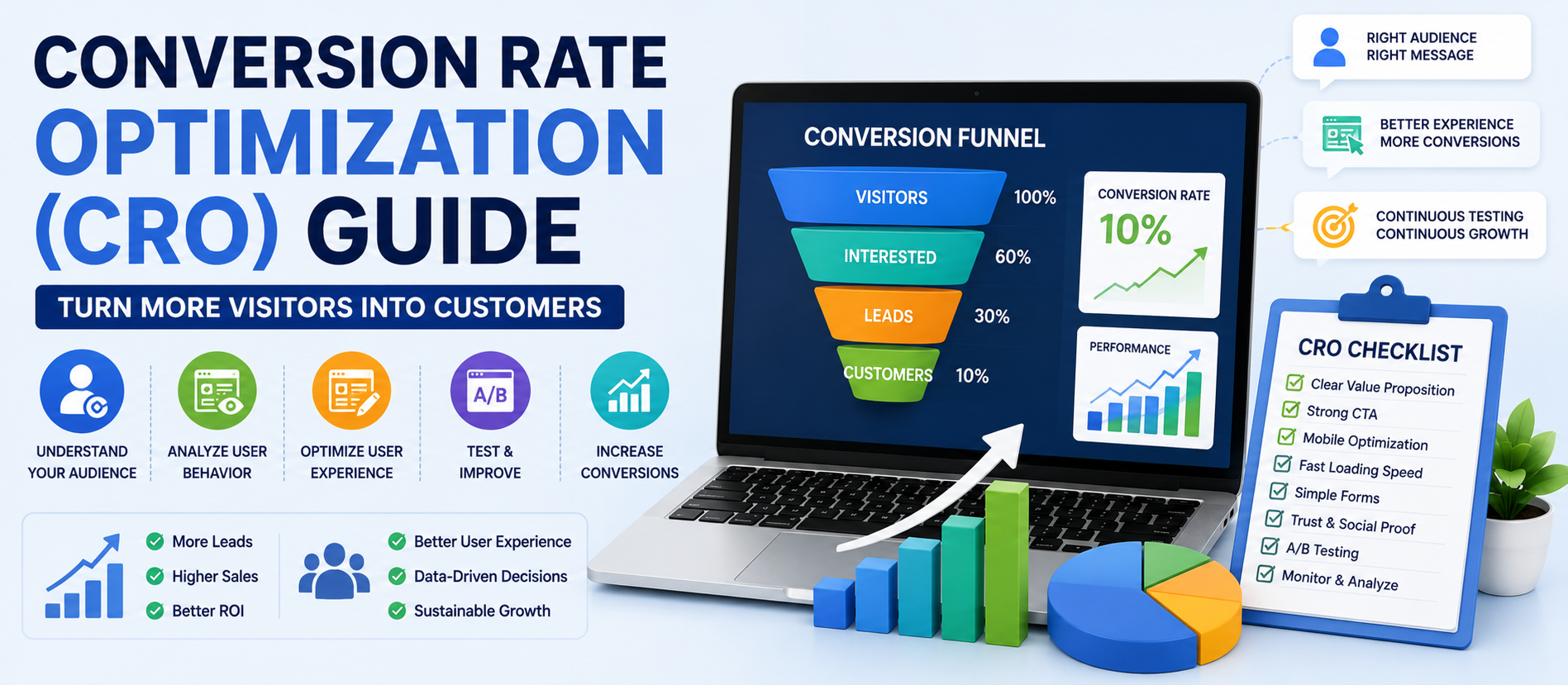
Conversion Rate Optimization (CRO) is the systematic process of improving a website, landing page, funnel, or digital experience so that more visitors complete a valuable action. That action might be a purchase, lead submission, demo request, booking, registration, phone call, subscription, or another business goal.
💡 Key Insight
CRO is not simply about changing button colors or making a headline larger. Effective CRO strategy combines analytics, user research, messaging, usability, landing-page optimization, experimentation, and business data. Google Analytics provides tools for measuring important user actions as conversions and connecting those actions with marketing performance, while established CRO practice emphasizes research and testing rather than relying on assumptions. citeturn0search0turn0search10
This complete Conversion Rate Optimization Guide explains how businesses can build a practical CRO process in 2026, improve landing pages, reduce friction, use analytics, run better A/B tests, and connect CRO with SEO, AEO, GEO, and AI Search Optimization.
Company: Designfo
Website: www.designfo.in
Contact: +91 9831037463
What Is Conversion Rate Optimization?
Conversion Rate Optimization focuses on increasing the percentage of visitors who complete a desired action. The basic formula is:
Conversion Rate = Number of Conversions ÷ Number of Relevant Visitors × 100
For example, if 1,000 relevant visitors produce 40 completed enquiries, the conversion rate is 4%.
The goal is not always to maximize the percentage at any cost. A good CRO program should improve the quality and business value of conversions as well. More low-quality leads are not necessarily better than fewer qualified opportunities.
Why CRO Matters for Business Growth
Traffic acquisition can be expensive. CRO helps businesses get more value from the visitors they already attract. Better conversion performance can improve the efficiency of paid campaigns, organic traffic, email campaigns, referrals, and other acquisition channels.
- Generate more leads from existing traffic.
- Increase ecommerce purchases.
- Improve landing-page performance.
- Reduce friction in forms and checkout.
- Improve marketing ROI.
- Understand customer behavior.
- Identify problems in the conversion funnel.
CXL describes conversion optimization as a process rather than a collection of isolated best practices, emphasizing research, frameworks, and experimentation. citeturn0search10
1. Define Your Primary Conversion Goal
Start by deciding what action matters most. Different businesses need different conversion goals.
- B2B: Demo request, qualified lead, consultation, or sales opportunity.
- Ecommerce: Purchase, checkout completion, or subscription.
- Local business: Call, booking, enquiry, or direction request.
- SaaS: Trial registration, activation, or paid upgrade.
- Publisher: Subscription, registration, or meaningful engagement.
Google Analytics allows businesses to mark valuable actions as conversions and use conversion data to improve marketing decisions. citeturn0search0
2. Audit Your Current Conversion Funnel
Before changing a page, understand where users are dropping out. A typical funnel might include:
- Ad, search result, email, or referral.
- Landing page visit.
- Product or service evaluation.
- Form, cart, or checkout interaction.
- Conversion.
- Sales or customer onboarding.
Compare performance at each stage. A high-traffic landing page with a very low conversion rate may deserve attention before a low-traffic page with the same percentage.
3. Use Analytics to Find Conversion Problems
Website analytics can reveal traffic sources, landing pages, device categories, engagement, events, and conversion behavior. Google Analytics measures events and can identify which actions are important to the business. citeturn0search11
Useful CRO Data
- Landing-page traffic
- Conversion rate
- Traffic source
- Device type
- Form starts and completions
- Checkout abandonment
- Returning vs. new users
- Revenue per visitor
Do not make decisions from a single metric. Combine quantitative data with qualitative research.
4. Understand Your Customers
Numbers tell you what happened; customer research can help explain why. Talk to customers, review support questions, examine sales-call notes, analyze reviews, and study objections that repeatedly appear during the buying process.
Questions to Investigate
- Why did customers choose your solution?
- What problem were they trying to solve?
- What almost stopped them from buying?
- What information was missing?
- Which alternatives did they consider?
- What created trust?
These insights can improve headlines, product descriptions, FAQs, calls to action, proof, and offers.
5. Improve the Value Proposition
A strong value proposition tells visitors what you offer, who it is for, and why it is useful. Generic statements such as "We provide high-quality solutions" do not explain enough.
Make the benefit specific. Explain the problem you solve, the outcome customers can expect, and what makes your approach different.
Simple Value Proposition Structure
For [target audience], we help you [desired outcome] by [key solution or differentiator].
Keep the wording understandable and support it with evidence.
6. Optimize Landing Pages
A high-converting landing page should guide visitors toward a clear next step. CXL's current landing-page guidance emphasizes clear messaging, value, relevance, trust, usability, and data-driven testing. citeturn0search5turn0search7
Important Landing Page Elements
- Clear headline
- Supporting subheadline
- Relevant visual
- Specific benefits
- Social proof
- Trust signals
- Objection handling
- Strong call to action
- Simple conversion path
Do not automatically assume that every important element must appear above the fold. The best layout depends on the offer, audience, and amount of information required before a visitor is ready to act. Testing is more reliable than blindly following generic rules. citeturn0search1
7. Reduce Conversion Friction
Conversion friction includes anything that makes the desired action confusing, difficult, slow, or risky.
- Too many form fields
- Unclear pricing
- Complicated navigation
- Slow page loading
- Unexpected costs
- Weak trust signals
- Unclear next steps
- Technical errors
Reduce unnecessary steps while keeping the information required for a good customer experience and useful lead qualification.
8. Make Calls to Action Clear
A CTA should tell visitors what happens next. "Submit" is functional, but "Get My Free Audit" or "Book a Strategy Call" can communicate more context when those actions accurately describe the experience.
Use one primary action for pages where a single conversion goal is appropriate. Multiple competing CTAs can distract visitors, particularly on focused landing pages. citeturn0search12
9. Build Trust With Social Proof
People are more comfortable taking action when they understand that other customers have had positive experiences. Use relevant and authentic proof.
- Customer testimonials
- Case studies
- Ratings and reviews
- Client logos where permitted
- Industry certifications
- Security or payment assurances
- Specific performance results with context
Social proof should support the exact decision visitors are making rather than simply decorate the page.
10. Improve Forms and Checkout Experiences
Forms are often a major conversion point. Ask only for information that is necessary at that stage of the customer journey. For higher-value B2B leads, additional fields may be justified if they improve qualification, but unnecessary fields can increase friction.
For ecommerce, review every checkout step, payment option, shipping disclosure, error message, and mobile interaction. Small usability problems can create significant abandonment when repeated across many sessions.
11. Optimize for Mobile Users
A CRO strategy should consider the experience across screen sizes. Check button sizes, form fields, text readability, navigation, image loading, sticky elements, and checkout interactions on mobile devices.
Do not assume the desktop version represents the entire customer experience. Compare conversion performance by device and investigate meaningful differences.
12. Improve Page Speed and Technical Experience
Technical problems can create conversion friction even when the copy and design are strong. Check page loading, broken elements, JavaScript errors, form failures, payment problems, and tracking issues.
Google's current Analytics troubleshooting documentation recommends validating tags, events, consent behavior, and data collection when analytics results do not match expectations. citeturn0search6
13. Use A/B Testing to Validate Ideas
A/B testing compares different versions of a page or element to determine which performs better against a defined goal. Examples include testing headlines, CTA copy, form length, page structure, offers, or product messaging.
Do not treat testing as a way to prove that your favorite idea is correct. Start with a hypothesis and let the data challenge your assumptions. CXL's CRO guidance emphasizes hypothesis-driven testing and warns against stopping tests too early or testing without enough data. citeturn0search9turn0search24
17. Use CRO for SEO, AEO, GEO, and AI Search
⚠ Watch Out
CRO and SEO should support each other. SEO can bring qualified visitors, while CRO helps those visitors take useful actions. Avoid optimizing a page for search in ways that damage clarity or user experience.
For AEO, answer important customer questions clearly. For GEO and AI Search Optimization, make your business information, expertise, services, evidence, and answers clear and consistent.
Useful conversion-focused content can include comparison pages, service guides, FAQs, case studies, calculators, checklists, and detailed product information.
18. Measure Revenue, Not Just Conversion Rate
A higher conversion rate is not automatically better if the additional conversions are low quality or unprofitable. Track downstream outcomes where possible.
- Qualified leads
- Sales opportunities
- Revenue
- Average order value
- Customer acquisition cost
- Customer lifetime value
- Revenue per visitor
Google's conversion reporting can attribute conversion credit to marketing touchpoints using supported attribution models, helping businesses evaluate campaign effectiveness beyond simple event counts. citeturn0search14
20. Build a Continuous CRO Process
CRO should not be a one-time redesign project. Treat it as an ongoing improvement cycle.
- Measure: Collect reliable data.
- Research: Understand users and problems.
- Prioritize: Select high-impact opportunities.
- Hypothesize: Define what should improve and why.
- Test: Compare the change against a suitable control.
- Learn: Document the result.
- Iterate: Apply the learning to the next experiment.
This process helps businesses replace guesswork with evidence-based optimization.
How Designfo Helps With Conversion Rate Optimization
Designfo helps businesses improve digital performance by connecting Conversion Rate Optimization with landing-page design, analytics, SEO, AEO, GEO, AI Search Optimization, paid advertising, content strategy, and marketing automation.
Designfo Digital Growth Services
- Conversion Rate Optimization
- Landing Page Optimization
- Analytics and A/B Testing
- SEO, AEO, GEO and AI Search Optimization
- Paid Marketing and Marketing Automation
Frequently Asked Questions
What is Conversion Rate Optimization?
Conversion Rate Optimization is the systematic process of improving digital experiences so more relevant visitors complete valuable actions such as purchases, enquiries, bookings, or registrations.
What is a good conversion rate?
There is no universal good conversion rate. It varies by industry, traffic source, offer, device, audience intent, business model, and conversion definition. Compare performance against your own baseline and business objectives.
What should I optimize first?
Start with high-traffic or high-value pages and the largest evidence-based conversion problems. Prioritize opportunities using potential impact rather than choosing changes because they are visually noticeable.
Is A/B testing necessary for CRO?
A/B testing is an important CRO method, but it is not the only one. Analytics, customer research, usability studies, surveys, session analysis, and funnel analysis can help identify problems and generate test hypotheses.
How can CRO support AI Search Optimization?
CRO can encourage businesses to make their content clearer, more useful, and better aligned with customer questions. Strong FAQs, comparisons, service explanations, proof, and structured customer journeys can support both user experience and broader search visibility.
Conclusion
A successful Conversion Rate Optimization strategy is built on evidence rather than guesswork. Start by defining meaningful business conversions, understand how visitors move through your funnel, use analytics to identify problems, and research why users hesitate or act.
Then improve the value proposition, landing-page structure, forms, CTAs, trust signals, mobile experience, and technical performance. Use A/B testing to validate important hypotheses and prioritize experiments according to potential impact. Measure qualified leads, revenue, and customer value—not just clicks or raw conversion volume.
Most importantly, treat CRO as an ongoing process. Customer expectations, traffic sources, offers, competitors, and digital experiences change continuously. A disciplined cycle of measurement, research, prioritization, testing, and learning can turn CRO into a long-term growth system.
When connected with SEO, AEO, GEO, AI Search Optimization, paid advertising, content marketing, CRM, and marketing automation, CRO helps businesses get more value from the attention they already earn.
Company: Designfo
Website: www.designfo.in
Contact: +91 9831037463
Ready to Grow?
Talk to us about a strategy tailored to your brand — we will help you stand out in search, AI discovery and social.
Comments (0)
Log in to leave a comment.