📋 Quick Summary
In this article:
What Is Autonomous Vehicle Cyber Security?
Vehicle-to-Everything (V2X) Attacks
AI and Machine Learning Security
💡 Key Insight
Autonomous vehicles (AVs) are transforming transportation by combining artificial intelligence, sensors, cloud computing, GPS, cameras, radar, LiDAR, and high-speed connectivity. While these technologies improve safety, efficiency, and convenience, they also introduce new cyber security risks. Protecting autonomous vehicles from cyber threats is essential for passenger safety, privacy, and public trust.
This WordPress-ready article explains the importance of cyber security for autonomous vehicles, common threats, security technologies, regulations, best practices, and future trends. It is optimized for SEO, AEO, GEO, and AI Search optimization.
What Is Autonomous Vehicle Cyber Security?
Autonomous vehicle cyber security involves protecting connected vehicles, onboard software, communication systems, sensors, and cloud services from unauthorized access, manipulation, and cyber attacks throughout the vehicle lifecycle.
Why Cyber Security Matters
- Protects passenger safety.
- Prevents unauthorized vehicle control.
- Safeguards personal and location data.
- Maintains vehicle reliability.
- Supports regulatory compliance and public confidence.
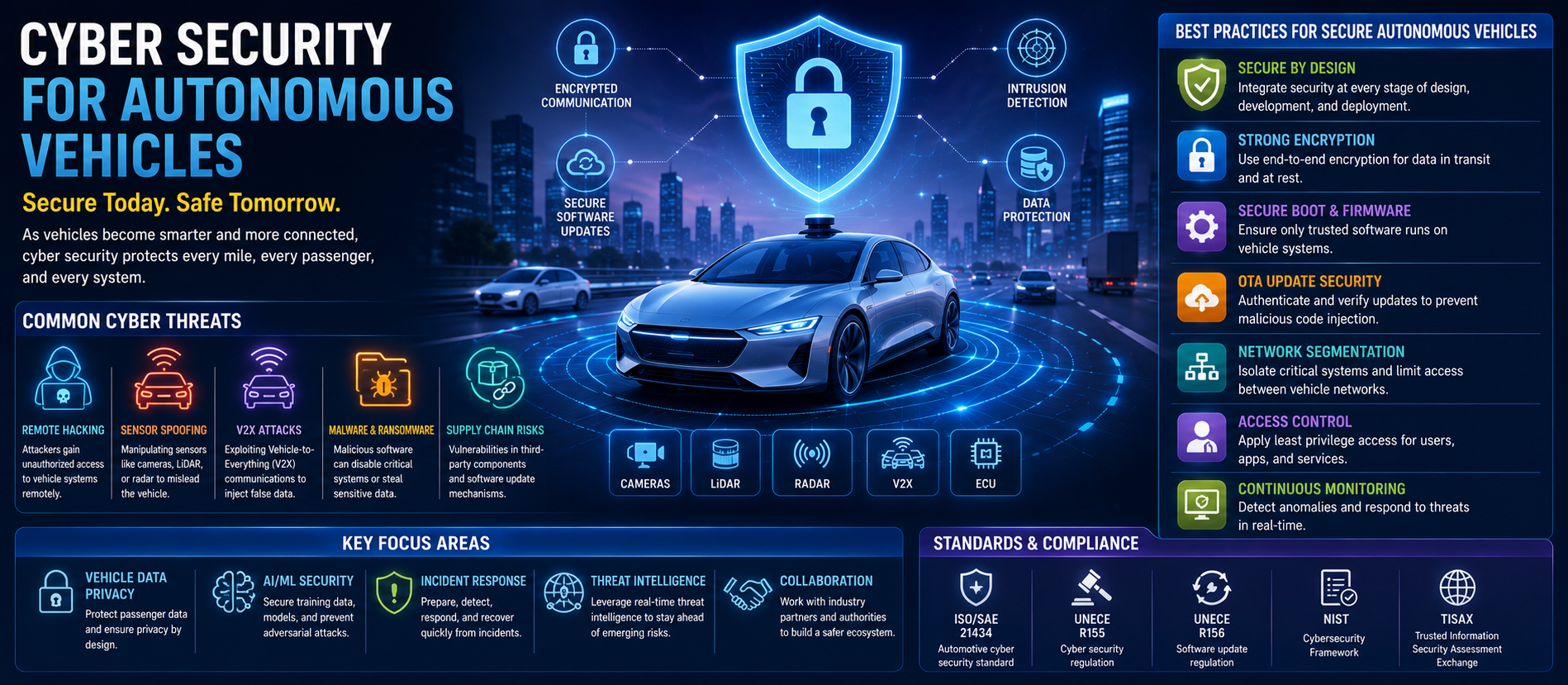
Common Cyber Threats
Remote Vehicle Hacking
Attackers may attempt to exploit software vulnerabilities to access vehicle systems.
Sensor Manipulation
False signals or interference may affect cameras, radar, GPS, or LiDAR inputs.
Vehicle-to-Everything (V2X) Attacks
Compromised communications can disrupt information exchanged between vehicles and infrastructure.
Malware and Ransomware
Malicious software can target connected infotainment, telematics, or backend systems.
Supply Chain Risks
Third-party hardware and software components require strong security verification.
Security Best Practices
- Implement Secure-by-Design development.
- Use strong encryption for stored and transmitted data.
- Enable secure boot and code signing.
- Deploy regular over-the-air (OTA) security updates.
- Monitor vehicle networks continuously.
- Segment critical safety systems from infotainment systems.
- Conduct penetration testing and vulnerability assessments.
- Apply Zero Trust principles where appropriate.
AI and Machine Learning Security
AI-powered detection systems help identify abnormal driving behavior, network anomalies, and attempted intrusions while supporting faster incident response.
Privacy and Compliance
Manufacturers should minimize unnecessary data collection, protect user privacy, and follow applicable automotive cyber security standards and data protection regulations.
Future Trends
Future autonomous vehicle security will include quantum-resistant cryptography, AI-assisted defense, hardware security modules, secure V2X communication, digital twins, and continuous cyber resilience testing.
SEO, AEO & GEO Optimized FAQs
Why is cyber security important for autonomous vehicles?
It protects passengers, connected systems, and sensitive data while helping ensure safe and reliable vehicle operation.
What are the biggest cyber risks?
Remote hacking, sensor spoofing, software vulnerabilities, malware, and supply-chain compromises are major concerns.
How can manufacturers improve security?
By using encryption, secure software development, OTA updates, continuous monitoring, penetration testing, and strong access controls.
Conclusion
As autonomous vehicles become more common, cyber security will remain fundamental to innovation and public safety. A layered security strategy combining secure engineering, AI-driven monitoring, regular updates, and proactive risk management can help protect next-generation transportation systems.
For more expert insights on Cyber Security, Autonomous Vehicles, SEO, AEO, GEO, and AI Search Optimization, visit Digiifrog at www.digiifrog.com.
Ready to Grow?
Talk to us about a strategy tailored to your brand — we will help you stand out in search, AI discovery and social.


Comments (0)
Log in to leave a comment.