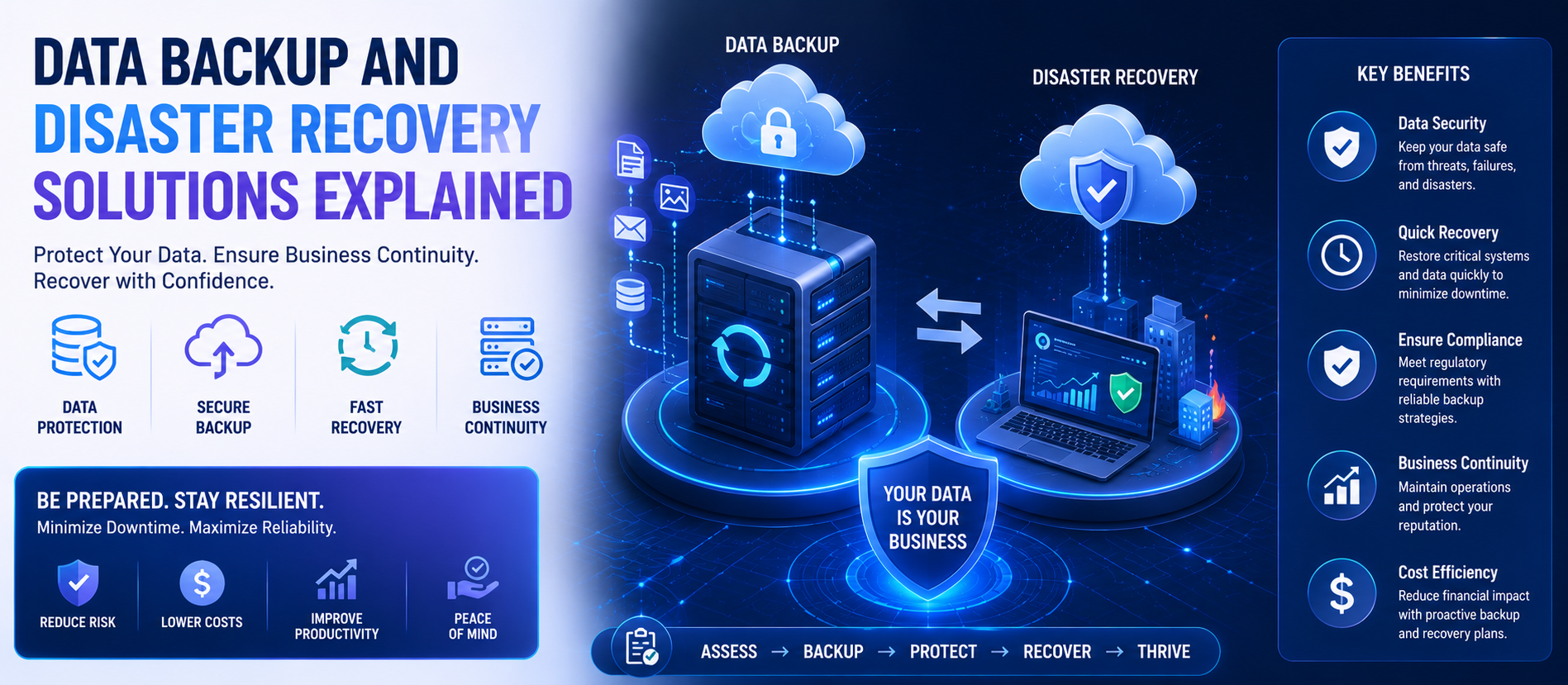
📋 Quick Summary
In this article:
Primary Objectives of Data Backup
Why Data Backup and Disaster Recovery Matter
Types of Data Backup Solutions
On-Premises Backup Solutions
In today's digital-first business environment, data has become one of the most valuable assets an organization possesses. From customer records and financial information to operational data and intellectual property, businesses rely heavily on data to drive decisions, maintain operations, and serve customers effectively.
However, data is constantly at risk from cyberattacks, ransomware, hardware failures, software corruption, human errors, natural disasters, and unexpected system outages. Without a proper backup and disaster recovery strategy, organizations may face devastating financial losses, reputational damage, regulatory penalties, and prolonged downtime.
💡 Key Insight
This is why Data Backup and Disaster Recovery (BDR) solutions have become essential components of modern business continuity planning. Effective backup and recovery strategies help organizations protect critical information, minimize downtime, and recover quickly from disruptive events.
This comprehensive guide explains data backup and disaster recovery solutions, their importance, key technologies, best practices, implementation strategies, and how modern organizations leverage SEO, AEO, GEO, and AI Search Optimization alongside digital resilience initiatives.
What Is Data Backup?
Data backup refers to the process of creating copies of data and storing them in secure locations to ensure recovery in case of data loss or corruption.
Primary Objectives of Data Backup
- Protect business information
- Prevent permanent data loss
- Support regulatory compliance
- Enable rapid recovery
- Ensure business continuity
- Reduce operational risks
Backups act as a safety net that allows businesses to restore information when unexpected incidents occur.
What Is Disaster Recovery?
Disaster recovery refers to the policies, procedures, technologies, and processes used to restore systems, applications, and operations following a disruptive event.
Disaster Recovery Goals
- Minimize downtime
- Restore critical systems
- Protect customer data
- Reduce financial losses
- Maintain service availability
- Ensure operational resilience
Disaster recovery focuses on restoring business operations as quickly and efficiently as possible.
Why Data Backup and Disaster Recovery Matter
Organizations face numerous threats that can disrupt operations and compromise data integrity.
Common Causes of Data Loss
- Ransomware attacks
- Cybersecurity breaches
- Hardware failures
- Software errors
- Human mistakes
- Natural disasters
- Power outages
- Network failures
Without proper backup and recovery solutions, businesses may struggle to recover critical information and resume operations.
Types of Data Backup Solutions
Full Backup
A full backup copies all selected data to a backup location.
Incremental Backup
Incremental backups only save data that has changed since the previous backup.
Differential Backup
Differential backups capture changes made since the last full backup.
Mirror Backup
Mirror backups create exact copies of source data in real time.
Each method offers unique advantages depending on business requirements and recovery objectives.
On-Premises Backup Solutions
Traditional backup systems store data within an organization's own infrastructure.
Advantages
- Direct control
- Fast local recovery
- Enhanced customization
- Internal security management
Challenges
- Higher hardware costs
- Maintenance requirements
- Limited scalability
Cloud Backup Solutions
Cloud backup services have become increasingly popular because they offer flexibility, scalability, and remote accessibility.
Benefits of Cloud Backups
- Offsite data protection
- Automatic backups
- Scalable storage capacity
- Reduced infrastructure costs
- Enhanced accessibility
Cloud solutions help businesses improve resilience while reducing operational complexity.
Hybrid Backup Strategies
Many organizations adopt hybrid approaches that combine local and cloud backups.
This strategy offers the advantages of both environments while improving redundancy and recovery options.
Hybrid Benefits
- Faster local recovery
- Offsite protection
- Improved reliability
- Greater flexibility
Understanding RPO and RTO
Two important disaster recovery metrics are Recovery Point Objective (RPO) and Recovery Time Objective (RTO).
Recovery Point Objective (RPO)
RPO defines the maximum amount of data loss an organization can tolerate.
Recovery Time Objective (RTO)
RTO defines the maximum acceptable downtime following a disruption.
These metrics help organizations design effective recovery strategies.
Business Continuity and Disaster Recovery Planning
Disaster recovery is a critical component of broader business continuity planning.
Planning Components
- Risk assessments
- Data classification
- Backup policies
- Recovery procedures
- Testing schedules
- Employee training
Comprehensive planning improves organizational resilience and preparedness.
Cybersecurity and Backup Protection
Modern cyber threats make backup security more important than ever.
Security Best Practices
- Encryption
- Multi-factor authentication
- Access controls
- Backup isolation
- Threat monitoring
- Regular security audits
Secure backups reduce vulnerability to ransomware and cyberattacks.
Disaster Recovery as a Service (DRaaS)
Disaster Recovery as a Service (DRaaS) allows organizations to outsource recovery infrastructure and processes to specialized providers.
DRaaS Benefits
- Lower capital expenses
- Scalable recovery resources
- Expert management
- Faster recovery capabilities
DRaaS is becoming increasingly popular among small and medium-sized businesses.
Artificial Intelligence in Backup and Recovery
Artificial Intelligence is transforming data protection and disaster recovery.
AI Applications
- Predictive failure analysis
- Threat detection
- Backup optimization
- Automated recovery workflows
- Risk assessment
AI improves efficiency, accuracy, and response speed.
Testing Backup and Recovery Plans
Many organizations create backup strategies but fail to test them regularly.
Testing Benefits
- Identify weaknesses
- Validate recovery procedures
- Improve employee readiness
- Ensure compliance
- Reduce recovery risks
Regular testing increases confidence and preparedness.
Compliance and Regulatory Requirements
Many industries must comply with regulations regarding data protection and recovery capabilities.
Common Compliance Areas
- Data privacy
- Information security
- Retention policies
- Audit requirements
- Business continuity standards
Compliance reduces legal and operational risks.
SEO, AEO, GEO and AI Search Considerations
Technology companies providing backup and disaster recovery solutions increasingly rely on digital visibility to attract customers.
SEO Optimization
Improve search engine rankings for backup and cybersecurity services.
AEO Optimization
Provide direct answers to common data protection questions.
GEO Optimization
Increase visibility in AI-generated search experiences.
AI Search Optimization
Create authoritative, structured content that AI systems can reference.
Common Backup and Recovery Mistakes
- Infrequent backups
- Lack of testing
- Poor documentation
- Single-location storage
- Weak security controls
- Unclear recovery procedures
⚠ Watch Out
Avoiding these mistakes improves resilience and recovery success.
Best Practices for Data Protection
- Follow the 3-2-1 backup rule
- Automate backup processes
- Use encryption
- Test recovery procedures regularly
- Monitor backup performance
- Maintain disaster recovery documentation
- Train employees
These best practices strengthen business continuity and operational resilience.
The Future of Backup and Disaster Recovery
The future of data protection will be driven by AI, automation, cloud-native architectures, predictive analytics, cybersecurity innovation, and increasingly sophisticated disaster recovery platforms.
Organizations that invest in modern backup and recovery solutions will be better prepared to navigate evolving threats and business challenges.
Conclusion
Data backup and disaster recovery solutions are essential for protecting business operations, minimizing downtime, and ensuring long-term resilience. By implementing effective backup strategies, leveraging cloud technologies, strengthening cybersecurity, and continuously testing recovery plans, organizations can safeguard their most valuable digital assets.
At Digiifrog, we help businesses grow through SEO, AEO, GEO, AI Search Optimization, digital transformation, cybersecurity awareness, and technology-driven growth strategies.
Website: www.digiifrog.com
Ready to Grow?
Talk to us about a strategy tailored to your brand — we will help you stand out in search, AI discovery and social.
Comments (0)
Log in to leave a comment.