📋 Quick Summary
In this article:
Why Data-Driven Marketing Matters
Core Data-Driven Marketing Strategies
1. Define Measurable Business Goals
2. Build a Reliable Data Foundation
3. Segment Audiences
4. Personalize Customer Experiences
5. Use Predictive Analytics
6. Continuously Test and Optimize
Introduction
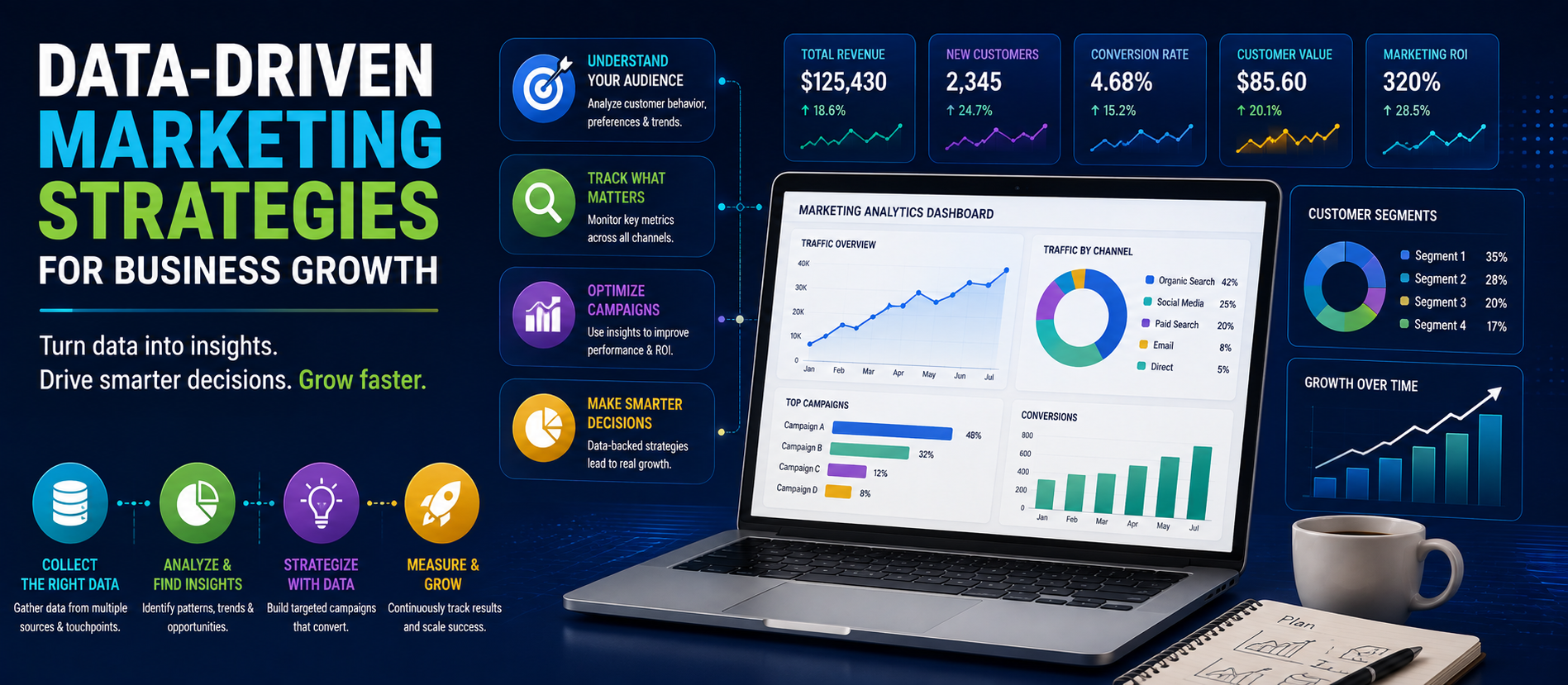
Data-driven marketing enables businesses to make informed decisions based on customer behavior, campaign performance, and measurable insights instead of assumptions. By combining analytics, artificial intelligence, automation, and customer intelligence, organizations can improve targeting, increase conversions, and maximize marketing return on investment. Modern marketers who embrace data-driven strategies are better equipped to personalize experiences, optimize budgets, and build sustainable long-term growth.
This WordPress-ready guide from Digiifrog explores practical data-driven marketing strategies for business growth. It is optimized for SEO, AEO, GEO, and AI Search Optimization.
Website: www.digiifrog.com
Why Data-Driven Marketing Matters
- Improves campaign performance through measurable insights.
- Enhances customer targeting and personalization.
- Optimizes marketing budgets and resource allocation.
- Supports faster, evidence-based decision-making.
- Increases customer retention and lifetime value.
Core Data-Driven Marketing Strategies
1. Define Measurable Business Goals
Establish SMART objectives and align marketing KPIs with overall business outcomes.
2. Build a Reliable Data Foundation
Integrate website analytics, CRM systems, advertising platforms, and customer databases to create a unified view of performance.
3. Segment Audiences
Group customers based on demographics, interests, purchase history, engagement, and behavior for more relevant campaigns.
4. Personalize Customer Experiences
Use behavioral insights to deliver personalized content, email campaigns, product recommendations, and offers.
5. Use Predictive Analytics
Leverage AI and machine learning to forecast trends, identify high-value prospects, and improve marketing efficiency.
6. Continuously Test and Optimize
Perform A/B testing, monitor campaign metrics, and refine messaging based on performance data.
Marketing Dashboard KPIs
- Organic Traffic
- Conversion Rate
- Cost Per Acquisition (CPA)
- Return on Ad Spend (ROAS)
- Customer Lifetime Value (CLV)
- Retention Rate
- Revenue Growth
Optimization Checklist
- Track GA4 events and conversions.
- Review dashboards weekly.
- Improve attribution accuracy.
- Refresh audience segments.
- Optimize for SEO, AEO, GEO, and AI Search.
- Automate repetitive reporting tasks.
Conclusion
Data-driven marketing empowers businesses to replace guesswork with measurable insights. Organizations that combine analytics, automation, AI, and continuous optimization can improve customer experiences, increase revenue, and achieve sustainable digital growth.
Digiifrog
Website: www.digiifrog.com
This unique draft is designed for expansion into a fully original 2,200–2,800+ word article featuring GA4 implementation, attribution models, AI-powered analytics, dashboard templates, real-world case studies, and 25–30 AEO-focused FAQs.
Ready to Grow?
Talk to us about a strategy tailored to your brand — we will help you stand out in search, AI discovery and social.


Comments (0)
Log in to leave a comment.