📋 Quick Summary
In this article:
What Is Data Privacy Compliance?
Why Data Privacy Compliance Matters
Data Privacy Compliance in India
Step 1: Create a Complete Data Inventory
Your Data Inventory Should Record:
Step 2: Define a Clear Purpose for Every Collection Activity
Step 3: Build a Clear Notice and Consent Process
A Good Privacy Notice Should Explain:
Step 4: Create a Privacy Policy That Matches Reality
Step 5: Control Access to Personal Data
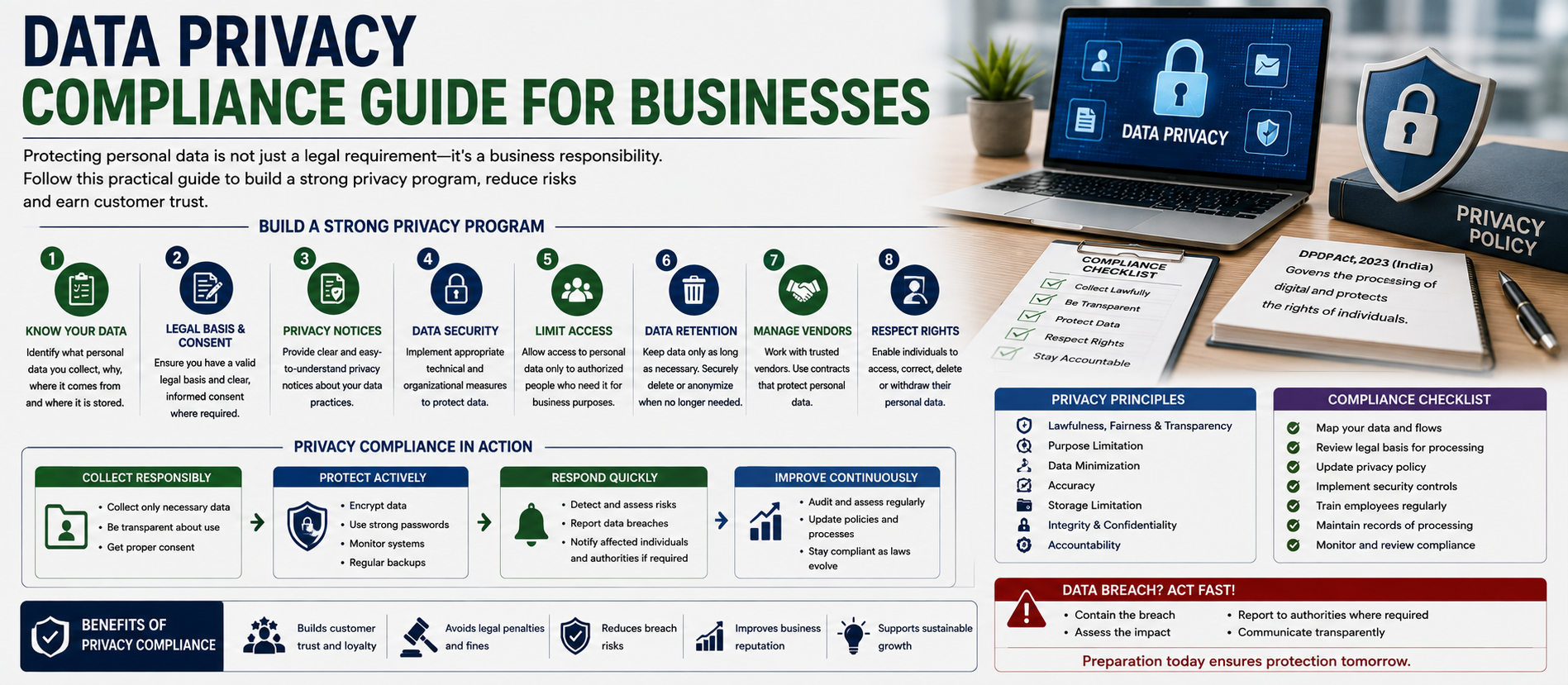
Data privacy is now a core business responsibility. Companies collect customer names, phone numbers, email addresses, payment details, employee records, website analytics and many other forms of information. If this information is collected or used carelessly, the business can face legal, financial, operational and reputational risks.
A strong data privacy compliance program helps a business understand what personal data it handles, why it handles that data, where the data is stored, who can access it and how long it should be retained.
This guide provides a practical, easy-to-read framework for businesses. It is written with India in mind while also highlighting broader privacy principles that are useful for organizations serving customers across multiple markets.
What Is Data Privacy Compliance?
Data privacy compliance means following the laws, regulations, contractual duties and internal policies that apply to the collection, use, storage, sharing, protection and deletion of personal data.
💡 Key Insight
It is not only about publishing a privacy policy. A business should be able to answer simple but important questions:
- What personal data do we collect?
- Why do we need it?
- What legal basis or permitted ground supports the processing?
- Who can access it?
- Which vendors receive it?
- How do we protect it?
- How long do we keep it?
- How do we respond when an individual exercises a privacy right or when a data breach occurs?
Why Data Privacy Compliance Matters
Privacy compliance protects more than a database. It protects customer trust and business continuity.
Key Benefits Include:
- Customer trust: People are more likely to share information with businesses that handle data responsibly.
- Lower risk: Good controls can reduce the chance of unauthorized access and misuse.
- Better data management: A privacy review often reveals unnecessary or outdated data.
- Stronger security: Privacy and cybersecurity programs support each other.
- Market readiness: Good privacy governance can help businesses work with larger clients and international partners.
- Clear accountability: Employees and vendors understand their responsibilities.
Understanding Personal Data
Personal data generally means information relating to an identifiable individual, subject to the definitions in the applicable law.
Common examples include:
- Name.
- Phone number.
- Email address.
- Postal address.
- Government-issued identification details.
- Employee information.
- Customer account information.
- Online identifiers.
- Location information.
- Financial information.
- Device and usage data when it can relate to an identifiable person.
Businesses should not assume that only “sensitive-looking” information creates privacy obligations. A simple contact database can also require proper governance.
Data Privacy Compliance in India
India's Digital Personal Data Protection Act, 2023 provides a framework for processing digital personal data while recognizing both an individual's interest in protecting personal data and the need to process personal data for lawful purposes.
The Act is supported by the Digital Personal Data Protection Rules, 2025, which provide further implementation detail and a phased commencement framework. Businesses should check the applicable notification and effective dates rather than assuming that every requirement began on the same day.
For practical planning, organizations should treat privacy compliance as an ongoing program. Waiting until the last moment to understand data flows, notices, security safeguards and vendor arrangements can create unnecessary pressure.
Step 1: Create a Complete Data Inventory
You cannot protect data you do not know you have.
Start by mapping every major category of personal data handled by the business.
Your Data Inventory Should Record:
- Type of personal data.
- Source of the data.
- Purpose of processing.
- Relevant legal or permitted basis.
- System or location where the data is stored.
- Employees or teams with access.
- Third parties or processors receiving the data.
- Retention period.
- Security controls.
A simple spreadsheet can be a starting point for a small business. Larger organizations may need a dedicated data governance or privacy management system.
Step 2: Define a Clear Purpose for Every Collection Activity
Do not collect information simply because it might be useful someday.
Before adding a new form field, analytics tool or customer database, ask:
- What information are we collecting?
- Why is it necessary?
- How will it be used?
- Who needs access?
- How long will we keep it?
This approach is often described as data minimization. Collecting less unnecessary information can reduce both privacy risk and security risk.
Step 3: Build a Clear Notice and Consent Process
People should be able to understand how a business intends to handle their personal data.
A privacy notice should use clear language. Avoid hiding important information inside long and confusing paragraphs.
A Good Privacy Notice Should Explain:
- What personal data is collected.
- The purpose of processing.
- How individuals can contact the organization.
- How rights or requests can be exercised where applicable.
- Whether data may be shared with relevant categories of third parties.
- How the organization handles retention and security at an appropriate level of detail.
Where consent is required, the consent experience should be designed carefully. Avoid pre-selected choices, confusing language or unnecessary pressure. Keep records that help demonstrate how and when consent was obtained where required.
Step 4: Create a Privacy Policy That Matches Reality
A privacy policy should describe what the business actually does.
A common mistake is copying a policy from another website. The result may mention services, cookies or data-sharing practices that do not exist in your organization.
Before publishing a policy, compare it with:
- Your website forms.
- CRM systems.
- Email marketing tools.
- Payment providers.
- Analytics platforms.
- Customer support tools.
- Cloud storage.
- Recruitment systems.
- Mobile applications.
Update the policy when your processing practices materially change.
Step 5: Control Access to Personal Data
Not every employee needs access to every customer record.
Use role-based access where practical. Give employees access only to the information they need for their job.
Basic Access Controls Include:
- Unique user accounts.
- Strong password requirements.
- Multi-factor authentication.
- Role-based permissions.
- Regular access reviews.
- Prompt removal of access when employees leave or change roles.
Access management is one of the simplest ways to reduce unnecessary exposure.
Step 6: Protect Data with Reasonable Security Safeguards
Privacy compliance and cybersecurity are closely connected.
Businesses should use reasonable technical and organizational safeguards based on the nature of the data, the systems involved and the risks faced by the organization.
Security measures may include:
- Encryption where appropriate.
- Access controls.
- System logging and monitoring.
- Regular software updates.
- Secure backups.
- Network protection.
- Vulnerability management.
- Employee security awareness.
- Incident response procedures.
The Digital Personal Data Protection Rules, 2025 set out reasonable security safeguards and specifically refer to measures such as encryption, obfuscation, masking or virtual tokens, access controls, logging, backups and appropriate contractual provisions with Data Processors.
Step 7: Manage Third-Party and Vendor Risk
Many businesses send personal data to external service providers.
Examples include:
- Cloud hosting companies.
- CRM providers.
- Email platforms.
- Payroll providers.
- Payment processors.
- Customer support software.
- Analytics services.
- Marketing agencies.
Before sharing personal data, understand what the vendor does with it and what security measures it maintains.
Vendor Agreements Should Consider:
- The permitted purpose of processing.
- Confidentiality obligations.
- Security responsibilities.
- Subcontractor or sub-processor arrangements.
- Incident notification procedures.
- Data return or deletion requirements.
- Audit or assurance rights where appropriate.
A business can outsource a technical service, but it should not outsource responsibility for understanding how its customer data is handled.
Step 8: Create a Data Retention and Deletion Schedule
Keeping personal data forever creates unnecessary risk.
Create a data retention schedule that explains how long different categories of information should be retained and what should happen when the period ends.
For example:
- Customer support records may have one retention period.
- Tax and accounting records may have another period based on legal obligations.
- Recruitment records may require a separate review.
- Inactive marketing records may need periodic deletion or suppression.
Retention periods should be based on business needs, legal requirements and applicable privacy obligations.
Step 9: Prepare for Individual Rights and Privacy Requests
Modern privacy laws can give individuals rights relating to their personal data. The exact rights and procedures depend on the applicable law.
Your business should have a simple process for receiving, verifying, tracking and responding to requests.
A Privacy Request Workflow May Include:
- Receive the request.
- Verify the request where necessary.
- Identify relevant systems.
- Review applicable legal requirements and exceptions.
- Coordinate with relevant teams.
- Respond within the applicable time period.
- Keep an internal record of the request and outcome.
Do not wait for the first complaint to design this process.
Step 10: Build a Personal Data Breach Response Plan
No security system can guarantee that an incident will never happen.
A business should therefore prepare for a personal data breach before one occurs.
Your Incident Response Plan Should Cover:
- How an incident is reported internally.
- Who leads the response.
- How affected systems are contained.
- How evidence is preserved.
- How the organization assesses the affected data and people.
- When management, legal advisers, regulators, customers or other parties may need to be informed.
- How the organization documents the response.
- How lessons learned are used to improve controls.
Under the DPDP framework, organizations should pay close attention to the breach-related obligations and phased commencement dates contained in the Rules and official notifications.
Step 11: Train Employees
Employees are often the first line of defense.
Training should be practical. Instead of sending one long policy document, teach employees how privacy affects daily work.
Training Topics Can Include:
- Recognizing personal data.
- Secure handling of files.
- Phishing awareness.
- Password and multi-factor authentication practices.
- Sharing data with vendors.
- Using personal devices safely.
- Reporting suspicious activity.
- Responding to privacy requests.
Repeat training periodically and update it when business processes change.
Step 12: Assign Ownership and Accountability
Privacy cannot be managed by an anonymous department.
Every business should define who is responsible for:
- Privacy governance.
- Security coordination.
- Vendor review.
- Privacy notices.
- Data subject or individual requests.
- Incident response.
- Employee training.
- Compliance monitoring.
The exact structure will depend on the size and complexity of the organization. Larger or specially classified organizations may have additional obligations under applicable law.
A Practical Data Privacy Compliance Checklist
- List every major source of personal data.
- Document the purpose of each processing activity.
- Review the applicable legal requirements.
- Prepare clear notices and consent processes where required.
- Limit collection to what is reasonably needed.
- Apply role-based access controls.
- Use reasonable security safeguards.
- Review vendors and contracts.
- Create retention and deletion rules.
- Build a process for privacy requests.
- Create and test a breach response plan.
- Train employees regularly.
- Review the program periodically.
Common Data Privacy Compliance Mistakes
1. Collecting Too Much Data
Extra data creates extra responsibility. Remove unnecessary fields and old databases where possible.
2. Using a Generic Privacy Policy
A copied policy may not match the actual business process.
3. Forgetting About Vendors
Cloud providers, marketing platforms and service partners may all process personal data.
4. Giving Everyone Full Access
Broad access increases the risk of accidental disclosure and misuse.
5. Keeping Data Forever
Old information can become a liability.
6. Ignoring Employee Training
A technically strong system can still fail because of human error.
7. Having No Incident Plan
Confusion during the first hours of a breach can make the impact worse.
India, GDPR and International Business
Businesses operating internationally may need to comply with more than one privacy regime. The General Data Protection Regulation (GDPR), for example, can apply to certain processing activities involving individuals in the European Economic Area depending on the facts and territorial scope.
Do not assume that compliance with one privacy law automatically creates compliance with another. A business serving multiple regions should map which laws apply to its activities and seek qualified advice where necessary.
Privacy by Design for New Products
Privacy is easier to build into a system before launch than to add after a major incident.
When launching a new website, application or AI feature, ask:
- What personal data will the product collect?
- Can we reduce the amount of data?
- Who will access it?
- Will it be shared with an AI provider or other vendor?
- How will the information be secured?
- How can users understand the processing?
- How can data be deleted or managed when required?
This is especially important for AI tools. Businesses should understand what information is sent to external AI systems and avoid placing confidential or unnecessary personal data into tools without appropriate controls.
SEO, AEO, GEO and AI Search Optimization for Privacy Content
People now ask direct privacy questions through search engines and AI systems:
- What is data privacy compliance?
- Does my business need a privacy policy?
- How do I protect customer data?
- What should a data breach response plan include?
- How can a small business prepare for privacy compliance?
SEO helps useful privacy content become discoverable in traditional search.
AEO focuses on direct, question-based answers.
GEO helps structure information for generative search experiences.
AI Search Optimization emphasizes clear language, logical headings, concise explanations and reliable information.
For compliance content, accuracy and readability should work together. A clear answer is more useful when it also identifies where legal requirements may vary.
How Digiifrog Supports Modern Business Content
Digiifrog helps businesses create structured, readable and search-focused content for modern digital audiences.
- SEO Content Strategy
- AEO and Answer-Focused Content
- GEO and Generative Search Optimization
- AI Search Optimization
- Business and Technology Content Development
- Digital Branding Strategy
Frequently Asked Questions
What is data privacy compliance?
Data privacy compliance means following applicable laws and organizational rules for collecting, using, sharing, securing, retaining and deleting personal data.
Does every small business need a privacy program?
The size and complexity of the program can vary, but every business that handles personal information should understand its data practices and apply appropriate privacy and security controls.
What is the first step toward data privacy compliance?
Start with a data inventory. Identify what personal data you collect, why you collect it, where it is stored and who can access it.
What should a privacy policy include?
A privacy policy should accurately explain the organization's data collection, use, sharing and relevant contact or rights processes, based on the applicable legal requirements.
How often should a business review its privacy program?
Review it regularly and after major changes such as launching a new product, adding a new vendor, changing data practices or experiencing a security incident.
What should happen after a data breach?
Contain the incident, preserve evidence, investigate the impact, follow the applicable notification and reporting requirements, communicate appropriately and improve controls to reduce recurrence.
Does compliance with Indian privacy law automatically mean GDPR compliance?
No. Different privacy laws have different scopes, obligations and rights. International businesses may need separate compliance analysis.
Conclusion
Data privacy compliance should be treated as a business process, not a one-time document.
Start with the basics: know your data, define your purpose, provide clear information, control access, secure systems, review vendors, delete data when it is no longer needed, prepare for incidents and train employees.
For Indian businesses, the DPDP Act, 2023 and the Digital Personal Data Protection Rules, 2025 make it especially important to follow official implementation timelines and prepare systems and processes in advance.
Know your data. Protect your customers. Build trust before a privacy problem occurs.
Legal Disclaimer: This article is for general educational and informational purposes only. It is not legal advice. Data privacy obligations depend on the nature of the organization, the data processed, applicable laws, sector-specific rules, contracts and current government notifications. Consult a qualified privacy or legal professional for advice about a specific compliance requirement.
Digiifrog
Website: www.digiifrog.com
Ready to Grow?
Talk to us about a strategy tailored to your brand — we will help you stand out in search, AI discovery and social.

Comments (0)
Log in to leave a comment.