Introduction
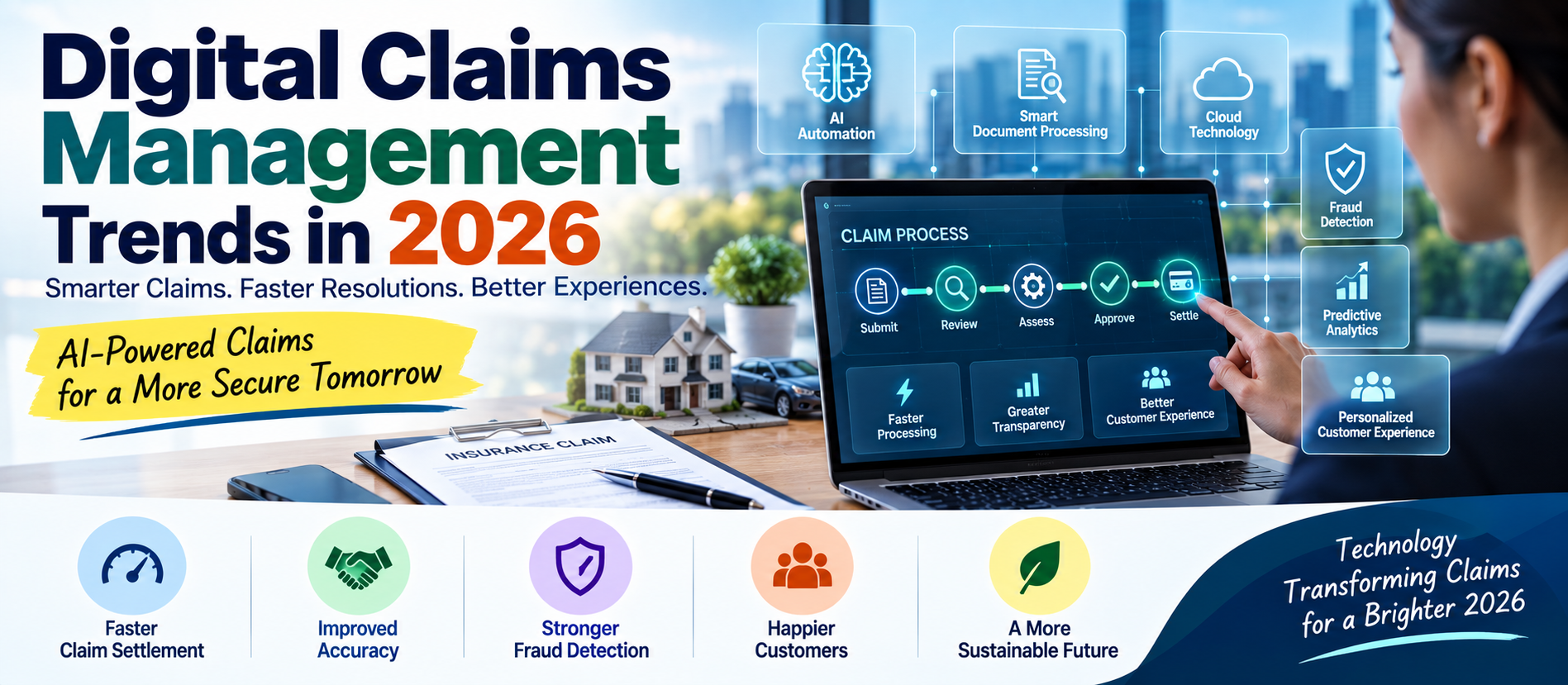
Insurance claims are moving into a new digital phase in 2026. Insurers are no longer using technology only to replace paperwork. They are redesigning the complete claims journey.
Customers want fast answers, simple claim submission, clear status updates, and convenient digital communication. Insurers also face pressure to control claims costs, detect fraud, manage large volumes, improve accuracy, and support experienced claims professionals.
Artificial intelligence, automation, cloud platforms, computer vision, advanced analytics, connected data, and digital customer journeys are becoming important parts of this transformation. Recent industry research shows that AI is increasingly used for claims triage, image analysis, repair estimation, fraud detection, document processing, customer communication, and decision support. Regulators are also paying greater attention to fairness, accuracy, explainability, data quality, and human oversight.
In 2026, the central idea is simple: digital claims management is moving from task automation toward end-to-end claims orchestration.
What Is Digital Claims Management?
Digital claims management means using digital technologies to collect, process, investigate, evaluate, communicate, and settle insurance claims.
A traditional process may involve phone calls, paper forms, manual data entry, physical documents, repeated emails, separate systems, and long approval chains. A digital process connects these activities through software and data.
A customer may submit a claim from a smartphone. The system can capture photos, documents, policy details, and incident information. Automation can validate the submission, classify the claim, identify missing information, estimate severity, detect potential fraud indicators, and route the case to the right team.
Simple claims may move through an automated workflow. Complex claims can be escalated to experienced adjusters. This combination of automation and human judgment is becoming a defining model for modern claims operations.
Why Digital Claims Management Matters in 2026
Claims are one of the most important moments in the insurance customer relationship. A customer may not think much about a policy until a loss happens. At that moment, the quality of the claims experience can strongly affect how the customer views the insurer.
Deloitte's July 2026 analysis of nearly 4,000 property-and-casualty customer responses found that the claims process had an above-average influence on future purchase intentions, while the claims journey also ranked relatively low in driving positive sentiment. The analysis identified friction from too many steps, slow processing, unclear processes, repeated information requests, and settlement delays.
- Customers want faster service.
- Insurers want lower administrative costs.
- Claims teams need better decision support.
- Fraud detection needs stronger data analysis.
- Catastrophe events can create sudden claim surges.
- Regulators expect responsible use of technology.
- Businesses need better visibility into claims performance.
1. AI-Powered Claims Triage
Claims triage is one of the most practical uses of artificial intelligence. When a claim arrives, an AI-enabled system can analyze the available information and classify the case. It may identify the claim type, estimated severity, missing documents, possible fraud indicators, or the level of human expertise required.
A simple claim can be routed toward an automated workflow. A complex claim can be assigned to a specialist. This can help claims teams use their time more effectively.
In 2026, the focus is increasingly shifting from isolated AI tools to AI embedded directly into claims workflows. Deloitte describes emerging AI-native claims processes in which AI supports tasks across the claims value chain while human oversight remains important.
2. Straight-Through Processing for Simple Claims
Straight-through processing, or STP, means that a claim can move from submission to resolution with little or no manual intervention. It is most suitable for claims with clear rules, predictable documentation, low complexity, and manageable risk.
A suitable claim may have a valid policy, a clearly defined loss, complete documentation, a low expected payment, no major coverage dispute, and no significant fraud indicators.
Industry commentary in 2026 points to continued growth in straight-through processing for low-complexity claims. Complex claims still require deeper investigation and human expertise.
3. AI Copilots for Claims Professionals
AI is not only being used to automate customer-facing processes. It is also becoming a work assistant for claims professionals.
An AI copilot can help summarize a large file, organize documents, identify relevant information, draft customer communications, highlight inconsistencies, and suggest next actions. This can reduce time spent searching through information.
It does not mean AI should automatically make every decision. High-impact decisions may require human review, depending on the claim, regulation, and governance framework. Deloitte reports that adjusters are increasingly supported by large language model copilots for decision support, next-best-action recommendations, and information retrieval.
4. Digital First Notice of Loss
First Notice of Loss, or FNOL, is the starting point of a claim. Digital FNOL is becoming more important because the first interaction can affect the complete claims journey.
- Report an incident from a mobile device.
- Upload photos and videos.
- Share documents.
- Answer guided questions.
- Receive a claim number.
- Track the claim.
- Communicate with the insurer.
AI can analyze information during intake and identify what additional information may be required. Deloitte recommends focusing AI investment on high-friction processes such as FNOL, mitigation services, and service-provider integration.
5. Computer Vision for Damage Assessment
Computer vision allows software to analyze images and video. In insurance claims, this can support vehicle damage, property damage, and other visual assessments.
A customer may upload photographs after an accident. An AI system can identify visible damage, classify damaged components, estimate severity, and support repair decisions.
NAIC notes that insurers use AI in claims for accident image analysis and estimating ultimate claim settlement values.
Computer vision can reduce manual review for straightforward visual claims. Poor images, unusual damage, hidden damage, or complex circumstances may still require human inspection.
6. Remote and Aerial Claims Assessment
Remote inspections, drones, satellite imagery, aerial photographs, and other digital sources can help insurers assess property losses without sending an adjuster to every location.
This is especially useful during catastrophes when many claims occur at the same time. Deloitte reports that aerial imagery can support remote assessments at scale during catastrophic events.
The goal is not simply to replace field inspections. It is to use the right assessment method for the right claim.
7. Generative AI for Claims Documents
Claims generate large amounts of text, including emails, statements, medical documents, repair estimates, reports, invoices, policy documents, inspection notes, and internal records.
Generative AI can help summarize these materials and draft customer updates, internal claim summaries, requests for missing documents, adjuster notes, workflow instructions, and common answers.
Generated content needs controls. AI systems can produce incorrect or incomplete information. NAIC notes that AI-generated information should be reviewed carefully, especially when used for important decisions.
8. Fraud Detection Using Advanced Analytics
Modern systems can analyze large numbers of claims and identify unusual patterns. AI may examine relationships between claimants, vehicles, properties, service providers, payment information, devices, locations, documents, and previous claims.
Graph-based AI can be useful because fraud may involve relationships between multiple entities rather than one suspicious data point.
PwC's 2026 guidance describes AI as a tool for highlighting anomalies and patterns that may indicate potential fraud, while emphasizing human investigation, secondary review, audit logs, escalation thresholds, and model recalibration.
An AI flag should generally be treated as a signal for investigation, not automatic proof of fraud.
9. Digital Claims Payments
Once a claim is approved, customers want payment to be simple and transparent. Digital payment systems can reduce manual steps and help customers receive settlement funds more efficiently, subject to applicable requirements.
Digital platforms can connect approval workflows with payment systems and create better payment records and reconciliation processes.
10. Real-Time Claim Status Updates
Customers often become frustrated when they do not know what is happening. Digital platforms can provide claim received confirmation, document status, inspection status, approval status, payment status, expected next steps, and requests for additional information.
Deloitte's 2026 research found that customers still often use multiple channels to resolve a single question and that mobile updates are not yet universal. The research highlights communication as an important part of the claims experience.
11. Omnichannel Claims Communication
Customers may start a claim on a mobile app and later contact a call center. They may send documents by email and then check status through a website.
An omnichannel claims platform connects these interactions. The customer should not have to repeat the same information every time. A connected claims record can give agents and adjusters a shared view of the case.
12. Cloud-Based Claims Platforms
Cloud technology is becoming a foundation for claims modernization. Cloud platforms can support scalable storage, application integration, analytics, remote work, and rapid deployment of digital services.
Cloud infrastructure can also help insurers handle sudden increases in claim volume. This is important during natural catastrophes. Deloitte identifies cloud and automation as important capabilities for surge readiness.
13. Claims Orchestration Across Multiple Systems
Many insurers operate multiple systems. A claim may require information from policy administration, billing, customer relationship management, document management, payment, repair networks, fraud platforms, and analytics tools.
Claims orchestration connects these systems. Instead of asking employees to move information manually, an orchestration layer can trigger the next step automatically.
- A customer submits a claim.
- The system validates the policy.
- Documents are extracted.
- The claim is classified.
- Fraud indicators are checked.
- The claim is routed.
- A repair partner is contacted if needed.
- The customer receives an update.
- Payment is initiated after approval.
This is a major shift from automating individual tasks to redesigning the complete workflow.
14. Predictive Analytics for Claims
Predictive analytics uses historical and current data to estimate future outcomes. In claims management, it can help estimate severity, identify claims that may become complex, predict repair requirements, forecast workloads, and support resource planning.
Predictive analytics can also help insurers identify claims that need early intervention. The purpose is to help teams prioritize attention, not remove human judgment.
15. Connected Devices and Loss Prevention
Digital claims management is increasingly connected to loss prevention. Smart-home sensors can detect water leaks, smoke, temperature changes, or unusual activity. Connected vehicles can provide information about driving events.
These technologies can help insurers move from reacting to losses toward preventing or reducing losses. NAIC describes a potential shift from a “detect and repair” approach toward “predict and prevent.”
16. Personalization in Claims
Customers do not all need the same claims experience. A simple digital process may work for one customer. Another may need a human claims specialist.
Digital systems can personalize communication based on claim type, customer preference, language, urgency, and complexity. The goal should be useful personalization rather than excessive automation.
17. Human-in-the-Loop Claims Management
One of the most important trends in 2026 is the continued role of human judgment. AI can process information quickly. Humans can understand context, negotiate, investigate unusual situations, and handle sensitive interactions.
A strong claims model combines both. Automation can handle simple claims. A human can review complex injury claims, disputed liability, suspicious cases, or emotionally sensitive situations.
Aon noted in its Q2 2026 global insurance market overview that digital and AI tools are being used mainly for triage and administrative efficiency, while the industry continues to emphasize frontline claims judgment.
18. AI Governance and Regulatory Oversight
More AI in claims also means more governance. Insurers need to understand what models do, what data they use, how they are tested, and how decisions are reviewed.
- Accuracy
- Fairness
- Explainability
- Data quality
- Privacy
- Cybersecurity
- Model monitoring
- Human oversight
- Third-party vendor management
- Auditability
NAIC's 2026 AI materials emphasize that insurers remain responsible for complying with insurance laws and consumer-protection requirements when AI supports insurance activities. The NAIC is also developing tools for regulators to evaluate AI systems, governance, risk controls, data, and higher-risk models.
19. Explainable AI in Claims
Explainability matters when technology influences a claim decision. A customer may ask why a claim was routed for additional review. Claims professionals may also need to understand why an AI system produced a recommendation.
Explainable AI can make important factors behind a model output easier to understand. Insurers should consider explainability during technology selection rather than treating it as an afterthought.
20. Synthetic Media and Document Verification
Digital claims create a new challenge: verifying digital evidence. Images, videos, and documents can be edited. Generative AI also makes synthetic content easier to create.
Modern claims systems are therefore exploring media forensics and document verification. Deloitte's 2026 discussion of AI-native claims highlights media forensics and synthetic-media detection as emerging tools for authenticating images and documentation.
21. Better Service-Provider Integration
Claims often involve outside providers such as repair shops, medical providers, inspectors, towing companies, restoration companies, contractors, and surveyors.
Digital integration can reduce delays between the insurer, customer, and provider. An approved vehicle claim, for example, can trigger a repair workflow and send relevant information to an authorized repair partner.
22. Claims Analytics Dashboards
Insurance leaders need visibility into claims performance. Modern dashboards can show claim volume, average cycle time, open claims, settlement amounts, fraud referrals, escalation rates, customer satisfaction, claims leakage, adjuster workload, and vendor performance.
Real-time or near-real-time analytics can help managers identify bottlenecks earlier.
23. Digital Claims and Catastrophe Response
Catastrophe events can create thousands of claims in a short period. Digital infrastructure can help insurers scale intake, triage, communication, inspection, and payment processes.
Cloud systems, remote inspection, automated routing, aerial imagery, and AI-assisted classification can help increase capacity. Deloitte's 2026 research identifies surge readiness as an important claims capability.
24. Cybersecurity Is Part of Digital Claims Management
Digital claims systems contain sensitive information, including personal, financial, medical, location, and identity data. More connectivity increases the importance of cybersecurity.
- Encryption
- Identity and access management
- Multi-factor authentication
- Secure APIs
- Vendor security
- Data minimization
- Monitoring and logging
- Incident response
- Backup and recovery
Digital convenience should not come at the cost of data security.
25. Third-Party AI and Claims Technology Risk
Insurers may use external vendors for AI models, fraud detection, document processing, cloud infrastructure, repair estimation, customer communication, or analytics.
This creates third-party risk. Insurers need to understand how vendor systems work, what data they use, how outputs are tested, and how problems are escalated.
NAIC's 2026 work on third-party data and models reflects growing regulatory attention to transparency, governance, accountability, and risk management around external AI systems.
26. The Shift From Automation to Orchestration
Automation performs tasks. Orchestration coordinates tasks.
An insurer may already have automated document extraction. But if employees still manually move extracted data between systems, the complete workflow is not truly digital.
Orchestration connects the entire journey. IBM's April 2026 analysis argues that insurers need to move beyond digitizing individual tasks and rethink decision authority, operating models, and end-to-end claims orchestration.
27. What Digital Claims Management Means for Claims Employees
Automation changes the work of claims teams. Employees may spend less time entering data and more time handling exceptions, investigations, negotiations, complex cases, and customer relationships.
This means insurers need strong training. New employees also need opportunities to develop claims judgment. Technology should support learning, not only productivity.
28. How Insurers Can Prepare for the Next Stage
- Map the current claims journey. Identify every major step and handoff.
- Find the biggest friction points. Focus on delays and repeated manual work.
- Improve data quality. AI performs better when underlying data is reliable.
- Modernize FNOL. Make claim reporting simple and digital.
- Automate low-risk tasks. Start with predictable workflows.
- Introduce AI copilots. Help claims professionals search and summarize information.
- Build fraud analytics. Use AI to prioritize investigation.
- Improve communication. Give customers clear status updates.
- Add human checkpoints. Keep expert review for complex or high-impact decisions.
- Measure results. Track cycle time, customer experience, leakage, accuracy, and operational cost.
Key Digital Claims Management KPIs
| KPIWhat It Shows | |
| Average claim cycle time | How long claims take to resolve |
| First-contact resolution | How often customer issues are solved without repeated contact |
| Digital FNOL completion rate | How effectively customers use digital claim reporting |
| STP rate | Percentage of suitable claims processed automatically |
| Fraud referral accuracy | Quality of AI-supported fraud prioritization |
| Claims leakage | Unnecessary or avoidable claim costs |
| Customer satisfaction | How customers perceive the claims experience |
| Adjuster productivity | How effectively claims professionals manage workloads |
| Digital communication rate | Use of app, web, messaging, or other digital updates |
Benefits of Digital Claims Management
- Faster processing for suitable claims
- Lower manual administration
- Better customer communication
- More consistent workflows
- Improved fraud detection support
- Better claims visibility
- Improved catastrophe response
- More effective use of claims expertise
- Better integration with service providers
- More scalable operations
Challenges of Digital Claims Management
Legacy Systems
Old systems may make integration difficult.
Data Quality
Poor data can reduce the reliability of analytics and AI.
Model Risk
AI models can produce inaccurate or inappropriate outputs.
Customer Trust
Customers may become frustrated if automation is unclear or impossible to challenge.
Employee Adoption
Claims professionals need training and involvement in technology design.
Cybersecurity
More connected systems create more data-security responsibilities.
Regulatory Compliance
Insurers must consider applicable insurance, privacy, consumer-protection, and AI requirements.
Digital Claims Management Trends in 2026: Quick Summary
- AI: More intelligence inside claims workflows.
- Automation: More low-complexity claims handled digitally.
- STP: Greater straight-through processing for suitable claims.
- Computer vision: Faster visual damage assessment.
- Generative AI: Better document and communication support.
- Fraud analytics: More advanced anomaly detection.
- Cloud: Greater scalability and catastrophe readiness.
- Orchestration: Connected end-to-end workflows.
- Personalization: More relevant customer journeys.
- Human oversight: Expert review for complex and high-impact decisions.
- Governance: More attention to fairness, accuracy, transparency, privacy, and accountability.
Frequently Asked Questions
What is digital claims management?
Digital claims management uses software, data, automation, AI, cloud platforms, and digital communication to manage insurance claims from first notice of loss through investigation, decision, settlement, and closure.
What is the biggest claims technology trend in 2026?
AI is one of the major trends, but the broader shift is toward AI-enabled, end-to-end claims orchestration. Insurers are combining AI with automation, analytics, cloud technology, digital communication, and human expertise.
What is straight-through claims processing?
It is an automated workflow in which suitable claims can move through validation and settlement without extensive manual handling.
Can AI settle insurance claims automatically?
For some simple and clearly defined claims, insurers may use automation for significant parts of the process. Complex, disputed, sensitive, or high-impact claims may require human review.
How is AI used in insurance claims?
AI can support claim intake, triage, image analysis, document processing, fraud detection, summarization, customer communication, severity estimation, and decision support.
Does AI replace claims adjusters?
AI can automate tasks and support claims professionals, but human judgment remains important for complex investigations, negotiations, exceptions, and customer interactions.
What is digital FNOL?
Digital FNOL is a technology-enabled way to report a loss using channels such as mobile apps, websites, online forms, messaging, or connected devices.
Why is claims communication important?
Customers need to know what has happened, what information is required, and what happens next. Clear communication can reduce uncertainty and repeated inquiries.
How does computer vision help insurance claims?
Computer vision can analyze photographs or video to identify visible damage, estimate severity, and support repair or inspection decisions.
What are the risks of AI in claims management?
Key risks include inaccurate outputs, biased results, poor data quality, privacy concerns, cybersecurity risks, limited explainability, model drift, and excessive reliance on automation.
What should insurers measure after implementing claims automation?
Useful measures include claim cycle time, STP rate, customer satisfaction, claims leakage, fraud referral quality, adjuster productivity, accuracy, digital adoption, and operational cost.
Conclusion
Digital Claims Management Trends in 2026 show that insurance claims are moving beyond simple digitization.
The next stage is connected, intelligent, and increasingly automated. AI can help classify claims, analyze images, summarize documents, identify unusual patterns, and support claims professionals. Automation can reduce repetitive work. Cloud platforms can increase scalability. Digital communication can make claim status clearer. Computer vision can support faster damage assessment. Advanced analytics can help insurers prioritize complex cases.
But technology alone is not the answer. The strongest claims operations will combine digital speed with human judgment. They will automate predictable tasks while keeping appropriate human oversight for complex and high-impact decisions.
💡 Key Insight
They will also treat governance as part of the technology. Data quality, privacy, cybersecurity, fairness, explainability, auditability, and vendor management will become increasingly important as AI moves deeper into claims operations.
For insurers, 2026 is therefore not simply about buying another claims platform. It is about redesigning the claims journey around better data, better workflows, better customer communication, and better decisions.
Digiifrog publishes practical insights on technology, digital transformation, business, marketing, AI, and modern insurance trends. Visit www.digiifrog.com for more business-focused resources.
Disclaimer: This article is provided for general educational and informational purposes. Insurance technology, regulations, AI governance requirements, and claims practices can vary by country, state, insurer, product, and policy. It is not legal, insurance, financial, or regulatory advice. Always consult applicable regulations, policy documents, and qualified professionals before making business or insurance decisions.
Ready to Grow?
Talk to us about a strategy tailored to your brand — we will help you stand out in search, AI discovery and social.


Comments (0)
Log in to leave a comment.