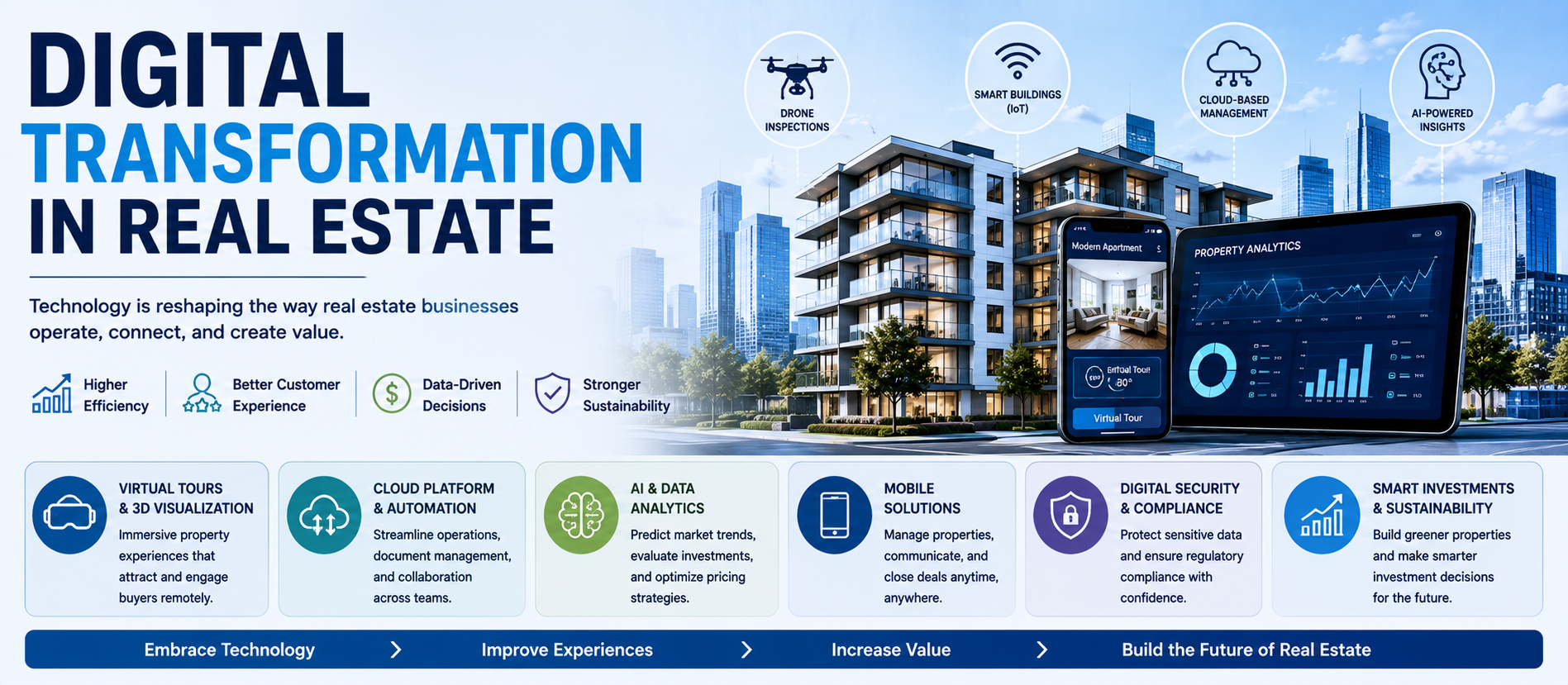
📋 Quick Summary
In this article:
What Is Digital Transformation in Real Estate?
Why Digital Transformation Matters
1. PropTech Is Changing Real Estate
2. Artificial Intelligence in Real Estate
3. Digital Lead Management and CRM
4. Virtual Tours and Digital Property Marketing
5. Cloud-Based Property Management
6. Smart Buildings and IoT
7. Digital Maintenance Management
8. Data Analytics for Better Decisions
9. Digital Documents and Transaction Workflows
10. Marketing Automation in Real Estate
Focus Keyword: Digital Transformation in Real Estate
Digital technology is changing the real estate industry. Buyers now search for properties online. Tenants expect fast communication and convenient digital services. Property managers need better ways to track maintenance, leases, payments, and documents. Investors want faster access to reliable property and market data.
Digital transformation in real estate means using technology to improve how properties are marketed, sold, leased, managed, developed, and analyzed. It is not simply about purchasing new software. True transformation improves workflows, connects information, reduces unnecessary manual work, and helps people make better decisions.
Modern real estate businesses are using artificial intelligence, cloud platforms, automation, virtual tours, customer relationship management systems, smart-building technology, digital documents, and data analytics. These tools are changing both the customer experience and the way real estate teams work.
Digiifrog creates practical, SEO-friendly, AEO-ready, GEO-focused, and AI Search optimized content for modern businesses. Visit www.digiifrog.com.
What Is Digital Transformation in Real Estate?
Digital transformation in real estate is the use of connected technology to improve business operations and customer experiences across the property lifecycle.
A digitally connected real estate business may use technology to:
- Capture and manage leads.
- Offer virtual property tours.
- Automate customer follow-up.
- Store documents digitally.
- Track leases and payments.
- Manage maintenance requests.
- Analyze market and property data.
- Monitor building systems.
- Improve reporting for owners and investors.
The main objective is to solve real business problems. A brokerage may want to respond to leads faster. A property manager may want to reduce unresolved maintenance requests. An investor may need better portfolio reporting. Technology should support these goals.
Why Digital Transformation Matters
Real estate businesses manage a large amount of information. Property listings, customer inquiries, leases, contracts, inspection reports, photographs, maintenance records, financial data, and market research can quickly become difficult to manage.
💡 Key Insight
Disconnected spreadsheets, paper documents, and manual communication can create delays. Digital systems can centralize information and make important data easier to find.
The major benefits may include:
- Faster customer response.
- Less repetitive administration.
- Better access to information.
- Improved operational visibility.
- More consistent communication.
- Stronger reporting.
- Better scalability as portfolios grow.
- Improved customer convenience.
1. Prop Tech Is Changing Real Estate
Prop Tech, or property technology, is a broad term for technology used in the real estate industry. It includes software and digital platforms that support property search, sales, leasing, management, investment, construction, and building operations.
Examples include online property platforms, CRM systems, property management software, virtual tours, smart-building systems, analytics tools, and digital transaction platforms.
The importance of Prop Tech is that it can connect different parts of a business. Marketing, sales, leasing, maintenance, finance, and customer service can work from more consistent information when systems are properly integrated.
2. Artificial Intelligence in Real Estate
Artificial intelligence is becoming an important part of digital transformation. AI can process information, identify patterns, support communication, and assist with repetitive tasks.
Possible real estate applications include:
- Lead classification and prioritization.
- Customer inquiry support.
- Property recommendations.
- Document summarization.
- Marketing content assistance.
- Market data analysis.
- Forecasting and trend analysis.
- Maintenance pattern detection.
AI should support human professionals rather than replace professional judgment. Real estate decisions can involve legal, financial, ethical, and local-market factors. Human review is especially important when AI output affects contracts, pricing, compliance, or major customer decisions.
3. Digital Lead Management and CRM
Real estate leads can come from websites, property portals, advertisements, social media, referrals, and other sources. Without a structured system, inquiries may be delayed or lost.
A customer relationship management system can organize leads and record their interactions with the business.
A typical workflow may look like this:
- A potential customer submits an inquiry.
- The system records the source and property of interest.
- Basic information is captured.
- The inquiry is assigned to the appropriate person.
- An acknowledgement or follow-up is sent.
- The sales or leasing professional continues the conversation.
Automation can help reduce delays, while AI may assist with classification or prioritization.
4. Virtual Tours and Digital Property Marketing
Virtual property tours allow potential buyers or tenants to explore a property before arranging an in-person visit. These experiences can include 360-degree photography, interactive tours, videos, floor plans, and detailed property information.
A strong digital property presentation may include:
- Professional photographs.
- Accurate floor plans.
- 360-degree views.
- Video walkthroughs.
- Property specifications.
- Location information.
- Clear answers to common questions.
Digital marketing can make the early property-search process more convenient. However, information should remain accurate. Visual editing or virtual staging should not create a misleading impression of the actual property.
5. Cloud-Based Property Management
Cloud platforms allow authorized users to access information through connected systems. This can reduce dependence on disconnected local files and manual spreadsheets.
A property management platform may centralize:
- Tenant information.
- Lease records.
- Payment data.
- Maintenance requests.
- Inspection reports.
- Vendor information.
- Property documents.
- Operational reports.
This can help managers understand what needs attention across one property or an entire portfolio.
6. Smart Buildings and IoT
Smart buildings use connected devices and sensors to collect information about building operations. Depending on the property, these systems may monitor energy use, temperature, water consumption, equipment performance, lighting, occupancy, or security.
The information can help building operators identify unusual patterns and respond more quickly to potential problems.
For example, a change in equipment performance may indicate that an inspection is needed. The technology itself does not solve the problem. Its value depends on accurate data and a clear process for acting on the information.
7. Digital Maintenance Management
Maintenance is a major part of property management. Digital systems can make requests easier to submit, track, assign, and close.
A modern workflow may include:
- A tenant submits a maintenance request.
- The request is categorized by urgency.
- A team member or vendor is assigned.
- Status updates are recorded.
- The work is completed and documented.
- Costs and recurring problems are analyzed.
Over time, this creates a maintenance history that can support future budgeting and capital planning.
8. Data Analytics for Better Decisions
Real estate businesses collect information from marketing campaigns, listings, transactions, leases, maintenance, occupancy, and financial operations.
Analytics can help answer important questions:
- Which marketing channels generate qualified leads?
- Which properties receive the most interest?
- How long does it take to convert a lead?
- Which units have recurring maintenance problems?
- Which leases are approaching expiration?
- How are occupancy and expenses changing?
Good analytics require reliable data. Duplicate records, missing information, and inconsistent naming can reduce the value of reports and AI systems.
9. Digital Documents and Transaction Workflows
Real estate transactions involve contracts, disclosures, inspection reports, financial documents, and other important records.
Digital document systems can improve organization through centralized storage, controlled access, version management, approval workflows, and searchable records. Electronic signatures may also be useful where legally valid and appropriate.
Businesses should confirm that their digital processes comply with the legal and regulatory requirements that apply to their location and type of transaction.
10. Marketing Automation in Real Estate
Marketing automation can reduce repetitive communication tasks. It can help businesses send timely responses without requiring every message to be created manually.
Examples include:
- Automatic inquiry acknowledgements.
- Viewing reminders.
- Property recommendation emails.
- Follow-up sequences.
- Audience segmentation.
- Campaign reporting.
Automation should remain useful and relevant. Sending more messages does not automatically improve customer experience. The best systems support a clear journey from the first inquiry to the next meaningful action.
11. Mobile Technology for Real Estate Professionals
Real estate professionals often work outside a traditional office. Mobile access can make it easier to view property information, customer records, appointments, inspection checklists, documents, and maintenance requests.
Mobile technology can improve response time, but businesses should protect sensitive information. Strong authentication, access controls, and secure devices are important parts of a digital strategy.
12. Challenges of Digital Transformation
Technology projects do not always succeed. Common problems include fragmented systems, poor data, employee resistance, inadequate training, weak integration, and unclear goals.
Another challenge is buying technology without understanding the workflow. A business can accumulate many software subscriptions while employees continue to work through old manual processes.
Successful transformation requires attention to three areas:
- People: Employees need training and a reason to adopt the new process.
- Process: Workflows should be simplified before they are automated.
- Data: Information should be accurate, organized, and properly protected.
13. Cybersecurity and Data Privacy
Real estate businesses may store personal information, financial records, transaction documents, and other sensitive data. As operations become more digital, cybersecurity becomes more important.
Basic security practices can include strong authentication, role-based access, regular software updates, secure backups, employee awareness training, and vendor security reviews.
Businesses should also understand the privacy and data-protection rules that apply in their markets.
How to Start a Real Estate Digital Transformation
Step 1: Identify the Problem
Start with a specific business challenge, such as slow lead response or poor maintenance tracking.
Step 2: Map the Current Process
Identify where information is delayed, duplicated, or lost.
Step 3: Set Measurable Goals
Define what success means. This could be faster response time, reduced administrative work, or improved maintenance completion.
Step 4: Improve Data Quality
Standardize important records and identify the main source of truth.
Step 5: Select Suitable Technology
Choose tools that fit the workflow, integrate with existing systems, and meet security requirements.
Step 6: Start Small
Test the solution with one team, process, or property group before expanding.
Step 7: Train and Measure
Train employees, monitor results, collect feedback, and continue improving the process.
SEO, AEO, GEO, and AI Search Optimization for Real Estate
Digital transformation should also improve how a real estate business communicates online. Traditional SEO helps search engines understand website content. AEO focuses on clear answers to direct questions. GEO and AI Search optimization focus on well-structured, accurate, useful content that generative systems can understand and reference.
Real estate websites can improve visibility with:
- Clear service pages.
- Accurate property information.
- Useful location-specific content.
- Frequently asked questions.
- Step-by-step guides.
- Clear business details.
- Helpful internal linking.
Local content should provide genuine value. Simply replacing one city name with another across multiple pages is not a strong long-term strategy. Explain the actual services, property types, markets, and customer questions relevant to each area.
Frequently Asked Questions
What is digital transformation in real estate?
It is the use of digital technology to improve real estate marketing, sales, leasing, property management, customer service, building operations, and decision-making.
What is Prop Tech?
Prop Tech refers to technology designed for the property and real estate industry, including property platforms, management software, analytics tools, smart-building systems, and digital transaction solutions.
How is AI used in real estate?
AI can assist with lead management, customer communication, document analysis, market research, property recommendations, and operational insights. Human review remains important for high-impact decisions.
How do virtual tours help?
Virtual tours allow potential customers to explore a property remotely and understand its layout before arranging an in-person visit.
Where should a company begin?
Start with a clear business problem, improve the underlying process and data, then choose technology that supports measurable goals.
Final Thoughts
Digital transformation in real estate is changing how properties are discovered, marketed, managed, and analyzed. AI, Prop Tech, automation, cloud platforms, virtual tours, smart buildings, and analytics can all create value when they are connected to real business needs.
The best strategy is not to adopt every new technology. Start with a problem. Improve the process. Organize the data. Choose the right tools. Train the people who will use them. Protect sensitive information and measure the results.
Real estate will always depend on physical properties and human decisions. Digital technology can make those decisions and operations faster, more organized, and easier to manage when used responsibly.
For clear, practical, SEO-friendly, AEO-ready, GEO-focused, and AI Search optimized digital content, visit Digiifrog at www.digiifrog.com.
Disclaimer: This article is for general informational purposes only. Technology, legal requirements, privacy obligations, and real estate regulations vary by location. Businesses should evaluate appropriate security, compliance, and professional requirements before implementing new systems.
Ready to Grow?
Talk to us about a strategy tailored to your brand — we will help you stand out in search, AI discovery and social.


Comments (0)
Log in to leave a comment.