📋 Quick Summary
In this article:
Why Investors Use Dividend Strategies
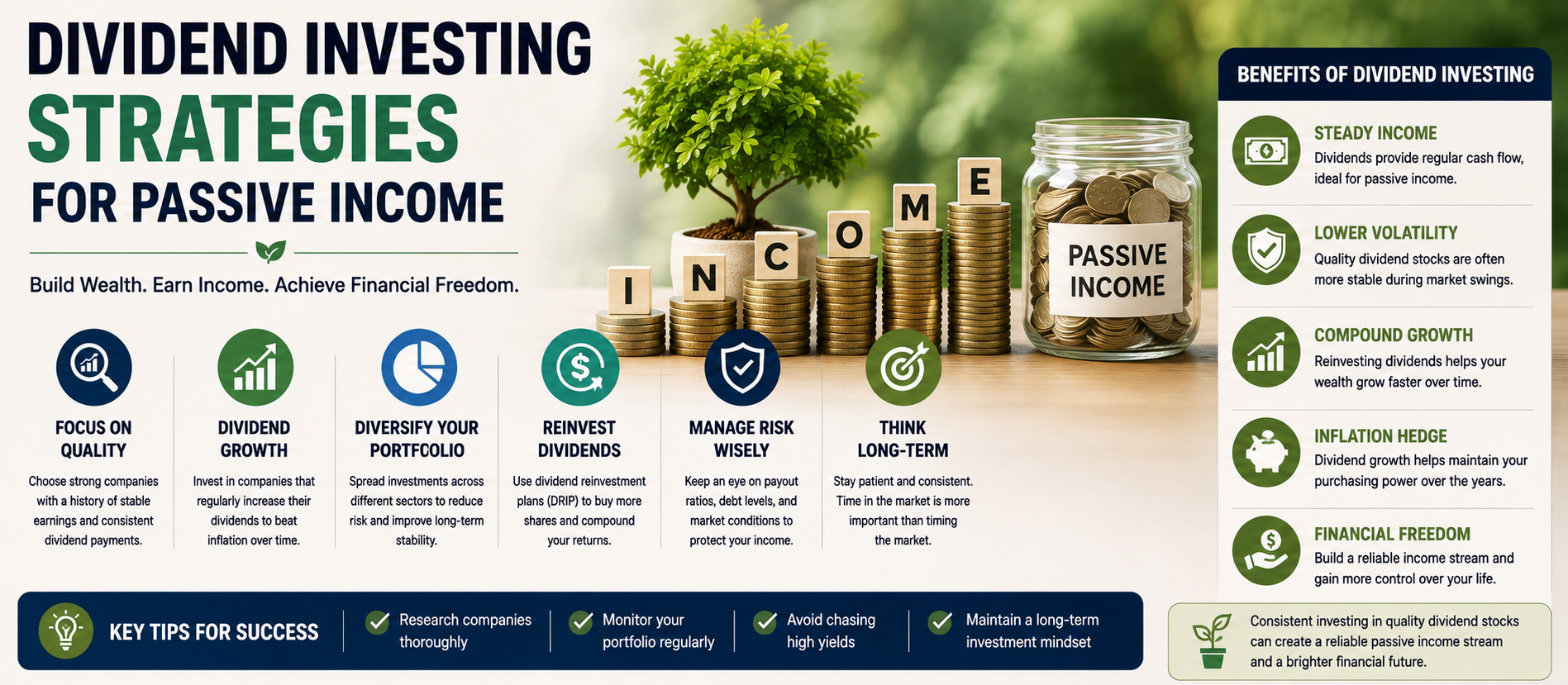
1. Do Not Chase the Highest Dividend Yield
2. Focus on Dividend Sustainability
3. Look for Dividend Growth, Not Only Current Income
4. Diversify Your Dividend Portfolio
5. Understand the Business Before Buying the Stock
6. Consider Dividend-Focused ETFs and Funds
7. Reinvest Dividends for Long-Term Growth
8. Match Dividend Income to Your Financial Goals
9. Review Dividend Payment History Carefully
10. Watch Debt and Interest Costs
Focus Keyword: Dividend Investing Strategies for Passive Income
Dividend investing is a popular strategy for investors who want to build a portfolio that may generate regular cash payments. Companies can distribute part of their profits to shareholders as dividends. These payments may provide income while investors continue to own their shares.
However, dividend investing is not a guaranteed income strategy. A company can reduce, suspend, or eliminate its dividend. Share prices can also rise or fall. A high dividend yield may sometimes signal opportunity, but it can also indicate higher risk or a falling share price.
The strongest approach is to look beyond the headline yield. Investors should understand the business, its financial strength, its ability to support future payments, and the role the investment plays in the overall portfolio.
⚠ Watch Out
This guide explains dividend investing strategies for passive income in clear language. It covers how dividends work, what to evaluate before investing, common mistakes to avoid, and how to build a long-term strategy.
What Is Dividend Investing?
Dividend investing involves buying shares of companies, funds, or other eligible investments that make distributions to investors. A dividend is generally a payment made to shareholders from a company's earnings and profits.
Many companies that pay dividends follow a regular schedule, such as quarterly, although schedules can vary. Some investment funds may also make regular distributions.
Dividend investors usually focus on two possible sources of return:
- Income: Cash distributions paid to the investor.
- Capital growth: An increase in the value of the investment over time.
Neither outcome is guaranteed. A stock can pay a dividend and still decline in value. A company can also retain profits instead of paying dividends if management believes the money can be used more effectively inside the business.
Why Investors Use Dividend Strategies
Dividend investing can appeal to people who want a portfolio that may produce cash flow. Retirees may use dividends as part of a broader income plan. Long-term investors may reinvest dividends to purchase additional shares. Other investors simply value businesses with established records of profitability and shareholder distributions.
Possible benefits include:
- The potential for regular cash income.
- The option to reinvest dividends.
- Exposure to established businesses.
- A focus on cash generation and financial discipline.
- The possibility of combining income with long-term capital appreciation.
These benefits should be balanced against risk. Dividend-paying companies are still equity investments. Their prices can be volatile, and the income stream can change.
1. Do Not Chase the Highest Dividend Yield
Dividend yield is usually calculated by dividing the annual dividend per share by the current share price. For example, if a company pays $4 per share annually and the share price is $100, the indicated yield is 4%.
A higher yield is not automatically better. A stock may show a very high yield because its share price has fallen sharply. The market may be concerned about declining earnings, high debt, weak cash flow, or the possibility of a dividend cut.
Instead of asking only, “Which stock has the highest yield?” ask:
- Why is the yield high?
- Is the company profitable?
- Is the dividend supported by cash flow?
- How much debt does the business carry?
- Could earnings weaken?
A moderate yield supported by a strong business may be more sustainable than an unusually high yield supported by weak finances.
2. Focus on Dividend Sustainability
A sustainable dividend is often more important than a large dividend. Investors can study the company's earnings, free cash flow, debt levels, business model, and history of capital allocation.
One useful measure is the payout ratio. In simple terms, it compares the amount paid as dividends with earnings. A very high payout ratio may leave less room for a company to handle business problems, although acceptable levels vary by industry.
💡 Key Insight
Cash flow is also important. Accounting earnings do not always show how much cash is available for dividends. Investors should examine whether the business regularly produces enough cash to support operations, debt obligations, investment needs, and shareholder payments.
There is no single “safe” payout ratio for every company. Different industries have different capital requirements. The goal is to understand whether the dividend policy matches the economics of the business.
3. Look for Dividend Growth, Not Only Current Income
Some investors focus on companies that have increased their dividends over time. Dividend growth can be attractive because rising payments may help income keep pace with changing financial needs.
A history of dividend increases does not guarantee future increases. Investors should still ask whether the company has the revenue, earnings, cash flow, and competitive position needed to continue growing.
Dividend growth investing may be especially useful for people with a long time horizon. A lower current yield combined with consistent growth can produce a different long-term outcome from a high-yield investment with no growth.
Consider both the starting income and the potential durability of future payments.
4. Diversify Your Dividend Portfolio
Concentrating too much money in one company can create unnecessary risk. Even a well-known business can face competition, regulation, technological change, litigation, or economic pressure.
Diversification can spread risk across companies, industries, geographic markets, and asset classes. For dividend investors, this may mean avoiding a portfolio that depends entirely on one sector such as banking, energy, utilities, real estate, or telecommunications.
A diversified strategy may include a combination of individual stocks, dividend-focused funds, broad-market funds, bonds, and other investments depending on the investor's goals and risk tolerance.
Diversification cannot eliminate market risk or guarantee a profit. Its purpose is to reduce the damage that may result from one investment or sector performing badly.
5. Understand the Business Before Buying the Stock
A dividend is only one part of an investment. Before buying a company, understand how it makes money.
Look at the products or services it sells, the strength of its customer base, its competitors, major risks, debt, and future growth prospects.
A company may have a long history of dividends but face a major structural challenge. For example, new technology, changing consumer behavior, or regulation can permanently affect demand.
Good dividend investing starts with business analysis. The dividend should be viewed as one result of a healthy business rather than the only reason to buy the shares.
6. Consider Dividend-Focused ETFs and Funds
Investors who do not want to select individual stocks may consider diversified funds that focus partly or fully on dividend-paying securities.
A dividend ETF or mutual fund can provide exposure to many companies through one investment. This may reduce company-specific risk and simplify portfolio management.
However, funds have their own risks. Investors should review:
- The fund's investment objective.
- The holdings and sector concentration.
- Fees and expenses.
- The distribution policy.
- Historical performance and risk.
- Whether distributions are automatically reinvested or paid in cash.
Regular fund distributions are not guaranteed, and a fund that makes distributions can still lose value.
7. Reinvest Dividends for Long-Term Growth
Investors who do not need immediate income may choose to reinvest dividends. Reinvestment uses dividend payments to purchase additional shares.
Over time, those additional shares may generate further dividends. This process can support compounding, although future returns and dividend payments are not guaranteed.
Many brokers and funds offer automatic dividend reinvestment options. Before using one, understand how the program works and whether there are any fees or tax consequences.
Reinvestment can be useful during the wealth-building stage. Later, an investor may decide to receive dividends in cash instead. The appropriate choice depends on personal financial goals.
8. Match Dividend Income to Your Financial Goals
Dividend investing should be part of a larger financial plan. Ask what the income is intended to support.
Your goal may be to:
- Build long-term wealth.
- Supplement employment income.
- Prepare for retirement.
- Generate a future income stream.
- Reinvest for portfolio growth.
A person who needs cash next year may require a different investment approach from someone investing for a goal twenty years away.
Consider your time horizon, emergency savings, debt, expected expenses, and need for liquidity before committing money to market investments.
9. Review Dividend Payment History Carefully
A company's dividend history can provide useful information, but it should not be treated as a promise.
Look for patterns. Has the company maintained or increased payments through different economic conditions? Has it cut the dividend before? If so, why?
A past dividend cut is not always a reason to reject a company. Sometimes reducing the dividend can protect the balance sheet and allow a business to recover. The important question is whether management's current strategy is financially sustainable.
Historical data should support your research, not replace forward-looking analysis.
10. Watch Debt and Interest Costs
Debt can become a major risk for dividend-paying companies. Businesses with large debt obligations may need to use cash for interest and repayments instead of dividends.
Higher borrowing costs can also pressure companies that need to refinance debt.
Review the balance sheet, debt maturity schedule, interest coverage, and cash generation. Companies in capital-intensive industries may naturally carry more debt, so comparisons should usually be made with similar businesses.
Strong dividend income is more valuable when it comes from a company with a financial structure that can survive difficult conditions.
11. Avoid Overconcentration in High-Yield Sectors
Some sectors are naturally popular with income investors because they often pay higher distributions. This can create concentration risk.
If your portfolio is heavily invested in one industry, a single economic event or regulatory change may affect many holdings at once.
Review sector exposure regularly. Diversifying across industries can help create a more balanced income strategy.
12. Understand Ex-Dividend Dates
The ex-dividend date is important because it generally determines whether a buyer is entitled to the next scheduled dividend. Buying a stock immediately before the ex-dividend date does not create “free money.”
Share prices can adjust to reflect the value of the distribution. Short-term trading solely to capture dividends can also create transaction costs, taxes, and market risk.
Dividend investing is usually more effective when based on the long-term quality and valuation of an investment rather than calendar timing alone.
13. Pay Attention to Valuation
A great company can still be a poor investment if purchased at an unrealistic price. Dividend investors should consider valuation alongside income.
Common measures may include the price-to-earnings ratio, price-to-cash-flow ratio, price-to-book ratio, or other industry-specific methods. No single metric is enough.
Compare the company's valuation with its growth prospects, profitability, competitors, and long-term risks.
Buying a dividend stock at a reasonable valuation may improve the balance between income potential and future return expectations.
14. Plan for Taxes and Account Structure
Dividend income can have tax consequences. The rules depend on your country, account type, investment, holding period, and personal circumstances.
For example, U.S. tax rules distinguish between ordinary dividends and qualified dividends, with qualified dividends potentially receiving different tax treatment when the relevant requirements are met.
Tax rules can change, and international investors may also face withholding taxes or treaty considerations. Keep accurate records and seek qualified tax advice for your own situation.
15. Create a Simple Dividend Investment Process
A written process can help prevent emotional decisions. Your process might include the following steps:
- Define your income and growth goals.
- Decide how much investment risk you can tolerate.
- Set diversification limits.
- Research the business and its financial strength.
- Evaluate dividend yield and sustainability.
- Check valuation.
- Decide whether dividends will be reinvested or received as cash.
- Review the portfolio periodically.
A repeatable process is often more useful than reacting to every market headline.
16. Review the Portfolio, But Do Not Overtrade
Dividend portfolios need monitoring. Companies can change strategy, reduce dividends, take on more debt, or face new competition.
Review important financial results and major changes in the business. At the same time, avoid making frequent trades simply because a share price moves.
Long-term investing requires patience, but patience should not mean ignoring a deteriorating business. A periodic review process can help you decide whether the original investment thesis still makes sense.
Common Dividend Investing Mistakes to Avoid
Chasing yield: A very high yield can be a warning sign rather than a bargain.
Ignoring diversification: Depending on a few companies or one sector can create unnecessary risk.
Assuming dividends are guaranteed: Companies can reduce or eliminate payments.
Ignoring valuation: A strong dividend business can still be overpriced.
Forgetting taxes: The amount you receive after tax may differ from the headline yield.
Using borrowed money without understanding the risk: Leverage can magnify losses and increase financial pressure.
Confusing distributions with investment returns: A regular cash payment does not guarantee that the underlying investment is growing in value.
SEO, AEO, GEO, and AI Search Optimization for Dividend Investing Content
Financial education content should answer questions clearly and avoid unrealistic promises. SEO can help useful content become discoverable through search. AEO focuses on direct answers to common questions. GEO and AI Search optimization emphasize clear structure, context, accuracy, and useful explanations that modern generative systems can understand.
Helpful content can answer questions such as:
- What is dividend investing?
- How is dividend yield calculated?
- Are high-yield dividend stocks always better?
- How can investors evaluate dividend sustainability?
- Should dividends be reinvested?
- Can a company stop paying dividends?
Use clear headings, concise definitions, transparent risk disclosures, updated information, and credible sources. Financial content should never promise guaranteed passive income or fixed investment returns.
Frequently Asked Questions
What is a good dividend yield?
There is no universally good yield. A suitable yield depends on the company's financial strength, growth prospects, industry, valuation, and the investor's goals. A very high yield may involve additional risk.
Are dividends guaranteed?
No. Companies can change, reduce, suspend, or eliminate dividend payments.
Should I reinvest my dividends?
Reinvestment can support long-term compounding if you do not need current income. Taking cash may be more appropriate when you need the money for expenses or other goals.
Are dividend ETFs safer than individual dividend stocks?
A diversified fund can reduce company-specific risk, but it still carries market and investment risk. Safety depends on the fund's holdings, strategy, diversification, and other factors.
How often should I review a dividend portfolio?
A regular review can help investors monitor major changes in a business or portfolio. The exact schedule depends on the strategy, but frequent trading based only on short-term price movements may not support a long-term plan.
Final Thoughts
Dividend investing strategies for passive income should focus on quality, sustainability, diversification, and long-term planning rather than simply finding the highest available yield.
A strong dividend strategy begins with understanding the business behind the payment. Review earnings, cash flow, debt, payout policy, competitive strength, and valuation. Diversify the portfolio and make sure the strategy matches your personal goals and risk tolerance.
For long-term investors, dividend reinvestment may help build additional shares. For investors who need cash flow, dividends may become one part of a broader income plan. In both cases, remember that payments and investment values can change.
The most practical approach is simple: invest carefully, avoid unrealistic income promises, spread risk, review your holdings, and make decisions based on a clear financial plan.
For practical SEO, AEO, GEO, and AI Search optimized digital content, visit Digiifrog at www.digiifrog.com.
Disclaimer: This article is for general informational and educational purposes only. It is not financial, investment, tax, or legal advice. Investments can lose value, and dividends are not guaranteed. Consider your own financial circumstances and consult a qualified professional before making investment decisions.
Ready to Grow?
Talk to us about a strategy tailored to your brand — we will help you stand out in search, AI discovery and social.

Comments (0)
Log in to leave a comment.