📋 Quick Summary
In this article:
1. Define the Business Goal Before Creating a Campaign
2. Set Up Conversion Tracking First
3. Start With a Focused Budget
4. Research Search Intent, Not Just Keywords
5. Understand Keyword Match Types
6. Use Negative Keywords to Reduce Waste
Example Negative Keyword Ideas
7. Organize Campaigns Around Clear Themes
Focus Keyword: Do-It-Yourself PPC Advertising Strategies
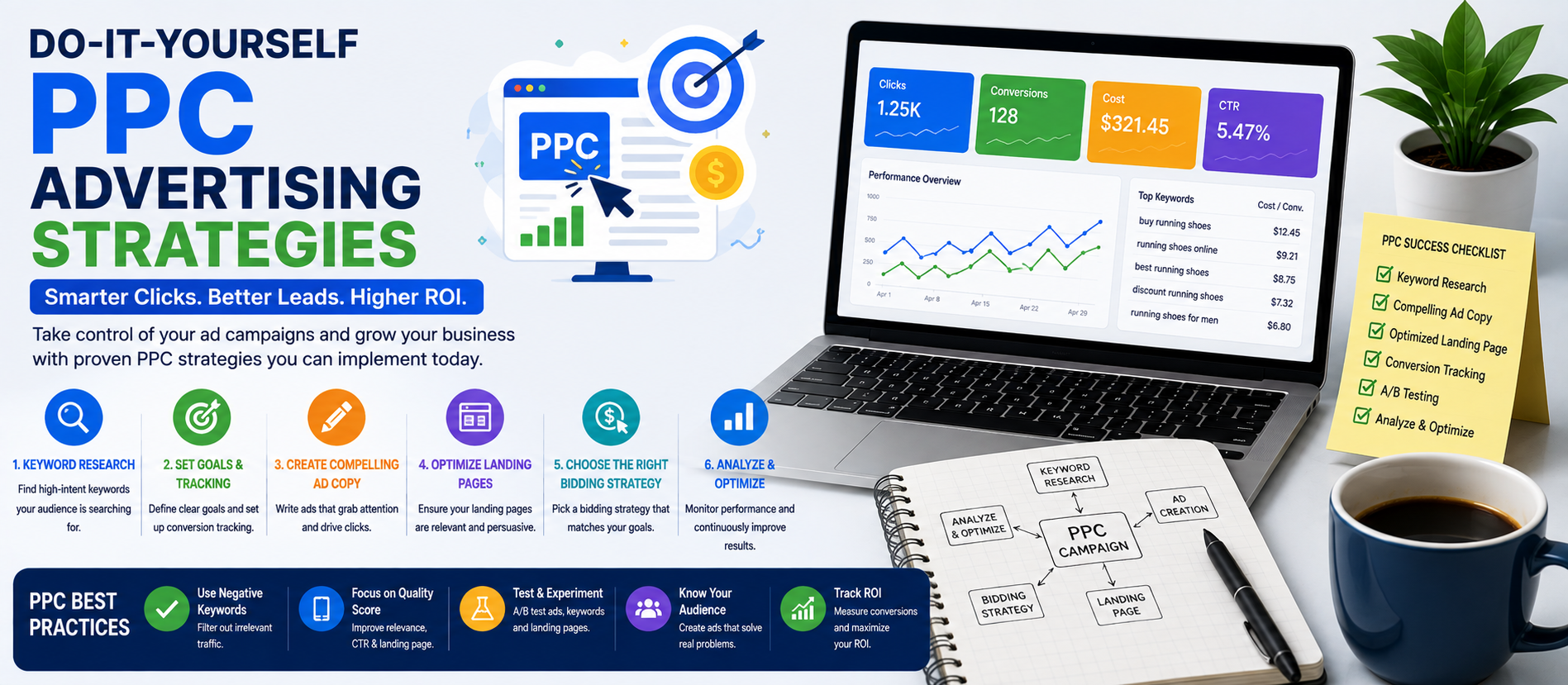
Do-it-yourself PPC advertising can be a practical option for small businesses, startups, and marketers who want greater control over their advertising budget. PPC, or pay-per-click advertising, allows advertisers to compete for visibility when people search for products, services, or solutions online. However, running a campaign without an agency does not mean simply creating an ad and waiting for sales.
Successful DIY PPC advertising strategies require a clear business goal, focused targeting, relevant ads, useful landing pages, accurate conversion tracking, and regular optimization. The good news is that a beginner can build a manageable PPC system by starting small and learning from real campaign data.
Designfo helps businesses build connected digital growth strategies through PPC planning, SEO, content marketing, website optimization, conversion rate optimization, marketing automation, AEO, GEO, and AI Search Optimization.
What Is DIY PPC Advertising?
PPC advertising is a digital advertising model in which an advertiser can pay when a user interacts with an ad, depending on the campaign and platform. Search advertising is a common example: an ad may become eligible to appear when a user's search is relevant to the advertiser's targeting.
💡 Key Insight
DIY PPC means managing important parts of the process yourself, including campaign planning, keyword research, ad creation, budgets, tracking, reporting, and optimization.
The goal is not to manage the largest possible account. For a beginner, a smaller and better-measured campaign is usually easier to understand and improve.
1. Define the Business Goal Before Creating a Campaign
Every campaign should begin with a measurable objective. Avoid launching ads simply because competitors are advertising.
Common PPC Goals
- Generate qualified leads
- Increase online sales
- Drive phone calls
- Increase consultation or booking requests
- Promote a specific product or service
- Build awareness for a new offer
- Encourage newsletter registrations
Choose the action that matters most. Google Ads and Microsoft Advertising both emphasize conversion tracking because meaningful actions such as purchases, calls, sign-ups, and form submissions allow advertisers to understand whether campaigns are producing business results.
2. Set Up Conversion Tracking First
One of the most important DIY PPC strategies is to measure valuable actions before spending heavily. Clicks alone do not tell you whether advertising is profitable.
Define what counts as a conversion for your business. This could be a purchase, lead form, booked appointment, phone call, newsletter sign-up, or another meaningful action.
- Identify the most valuable customer action.
- Create the conversion action or goal in your advertising platform.
- Install the required tracking tag or code.
- Test whether the action is recorded correctly.
- Review campaign results based on conversions and cost efficiency.
Google recommends setting up conversion tracking before using conversion-based Smart Bidding. Microsoft Advertising uses Universal Event Tracking (UET) to collect website activity for conversion goals and remarketing.
3. Start With a Focused Budget
A common beginner mistake is spreading a small budget across too many campaigns, locations, products, and audiences. This makes it difficult to learn what is actually working.
Start with one important offer, a focused target audience, and a budget you can afford to test. The exact amount will depend on your industry, competition, average customer value, and advertising goals.
A Simple Budgeting Approach
- Choose one high-priority service or product.
- Estimate the value of a successful lead or sale.
- Set an acceptable cost per acquisition.
- Start with a controlled testing budget.
- Do not make major changes every day.
- Increase investment gradually when results are consistently profitable.
4. Research Search Intent, Not Just Keywords
Good keyword research is about understanding what people want when they search. A keyword with high search volume may not be useful if the searcher's intent does not match your offer.
Common Intent Categories
- Informational: The user wants to learn.
- Commercial: The user is comparing options.
- Transactional: The user is ready to take action or buy.
- Navigational: The user is looking for a specific brand or destination.
For a lead-generation campaign, commercial and transactional searches may often be more valuable than very broad informational searches.
Google recommends building keyword lists around the words and phrases customers use when searching for what you offer, and its Keyword Planner can help identify relevant keyword ideas.
5. Understand Keyword Match Types
Google Ads provides broad match, phrase match, and exact match options. These settings influence how closely a search needs to relate to a keyword before an ad can be considered for the auction.
- Broad match: Can reach a wider range of related searches.
- Phrase match: Can reach searches that include the meaning of the keyword.
- Exact match: Provides the most control but generally reaches fewer searches.
Google's current guidance notes that broad match works with additional signals and recommends pairing it with Smart Bidding, while exact and phrase match can be useful when tighter query control is required.
For beginners, the best approach is not automatically to choose one match type forever. Test according to campaign goals, monitor the actual search terms triggering your ads, and adjust based on conversion quality.
6. Use Negative Keywords to Reduce Waste
Negative keywords help prevent ads from appearing for searches that are not relevant to your business. They can be especially useful when broad targeting creates unwanted traffic.
Example Negative Keyword Ideas
- Free
- Jobs
- Training
- DIY
- Used
- Cheap, if low-price shoppers are not your target
- Competitor categories that you do not serve
Do not add negative keywords blindly. Review search terms and make decisions based on relevance. Google specifically describes negative keywords as a way to exclude terms for which you do not want ads to show.
7. Organize Campaigns Around Clear Themes
⚠ Watch Out
Campaign structure should make it easier to understand performance. Avoid placing unrelated products or services in the same ad group.
For example, a home service company could create separate groups around different high-value services rather than mixing every service into one set of ads.
Simple Structure
- Campaign: Main business objective.
- Ad group: Closely related service or product theme.
- Keywords: Searches related to that theme.
- Ads: Messages matching the keyword intent.
- Landing page: A page focused on the same offer.
Google's setup guidance recommends grouping keywords into more than one ad group and writing ads that directly relate to what customers want to buy.
8. Write Ads That Match the Search
Relevance is one of the foundations of PPC performance. If a person searches for a specific service, the ad should make it clear that the business offers that service.
Strong Ad Copy Often Includes
- The product or service
- A specific customer benefit
- A differentiator or proof point
- A relevant call to action
Google explains that keyword quality and landing-page relevance are connected to Quality Score, which considers expected click-through rate, ad relevance, and landing page experience.
9. Improve the Landing Page Before Raising the Budget
Getting a click is only the first step. If visitors arrive on a confusing, slow, or irrelevant page, advertising spend may be wasted.
A Conversion-Focused Landing Page Should Include
- A clear headline matching the ad's promise
- A concise explanation of the offer
- Relevant benefits
- Trust signals or customer proof where appropriate
- A simple form or call to action
- Mobile-friendly design
- Fast and reliable page performance
Microsoft's current guidance advises advertisers who receive clicks but no leads or sales to check whether the landing page is clear, fast, focused on one main action, and consistent with the ad promise.
10. Choose Bidding Based on Available Data
Manual control can feel safer for beginners, but automated bidding can become useful when accurate conversion data is available. Google recommends setting up conversion tracking before using conversion-based Smart Bidding and identifies Maximize Conversions as a strategy designed to optimize toward valuable actions.
The important point is that automation depends on meaningful data. If conversion tracking is incorrect, automated optimization can make decisions based on the wrong signals.
11. Review Search Terms and Performance Regularly
DIY PPC requires regular review, but constant changes can make learning difficult. Establish a routine for checking performance.
Weekly PPC Checklist
- Review conversions and cost per conversion.
- Check the search terms report.
- Add genuinely irrelevant terms as negatives.
- Identify high-performing keywords and ads.
- Pause or investigate persistent spend without results.
- Review landing-page performance.
- Check budget limitations.
Microsoft recommends reviewing campaign, ad group, keyword, and search-term performance, then shifting budget toward stronger performers and adding negative keywords to reduce irrelevant traffic.
12. Test One Important Variable at a Time
If you change the budget, keywords, targeting, bidding, ad copy, and landing page simultaneously, it becomes difficult to know which change affected performance.
Use controlled tests when possible. Examples include:
- Testing two ad messages.
- Comparing different calls to action.
- Testing a revised landing-page headline.
- Comparing keyword themes.
- Testing a new audience or location.
13. Use Remarketing Carefully
Not every visitor converts on the first visit. Remarketing can help reconnect with relevant audiences, but messages should remain useful and appropriate.
Microsoft Advertising explains that UET-based tracking can support remarketing lists and that understanding which actions and audiences drive value can improve future investment decisions.
14. Combine PPC With SEO, AEO, GEO, and AI Search
PPC and SEO can support each other. PPC search data may reveal the language customers use, high-converting offers, and common questions. These insights can help improve website pages and content.
For AEO, identify recurring customer questions and create clear answers on relevant website pages. For GEO and AI Search Optimization, focus on accurate brand information, original expertise, useful content, and technically accessible pages rather than creating low-value pages for every possible AI query.
A connected strategy can use paid advertising for immediate testing while SEO and useful content build longer-term visibility.
15. Common DIY PPC Mistakes to Avoid
- Launching campaigns without conversion tracking.
- Targeting too many products with a small budget.
- Choosing keywords based only on search volume.
- Ignoring search terms.
- Using irrelevant landing pages.
- Changing campaign settings too frequently.
- Optimizing only for clicks.
- Ignoring negative keywords.
- Increasing budgets before proving conversion quality.
- Copying competitors without understanding your own customer economics.
A Practical 30-Day DIY PPC Plan
- Week 1: Define goals, conversion actions, budget, audience, and primary offer.
- Week 2: Research keywords, build campaign themes, write ads, and prepare landing pages.
- Week 3: Launch with controlled targeting and confirm that tracking works correctly.
- Week 4: Review conversions, search terms, ad relevance, landing-page behavior, and budget efficiency.
After the first month, continue improving based on real data instead of assumptions.
How Designfo Supports PPC and Digital Growth
Designfo helps businesses build integrated digital strategies designed around visibility, engagement, conversion, and long-term growth.
- PPC and Paid Advertising Strategy
- Keyword and Search Intent Research
- Landing Page Optimization
- Conversion Rate Optimization
- SEO and Technical SEO
- Content Marketing
- Marketing Automation
- AEO, GEO, and AI Search Optimization
- Website Design and Development
Frequently Asked Questions
Can I manage PPC advertising myself?
Yes. A beginner can manage a focused campaign by starting with a clear goal, accurate conversion tracking, relevant targeting, a controlled budget, and regular optimization. More complex accounts may require additional expertise.
What should I track in a PPC campaign?
Track the outcomes that matter to your business, such as purchases, qualified leads, calls, form submissions, cost per conversion, and conversion value where relevant.
Should I focus on clicks or conversions?
Clicks are useful diagnostic data, but conversions usually provide a clearer connection to business results. The right primary metric depends on your campaign objective.
What are negative keywords?
Negative keywords prevent ads from showing for selected terms or search contexts, helping reduce irrelevant traffic.
How does AI affect PPC advertising?
AI-powered bidding and campaign tools can automate parts of targeting and optimization, but they depend on useful goals, accurate tracking, relevant creative assets, and regular performance review.
Conclusion
Do-it-yourself PPC advertising strategies work best when they are simple, measurable, and closely connected to real business goals. Begin with conversion tracking, focus on relevant customer intent, create tightly aligned ads and landing pages, and use campaign data to make gradual improvements.
In 2026, automation and AI can help advertisers manage campaigns more efficiently, but they do not replace strategy. Accurate conversion data, clear offers, useful landing pages, and disciplined optimization remain essential.
By combining PPC advertising with SEO, AEO, GEO, and AI Search Optimization, businesses can create a more balanced digital marketing system that supports both immediate opportunities and long-term organic visibility.
Designfo
Website: www.designfo.in
Ready to Grow?
Talk to us about a strategy tailored to your brand — we will help you stand out in search, AI discovery and social.

Comments (0)
Log in to leave a comment.