📋 Quick Summary
In this article:
What Is Content Marketing for Startups?
Why Content Marketing Matters for Startups
1. Start With the Customer Problem
2. Define a Clear Content Goal
3. Build a Focused Content Strategy
4. Prioritize Original Expertise
Focus Keyword: Effective Content Marketing for Startups
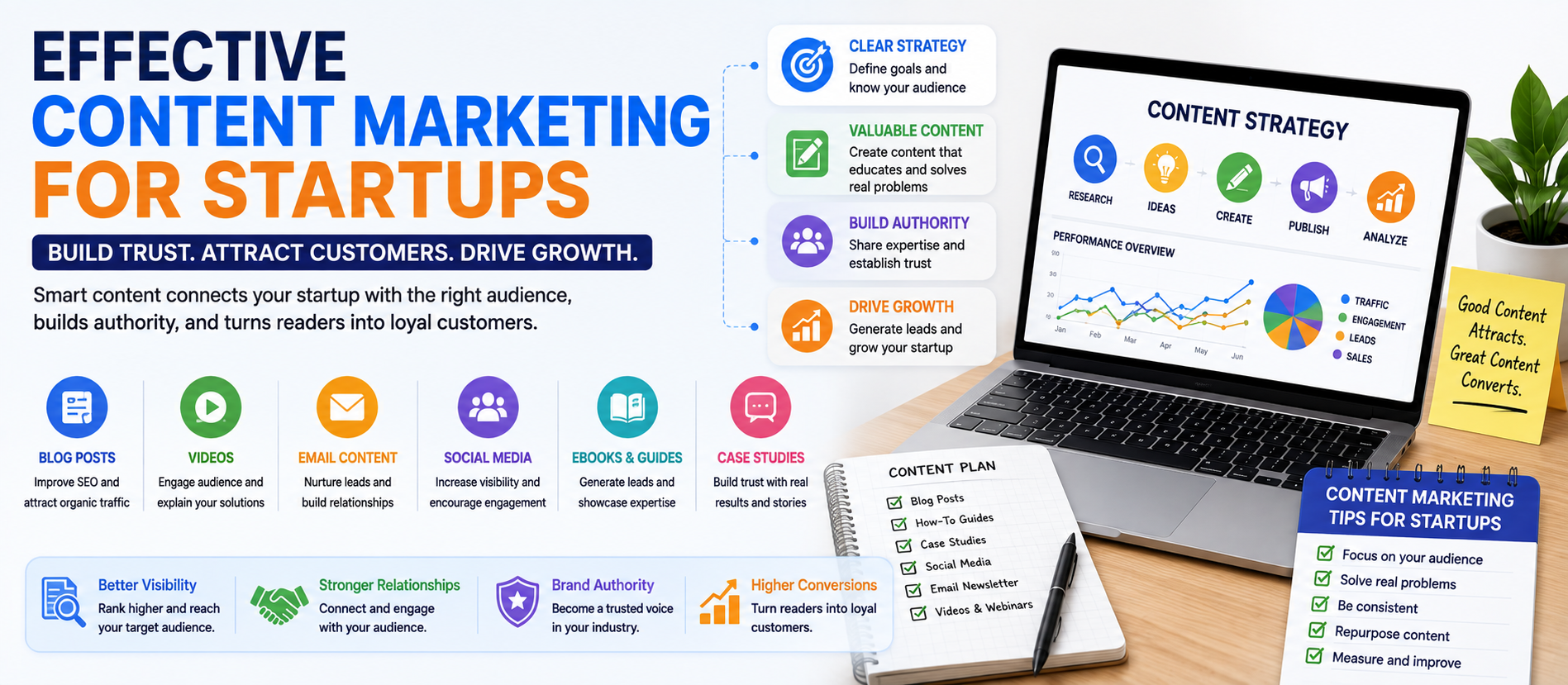
Effective content marketing for startups is not about publishing as many blog posts as possible. A startup usually has limited time, budget, and people, so every piece of content should have a clear purpose. The right strategy can help a new company explain its value, attract the right audience, build trust, support sales conversations, and create long-term organic visibility.
💡 Key Insight
In 2026, startups are competing across traditional search, social platforms, communities, email, video, and AI-powered search experiences. This makes content more important, but it also raises the standard. Generic articles that simply repeat information already available online are unlikely to create a meaningful competitive advantage.
Designfo helps businesses and growing companies build connected digital strategies through content marketing, SEO, website optimization, marketing automation, AEO, GEO, and AI Search Optimization.
What Is Content Marketing for Startups?
Content marketing is the strategic creation and distribution of useful information that helps a defined audience solve problems, understand options, or make better decisions. For a startup, content may include articles, guides, case studies, videos, social media posts, newsletters, product education, research, and customer stories.
The objective is not simply to gain traffic. A successful startup content strategy should support real business outcomes such as:
- Building awareness in a new market
- Explaining a new or complex product
- Attracting qualified website visitors
- Generating leads and demo requests
- Supporting sales conversations
- Improving customer education and retention
- Building expertise and brand trust
Why Content Marketing Matters for Startups
Paid advertising can create immediate visibility, but startups often cannot depend entirely on continuously increasing ad spend. Useful content can become a long-term business asset. A strong article, guide, video, or case study may continue attracting relevant audiences after publication.
Content is also valuable when the startup is selling something unfamiliar. Customers may first need to understand the problem before they are ready to evaluate a solution. Educational content can reduce confusion and help prospects move toward a purchase decision.
1. Start With the Customer Problem
The best startup content begins with a clear understanding of the customer. Do not begin with a list of random keywords. First identify the problems, questions, objections, and goals that matter to the people you want to reach.
Ask Questions Such As
- Who is our ideal customer?
- What problem are they trying to solve?
- What happens if they do nothing?
- What alternatives are they currently using?
- What questions do they ask before buying?
- What objections delay a decision?
- What information would make the next step easier?
Sales calls, support tickets, product demonstrations, customer interviews, and community discussions can all provide useful content ideas.
2. Define a Clear Content Goal
Every content asset does not need to generate a sale immediately. Different pieces can serve different purposes.
Awareness Content
Explains a problem, trend, or opportunity to people who may not yet know the startup.
Consideration Content
Helps prospects compare approaches, understand features, calculate value, or evaluate alternatives.
Decision Content
Supports conversion through case studies, demonstrations, pricing explanations, implementation guides, and customer proof.
Retention Content
Helps existing customers use the product successfully and discover additional value.
A balanced content strategy should map topics to the customer journey instead of publishing only broad top-of-funnel articles.
3. Build a Focused Content Strategy
⚠ Watch Out
Startups should avoid covering every possible industry topic. A focused content strategy is easier to manage and helps create a clearer area of expertise.
Choose a small number of important themes connected to your product, customers, and market. Under each theme, develop useful content that answers related questions from different stages of the buying journey.
Example Content Framework
- Define three to five core customer problems.
- List the questions customers ask about each problem.
- Identify beginner, comparison, and decision-stage topics.
- Create major pillar pages or comprehensive guides.
- Support them with focused articles, FAQs, videos, and case studies.
- Review performance and improve the strongest topics.
4. Prioritize Original Expertise
One of the strongest advantages a startup has is its own knowledge. Founders, product teams, engineers, consultants, and customers may have insights that competitors cannot easily copy.
Instead of rewriting the top search results, create content based on first-hand experience. Explain what you learned while building the product, solving customer problems, testing strategies, or analyzing market data.
Original Content Ideas
- Founder insights
- Original research
- Customer case studies
- Product experiments
- Behind-the-scenes lessons
- Expert interviews
- Industry data and analysis
- Detailed implementation guides
Originality gives readers a reason to choose your content over a generic summary.
5. Use SEO Without Creating Content Only for Search Engines
SEO for startups should help the right people discover useful content. Research the words and questions potential customers use, then create pages that genuinely address those needs.
Place important terms naturally in descriptive titles, headings, internal links, and relevant page content. Do not repeat keywords excessively. Search optimization should improve discoverability without making the content difficult to read.
Core Startup SEO Priorities
- Clear site architecture
- Useful titles and headings
- Search-intent research
- Internal linking
- Mobile-friendly pages
- Crawlable and indexable content
- Original, useful information
- Clear authorship and trust signals where relevant
6. Build Content for AEO and Customer Questions
Answer Engine Optimization (AEO) can be approached by making answers easy for people to find and understand. Identify recurring customer questions and answer them directly before expanding with useful context.
Useful Question-Based Topics
- What is [your category]?
- How does [solution] work?
- How much does it cost?
- What are the alternatives?
- Who is it best for?
- How long does implementation take?
- What mistakes should buyers avoid?
FAQ sections, product documentation, comparison pages, and detailed guides can all support this approach when they provide genuinely useful answers.
7. Prepare for GEO and AI Search Optimization
Generative Engine Optimization (GEO) and AI Search Optimization are becoming important topics as users increasingly ask longer and more conversational questions. However, startups should avoid chasing shortcuts or artificial “AI optimization” tactics.
A practical strategy is to build strong SEO foundations and publish unique, valuable information. Make it clear what the company does, who it serves, what problems it solves, and what evidence supports its claims.
- Publish expert-led insights.
- Keep product and business information accurate.
- Create useful text, images, and video where relevant.
- Use clear technical website structure.
- Build legitimate recognition and mentions.
- Measure search visibility and engagement.
For Google Search, AEO and GEO should complement—not replace—foundational SEO and people-first content.
8. Create a Lean Content Production System
Startups do not need a large editorial department to publish useful content. Build a repeatable system around available expertise.
A Simple Workflow
- Collect questions from customers and internal teams.
- Prioritize topics based on business value and audience need.
- Create a brief with audience, intent, key points, and CTA.
- Gather original insights from subject experts.
- Create the first draft.
- Review for accuracy, usefulness, and brand voice.
- Optimize the page for readability and search discovery.
- Publish and distribute the content.
- Measure performance and update useful assets.
9. Use AI as an Assistant, Not a Content Factory
AI can make a small content team more efficient. It can help brainstorm topics, organize research, create outlines, repurpose ideas, and assist with early drafts. However, publishing large volumes of unreviewed AI-generated content can create quality and originality problems.
The most effective approach is to combine AI efficiency with human expertise, editing, fact-checking, and original experience. The startup's unique knowledge should remain the foundation of the content.
10. Repurpose Every Strong Content Asset
One high-quality content asset can support multiple channels. This is especially valuable for startups with limited resources.
For example, a detailed guide can become:
- A series of LinkedIn posts
- Short educational videos
- An email newsletter sequence
- FAQ content
- A webinar topic
- Sales enablement material
- Short social media graphics
Repurposing should adapt the idea to each channel rather than simply copying the same text everywhere.
11. Distribute Content Strategically
Publishing is only the beginning. Startups should decide how the right audience will discover each important asset.
Possible Distribution Channels
- Organic search
- Email newsletters
- LinkedIn and other social platforms
- Founder-led content
- Industry communities
- Partner newsletters
- Sales follow-up sequences
- Webinars and events
Choose channels based on where your audience is active. A focused distribution plan is more effective than posting links everywhere.
12. Use Case Studies and Customer Proof
Case studies can be particularly valuable for startups because prospects often want evidence that the product or service works in a real situation.
A Strong Case Study Can Cover
- The customer's original challenge
- Why the previous approach was insufficient
- The solution and implementation process
- Measurable outcomes where available
- Lessons learned
- Who may benefit from a similar approach
Specific, honest details are generally more useful than exaggerated claims.
13. Measure Content Performance
Do not evaluate content only by page views. Connect measurement to the original purpose of the content.
- Organic impressions and clicks
- Qualified website traffic
- Engagement with important pages
- Newsletter subscriptions
- Demo or contact requests
- Assisted conversions
- Sales pipeline influence
- Customer education and retention indicators
Use performance data to update successful content, improve weak conversion paths, and identify the topics that generate the most valuable audience.
14. Avoid Common Startup Content Marketing Mistakes
- Publishing without understanding the audience.
- Writing only about broad, high-volume keywords.
- Copying competitor content.
- Creating content without a clear business purpose.
- Using AI to mass-produce low-value pages.
- Ignoring distribution.
- Measuring only traffic and social likes.
- Publishing without clear calls to action.
- Failing to update valuable content.
- Trying to be active on every channel at once.
How Designfo Supports Startup Content Marketing
Designfo helps startups and businesses create connected digital strategies designed around visibility, trust, and measurable growth.
Designfo Services
- Content Marketing Strategy
- SEO and Technical SEO
- Website and Landing Page Optimization
- Blog and Educational Content
- Conversion Rate Optimization
- Marketing Automation
- AEO, GEO, and AI Search Optimization
- Social Media and Digital Marketing Strategy
Frequently Asked Questions
What is the best content marketing strategy for a startup?
The best strategy starts with a clear audience, important customer problems, focused topics, original expertise, and measurable business goals. Start small, learn from performance, and expand what works.
How often should a startup publish content?
There is no universal publishing frequency. A startup should choose a sustainable schedule that allows it to maintain quality and consistency rather than publishing a large quantity of weak content.
Is SEO important for startup content marketing?
Yes. SEO can help useful content become discoverable through search. However, optimization should support people-first content rather than encourage keyword stuffing or low-value publishing.
Can AI write startup content?
AI can assist with research, ideation, structure, and drafting. The final content should still be reviewed for accuracy, relevance, originality, and useful expert insight.
What is GEO in content marketing?
GEO is commonly used to describe efforts to improve visibility in generative AI search experiences. A practical approach is to create unique, reliable content and maintain strong SEO and technical foundations.
Conclusion
Effective content marketing for startups is a long-term growth system, not a publishing contest. Start with the customer, focus on meaningful problems, use your unique expertise, and create content that helps people make progress.
In 2026, the strongest approach connects SEO, AEO, GEO, and AI Search Optimization with original content, strong website fundamentals, strategic distribution, and measurable business goals. Startups that create genuinely useful assets can build visibility and trust that compound over time.
Designfo
Website: www.designfo.in
Ready to Grow?
Talk to us about a strategy tailored to your brand — we will help you stand out in search, AI discovery and social.

Comments (0)
Log in to leave a comment.