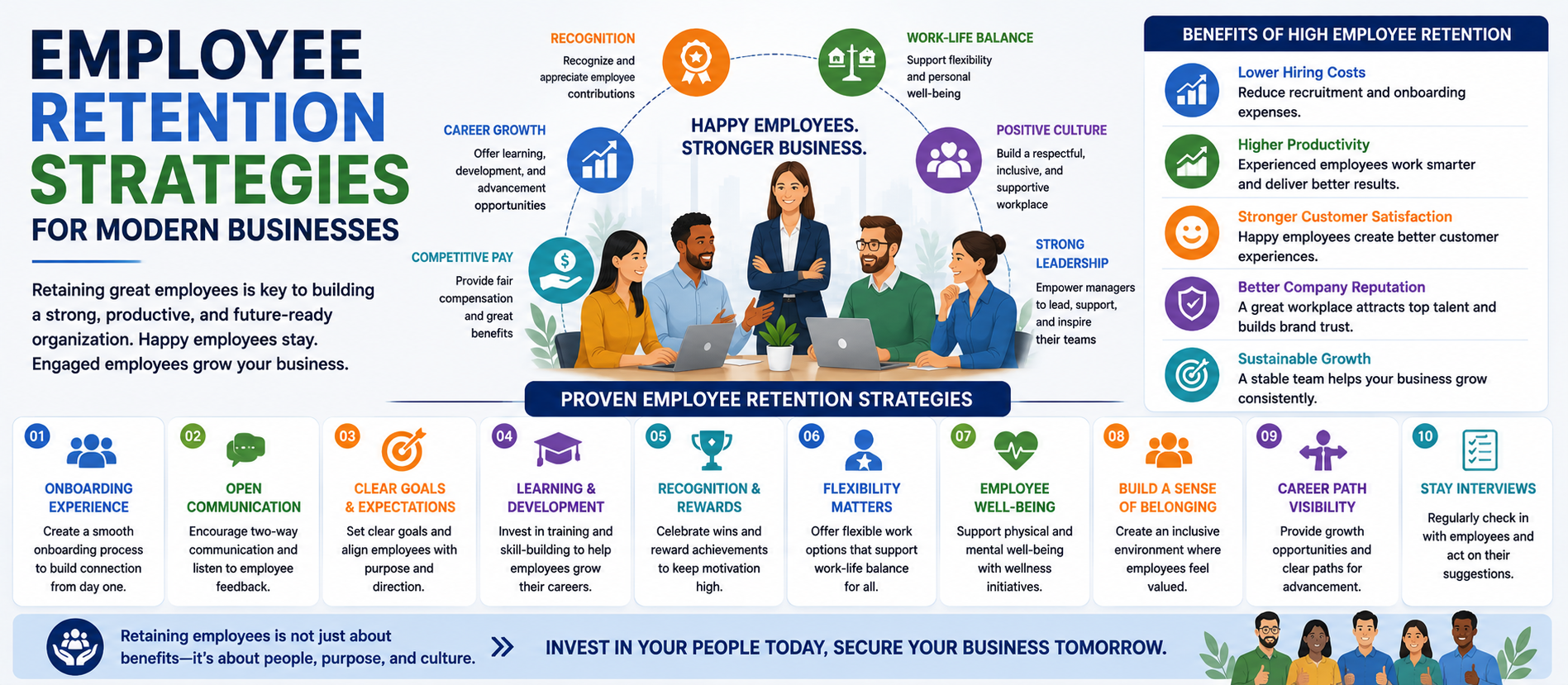
📋 Quick Summary
In this article:
Quick Answer: What Is the Best Employee Retention Strategy?
Why Employee Retention Matters
1. Understand Why Employees Leave
2. Hire People Who Fit the Role and the Reality of the Job
3. Build Strong Career Development Pathways
4. Invest in Learning and Upskilling
5. Pay Fairly and Communicate Clearly
6. Improve the Quality of Managers
7. Give Employees Clear Expectations
8. Offer Flexibility Where the Work Allows
9. Recognize Good Work
10. Protect Employee Wellbeing and Manage Burnout
Employee retention has become a major business priority. Modern employees evaluate more than salary when deciding whether to stay. They consider career growth, leadership, flexibility, workload, culture, recognition, learning opportunities, and confidence in the future of the organization.
💡 Key Insight
This does not mean that compensation is unimportant. Fair and competitive pay remains essential. However, salary alone rarely solves every retention problem.
Modern businesses are also changing quickly. Artificial intelligence is reshaping jobs. Skills are evolving. Teams are becoming more distributed. Employees expect clearer communication and stronger support from managers. At the same time, businesses need to control costs and maintain productivity.
As a result, employee retention is no longer only an HR metric. It is connected to business performance, customer experience, knowledge retention, and long-term growth.
This guide explains practical employee retention strategies for modern businesses. It uses clear, direct language and a structured format designed for SEO, AEO, GEO, and AI Search Optimization.
Digiifrog creates clear, structured, and search-friendly content for businesses, technology companies, service providers, and digital growth strategies.
Quick Answer: What Is the Best Employee Retention Strategy?
The best employee retention strategy is a combination of fair compensation, strong managers, meaningful career opportunities, continuous learning, flexible work practices where possible, employee recognition, healthy workloads, and a workplace culture built on trust and clear expectations.
There is no single retention tactic that works for every organization. Businesses should understand why employees leave, identify patterns, and improve the areas that have the greatest effect on employee experience.
Why Employee Retention Matters
When experienced employees leave, businesses can lose more than a job position. They may lose customer knowledge, technical skills, relationships, process knowledge, and team stability.
High turnover can also create additional pressure on the employees who remain. Teams may need to cover vacant roles while new employees are recruited and trained.
Gallup's 2026 employee engagement research shows that highly engaged organizations can experience lower turnover, less absenteeism, higher productivity, stronger customer outcomes, and higher profitability compared with organizations at the lower end of engagement.
SHRM's 2026 Talent Trends research also reported that 42% of HR professionals experienced difficulty retaining full-time employees during the previous 12 months. The same research highlights the importance of training and developing existing employees as organizations face continuing talent and skills challenges.
1. Understand Why Employees Leave
Businesses should not build a retention strategy based only on assumptions.
Employees leave for different reasons, including:
- Limited career growth.
- Uncompetitive compensation.
- Burnout and excessive workload.
- Poor management.
- Lack of recognition.
- Limited flexibility.
- Weak communication.
- A negative workplace culture.
- Uncertainty about the future.
Regular employee surveys, stay interviews, exit interviews, manager feedback, and workforce data can help identify the real causes.
Ask simple questions:
- What makes employees want to stay?
- What creates frustration?
- Which teams have the highest turnover?
- Are new employees leaving early?
- Do employees see a future inside the organization?
The goal is to find patterns before turnover becomes a larger problem.
2. Hire People Who Fit the Role and the Reality of the Job
Retention begins before an employee starts.
Job descriptions should clearly explain responsibilities, expectations, required skills, reporting relationships, and major challenges.
⚠ Watch Out
Employers should avoid overselling the role. A candidate who joins with unrealistic expectations may leave quickly when the day-to-day reality is different.
A better hiring process includes:
- Clear job descriptions.
- Realistic information about the role.
- Structured interviews.
- Transparent communication about growth opportunities.
- Clear discussion of work arrangements.
- Accurate information about compensation and benefits.
Good retention starts with an honest match between the employee, the role, and the organization.
3. Build Strong Career Development Pathways
Employees are more likely to look outside the organization when they cannot see a future inside it.
Career development should not depend only on annual promotions.
Modern career pathways can include:
- Promotion opportunities.
- Lateral moves.
- Cross-functional projects.
- Leadership development.
- Technical specialization.
- Mentoring.
- Professional certifications.
SHRM has highlighted internal mobility as an increasingly important retention strategy, particularly as employee expectations, skill needs, and job structures continue to change.
Managers should discuss career goals regularly rather than waiting for an annual performance review.
4. Invest in Learning and Upskilling
Technology is changing the skills employees need.
Artificial intelligence, automation, analytics, cloud technology, cybersecurity, and other digital capabilities are changing many jobs. Employees may become concerned when they do not understand how these changes will affect their work.
A strong learning strategy can improve both business capability and employee confidence.
Useful learning options include:
- Short skill-based training.
- AI literacy programs.
- Technical certifications.
- Manager development.
- Mentoring and coaching.
- Learning through projects.
SHRM's 2026 research found that organizations are actively training existing employees for difficult-to-fill roles, reinforcing the importance of building talent instead of relying only on external hiring.
5. Pay Fairly and Communicate Clearly
Compensation remains a foundation of retention.
Employees should understand how their pay is determined and how performance, skills, responsibilities, or market conditions may influence compensation.
A practical compensation strategy should consider:
- Market competitiveness.
- Internal fairness.
- Role responsibilities.
- Performance.
- Skill value.
- Total benefits.
Pay does not need to be the only reason an employee stays, but unfair or unclear compensation can quickly become a reason to leave.
6. Improve the Quality of Managers
Managers have a direct influence on the daily employee experience.
A good manager provides clarity, feedback, recognition, support, and accountability.
Gallup's recent workplace research has also emphasized the importance of manager support as organizations introduce AI and other major workplace changes.
Businesses should invest in manager development around:
- Communication.
- Coaching.
- Feedback.
- Conflict management.
- Performance conversations.
- Change leadership.
- Workload management.
Promoting a high-performing employee into management without providing leadership training can create avoidable problems.
7. Give Employees Clear Expectations
Employees perform better when they understand what success looks like.
Clear expectations should include:
- Role responsibilities.
- Business priorities.
- Performance goals.
- Decision-making authority.
- Available resources.
Gallup reported in July 2026 that employees were more likely to be engaged when AI adoption was supported by clear expectations, thoughtful implementation, and active manager support.
The broader lesson applies beyond AI. Employees need clarity when the organization is changing.
8. Offer Flexibility Where the Work Allows
Not every role can be fully remote or follow the same schedule. However, businesses can still look for practical flexibility.
Depending on the role, options may include:
- Flexible start and finish times.
- Hybrid work.
- Remote work.
- Compressed schedules.
- Flexible leave arrangements.
The most effective approach balances employee needs with customer requirements, teamwork, security, and business operations.
Flexibility should also be managed fairly. Employees in different roles may not receive identical options, but the reasons for differences should be clear and consistent.
9. Recognize Good Work
Recognition is simple, but it is often inconsistent.
Employees want to know that their work has value. Recognition can be formal or informal.
Examples include:
- A specific thank-you message.
- Recognition during team meetings.
- Peer recognition programs.
- Performance awards.
- New responsibilities and growth opportunities.
The best recognition is specific. Instead of saying only, “Good job,” explain what the employee did and why it mattered.
10. Protect Employee Wellbeing and Manage Burnout
Retention becomes difficult when employees are consistently overloaded.
Modern businesses often move quickly, and teams may face constant deadlines, changing priorities, and staffing pressure.
Employers should regularly review:
- Workload distribution.
- Unrealistic deadlines.
- After-hours expectations.
- Meeting overload.
- Staffing gaps.
- Manager workload.
Wellbeing programs can be useful, but they should not replace practical workload management.
If employees are experiencing burnout because of poor staffing or unrealistic expectations, the business should address the source of the problem.
11. Build a Culture of Trust
Culture is reflected in everyday behavior.
Employees observe how leaders communicate, how managers treat people, how conflict is handled, and whether the organization follows its stated values.
A healthy culture is supported by:
- Respect.
- Fairness.
- Transparency.
- Psychological safety.
- Accountability.
- Consistent leadership.
Trust is especially important during periods of change.
12. Communicate Openly About AI and Workplace Change
AI can improve productivity, but employees may also have concerns about changing job responsibilities, required skills, and job security.
Businesses should communicate clearly about:
- Why AI is being introduced.
- Which work may change.
- What new skills employees will need.
- How employees can receive training.
- Where human judgment remains important.
SHRM's 2026 State of AI in HR report found that AI is affecting work responsibilities more often than it is directly displacing jobs. The report also emphasizes the continuing importance of human capabilities such as empathy, judgment, relationship building, and complex decision-making.
A retention strategy should treat AI adoption as a workforce change project, not only a technology project.
13. Create a Better Employee Experience
The employee experience begins before the first day and continues throughout the employment relationship.
Businesses should review important moments such as:
- Recruitment.
- Onboarding.
- First 90 days.
- Performance reviews.
- Career discussions.
- Internal job changes.
- Parental or extended leave.
- Leadership transitions.
These moments can strongly influence whether employees feel supported.
14. Improve Onboarding and the First 90 Days
Early turnover is expensive and disruptive.
A strong onboarding process should help employees understand:
- The company.
- Their role.
- The team.
- Performance expectations.
- Key tools and processes.
- Where to ask for help.
Managers should schedule regular check-ins during the first weeks and months.
Onboarding should not be limited to paperwork and orientation.
15. Use Stay Interviews
Exit interviews explain why someone has already decided to leave.
Stay interviews can identify concerns earlier.
Useful questions include:
- What do you enjoy most about your work?
- What makes your job difficult?
- What would make you consider leaving?
- What skills do you want to develop?
- What can the company do better?
The most important part is acting on useful feedback where possible.
16. Use Employee Surveys Carefully
Surveys can reveal patterns that managers may not see.
However, businesses should avoid collecting feedback without a plan to respond.
A useful survey process is:
- Ask focused questions.
- Analyze the results.
- Share key findings.
- Select practical improvements.
- Explain what will change.
- Measure progress later.
Short pulse surveys can sometimes provide more useful ongoing information than a single long annual survey.
17. Strengthen Internal Mobility
Employees do not always need to leave a company to change careers.
Internal mobility can help businesses retain knowledge while giving employees new opportunities.
Companies can support mobility through:
- Internal job boards.
- Skills profiles.
- Transparent role requirements.
- Cross-training.
- Project-based assignments.
- Career mentoring.
SHRM's 2026 discussion of internal mobility highlights career growth, skill development, and job flexibility as important elements of modern retention strategies.
18. Give Employees a Voice
Employees are more likely to support decisions when they understand how those decisions are made and have opportunities to share relevant input.
This does not mean every decision requires a vote.
It means leaders should listen to the people closest to the work.
Useful methods include:
- Team meetings.
- Suggestion channels.
- Employee resource groups.
- Feedback sessions.
- Cross-functional workshops.
19. Build Inclusive and Fair Work Practices
Retention can suffer when employees believe opportunities, recognition, workload, or promotion decisions are inconsistent.
Businesses should review processes for fairness and transparency.
Areas to examine include:
- Hiring.
- Pay decisions.
- Performance reviews.
- Promotions.
- Learning opportunities.
- Access to leadership.
Clear processes can reduce confusion and improve trust.
20. Use Technology and AI to Support, Not Replace, Human Connection
HR technology and AI can reduce repetitive work and improve access to information.
Possible uses include:
- Answering routine employee questions.
- Supporting onboarding.
- Identifying skill gaps.
- Improving workforce analytics.
- Personalizing learning recommendations.
- Reducing administrative work.
However, sensitive conversations, coaching, conflict resolution, and high-stakes people decisions still require appropriate human judgment.
SHRM's 2026 AI in HR research found that HR professionals see AI as useful for efficiency and work quality while continuing to value human intelligence for empathy, judgment, ethical reasoning, and relationship building.
21. Use Retention Data to Identify Risk Early
Data can help businesses identify patterns, but employees should not be treated as simple numbers.
Useful indicators may include:
- Voluntary turnover.
- Turnover by team.
- New-hire turnover.
- Internal mobility.
- Promotion rates.
- Employee engagement.
- Absenteeism.
- Training participation.
When a pattern appears, investigate the business context before making assumptions.
22. Measure the Cost of Turnover
Retention programs need business support.
Estimate the impact of turnover by considering:
- Recruitment costs.
- Training costs.
- Lost productivity.
- Manager time.
- Knowledge loss.
- Customer impact.
The exact cost varies by role and industry. A practical estimate can help leaders prioritize retention investments.
Employee Retention Strategy Framework
| Area Main Goal Example Actions | ||
| Compensation | Maintain fairness and competitiveness | Regular market reviews and transparent pay practices |
| Career Growth | Create a future inside the company | Career paths, mentoring, internal mobility |
| Learning | Keep skills relevant | Upskilling, AI literacy, certifications |
| Management | Improve the daily employee experience | Manager coaching and leadership development |
| Flexibility | Support sustainable ways of working | Role-appropriate schedules and work arrangements |
| Recognition | Show employees that their work matters | Specific and timely recognition |
| Wellbeing | Reduce preventable burnout | Workload reviews and realistic staffing |
| Technology | Improve employee experience | Useful HR tools and responsible AI |
How to Build an Employee Retention Plan
Step 1: Measure Current Retention
Review turnover trends and identify where voluntary departures are concentrated.
Step 2: Find the Main Causes
Use surveys, stay interviews, exit feedback, and manager insights.
Step 3: Segment the Data
Different employee groups may have different retention challenges.
Step 4: Select Priority Problems
Focus on the issues with the largest business and employee impact.
Step 5: Create Practical Actions
Assign owners, timelines, resources, and measurable goals.
Step 6: Train Managers
Managers need the skills to support the strategy in everyday work.
Step 7: Communicate Clearly
Employees should understand what the organization is improving and why.
Step 8: Measure Results
Track turnover, engagement, internal mobility, and other relevant indicators over time.
Common Employee Retention Mistakes to Avoid
Relying Only on Salary Increases
Fair pay matters, but it does not solve weak leadership, burnout, or limited growth.
Waiting for Exit Interviews
Talk to employees while they are still part of the organization.
Promoting Without Developing Managers
Leadership skills require training and practice.
Offering Perks Instead of Fixing Core Problems
Small benefits cannot compensate for consistently unhealthy workloads or poor management.
Ignoring Career Development
Employees need to see realistic ways to grow.
Introducing AI Without Communication
Explain how technology will change work and what support employees will receive.
Collecting Feedback Without Action
Repeated surveys with no visible response can reduce trust.
SEO, AEO, GEO, and AI Search Optimization for HR and Retention Businesses
HR service providers, recruitment firms, training companies, and business consultants can improve digital visibility by answering real employee and employer questions clearly.
SEO helps useful retention content appear in traditional search results.
AEO focuses on direct answers to questions such as:
- How can a company improve employee retention?
- What causes high employee turnover?
- What are the best employee retention strategies?
- How does career development improve retention?
GEO helps generative AI systems understand the business, its expertise, and the context of its content.
AI Search Optimization benefits from clear headings, direct answers, accurate information, structured FAQs, practical examples, and consistent expertise signals.
Frequently Asked Questions
What are the most effective employee retention strategies?
The most effective strategies usually combine fair compensation, career growth, strong management, learning opportunities, recognition, healthy workloads, flexibility where possible, and a culture of trust.
Why do employees leave companies?
Common reasons include limited career opportunities, poor management, unfair compensation, burnout, weak culture, lack of recognition, and better external opportunities.
How can small businesses improve employee retention?
Small businesses can focus on clear communication, fair compensation, manager quality, flexible practices, recognition, learning opportunities, and honest career discussions. Expensive programs are not always required.
Does AI affect employee retention?
AI can affect retention positively or negatively depending on how it is introduced. Clear communication, training, thoughtful implementation, and manager support can help employees adapt to changing work.
What is internal mobility?
Internal mobility means helping employees move into new roles, projects, functions, or career paths within the same organization.
How often should companies measure employee engagement?
The right frequency depends on the organization. Many businesses combine periodic comprehensive surveys with shorter pulse surveys and regular manager conversations.
Conclusion
Modern employee retention is about creating a workplace where people can contribute, develop, and see a meaningful future.
Businesses cannot depend on one tactic. Competitive pay matters. So do career opportunities, skilled managers, learning, recognition, flexibility, manageable workloads, and trust.
AI and workplace technology are adding another layer to retention strategy. Companies need to help employees understand how their work is changing and provide opportunities to build relevant skills.
The strongest retention strategies are continuous. They listen to employees, identify problems early, improve the daily work experience, and measure results.
In a competitive and rapidly changing workforce, retaining good employees is not simply about convincing people to stay. It is about building an organization where talented people have strong reasons to grow.
Disclaimer: This article is for general educational and informational purposes only. Employment laws, compensation practices, workplace requirements, and employee expectations vary by country, industry, and organization. Businesses should consult qualified HR, legal, and employment professionals when developing policies or making employment decisions.
Digiifrog
Website: www.digiifrog.com
Ready to Grow?
Talk to us about a strategy tailored to your brand — we will help you stand out in search, AI discovery and social.


Comments (0)
Log in to leave a comment.