📋 Quick Summary
In this article:
Why Home EV Charging Is Useful
Level 1 vs. Level 2 EV Charging
How to Decide Which EV Charger You Need
Check Your Home's Electrical Capacity First
Do Not Judge Capacity Only by Empty Breaker Slots
When Might an Electrical Panel Upgrade Be Needed?
Choose the Best Location for the EV Charger
Think About Cable Length Before Installation
💡 Key Insight
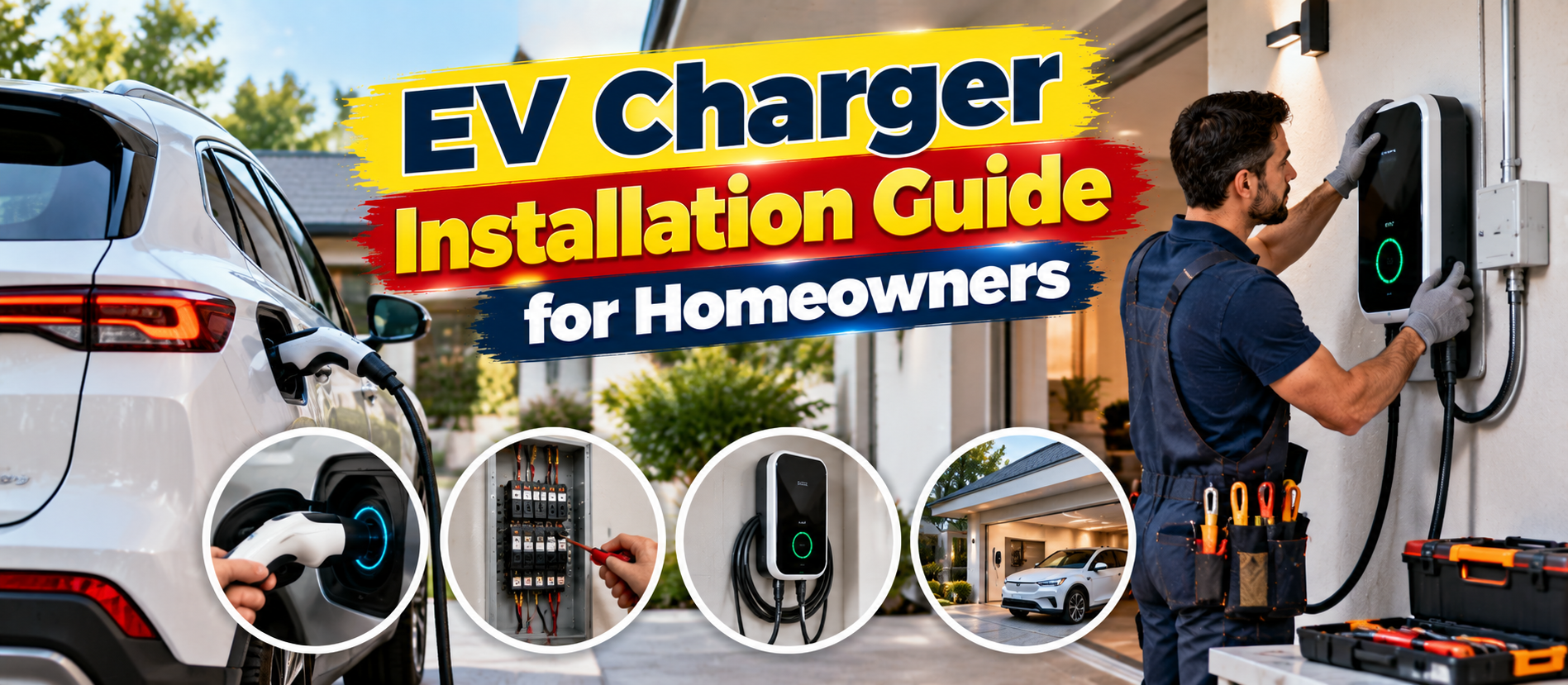
EV Charger Installation Guide for Homeowners is becoming an important resource as more households switch to electric vehicles. Home charging can make EV ownership much easier because you can charge the vehicle while it is parked at home, often overnight. But installing a home EV charger is more than mounting a box on a wall and plugging in a cable. The charger, vehicle, electrical panel, wiring, protection devices, parking location, and local rules all need to work together.
The good news is that home EV charging can be straightforward when it is planned correctly. The first step is to understand how much charging you actually need. The next step is to check whether your home's electrical system can safely support the required load. A qualified electrician should evaluate the installation before new high-load wiring is added.
ENERGY STAR explains that Level 1 charging can use a standard household outlet, while Level 2 charging uses a higher-capacity 240-volt circuit and can deliver substantially more charging range per hour. The U.S. Department of Energy also advises homeowners to check electrical capacity, local requirements, and installation needs before adding charging equipment.
For homeowners in India, the Ministry of Power's 2024 EV charging guidelines state that residential owners may use an existing electricity connection for EV charging or opt for a separate metered connection with a dedicated EV charging tariff. Local distribution-company rules and approvals still need to be checked before installation.
This guide explains EV charger installation for homeowners in simple terms. It covers charger types, electrical capacity, installation location, safety, costs, permits, smart charging, maintenance, common mistakes, and questions to ask an installer.
An electric vehicle charger, often called EVSE or Electric Vehicle Supply Equipment, supplies electricity to an EV according to the vehicle and charging system's requirements. The equipment may be a portable cordset connected to a suitable outlet or a wall-mounted charging unit connected to a dedicated circuit.
In everyday conversation, people often call the entire charging unit a “charger.” Technically, the vehicle's onboard charging system also plays a major role in converting and managing electricity for the battery.
The most important point for homeowners is this: the charger must be compatible with the vehicle and safely matched to the home's electrical system.
Why Home EV Charging Is Useful
Home charging offers convenience. Instead of making a separate trip to a public charging station every time the battery needs energy, you can plug in while the car is parked at home.
- Charge while the vehicle is parked overnight.
- Start each day with a useful amount of battery range.
- Reduce dependence on public charging for everyday driving.
- Schedule charging during preferred hours when supported.
- Monitor charging through a compatible smart charger or app.
Home charging is especially convenient for drivers who have a dedicated parking space near a suitable electrical connection.
Level 1 vs. Level 2 EV Charging
The two main residential AC charging options are Level 1 and Level 2.
Level 1 Charging
Level 1 generally uses a standard household outlet. ENERGY STAR describes Level 1 charging as roughly 2 to 5 miles of driving range per hour in its U.S. guidance, although actual charging performance varies by vehicle, temperature, battery state, and electrical conditions.
Level 1 can be enough for drivers with low daily mileage or plug-in hybrid vehicles. It is also useful when overnight charging time is long enough to meet daily driving needs.
Level 2 Charging
Level 2 charging uses a higher-voltage circuit and is commonly associated with 240-volt residential installations in the United States. ENERGY STAR reports typical Level 2 charging at around 10 to 20 miles of range per hour, with actual performance depending on the charger and vehicle.
Level 2 is usually the better choice for homeowners who drive more miles, own a full battery-electric vehicle, or want faster overnight charging.
In India and other countries, the exact supply voltage, wiring arrangement, protection requirements, connector, and installation method may differ. Always follow the vehicle manufacturer's instructions, charger documentation, Indian standards where applicable, and local electrical rules.
How to Decide Which EV Charger You Need
Do not start with the fastest charger available. Start with your driving pattern.
Ask yourself:
- How many kilometers do I normally drive each day?
- How long is the vehicle parked at home?
- Do I have a plug-in hybrid or a full battery-electric vehicle?
- Do I need to recover a large amount of range overnight?
- What charging rate does my vehicle support?
- What electrical capacity is available at my home?
If your car is parked for many hours every night, you may not need the highest charging power. A properly sized charger can be more practical than paying for an unnecessarily large installation.
Check Your Home's Electrical Capacity First
This is one of the most important steps in the entire project.
An EV charger can become a significant electrical load. Your home may already supply an air conditioner, water heater, refrigerator, oven, washing machine, pump, induction cooktop, and other high-power equipment.
ENERGY STAR recommends checking the home's electrical capacity and working with a licensed electrician before installing new EV charging equipment. The electrician may need to assess the panel, available circuit space, existing loads, wiring, and the proposed charger.
Do Not Judge Capacity Only by Empty Breaker Slots
An empty space in an electrical panel does not automatically mean the home has enough capacity for a new EV charger. Physical space and electrical load capacity are different questions.
A qualified electrician should perform the appropriate load assessment and determine whether the existing installation can safely support the new circuit.
When Might an Electrical Panel Upgrade Be Needed?
A panel or service upgrade may be considered when the existing system cannot safely accommodate the additional EV charging load or when the equipment is outdated or unsuitable.
Possible warning conditions include:
- An older electrical service with limited capacity.
- Very few available circuit spaces.
- Existing electrical loads already close to system capacity.
- Damaged, obsolete, or unsuitable panel equipment.
- A planned charger with a high continuous load.
- Additional major electrical upgrades planned at the same time.
Do not assume a panel upgrade is necessary just because you are installing an EV charger. The correct answer depends on the home's actual electrical capacity and the charger's requirements.
Choose the Best Location for the EV Charger
The best charger location is usually close to where the vehicle is parked and where the electrical installation can be completed safely and efficiently.
Common locations include:
- Inside a garage.
- On an exterior wall near the driveway.
- On a dedicated outdoor post.
- In a covered parking area.
- In a designated residential parking space.
Garage Installation
A garage can protect the equipment from direct weather exposure and may provide a shorter wiring route. It also makes cable storage easier.
Outdoor Installation
Outdoor charging can work well when the equipment is rated for outdoor use and installed according to the manufacturer's requirements. Weather protection, mounting, cable management, drainage, and electrical protection all matter.
Think About Cable Length Before Installation
The charger should be positioned so the cable can reach the vehicle's charging port without creating a trip hazard or requiring unsafe cable routing.
A cable that is too short can be frustrating. A cable that is excessively long can create unnecessary loops and storage problems.
Consider where different vehicles may park in the future. A slightly more flexible location can make the installation useful for longer.
Hardwired EV Charger vs. Plug-In Charger
Some Level 2 chargers can be hardwired. Others can connect through a suitable receptacle. The correct choice depends on the charger, electrical system, local rules, installation location, and homeowner preference.
Hardwired Installation
A hardwired charger is directly connected to the electrical wiring. It can provide a clean installation and can be appropriate for permanent setups.
Plug-In Installation
A plug-in charger can provide flexibility if the correct receptacle and circuit are installed. ENERGY STAR notes that a suitable heavy-duty receptacle can provide flexibility for certain Level 2 setups, but the outlet and circuit must be correctly designed and installed.
Never assume that an existing high-power outlet is automatically suitable for EV charging. Continuous EV loads can have different requirements from ordinary intermittent appliance use.
Use a Dedicated Circuit When Required
EV charging should be treated as a serious electrical load. Depending on the charger and local electrical requirements, a dedicated circuit may be required.
Your electrician should determine the correct breaker, conductor size, circuit arrangement, protective devices, grounding, and installation method based on the equipment and applicable code.
Do not select a breaker size simply because a larger breaker appears to provide faster charging. The breaker, wiring, charger, and electrical system must be correctly matched.
Electrical Safety Is the Top Priority
EV charger installation is not a good project for guesswork. Electricity at high load can create shock, fire, equipment-damage, and overheating risks if the installation is incorrect.
ENERGY STAR recommends using qualified electrical contractors to assess whether the home's wiring, outlets, and other electrical hardware can support EV charging.
In India, BIS maintains standards covering electric vehicle conductive charging systems, including IS 17017. The standard family addresses EV supply equipment and safety requirements.
Choose a Properly Certified Charger
Do not buy an EV charger only because it has a low price or attractive features.
Look for a reputable manufacturer, appropriate safety certification, clear technical documentation, compatible connectors, warranty support, and installation instructions.
ENERGY STAR notes that not all EV chargers sold in the market are safety certified and recommends choosing certified equipment.
For Indian installations, check relevant BIS standards and applicable certification or compliance requirements. IS 17017 Part 1:2018 provides general requirements for EV conductive charging systems, while additional parts cover specific charging equipment and interfaces.
Smart EV Chargers: Are They Worth It?
Smart chargers can offer useful features beyond basic charging.
Depending on the model, smart features may include:
- Scheduled charging.
- Mobile-app control.
- Energy monitoring.
- Charging history.
- Remote start and stop.
- Load management.
- Notifications.
- Integration with energy-management systems.
Smart features are most useful when they solve a real problem. Do not pay extra for features you will never use.
Load Management Can Reduce Upgrade Needs
Some homes may have enough electrical capacity for EV charging only if charging is managed intelligently. Load-management systems can coordinate EV charging with other high-demand equipment.
For example, a smart system may reduce or pause EV charging while another major electrical load is operating, depending on the equipment and design.
ENERGY STAR describes smart circuit and power-sharing approaches as potential ways to manage competing electrical loads.
This is an area where a qualified electrician should design the solution. Do not create homemade power-sharing arrangements.
EV Charger Installation Process: Step by Step
Step 1: Confirm Vehicle Requirements
Check the vehicle owner's manual for compatible charging levels, connector type, maximum AC charging rate, and any installation recommendations.
Step 2: Estimate Your Daily Charging Need
Consider your normal driving distance and how many hours the car is parked at home.
Step 3: Select Level 1 or Level 2
Choose the charging level that meets your actual needs rather than automatically selecting the highest power.
Step 4: Select a Location
Choose a safe location with practical access to the parking space and a suitable electrical route.
Step 5: Get an Electrical Assessment
Have a qualified electrician evaluate the panel, service capacity, existing loads, wiring route, protection, grounding, and other requirements.
Step 6: Check Local Requirements
Confirm permit, inspection, utility, apartment-society, landlord, and local electrical requirements before work begins.
Step 7: Install the Electrical Infrastructure
The electrician installs the required circuit, wiring, protective equipment, conduit, outlet or hardwired connection, and charger mounting system.
Step 8: Configure the Charger
Set the appropriate current or charging configuration according to the vehicle, charger, and electrical installation.
Step 9: Test the Installation
The installer should verify correct operation and safety before regular use.
Step 10: Keep Documentation
Save the charger manual, invoice, warranty, electrical documentation, inspection records, and any configuration information.
EV Charger Installation in India
For Indian homeowners, the Ministry of Power's Guidelines for Installation and Operation of Electric Vehicle Charging Infrastructure-2024 are an important reference. The guidelines apply to charging infrastructure in private parking spaces as well as other settings and are intended to support safe, reliable, and accessible charging infrastructure.
The Ministry has also stated that residential owners may use existing electricity connections for EV charging or choose a separate metered connection from the distribution licensee with a dedicated EV charging tariff.
However, homeowners should not assume that one installation process applies everywhere. Distribution-company procedures, apartment or housing-society rules, electrical connection capacity, parking ownership, and local approvals can differ.
If you live in an apartment or gated community, obtain written approval where required before installing a charger in a shared parking area.
EV Charger Installation for Apartments
Apartment charging can require more planning than a detached home.
You may need to consider:
- Who owns the parking space.
- Where the electricity will come from.
- Whether wiring must pass through common areas.
- Whether the housing society permits private chargers.
- How electricity consumption will be measured.
- Whether a separate meter is appropriate.
- Who is responsible for maintenance.
- Whether multiple residents may need chargers later.
For apartment communities, planning for future EV demand can be more efficient than installing separate improvised wiring for every vehicle.
EV Charger Installation for a Detached Home
Detached homes usually provide more flexibility. You may be able to install a charger in a garage, driveway, side wall, or dedicated outdoor location.
The main questions remain the same: Is there sufficient electrical capacity? Is the location practical? Is the equipment suitable? Does the installation comply with local rules?
How Much Does Home EV Charger Installation Cost?
There is no single installation price that applies to every home.
The total project cost can include:
- EV charger equipment.
- Electrical circuit installation.
- Wiring and conduit.
- Protective devices.
- Outlet or hardwired connection.
- Panel modifications.
- Panel or service upgrade if required.
- Trenching for detached parking areas.
- Mounting equipment.
- Permits and inspections where applicable.
- Labor.
The U.S. Department of Energy notes that Level 2 equipment pricing varies widely and that installation costs depend heavily on electrical capacity and site conditions.
For an accurate price, get a site-specific quote rather than relying on a generic online estimate.
Ways to Keep Installation Costs Under Control
- Choose the charging speed you actually need.
- Install close to the main panel when practical.
- Use an existing suitable electrical route where allowed.
- Compare more than one qualified installer.
- Ask whether load management can avoid unnecessary upgrades.
- Check utility or government incentives before purchasing.
- Plan EV wiring during other electrical renovation work.
Do not reduce costs by using undersized wiring, unsafe extension arrangements, unqualified labor, or non-compliant equipment.
Should You Install an EV Charger Before Buying an EV?
It can make sense if you know you will need home charging soon. Pre-wiring can also be useful during new-home construction or major electrical renovations.
ENERGY STAR notes that pre-wiring can make a future EV charger installation easier and can give homeowners flexibility to select the charger model later.
If you do not yet know which EV you will buy, it may be better to prepare the electrical pathway and capacity rather than purchasing a charger too early.
EV Charger Maintenance
Home chargers generally need less routine maintenance than many household appliances, but they should still be inspected.
- Keep the charging connector clean and dry.
- Inspect the cable for cuts, crushing, or unusual wear.
- Check the wall unit for visible damage.
- Keep vents and cooling openings clear when applicable.
- Do not drive over the charging cable.
- Store the cable safely when it is not in use.
- Watch for repeated fault messages.
- Report unusual heat, burning smells, sparks, or discoloration immediately.
Signs Your EV Charger Needs Attention
Stop using the equipment and seek professional assistance if you notice serious warning signs.
- Burning smell.
- Visible melting or discoloration.
- Repeated circuit trips.
- Cracked charger housing.
- Damaged cable or connector.
- Water intrusion into equipment not rated for it.
- Unexpected overheating.
- Repeated charging failures.
Do not open the charger enclosure or attempt electrical repairs unless you are qualified to do so.
Common EV Charger Installation Mistakes
1. Buying the Charger Before Checking the Electrical System
A charger can be technically excellent but unsuitable for your home's available capacity.
2. Choosing Maximum Charging Power Without a Reason
Higher charging power is not automatically better. The vehicle may not support it, and your daily driving may not require it.
3. Using an Ordinary Extension Cord
Do not improvise a high-load EV charging installation with household extension cords unless the vehicle and manufacturer specifically provide an approved solution. Follow the charging equipment instructions.
4. Ignoring Outdoor Conditions
Outdoor installations need equipment and mounting arrangements suitable for the environment.
5. Hiring an Unqualified Installer
EV charging is an electrical installation. Use a qualified professional who understands EV charging requirements.
6. Ignoring Permits or Housing-Society Rules
Check requirements before installation. Retrofitting after an unauthorized installation can be more expensive.
7. Forgetting Future Needs
If you expect another EV, solar installation, heat pump, induction cooking, or other major electrical loads, tell the electrician during planning.
How to Choose an EV Charger Installer
Choose an installer based on qualifications, experience, documentation, and willingness to explain the proposed installation.
Questions to Ask
- Have you installed EV chargers before?
- Can you evaluate my home's electrical load?
- Will you inspect the main panel and service capacity?
- What charger rating do you recommend and why?
- What circuit and protective equipment will be used?
- Is the installation hardwired or plug-in?
- Are permits or inspections required?
- Are you licensed or authorized as required locally?
- What happens if the existing panel cannot support the charger?
- Will the charger be tested after installation?
- What warranty applies to the installation?
- What documentation will I receive?
Home EV Charger Installation Checklist
- ☐ Confirm your EV's charging requirements.
- ☐ Estimate your daily driving needs.
- ☐ Decide whether Level 1 or Level 2 is appropriate.
- ☐ Choose a practical parking location.
- ☐ Check electrical panel and service capacity with a professional.
- ☐ Select a reputable, compliant charger.
- ☐ Confirm local electrical and permitting requirements.
- ☐ Check utility or distribution-company requirements.
- ☐ Get a written installation quote.
- ☐ Install using qualified electrical labor.
- ☐ Test the system before regular use.
- ☐ Save manuals, invoices, warranty, and inspection records.
Frequently Asked Questions
Can I install an EV charger myself?
A simple portable Level 1 setup may only require a suitable existing outlet, but new high-power circuits and Level 2 installations should be assessed and installed by a qualified electrical professional. Local rules may require licensed installation or permits.
Is Level 2 charging better than Level 1?
Level 2 is faster, but it is not automatically better for every driver. If your daily mileage is low and the car stays parked overnight, Level 1 may be sufficient. ENERGY STAR recommends choosing based on driving needs and vehicle type.
Does an EV charger require a separate meter?
It depends on the location and local rules. In India, the Ministry of Power's 2024 guidelines state that residential owners may use existing electricity connections or opt for a separate metered connection with a dedicated EV charging tariff. Check with your local distribution licensee.
Will I need to upgrade my electrical panel?
Not necessarily. The need depends on existing service capacity, current electrical loads, panel condition, available circuit space, and the proposed charger. A qualified electrician should assess the system before deciding.
Can I install an EV charger outside?
Yes, when the charger and installation are designed for outdoor use. Weather exposure, mounting, cable routing, drainage, and electrical protection must be considered.
How long does home EV charger installation take?
A straightforward installation can be relatively quick. More complex work involving long cable runs, trenching, panel upgrades, service upgrades, or permits can take longer. Ask the installer for a site-specific schedule.
Can I use my existing electrical outlet?
Only if the outlet, circuit, wiring, protection, grounding, and charger requirements are all suitable. Do not assume that an outlet is safe for continuous EV charging simply because another appliance can use it.
Should I buy a smart EV charger?
A smart charger can be useful if you want scheduling, monitoring, load management, or remote control. If you do not need those features, a simpler compliant charger may be enough.
How do I know whether an EV charger is safe?
Buy from a reputable manufacturer and look for relevant safety certification and compliance information. In India, check applicable BIS standards such as the IS 17017 series and follow local requirements.
Can home EV charging increase my electricity bill?
Yes. Charging adds electricity consumption. The amount depends on how much energy your vehicle uses, how far you drive, charging losses, and your electricity tariff. Smart scheduling may help manage when charging occurs.
Final Thoughts
EV charger installation for homeowners becomes much easier when you plan around your real driving needs instead of simply buying the most powerful charger available.
Start with your vehicle. Determine how much charging you need. Then evaluate your home's electrical capacity and choose a safe installation location. A qualified electrician should assess the electrical system and determine the correct circuit, wiring, protection, and installation method.
For homeowners in India, also check the Ministry of Power's 2024 EV charging guidelines, applicable BIS standards, distribution-company requirements, and apartment or housing-society rules where relevant.
Do not cut corners on electrical safety. Use compliant equipment, qualified installation, appropriate protection, and clear documentation. With the right planning, a home EV charger can provide convenient overnight charging and become a practical long-term part of your home's electrical system.
About Digiifrog
Digiifrog creates practical, search-optimized digital content designed to give businesses and customers clear answers. Visit www.digiifrog.com for digital marketing, SEO, AEO, GEO, AI Search, and content marketing resources.
Sources and Further Reading
- U.S. Department of Energy — Electric Vehicles for Consumers: Home Charging.
- ENERGY STAR — Electric Vehicle Chargers.
- ENERGY STAR — Make Your Home Electric Ready / EV Pre-Wiring Guidance.
- Government of India, Ministry of Power — Guidelines for Installation and Operation of Electric Vehicle Charging Infrastructure-2024.
- Bureau of Indian Standards — IS 17017 Electric Vehicle Conductive Charging System standards.
Ready to Grow?
Talk to us about a strategy tailored to your brand — we will help you stand out in search, AI discovery and social.


Comments (0)
Log in to leave a comment.