📋 Quick Summary
In this article:
What Is Facebook Lead Generation?
Why Facebook Lead Generation Still Matters
1. Define the Lead Before You Build the Campaign
2. Choose the Right Lead Conversion Location
3. Create an Offer People Actually Want
4. Build a Strong Facebook Lead Ad
5. Test Multiple Creative Concepts
6. Use Audience Strategy Carefully
7. Use Creative to Pre-Qualify Leads
Introduction
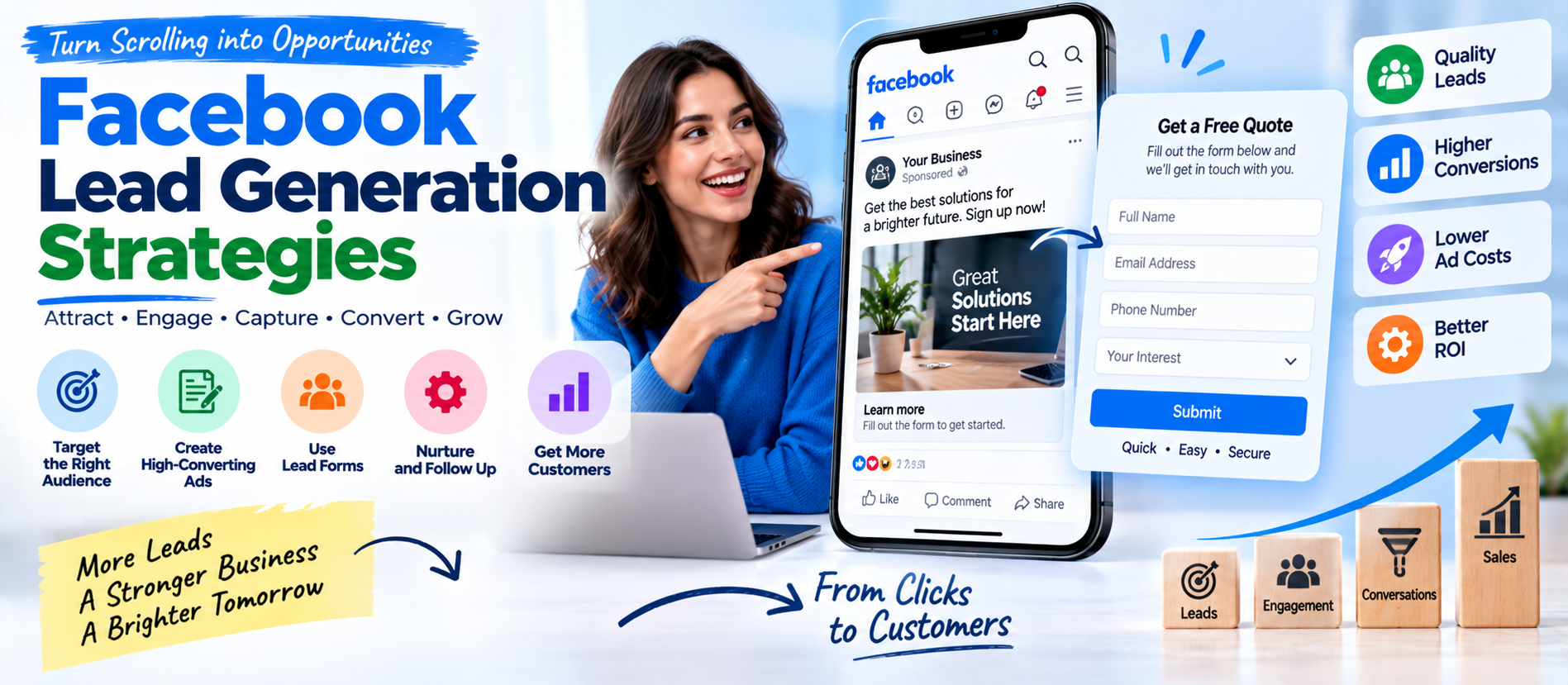
Facebook lead generation is more than collecting names, email addresses, and phone numbers. A successful campaign connects the right audience with a clear offer, a useful ad, a simple conversion path, fast follow-up, and reliable measurement.
Meta's current lead-generation options can include Instant Forms and website forms, with additional lead experiences such as Messenger, Instagram Direct, WhatsApp, or calls depending on account and campaign availability. Meta also supports CRM integration and the Conversions API to help advertisers send downstream lead-quality signals back to its systems.
This guide explains how to build a Facebook lead generation system that focuses on qualified leads, not just cheap form submissions. It also covers audience strategy, creative testing, form design, landing pages, retargeting, CRM workflows, AI-assisted optimization, and SEO, AEO, GEO, and AI Search considerations.
What Is Facebook Lead Generation?
Facebook lead generation uses Facebook and the wider Meta advertising ecosystem to encourage potential customers to provide information or start a sales conversation.
A lead may submit an Instant Form, complete a website form, send a message, contact a business through an available messaging destination, or take another action configured for the campaign.
The basic funnel is simple:
- Reach the right audience.
- Present a relevant problem or opportunity.
- Offer a clear reason to respond.
- Reduce friction during conversion.
- Capture useful information.
- Follow up quickly.
- Qualify the lead.
- Measure the final business result.
Why Facebook Lead Generation Still Matters
Facebook and Instagram provide businesses with large audiences and multiple ways to introduce an offer. The bigger opportunity, however, is the ability to connect advertising with business outcomes.
A lead campaign can support local services, education, real estate, healthcare businesses, B2B services, software companies, financial services, events, consultations, and many other models.
The key is to match the campaign to the buying journey. A person who has never heard of your company may need education before asking for a quote. A returning visitor may be ready to book a call.
1. Define the Lead Before You Build the Campaign
Do not start with the form. Start with the definition of a good lead.
For example, a web design agency may define a good lead as a business owner who needs a new website, has a realistic project timeline, and is willing to discuss budget. A form submission alone does not prove those conditions.
2. Choose the Right Lead Conversion Location
Meta's lead-generation framework supports different conversion locations. Two important options are Instant Forms and Website forms. Meta's documentation also describes lead-generation experiences involving messaging and other destinations.
Instant Forms
Instant Forms open within the Meta experience. They can reduce the number of steps between the advertisement and the lead submission. This can be useful for mobile-first campaigns and offers that need a quick response.
Website Forms
Website forms give you more control over the surrounding experience. You can provide detailed information, stronger qualification, pricing context, case studies, testimonials, and additional navigation before asking for contact details.
Choose based on the buying journey rather than assuming one destination is always better.
3. Create an Offer People Actually Want
A lead form cannot fix a weak offer. Cold audiences usually need a clear reason to respond.
Useful lead offers can include:
- Free consultation.
- Custom quote.
- Product demonstration.
- Strategy session.
- Downloadable guide.
- Assessment or audit.
- Appointment request.
- Sample or trial where appropriate.
The offer should match the ad and be something your team can deliver.
4. Build a Strong Facebook Lead Ad
Good lead ads make the value clear within seconds. The creative should answer three questions:
- What is the problem?
- What is the benefit?
- What should I do next?
Use a strong opening statement. Show the outcome instead of listing every feature. Keep the message easy to scan on a mobile screen.
For example, instead of “We provide comprehensive digital marketing services,” try “Get a clear digital marketing plan built around your business goals.” The second message gives the audience a more concrete reason to respond.
5. Test Multiple Creative Concepts
Creative fatigue can reduce performance when people repeatedly see the same advertisement.
Change one major variable at a time when you need to understand why performance changed.
6. Use Audience Strategy Carefully
Audience targeting should reflect your actual customer profile. Start with useful first-party signals when available, such as existing customers, qualified leads, website visitors, or engaged users.
⚠ Watch Out
Depending on campaign setup and eligibility, businesses may also use lookalike audiences and broader automated audience solutions. Meta's current guidance emphasizes avoiding unnecessarily narrow audiences and allowing its systems enough data to learn.
Do not create dozens of tiny ad sets simply because you can. Fragmentation can make it harder for campaigns to collect enough conversion data.
7. Use Creative to Pre-Qualify Leads
One of the simplest ways to improve lead quality is to be clear about who the offer is for.
If your service starts at a certain price, say so when appropriate. If you only serve businesses, make that clear. If the service is limited to a specific location, mention it.
Pre-qualification may reduce total leads, but fewer relevant leads can be more valuable than a large number of people who cannot buy.
8. Design a Better Instant Form
Meta recommends communicating why people should complete the form, explaining what they can expect, reducing unnecessary questions, and using questions that are easy to answer.
A practical form structure is:
- Headline: Repeat the value of the offer.
- Short introduction: Explain what happens after submission.
- Contact fields: Collect essential information.
- Qualification questions: Ask only what sales truly needs.
- Privacy information: Make data handling clear.
- Completion message: Give the next step.
Do not ask ten questions when three will do. Every extra question creates another opportunity for abandonment.
9. Balance Lead Volume and Lead Quality
A campaign can produce thousands of inexpensive leads and still lose money. The real goal is profitable customer acquisition.
Compare:
- Cost per lead.
- Cost per qualified lead.
- Lead-to-opportunity rate.
- Opportunity-to-customer rate.
- Customer acquisition cost.
- Revenue per customer.
- Return on advertising spend.
Meta's lead-generation guidance includes performance goals focused on lead volume and conversion leads. For Instant Forms, Meta describes a conversion-leads approach supported by CRM integration and the Conversions API.
10. Connect Your CRM
Lead generation should not end when someone submits a form. Send the lead into your CRM or sales system as quickly as practical.
A useful workflow is:
- Lead submits the form.
- Lead enters the CRM.
- Lead receives an immediate confirmation.
- Sales or support receives an alert.
- Lead is scored or qualified.
- Follow-up begins.
- Outcome is recorded.
- Qualified and converted events are sent back for measurement and optimization where supported.
Meta specifically recommends CRM integration and the Conversions API so advertisers can share CRM data and help optimize toward leads that are more likely to convert.
11. Follow Up Fast
Speed matters because interest can fade. A person who requested a consultation today may be less responsive after several days.
Create an immediate confirmation message. Then route high-intent leads to the appropriate person or workflow. The message should identify the business, confirm the request, and explain the next step.
Do not rely on one automated email. Depending on the business and consent requirements, follow-up can include email, phone, SMS, or another appropriate communication channel.
12. Build a Retargeting Funnel
Not everyone converts during the first interaction. Retarget meaningful engagers.
Possible retargeting audiences include:
- People who engaged with your Facebook or Instagram content.
- People who watched your videos.
- Website visitors.
- People who started but did not finish an Instant Form.
- Previous leads who have not converted.
Meta's lead-generation documentation specifically describes custom audiences for people who started but did not finish forms and website visitors who did not complete a form.
13. Use Different Messages at Different Funnel Stages
A cold audience may need education. A warm audience may need proof. A high-intent prospect may need a clear offer.
Awareness: Explain the problem.
Consideration: Explain the solution and show evidence.
Conversion: Make the next step simple.
Re-engagement: Address objections or provide another reason to act.
This approach prevents every advertisement from asking for the same action from every person.
16. Measure the Full Lead Funnel
Ads Manager metrics are useful, but they do not tell the entire business story.
Build a funnel such as:
Impression → Click/Engagement → Lead → Qualified Lead → Opportunity → Customer → Revenue
Then calculate where users drop out. A campaign with a high click-through rate but poor lead quality may need a different offer or stronger qualification. A campaign with good leads but poor sales conversion may have a follow-up or sales-process problem.
18. Use AI to Improve Lead Generation
AI can assist with campaign planning, creative ideas, copy variations, audience research, lead scoring, reporting, and follow-up workflows. Meta itself describes AI as useful for research, content ideation, campaign planning, and performance analysis.
AI should support decisions rather than replace human review. Check generated claims, customer messages, targeting assumptions, and lead scores before using them in production.
A Practical 2026 Facebook Lead Generation Workflow
- Define the customer: Describe the best-fit lead.
- Choose the offer: Give the audience a clear reason to respond.
- Select the conversion path: Use Instant Form, website, or another suitable destination.
- Build creative: Create several concepts with clear hooks.
- Set audience signals: Use relevant first-party and platform-supported audience options.
- Build the form: Keep it short while collecting essential qualification data.
- Connect CRM: Route leads into the sales workflow.
- Follow up: Confirm the request and provide the next step.
- Measure quality: Track qualified leads, opportunities, customers, and revenue.
- Optimize: Improve the offer, creative, form, audience, and follow-up based on evidence.
Frequently Asked Questions
What is the best Facebook lead generation strategy?
There is no single best strategy. A strong system combines a clear offer, relevant creative, appropriate audience signals, a low-friction conversion path, fast follow-up, CRM tracking, and optimization toward business outcomes.
Are Facebook Instant Forms good for lead generation?
They can be effective when reducing friction is important. Meta recommends keeping forms clear, explaining what happens after submission, and avoiding unnecessary questions.
How can I improve Facebook lead quality?
Clarify who the offer is for, use relevant creative, add a small number of useful qualification questions, connect your CRM, and measure qualified leads rather than only total form submissions.
Should I use Facebook lead ads or a landing page?
It depends on the buying journey. Instant Forms can reduce friction. Landing pages provide more space for education, proof, qualification, and brand experience.
How often should Facebook lead ads be tested?
Test continuously, but avoid changing too many variables at once. Watch for creative fatigue and replace weak concepts with new angles based on actual performance.
What is more important: CPL or qualified lead cost?
Qualified lead cost is usually more meaningful for businesses that have significant differences in lead quality. A more expensive lead can be better if it produces more customers and revenue.
Final Thoughts
Facebook Lead Generation Strategies work best when advertising is treated as a complete funnel rather than a form-collection exercise.
Start with the customer and offer. Create clear creative. Choose the right conversion path. Keep the form simple. Qualify without creating unnecessary friction. Connect the CRM. Follow up quickly. Then measure what happens after the lead enters your business.
In 2026, automation and AI can help advertisers process more signals and test more ideas. But strong fundamentals still matter. Better offers, better creative, better data, and better follow-up create the foundation for sustainable lead generation.
Build a smarter lead generation system with Digiifrog.
SEO • Digital Marketing • AI Search Optimization • Marketing Automation
Visit: www.digiifrog.com
Ready to Grow?
Talk to us about a strategy tailored to your brand — we will help you stand out in search, AI discovery and social.

Comments (0)
Log in to leave a comment.