📋 Quick Summary
In this article:
Understanding Cloud Software Technology
Why Cloud Software Continues to Grow
Artificial Intelligence and Cloud Software
Hyperautomation and Intelligent Workflows
Cloud-Native Application Development
Multi-Cloud and Hybrid Cloud Strategies
Enhanced Cybersecurity for Cloud Platforms
Cloud Software and Remote Work
Industry-Specific Cloud Solutions
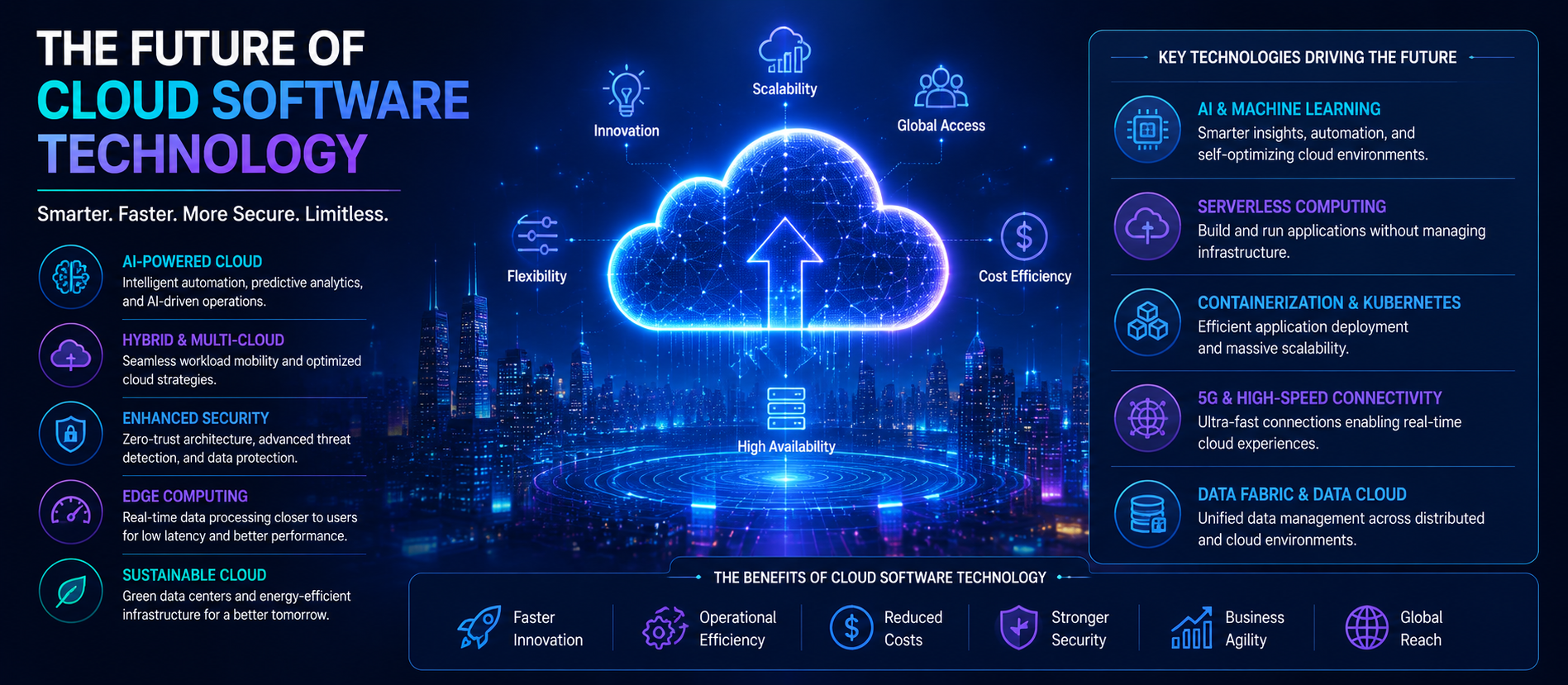
Cloud software technology has become the foundation of modern digital transformation. From small startups and growing businesses to global enterprises, organizations increasingly rely on cloud-based applications to improve efficiency, reduce costs, enhance collaboration, and accelerate innovation. As technology continues evolving, the future of cloud software technology promises even greater capabilities powered by artificial intelligence, automation, edge computing, cybersecurity advancements, and next-generation cloud infrastructure.
Cloud software has fundamentally changed how businesses access, deploy, and manage applications. Instead of relying on expensive on-premises systems, organizations can now access powerful software solutions through the internet, enabling flexibility, scalability, and global accessibility.
This comprehensive guide explores the future of cloud software technology, emerging trends, business benefits, challenges, innovations, and its growing role in SEO, AEO, GEO, and AI-powered search ecosystems.
Understanding Cloud Software Technology
Cloud software refers to applications hosted on remote servers and delivered via the internet. Users can access these applications from virtually any device without installing complex infrastructure locally.
Common cloud software categories include:
- Customer Relationship Management (CRM)
- Project Management Software
- Accounting Platforms
- Human Resource Systems
- Collaboration Tools
- Marketing Automation Platforms
- Enterprise Resource Planning (ERP)
Cloud technology has become the backbone of modern business operations.
Why Cloud Software Continues to Grow
Organizations increasingly choose cloud solutions because they provide flexibility, scalability, and cost efficiency.
Major Growth Drivers:
- Remote work adoption
- Digital transformation initiatives
- Growing demand for automation
- Artificial intelligence integration
- Global business expansion
- Improved cybersecurity solutions
These factors continue accelerating cloud software adoption worldwide.
Artificial Intelligence and Cloud Software
💡 Key Insight
Artificial Intelligence is becoming one of the most important drivers shaping the future of cloud software technology.
Modern cloud platforms increasingly integrate AI-powered capabilities such as:
- Predictive analytics
- Automated workflows
- Virtual assistants
- Intelligent reporting
- Customer behavior analysis
- Natural language processing
AI-powered cloud software helps businesses make smarter decisions while improving operational efficiency.
Hyperautomation and Intelligent Workflows
The future of cloud software includes advanced automation capabilities that reduce manual work and improve productivity.
Hyperautomation combines:
- Artificial Intelligence
- Machine Learning
- Robotic Process Automation (RPA)
- Workflow Automation
- Business Process Management
Organizations can automate complex processes across multiple departments and systems.
Cloud-Native Application Development
Cloud-native development is becoming the preferred approach for modern software creation.
Cloud-native applications are designed specifically for cloud environments and offer:
- Improved scalability
- Faster deployment
- Higher reliability
- Better performance
- Enhanced flexibility
This development model supports continuous innovation and rapid business growth.
Multi-Cloud and Hybrid Cloud Strategies
Organizations increasingly use multiple cloud providers rather than relying on a single vendor.
Benefits include:
- Reduced vendor dependency
- Improved resilience
- Enhanced performance
- Greater flexibility
- Cost optimization
Hybrid cloud environments combining private and public cloud resources are expected to become even more common.
Edge Computing Integration
Edge computing is reshaping cloud architecture by processing data closer to where it is generated.
Advantages include:
- Reduced latency
- Faster response times
- Improved performance
- Enhanced user experiences
- Support for IoT devices
Cloud software platforms increasingly integrate edge computing capabilities to meet growing performance requirements.
Enhanced Cybersecurity for Cloud Platforms
Security remains a major priority for cloud software providers.
Future cloud security innovations include:
- Zero Trust Architecture
- AI-powered threat detection
- Automated incident response
- Advanced encryption
- Identity management systems
- Continuous monitoring
Organizations demand stronger protection for sensitive data and critical business applications.
Cloud Software and Remote Work
The future workforce will continue relying heavily on cloud technologies.
Cloud software supports:
- Remote collaboration
- Virtual meetings
- Document sharing
- Project management
- Knowledge management
- Business continuity
Cloud platforms enable employees to work efficiently from virtually any location.
Industry-Specific Cloud Solutions
Cloud software providers increasingly develop specialized solutions tailored to specific industries.
Examples Include:
- Healthcare cloud platforms
- Financial services software
- Manufacturing systems
- Educational technology platforms
- Retail management solutions
- Legal practice software
Industry-specific cloud applications deliver greater value through specialized functionality.
Internet of Things (IoT) and Cloud Integration
IoT devices generate massive amounts of data that require cloud-based processing and storage.
Future cloud platforms will increasingly support:
- Smart devices
- Industrial sensors
- Connected vehicles
- Smart cities
- Healthcare monitoring systems
The combination of IoT and cloud software creates powerful opportunities for innovation.
Data Analytics and Business Intelligence
Cloud software is becoming increasingly data-driven.
Advanced analytics capabilities enable organizations to:
- Monitor performance
- Predict trends
- Improve decision-making
- Optimize operations
- Identify opportunities
Business intelligence features are expected to become standard across cloud platforms.
Low-Code and No-Code Development
Future cloud software platforms will increasingly empower non-technical users.
Low-code and no-code tools allow businesses to:
- Create applications quickly
- Automate workflows
- Build custom dashboards
- Integrate systems
- Reduce development costs
This democratization of software development accelerates innovation.
Sustainability and Green Cloud Computing
Environmental sustainability is becoming a major consideration in technology decisions.
Cloud providers are investing in:
- Energy-efficient data centers
- Renewable energy sources
- Carbon reduction initiatives
- Efficient infrastructure management
Green cloud computing supports both environmental and business objectives.
Benefits of Future Cloud Software Technologies
- Lower operational costs
- Improved scalability
- Faster innovation
- Better collaboration
- Enhanced security
- Global accessibility
- Greater flexibility
- Increased productivity
Challenges Organizations Must Address
Despite significant advantages, businesses should consider several challenges.
- Data privacy concerns
- Vendor management
- Compliance requirements
- Integration complexity
- Skills shortages
- Cybersecurity risks
Successful cloud adoption requires careful planning and governance.
Cloud Software and Digital Marketing
Cloud platforms play a major role in modern marketing strategies.
Marketing teams use cloud software for:
- Content management
- Customer engagement
- Campaign automation
- Analytics reporting
- SEO management
Cloud technologies enable faster execution and improved marketing performance.
How Cloud Software Supports SEO, AEO, GEO, and AI Search
SEO (Search Engine Optimization) benefits from faster websites, scalable infrastructure, and advanced analytics provided by cloud platforms.
AEO (Answer Engine Optimization) relies on structured content management and efficient data delivery systems.
GEO (Generative Engine Optimization) requires cloud-powered content creation, management, and distribution workflows.
Cloud software provides the infrastructure necessary for modern digital visibility strategies.
Why Digiifrog Recommends Cloud Software Technology
At Digiifrog, we believe cloud technology is one of the most important drivers of business innovation and digital transformation.
Organizations that embrace cloud software gain improved flexibility, stronger collaboration, enhanced security, and greater opportunities for growth.
Website: www.digiifrog.com
Conclusion
The future of cloud software technology is incredibly promising. Artificial intelligence, automation, edge computing, cybersecurity innovations, cloud-native development, and industry-specific solutions will continue transforming how businesses operate.
Organizations that invest in modern cloud technologies today will be better prepared for tomorrow's challenges and opportunities. As cloud software becomes more intelligent, scalable, and integrated, it will remain a cornerstone of digital transformation and business success for years to come.
Ready to Grow?
Talk to us about a strategy tailored to your brand — we will help you stand out in search, AI discovery and social.

Comments (0)
Log in to leave a comment.