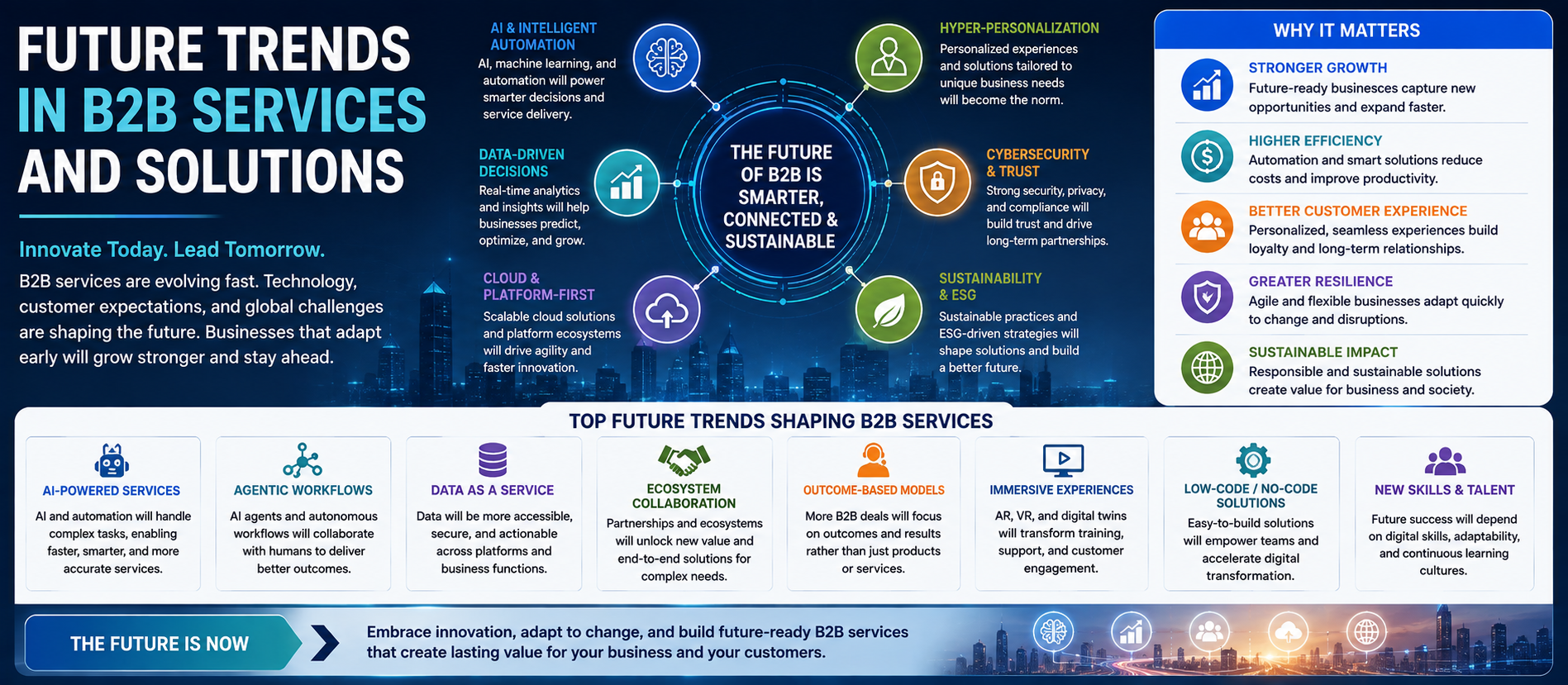
📋 Quick Summary
In this article:
Quick Answer: What Are the Future Trends in B2B Services?
Why the B2B Services Market Is Changing
1. AI Agents Will Become Part of Everyday B2B Service Delivery
2. Service Providers Will Shift from Labor-Based to Outcome-Based Models
3. AI-Powered Buying Will Change How Vendors Are Discovered
4. B2B Content Will Need SEO, AEO, GEO, and AI Search Optimization
5. Hyper-Personalization Will Become a Standard Expectation
6. Omnichannel Service Delivery Will Become Essential
7. Self-Service Will Grow for Routine B2B Transactions
8. Data Platforms Will Become the Foundation of Better Services
9. Cybersecurity Will Become a Core Part of the B2B Value Proposition
10. AI Governance and Human Oversight Will Create Competitive Trust
Focus Keyword: Future Trends in B2B Services and Solutions
B2B services are entering a major period of change. Artificial intelligence is moving from experiments into business workflows. Buyers are using AI to research vendors. Service providers are redesigning delivery models. Pricing is becoming more flexible. Cybersecurity and trust are becoming part of the value proposition.
The future of B2B will not be defined by one technology. It will be shaped by the combination of AI, data, automation, human expertise, customer experience, resilience, and measurable outcomes.
Businesses that prepare early can improve efficiency and create stronger customer relationships. Businesses that continue to rely only on traditional service models may find it harder to compete.
💡 Key Insight
This guide explains the most important future trends in B2B services and solutions using clear and simple language.
Digiifrog creates structured, search-friendly content for businesses, technology companies, service providers, and digital growth strategies.
Quick Answer: What Are the Future Trends in B2B Services?
The biggest future trends include AI agents, workflow automation, outcome-based services, hyper-personalization, AI-assisted buying, stronger cybersecurity, integrated data platforms, flexible pricing, specialized human expertise, and content designed for both traditional and AI-powered search.
The common theme is simple: B2B services are moving away from disconnected manual work and toward intelligent, connected, and measurable business outcomes.
Why the B2B Services Market Is Changing
Business buyers expect faster answers, clearer value, and easier experiences. They also face more choices and greater pressure to justify spending.
Technology has changed how services are delivered. Cloud platforms connect systems. Automation reduces repetitive work. AI can analyze information and coordinate multi-step workflows. At the same time, cyber threats and regulatory requirements create new responsibilities for service providers.
The result is a new competitive environment. A provider can no longer depend only on expertise or a large delivery team. Customers increasingly want evidence of value, transparency, speed, security, and flexibility.
1. AI Agents Will Become Part of Everyday B2B Service Delivery
Traditional automation follows predefined rules. AI agents can perform more flexible, multi-step work within defined limits.
An AI agent may receive a request, gather information from approved systems, check business rules, prepare a response, and route the work for human approval.
Possible B2B applications include:
- Customer service and support.
- Sales research and account intelligence.
- Procurement and supplier workflows.
- Finance and document processing.
- IT operations and incident support.
- Marketing and campaign operations.
The future is likely to involve hybrid teams. People will manage relationships, strategy, judgment, exceptions, and accountability. AI agents will handle more repetitive and information-intensive work.
2. Service Providers Will Shift from Labor-Based to Outcome-Based Models
Many traditional B2B services are priced according to hours, projects, licenses, or the number of people involved.
AI changes this equation because some work can be completed with fewer manual hours.
As a result, more providers will explore outcome-based models. Customers may pay for a measurable result, service level, transaction, usage level, or business outcome instead of simply paying for effort.
Examples include:
- Payment based on qualified opportunities.
- Pricing linked to resolved support cases.
- Fees connected to cost savings.
- Usage-based AI services.
- Performance-based managed services.
This model requires better measurement. Providers must define the outcome clearly and agree on what data will be used to evaluate performance.
3. AI-Powered Buying Will Change How Vendors Are Discovered
B2B buyers increasingly use AI tools to understand categories, compare options, create shortlists, and prepare questions.
This means the traditional path from search engine to website to sales call is changing.
Businesses should make their information easy to understand for both people and AI systems. Important details should not be hidden in vague marketing language.
Clear service descriptions, structured pages, product details, case studies, pricing context, FAQs, and accurate company information can make a business easier to evaluate.
4. B2B Content Will Need SEO, AEO, GEO, and AI Search Optimization
Traditional SEO remains important, but it is no longer the only discovery channel.
SEO helps businesses improve visibility in traditional search results.
AEO, or Answer Engine Optimization, focuses on clear answers to real questions.
GEO, or Generative Engine Optimization, helps generative AI systems understand a company's expertise, services, entities, products, and evidence.
AI Search Optimization focuses on creating useful, structured, accurate content that can be understood and evaluated by AI-powered discovery systems.
Future-ready B2B content should include:
- Direct answers.
- Clear headings.
- Specific service descriptions.
- Real examples and case studies.
- Consistent company information.
- Expert commentary where appropriate.
- Useful FAQs.
5. Hyper-Personalization Will Become a Standard Expectation
Generic B2B communication is becoming less effective.
AI and customer data can help businesses tailor information to a buyer's industry, role, business need, account history, and stage in the buying process.
Hyper-personalization does not mean sending more automated messages. It means improving relevance.
A technology buyer may need implementation details. A finance leader may need ROI information. A procurement team may need security and contract information. A senior executive may want strategic outcomes.
Future B2B experiences will increasingly adapt information to these different needs.
6. Omnichannel Service Delivery Will Become Essential
B2B customers use websites, email, meetings, digital platforms, messaging, marketplaces, partner channels, and self-service tools.
They expect information to remain consistent across these channels.
A future-ready service provider should connect the customer journey. A customer should not need to repeat the same information every time they move from a chatbot to an employee or from a website to a sales conversation.
The goal is continuity, not simply being present on many channels.
7. Self-Service Will Grow for Routine B2B Transactions
Business customers increasingly expect the ability to complete simple tasks without waiting for a representative.
Self-service options may include:
- Account management.
- Order tracking.
- Knowledge bases.
- Service configuration.
- Invoice access.
- Support requests.
- Product comparison.
Self-service does not eliminate the need for people. Complex decisions still require expertise. The best model combines digital convenience with easy access to qualified human support.
8. Data Platforms Will Become the Foundation of Better Services
AI is only as useful as the information and systems supporting it.
Many businesses still operate with fragmented customer, product, operational, and financial data.
The future of B2B services will depend heavily on connected data foundations.
Businesses will need clearer data ownership, stronger quality controls, secure access, and practical integration between important systems.
Without these foundations, AI can simply automate confusion.
9. Cybersecurity Will Become a Core Part of the B2B Value Proposition
Customers increasingly evaluate how a provider protects systems, data, and business operations.
This is especially important as service providers connect more deeply with customer systems and use AI agents, cloud services, APIs, and third-party platforms.
Future service providers will need to demonstrate:
- Security governance.
- Identity and access controls.
- Third-party risk management.
- Incident response readiness.
- Data protection.
- AI governance.
Security will become part of the buying decision, not only an internal IT issue.
10. AI Governance and Human Oversight Will Create Competitive Trust
Customers will ask more questions about how AI systems are used.
They may want to know what data an AI can access, how decisions are reviewed, what actions can be automated, and what happens when a system produces an incorrect result.
Strong governance can become a competitive advantage.
Useful practices include:
- Clear AI use policies.
- Defined human approval points.
- Testing and monitoring.
- Access controls.
- Audit trails for important actions.
- Vendor and model risk assessment.
Trust will be especially important for services involving finance, legal information, healthcare, cybersecurity, public services, and other high-impact decisions.
11. Specialized Human Expertise Will Become More Valuable
AI can generate summaries and automate routine tasks. However, it does not remove the need for experienced professionals.
In many cases, AI increases the value of people who can define the problem, evaluate output, manage risk, negotiate, make decisions, and communicate with stakeholders.
B2B service teams will increasingly need skills in:
- AI and workflow design.
- Data literacy.
- Industry expertise.
- Consultative problem solving.
- Relationship management.
- Governance and risk.
The future is less about replacing every role and more about redesigning how people and technology work together.
12. Managed AI Services Will Become a Major B2B Category
Many organizations want the benefits of AI but do not have the internal skills or resources to design, integrate, secure, and manage every system themselves.
This creates opportunities for managed AI services.
Providers may offer:
- AI strategy.
- Agent development.
- Workflow automation.
- AI integration.
- Model and application monitoring.
- AI governance.
- Employee training.
Successful providers will combine technical delivery with business understanding.
13. AI Workflows Will Become More Important Than Standalone AI Tools
A common mistake is to buy many AI tools without changing the underlying workflow.
The future competitive advantage will come from redesigning end-to-end processes.
For example, improving a sales process may involve connected account research, customer signals, content preparation, pricing intelligence, CRM updates, and follow-up actions.
Automating only one small step may provide limited value. Connecting the workflow can create a larger impact.
14. B2B Pricing Will Become More Flexible
Traditional fixed pricing will continue, but businesses will see more usage-based, consumption-based, subscription, hybrid, and outcome-linked models.
AI services may introduce new variables such as model usage, tokens, automation volume, and computing requirements.
Customers will expect transparency. They will want to understand what they are paying for and how costs can change.
Clear pricing will become particularly important as AI introduces new and sometimes variable cost structures.
15. Procurement Will Become More Influential in B2B Buying
Complex purchases involve more stakeholders than before.
Finance, security, procurement, IT, legal, and operational teams may all influence the final decision.
This means service providers need to prepare information for different audiences.
A strong sales presentation is not enough. Providers may also need security documentation, ROI models, implementation plans, references, integration information, and clear contractual terms.
16. Trust and Proof Will Matter More Than Marketing Claims
AI makes it easier to create large volumes of content. This creates a new problem: more information does not automatically create more trust.
Future B2B buyers will look for evidence.
Useful proof may include:
- Case studies.
- Customer references.
- Documented results.
- Independent reviews.
- Security certifications.
- Transparent implementation processes.
Businesses that make unrealistic claims may struggle as buyers use more tools and networks to validate information.
17. Ecosystems and Partnerships Will Replace Some Standalone Offerings
Customers often need complete solutions rather than isolated products.
A cybersecurity project may require technology, implementation, monitoring, training, and incident response. A business automation project may require AI, data integration, process design, and change management.
Service providers will increasingly build partner ecosystems to combine complementary expertise.
The key is clarity. Customers should understand who is responsible for each part of the solution.
18. Sustainability and Resilience Will Remain Important
Customers are increasingly concerned about supply chain resilience, operational continuity, energy use, compliance, and sustainability reporting.
B2B providers can add value by helping customers measure risk and build more resilient operations.
This may include:
- Supply chain visibility.
- Operational monitoring.
- Business continuity.
- Energy and resource optimization.
- Data collection and reporting support.
19. Vertical-Specific Solutions Will Grow
Generic services are useful, but many industries have unique workflows, regulations, terminology, and risks.
Providers that combine technology with deep industry knowledge can create stronger differentiation.
Examples include AI solutions designed specifically for:
- Financial services.
- Manufacturing.
- Healthcare.
- Education.
- Legal services.
- Retail and commerce.
- Logistics.
The future B2B market will reward providers that understand a customer's real operating environment.
20. Continuous Learning Will Become a Business Requirement
Technology and customer expectations will continue to change.
Businesses will need regular skill development rather than one-time training programs.
Important areas will include AI literacy, cybersecurity awareness, data analysis, automation, and industry-specific technology.
Leaders should also train teams to question AI output, understand limitations, and recognize when human judgment is required.
A Practical Future B2B Services Framework
| Trend Business Impact Recommended Action | ||
| AI Agents | More automated workflows | Start with controlled, high-value use cases. |
| AI Search | New vendor discovery paths | Create clear, structured, evidence-based content. |
| Outcome-Based Services | Pricing shifts toward value | Define measurable outcomes and service metrics. |
| Hyper-Personalization | Higher relevance expectations | Improve customer data and journey design. |
| Cybersecurity | Trust becomes a buying factor | Strengthen controls and communicate them clearly. |
| Data Integration | Better AI and decisions | Fix fragmented data and system connections. |
| Human Expertise | More strategic roles | Upskill teams for judgment and problem solving. |
How Businesses Should Prepare Now
Audit Current Workflows
Identify repetitive, slow, expensive, or error-prone processes. These are possible candidates for redesign.
Improve Data Quality
Clean customer, product, supplier, and operational information. Reliable data is a foundation for automation and AI.
Choose a Few High-Value AI Use Cases
Do not attempt to transform everything at once. Start with a measurable problem.
Build Governance Early
Define acceptable AI use, security requirements, access rules, human oversight, and accountability.
Redesign the Workflow
Do not simply add AI to a broken process. Simplify the process and then automate the right parts.
Measure Business Results
Track metrics such as cycle time, cost, quality, customer satisfaction, risk reduction, revenue, and employee productivity.
Common Mistakes to Avoid
- Buying AI tools without a business problem.
- Ignoring data quality.
- Automating broken workflows.
- Removing human oversight from high-impact decisions.
- Using generic marketing instead of clear proof.
- Ignoring cybersecurity and third-party risk.
- Measuring activity instead of business outcomes.
Frequently Asked Questions
What is the future of B2B services?
The future of B2B services will be more AI-enabled, automated, personalized, outcome-focused, secure, and data-driven. Human expertise will remain important for strategy, relationships, judgment, and accountability.
How will AI change B2B companies?
AI will automate routine tasks, improve analysis, support personalization, coordinate workflows, and help employees make faster decisions. The greatest value will come from redesigning complete workflows rather than adding isolated AI tools.
Will AI agents replace B2B service providers?
AI agents are more likely to change service-provider roles than eliminate them completely. Organizations still need experts to design systems, manage risk, integrate technology, govern AI, and handle complex customer needs.
Why is AI Search Optimization important for B2B?
Business buyers increasingly use AI tools during research and evaluation. Clear, structured, accurate content can help a company's services and expertise become easier to understand and evaluate across AI-powered discovery experiences.
What will B2B pricing look like in the future?
B2B pricing will increasingly include subscriptions, usage-based charges, consumption models, hybrid structures, and outcome-linked fees. Transparency and clear value measurement will be important.
How should a B2B company start preparing?
Start by mapping important workflows, improving data quality, identifying a high-value problem, piloting the right technology, defining governance, measuring results, and scaling only after the process proves useful.
Conclusion
The future of B2B services and solutions will be shaped by intelligent automation, AI-powered workflows, changing buyer behavior, stronger expectations for trust, and a greater focus on measurable outcomes.
The most successful businesses will not simply adopt more technology. They will connect technology with better processes, reliable data, skilled people, and clear customer value.
AI agents will handle more routine and multi-step work. Buyers will use AI to research and evaluate vendors. Service providers will face pressure to prove outcomes. Cybersecurity and governance will become part of the service itself.
The winning B2B strategy will combine AI efficiency with human expertise, customer trust, and measurable business results.
Disclaimer: This article is for general educational and informational purposes only. Technology, AI, cybersecurity, regulatory, contractual, and market conditions vary by industry and jurisdiction. Businesses should assess their own requirements and consult appropriate professionals before making major operational or technology decisions.
Digiifrog
Website: www.digiifrog.com
Ready to Grow?
Talk to us about a strategy tailored to your brand — we will help you stand out in search, AI discovery and social.

Comments (0)
Log in to leave a comment.