📋 Quick Summary
In this article:
SEO vs GEO: The Core Difference
Authority Is More Important Than Ever
E-E-A-T in GEO and SEO
The search landscape is undergoing its biggest transformation since the rise of Google. For years, Search Engine Optimization (SEO) has been the primary strategy businesses used to improve visibility online. However, the rapid adoption of artificial intelligence, conversational search, and AI-generated answers has introduced a new discipline: Generative Engine Optimization (GEO).
💡 Key Insight
As users increasingly rely on AI-powered platforms to discover information, businesses must adapt their digital strategies. Traditional SEO remains essential, but it is no longer enough on its own. Organizations that understand the relationship between SEO and GEO will be better positioned to thrive in the future of search.
This comprehensive guide explores the differences between SEO and GEO, explains why GEO matters, and provides actionable strategies for optimizing content for both traditional search engines and AI-powered discovery systems.
What Is SEO?
Search Engine Optimization (SEO) is the process of improving a website's visibility in search engine results pages (SERPs). The goal is to rank higher for relevant keywords, attract organic traffic, and generate leads or sales.
SEO traditionally focuses on:
- Keyword optimization
- Content creation
- Technical SEO
- Backlink building
- User experience
- Mobile optimization
- Website authority
For decades, SEO has been one of the most effective digital marketing channels for sustainable growth.
What Is GEO?
Generative Engine Optimization (GEO) is the process of optimizing content so it can be discovered, understood, trusted, and cited by generative AI systems.
Unlike traditional search engines that display lists of web pages, generative engines create answers by synthesizing information from multiple sources.
Examples of generative search experiences include:
- AI-generated search summaries
- Conversational AI assistants
- Generative answer engines
- AI-powered research tools
- Large language model search systems
GEO focuses on helping content become a trusted source within these AI-generated responses.
Why GEO Has Emerged
User behavior is changing rapidly. People increasingly prefer conversational experiences that provide immediate answers rather than forcing them to browse multiple web pages.
As AI-powered search adoption grows, businesses need strategies that ensure visibility beyond traditional search results.
GEO emerged because AI systems evaluate information differently from traditional search engines.
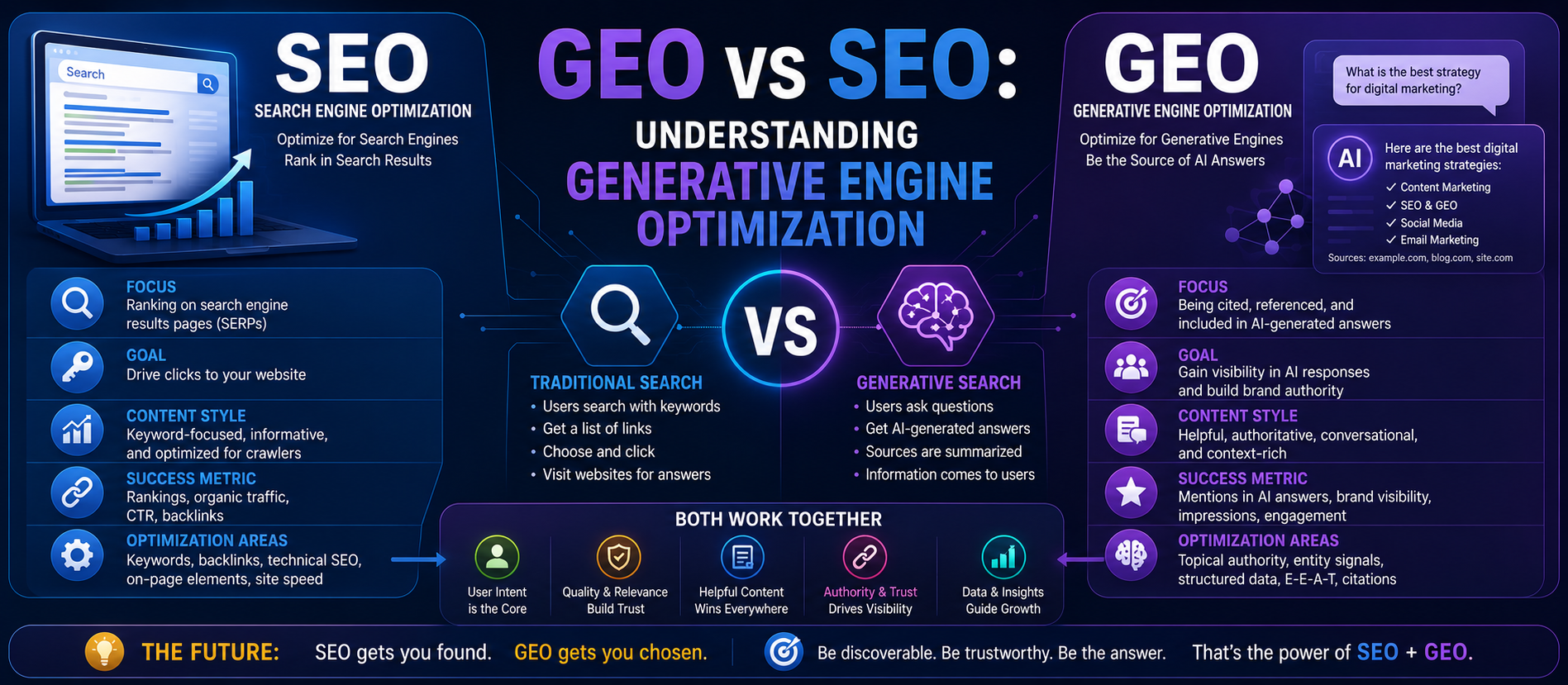
SEO vs GEO: The Core Difference
The primary difference is simple:
- SEO focuses on ranking web pages.
- GEO focuses on becoming a trusted source cited by AI systems.
Traditional SEO aims to earn clicks. GEO aims to earn references, mentions, citations, and inclusion within AI-generated answers.
How Search Engines Work
Traditional search engines crawl, index, and rank web pages based on numerous ranking signals.
Google evaluates:
- Keywords
- Content quality
- Backlinks
- User engagement
- Technical SEO
- Authority signals
Search results are presented as ranked links.
How Generative Engines Work
Generative engines use artificial intelligence to analyze and synthesize information.
Instead of showing only links, they generate direct answers by combining information from multiple trusted sources.
These systems evaluate:
- Authority
- Expertise
- Trustworthiness
- Entity relationships
- Contextual relevance
- Semantic understanding
The result is a conversational answer rather than a list of websites.
The Role of Keywords
Keywords remain important in SEO because they help search engines understand user intent.
In GEO, keywords still matter, but semantic meaning and context play much larger roles.
Generative engines focus more heavily on understanding concepts and relationships than exact keyword matches.
Authority Is More Important Than Ever
Authority has always mattered in SEO, but it is even more critical for GEO.
AI systems are more likely to cite content from trusted, authoritative sources.
Businesses should focus on:
- Industry expertise
- Thought leadership
- Research-backed content
- Brand reputation
- Media recognition
Authority increases both SEO and GEO performance.
E-E-A-T in GEO and SEO
Google's E-E-A-T framework remains highly relevant.
E-E-A-T stands for:
- Experience
- Expertise
- Authoritativeness
- Trustworthiness
Both SEO and GEO benefit from strong E-E-A-T signals because AI systems prefer reliable sources.
Content Strategy Differences
SEO content often focuses on ranking for specific keywords.
GEO content focuses on becoming the best answer source.
Effective GEO content should:
- Provide clear answers
- Offer comprehensive coverage
- Include factual information
- Demonstrate expertise
- Use structured formatting
Content quality is central to both approaches.
The Importance of Entities
Generative AI systems rely heavily on entities.
Entities include:
- People
- Organizations
- Brands
- Products
- Locations
- Concepts
Businesses should clearly define and reinforce their brand entities across digital channels.
Structured Data and GEO
Structured data helps both search engines and AI systems understand content.
Important schema types include:
- Article Schema
- FAQ Schema
- Organization Schema
- Product Schema
- Review Schema
Schema markup improves machine readability and discoverability.
The Connection Between GEO and AEO
Answer Engine Optimization (AEO) serves as a bridge between SEO and GEO.
AEO focuses on optimizing content for direct answers, featured snippets, and voice search results.
GEO expands this concept to AI-generated responses.
Together, SEO, AEO, and GEO create a comprehensive visibility strategy.
How AI Search Optimization Fits In
AI Search Optimization is the broader discipline that encompasses SEO, AEO, and GEO.
Its goal is to maximize visibility across all search environments, including:
- Traditional search engines
- Answer engines
- Voice assistants
- Generative AI systems
- Conversational search platforms
Modern businesses should view GEO as part of a larger AI Search strategy.
Best Practices for GEO
To improve GEO performance, businesses should:
- Create authoritative content
- Build strong E-E-A-T signals
- Use structured data
- Optimize entities
- Develop topic clusters
- Earn quality mentions
- Strengthen brand authority
- Publish research-backed insights
These practices increase the likelihood of being referenced by AI systems.
Common GEO Mistakes
- Publishing thin content
- Ignoring authority building
- Over-focusing on keywords
- Neglecting structured data
- Failing to establish expertise
- Ignoring conversational search trends
Avoiding these mistakes improves long-term visibility.
The Future of GEO and SEO
SEO is not disappearing. Instead, it is evolving.
The future belongs to businesses that combine traditional SEO best practices with GEO strategies.
Search visibility will increasingly depend on:
- Authority
- Trust
- Expertise
- Structured content
- AI-friendly formatting
- Entity optimization
Organizations that adapt early will gain sustainable competitive advantages.
Why Businesses Should Start Today
Generative search is already influencing how consumers discover information and make decisions.
Businesses that invest in GEO today will establish stronger authority, improve AI visibility, and future-proof their digital presence.
Waiting until AI search becomes dominant may result in lost opportunities.
Conclusion
GEO and SEO are not competing strategies—they are complementary disciplines.
SEO helps businesses rank in traditional search engines, while GEO helps businesses become trusted sources within AI-generated responses.
Success in 2026 and beyond requires a unified approach that combines SEO, AEO, GEO, and AI Search Optimization.
Digiifrog helps businesses prepare for the future through advanced SEO, AEO, GEO, AI Search Optimization, authority building, content marketing, and performance-driven digital growth strategies.
Website: www.digiifrog.com
Whether you are a startup, local business, eCommerce company, or enterprise brand, Digiifrog provides innovative search optimization solutions designed to maximize visibility across both traditional and AI-powered search ecosystems.
Ready to Grow?
Talk to us about a strategy tailored to your brand — we will help you stand out in search, AI discovery and social.

Comments (0)
Log in to leave a comment.