📋 Quick Summary
In this article:
What Is Graphic Design Software?
Why Graphic Design Software Matters in 2026
What Makes Graphic Design Software Effective?
Top Graphic Design Software Trends in 2026
1. Generative AI for Graphic Design
2. AI-Powered Image Editing
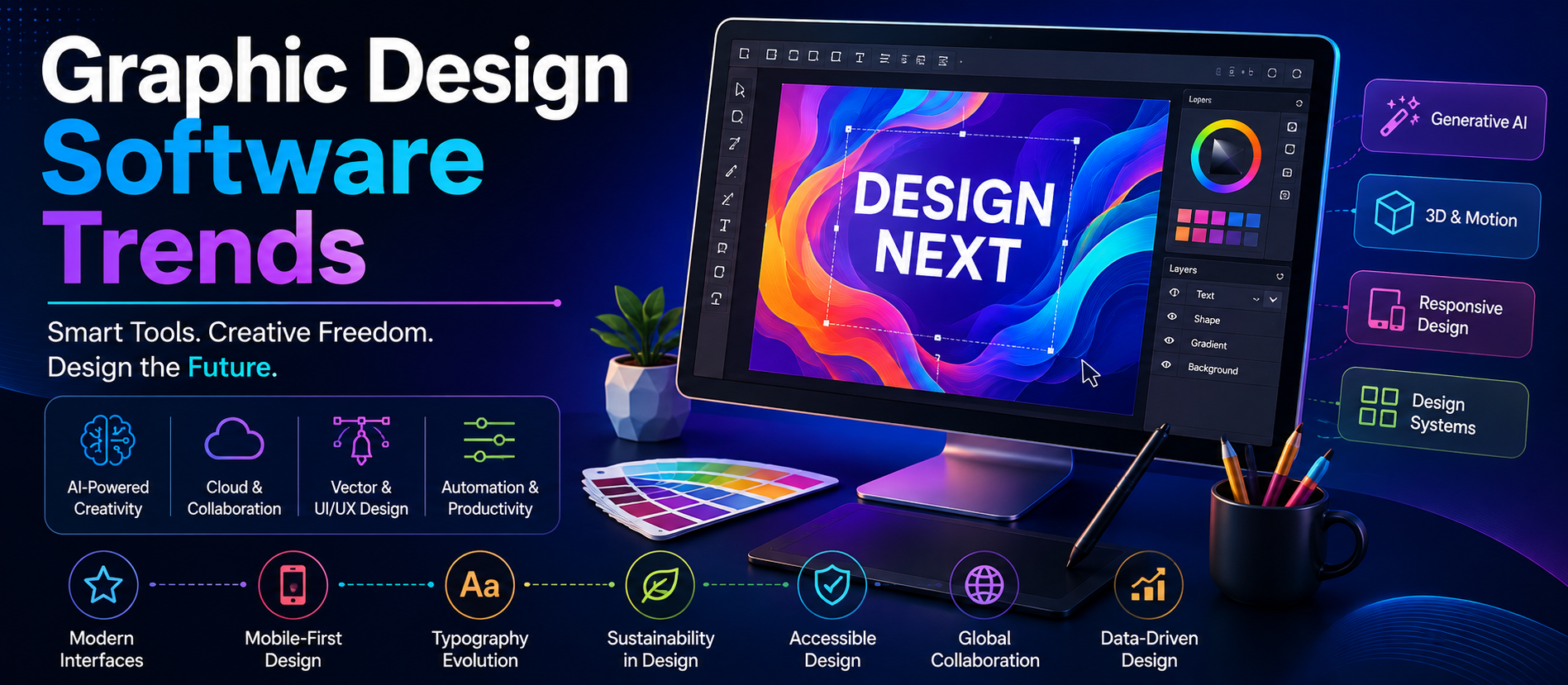
The latest graphic design software trends show a clear movement toward AI-assisted creativity, browser-based design, collaborative workflows, automated resizing, real-time feedback, 3D and motion design, brand automation, and connected creative ecosystems. These developments are changing how professional designers work while also making sophisticated design capabilities more accessible to small businesses and non-designers.
This WordPress-ready HTML article is prepared for Digiifrog (www.digiifrog.com) with a strong focus on SEO, AEO, GEO, and AI Search optimization.
What Is Graphic Design Software?
Graphic design software includes digital applications used to create, edit, arrange, illustrate, publish, and manage visual content. Depending on the platform, designers can work with vector graphics, photographs, typography, layouts, illustrations, presentations, social media graphics, advertisements, interfaces, animations, and other visual assets.
Modern design software can support the complete creative process, from initial concepts and moodboards to final production and delivery. Cloud-based platforms also allow multiple people to work on the same project without exchanging large numbers of files.
- Vector illustration
- Photo editing
- Page and layout design
- Brand identity design
- Social media graphics
- UI and UX design
- Presentation design
- Motion and animation
- 3D design
- AI-assisted content creation
- Collaborative design
Why Graphic Design Software Matters in 2026
Visual communication has become central to modern marketing. Businesses need graphics for websites, advertisements, social media, email campaigns, presentations, product interfaces, videos, online marketplaces, and digital publications.
At the same time, creative teams are expected to produce more content for more channels and often within shorter deadlines. This has increased demand for design software that can accelerate repetitive production while maintaining brand consistency and creative quality.
💡 Key Insight
AI and automation are becoming especially important because designers can use software to generate concepts, remove backgrounds, create variations, resize assets, summarize design feedback, and perform other repetitive tasks.
- Faster creative production
- More consistent branding
- Better team collaboration
- Efficient content adaptation
- Automated repetitive tasks
- Greater accessibility for non-designers
- Improved digital asset management
What Makes Graphic Design Software Effective?
The best design software depends on the type of work, skill level, team structure, budget, file requirements, and preferred workflow. A professional illustration platform may not be the best choice for a marketing team that primarily needs social media content.
Creative Control
Professional designers need precise control over typography, shapes, colors, layers, paths, effects, grids, and other visual elements.
Ease of Use
Modern software should make common tasks accessible without creating unnecessary complexity. Templates, reusable components, shortcuts, and guided workflows can improve productivity.
Collaboration
Cloud-based collaboration allows designers, marketers, developers, clients, and managers to review and work on visual assets together.
AI Capabilities
AI features can accelerate ideation, image generation, editing, background removal, content variations, and other creative tasks.
File Compatibility
Professional workflows often involve multiple file formats and applications. Strong import and export support is therefore important.
Brand Management
Businesses need consistent fonts, colors, logos, templates, and visual guidelines. Brand libraries and reusable components can help maintain consistency.
Top Graphic Design Software Trends in 2026
The following trends are shaping the future of graphic design software and creative workflows.
1. Generative AI for Graphic Design
Generative AI is one of the biggest changes in the design software industry. AI-powered tools can generate images, concepts, backgrounds, illustrations, visual variations, and other creative assets from natural-language instructions.
For designers, the value of generative AI is not simply replacing manual creation. It can accelerate exploration. A designer can test several visual directions quickly, refine a promising concept, and then apply professional judgment to the final result.
AI can also assist with repetitive editing tasks, allowing designers to spend more time on composition, storytelling, brand strategy, and creative direction.
2. AI-Powered Image Editing
Image editing software is increasingly incorporating AI for tasks that previously required detailed manual work. Background removal, object selection, image expansion, restoration, retouching, and content-aware editing can now be accelerated through intelligent tools.
This can be particularly valuable for marketing teams that need to adapt product photographs or campaign images for multiple formats.
- Automatic background removal
- Object selection
- Generative fill
- Image expansion
- AI retouching
- Resolution enhancement
- Object replacement
3. Browser-Based Graphic Design
Cloud-based design platforms have reduced the dependence on high-powered desktop applications for many creative tasks. Designers and marketing teams can access projects through browsers and collaborate from different locations.
Browser-based workflows are particularly useful for distributed organizations because team members can review, edit, comment, and share designs without installing identical desktop environments.
This trend is also making professional-looking design more accessible to small businesses and entrepreneurs.
4. Real-Time Collaborative Design
Collaboration is becoming a standard expectation in modern design software. Multiple users can review designs, leave comments, edit shared files, and communicate within the same project environment.
Real-time collaboration reduces the need to send design files back and forth through email. It can also make approval processes faster because feedback remains connected to the actual design.
5. Design Systems and Reusable Components
Large organizations often produce hundreds or thousands of digital assets. Maintaining consistency manually can become difficult. Design systems provide reusable components, typography rules, colors, layouts, and interface patterns that help teams maintain a consistent visual language.
Design software is increasingly supporting reusable components and shared libraries so teams can update common elements without rebuilding every design from scratch.
6. Automated Brand Design
Businesses want to maintain consistent branding across websites, social media, presentations, advertisements, documents, and marketing campaigns. Modern design platforms can use brand kits, templates, content libraries, and AI assistance to automate parts of this process.
Automated brand workflows can help non-designers create materials that remain closer to approved brand standards.
Human creative direction remains important because brand identity involves strategy, positioning, audience understanding, and emotional communication rather than visual consistency alone.
7. Automated Design Resizing and Adaptation
A single campaign often needs to be adapted for many dimensions. Social media platforms, websites, advertisements, email newsletters, presentations, and print materials all use different formats.
Modern design software can automate resizing and layout adaptation, reducing repetitive production work.
- Social media posts
- Stories and vertical formats
- Website banners
- Digital advertisements
- Email graphics
- Presentation layouts
- Print variations
8. Vector Design with AI Assistance
Vector design remains important for logos, icons, illustrations, packaging, signage, and scalable graphics. AI is beginning to assist with vector generation, shape creation, tracing, color exploration, and design variations.
The combination of vector precision and AI-assisted ideation can help designers explore concepts faster while retaining control over the final artwork.
9. 3D Design and Visualization
Three-dimensional design is becoming more accessible through improved software, real-time rendering, AI-assisted modeling, and browser-based tools. Designers can create product visualizations, packaging concepts, environments, illustrations, and marketing assets with increasingly realistic results.
3D workflows can reduce the need for traditional photography in some product marketing scenarios by allowing teams to generate controlled visual environments digitally.
10. Motion Graphics and Animation Integration
Static graphics are increasingly being combined with motion. Social platforms, advertisements, websites, digital presentations, and product interfaces frequently use animation to attract attention and communicate information.
Design platforms are therefore adding animation timelines, motion presets, video editing, transitions, and other capabilities that allow graphic designers to create moving content without switching between many applications.
11. Design-to-Development Workflows
Digital product teams need designers and developers to work closely together. Modern design platforms increasingly provide developer inspection, asset export, measurements, design tokens, component libraries, and code-related workflows.
Better design-to-development collaboration can reduce misunderstandings and help developers reproduce intended visual behavior more accurately.
12. Accessibility-First Design Tools
Accessibility is becoming an increasingly important consideration in digital design. Designers need to consider contrast, typography, readable layouts, alternative text, interaction patterns, and other factors that influence whether digital experiences can be used by people with different abilities.
Modern design software can help identify some accessibility issues and encourage designers to consider accessibility earlier in the creative process.
13. AI-Powered Design Search
As creative libraries become larger, finding the right asset can be difficult. AI-powered search can help users locate images, templates, documents, components, and previous designs using natural-language descriptions.
Instead of remembering the exact file name, a designer may be able to describe the type of asset needed and receive relevant results.
14. Intelligent Template Generation
Templates have traditionally provided fixed layouts. AI is making templates more adaptive by allowing users to generate variations based on content, brand requirements, audience, and platform.
This can be particularly valuable for marketing departments that need large volumes of localized or personalized creative content.
15. Personalized Creative Production
Businesses increasingly want to personalize advertisements, email campaigns, landing pages, and social media content. Design software can support dynamic content variations where images, text, colors, or layouts change according to audience segments.
Automation can then produce multiple versions while maintaining predefined brand rules.
16. Cloud Digital Asset Management
As companies create more visual content, managing assets becomes a significant challenge. Cloud-based asset libraries can help teams organize logos, photographs, illustrations, videos, templates, and campaign files.
Good digital asset management should include permissions, version history, metadata, search, organization, and lifecycle controls.
17. Design Automation for Marketing Teams
Marketing teams frequently need design assets faster than a traditional creative production process can provide. Automation can connect marketing workflows with design templates and content systems.
For example, a campaign system can provide approved text and product information to a design workflow that creates branded visual variations for different channels.
This approach allows designers to focus on high-value creative work while automation handles repetitive production.
18. Cross-Platform Design Workflows
Modern businesses publish content across websites, social media, mobile applications, email, advertising networks, presentations, and print. Design software increasingly supports workflows that make it easier to reuse and adapt creative assets across platforms.
Cross-platform design reduces duplication and helps maintain consistent visual identity.
19. Voice and Natural-Language Design Interfaces
Natural-language interaction is changing how users communicate with software. Instead of navigating through every command manually, users can increasingly describe the desired result in ordinary language.
Examples include asking a design assistant to create a layout, generate alternative headlines, change the visual style, remove an object, or adapt a design for a different platform.
Natural-language controls will not eliminate professional design skills. They can, however, make software more accessible and reduce the friction involved in routine operations.
20. Sustainable and Efficient Design Workflows
Sustainability is becoming a consideration for digital businesses. Efficient asset management, optimized media, cloud resource management, and reusable design systems can reduce unnecessary duplication and operational overhead.
For organizations producing large volumes of digital content, efficient workflows can also reduce storage requirements and repetitive production effort.
Popular Graphic Design Software Platforms
Businesses and designers have many software choices, and each platform has different strengths. Commonly evaluated tools include Adobe Creative Cloud applications, Canva, Figma, Affinity applications, CorelDRAW, Sketch, and specialized illustration, photo, motion, and 3D platforms.
Adobe Creative Cloud
Adobe Creative Cloud provides a broad collection of professional creative applications covering image editing, vector design, page layout, video, motion graphics, photography, and other creative disciplines. Adobe is also integrating generative AI and other intelligent features into its creative ecosystem.
Canva
Canva focuses on accessible visual content creation with templates, collaboration, brand tools, presentations, social media graphics, and AI-assisted design capabilities. It is widely useful for marketing teams and non-designers as well as professional creatives.
Figma
Figma is strongly associated with collaborative interface and product design. Its browser-based workflow supports real-time collaboration, components, design systems, prototyping, and developer handoff.
Affinity
Affinity applications provide professional tools for vector design, photo editing, and page layout. They can be considered by designers looking for alternatives to subscription-centered creative workflows.
CorelDRAW
CorelDRAW provides vector illustration and page-layout capabilities and is used across branding, print, signage, illustration, and other professional design workflows.
Sketch
Sketch has a long history in digital interface design and continues to support workflows around UI design, prototyping, collaboration, and design systems.
These platforms are not ranked universally. Designers should evaluate current features, compatibility, collaboration requirements, pricing, performance, and workflow fit before selecting software.
How to Choose Graphic Design Software
Selecting design software should begin with the type of work being produced.
Define Your Primary Design Tasks
Determine whether the main requirements involve photo editing, vector illustration, branding, UI design, social media content, presentations, video, animation, or a combination.
Consider Skill Level
Professional designers may require advanced controls, while marketing teams may prioritize templates, speed, collaboration, and ease of use.
Evaluate Collaboration
If several people need to review and edit projects, real-time collaboration and cloud-based sharing can be important selection criteria.
Check AI Features
Evaluate whether AI tools genuinely improve the workflow. Useful features can include image editing, ideation, resizing, search, content generation, and repetitive task automation.
Review File Compatibility
Designers often exchange files with clients, printers, developers, agencies, and other software. Make sure the platform supports the formats required by the workflow.
Consider Brand Management
Businesses with multiple teams should consider shared brand libraries, templates, permissions, and reusable components.
Graphic Design Software for Small Businesses
Small businesses often need to create professional graphics without maintaining a large internal design department. Cloud-based design platforms, templates, brand kits, and AI-assisted tools can help small teams produce websites, advertisements, social media graphics, presentations, and promotional materials.
However, automation should not replace brand strategy. Businesses should establish clear visual guidelines for logos, typography, colors, imagery, tone, and layout before scaling content production.
Graphic Design Software for Professional Designers
Professional designers typically need greater control over typography, color management, layers, vectors, effects, grids, export settings, and complex files. They may also use multiple specialized applications rather than relying on a single platform.
The future professional workflow is increasingly hybrid: designers may use traditional creative software for precision and AI tools for exploration, repetitive editing, research, and production acceleration.
AI and the Future Role of Graphic Designers
AI is changing design workflows, but creative strategy remains important. Designers provide context, taste, visual judgment, brand understanding, storytelling, composition, and audience insight.
AI can generate possibilities quickly, but a strong final design still requires decisions about hierarchy, clarity, relevance, emotion, accessibility, and consistency.
The role of designers may increasingly shift toward creative direction, system design, art direction, brand strategy, quality control, and human-centered problem solving.
Common Graphic Design Software Mistakes
Using Too Many Applications
A large collection of tools can create unnecessary complexity. Teams should identify which applications are essential and how they connect.
Ignoring File Organization
Poor naming, duplicate assets, and missing version information can make creative libraries difficult to manage.
Relying Completely on AI
AI-generated content can contain visual inconsistencies, incorrect details, or outputs that do not match brand requirements. Human review remains essential.
Ignoring Accessibility
Design should consider readability, contrast, typography, and usability rather than focusing only on visual appearance.
Creating Without a Brand System
Without defined brand rules, automated content production can create inconsistent visual communication.
How to Build a Modern Graphic Design Workflow
A practical creative workflow can combine human creativity, professional design software, collaboration, automation, and AI.
Stage 1: Research
Understand the audience, business objective, brand, platform, and creative requirements.
Stage 2: Ideate
Use sketches, moodboards, references, and AI-assisted concept exploration to develop creative directions.
Stage 3: Design
Create the primary visual using the appropriate design software and established brand guidelines.
Stage 4: Review
Collect feedback from stakeholders through comments, annotations, and structured approval workflows.
Stage 5: Adapt
Resize and modify the approved design for different channels and formats.
Stage 6: Automate
Use templates, reusable components, batch production, and workflow automation for repetitive variations.
Stage 7: Publish and Manage
Export the correct formats, publish the assets, and store approved versions in an organized digital asset library.
Graphic Design, SEO, AEO, GEO and AI Search
Graphic design and search optimization increasingly overlap because visual content is part of the overall digital experience. Websites, landing pages, social media graphics, infographics, and branded assets can all influence how users understand a business.
SEO focuses on search visibility, while AEO helps content answer questions directly. GEO supports visibility and usefulness in generative search experiences, and AI Search optimization emphasizes clear, structured, trustworthy information that intelligent systems can understand.
For design-related content, businesses should combine strong visual communication with descriptive text, accessible structure, meaningful headings, useful FAQs, and relevant contextual information.
Future of Graphic Design Software
The future of graphic design software will likely be defined by intelligent assistance, deeper collaboration, adaptive layouts, automated content production, 3D workflows, motion integration, and connected brand systems.
Design applications are becoming less like isolated desktop tools and more like collaborative creative ecosystems. Designers, marketers, developers, clients, and AI assistants can increasingly participate in the same workflow.
As these tools mature, the competitive advantage will not come simply from knowing how to operate a particular application. It will come from knowing how to combine creativity, strategy, technology, automation, and human judgment effectively.
Frequently Asked Questions About Graphic Design Software Trends
What are the biggest graphic design software trends in 2026?
The major trends include generative AI, AI-powered image editing, browser-based design, real-time collaboration, automated resizing, design systems, brand automation, 3D design, motion graphics, natural-language interfaces, and integrated digital asset management.
What is the best graphic design software?
There is no single best software for every designer. Adobe Creative Cloud, Canva, Figma, Affinity, CorelDRAW, Sketch, and specialized creative applications serve different needs.
Will AI replace graphic designers?
AI is likely to automate some repetitive design tasks, but professional design still requires strategy, creative judgment, brand understanding, storytelling, composition, accessibility, and quality control. AI is more accurately viewed as a powerful creative assistant than a complete replacement for human designers.
Is cloud-based design software better?
Cloud-based software can provide strong collaboration, accessibility, sharing, and centralized project management. Desktop software can still provide advanced performance and specialized capabilities. The better approach depends on the workflow.
How can small businesses use AI design software?
Small businesses can use AI-assisted design tools for social media graphics, advertisements, presentations, website visuals, content variations, background removal, image editing, and brand templates while maintaining human review.
What should businesses consider when buying design software?
Important factors include creative capabilities, ease of use, collaboration, AI features, file compatibility, brand management, integrations, security, pricing, performance, and long-term workflow requirements.
How will graphic design software change in the future?
Design software is likely to become more collaborative, AI-assisted, automated, adaptive, and connected to marketing, development, content management, and digital asset workflows.
Conclusion
The latest graphic design software trends show that the creative industry is moving toward intelligent, collaborative, cloud-based, and highly automated workflows. Generative AI, automated image editing, reusable design systems, real-time collaboration, adaptive templates, 3D, motion, and connected asset management are changing how visual content is created and delivered.
Platforms such as Adobe Creative Cloud, Canva, Figma, Affinity, CorelDRAW, and Sketch continue to serve different segments of the design market, while AI is adding new capabilities across the creative process.
The most effective future workflow will not be about choosing between human creativity and AI. It will be about combining professional design expertise with intelligent tools that reduce repetitive work, accelerate exploration, improve collaboration, and help teams produce high-quality visual communication at scale.
For businesses looking to explore AI-powered design, digital transformation, automation, branding, and modern creative technology solutions, Digiifrog can help develop practical strategies. Visit www.digiifrog.com to learn more.
Quick Answer: What Are the Biggest Graphic Design Software Trends?
The biggest graphic design software trends include generative AI, AI-powered editing, browser-based design, real-time collaboration, automated resizing, design systems, brand automation, 3D visualization, motion graphics, natural-language design, digital asset management, and AI-assisted creative workflows. Businesses and designers should adopt these technologies according to their creative requirements while maintaining human review, brand consistency, accessibility, and quality control.
Ready to Grow?
Talk to us about a strategy tailored to your brand — we will help you stand out in search, AI discovery and social.

Comments (0)
Log in to leave a comment.