📋 Quick Summary
In this article:
What Is Green Building in Real Estate?
Why Green Building Matters to Real Estate
1. Energy-Efficient Building Design
2. High-Performance Building Envelopes
3. Heat Pumps and Efficient HVAC
4. Smart Building Controls
5. Renewable Energy Integration
6. Zero Energy and Net-Zero Buildings
7. Water-Efficient Real Estate
8. Sustainable and Low-Carbon Materials
9. Adaptive Reuse and Building Renovation
10. Indoor Air Quality and Healthy Buildings
💡 Key Insight
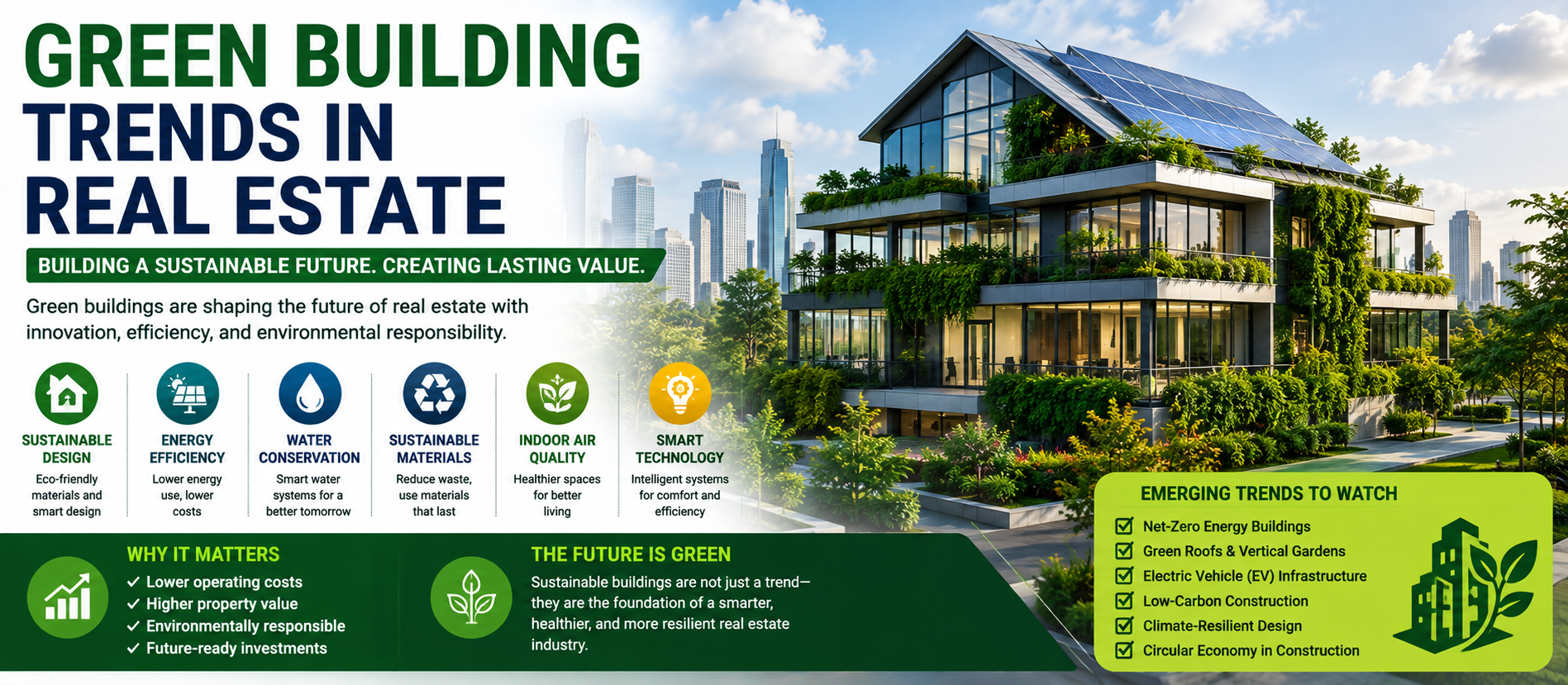
Green building trends in real estate are changing how residential and commercial properties are designed, constructed, renovated, marketed, and managed. Energy efficiency, low-carbon materials, water conservation, healthier indoor environments, climate resilience, smart building controls, and measurable building performance are becoming important considerations for developers, investors, owners, tenants, and buyers.
Green buildings are no longer limited to solar panels or energy-efficient light bulbs. Modern sustainable real estate takes a whole-building approach that considers the building envelope, HVAC systems, lighting, water, materials, indoor air quality, operations, resilience, and long-term asset performance. The U.S. Department of Energy emphasizes energy efficiency, sustainability, safety, advanced technologies, and building performance as major areas of modern building innovation. citeturn0search0turn0search3
Green building is also becoming more measurable. The U.S. Green Building Council's current LEED v5 framework focuses on sustainable building performance and includes stronger attention to resilience and climate-related considerations. citeturn0search1turn0search17
This guide explores the major green building trends influencing real estate in 2026, the technologies and strategies behind them, their potential benefits, common challenges, and how real estate companies can use SEO, AEO, GEO, and AI Search optimization to communicate sustainability more effectively.
This WordPress-ready HTML article is prepared for Digiifrog (www.digiifrog.com).
What Is Green Building in Real Estate?
Green building means designing, constructing, renovating, and operating properties in ways that use resources efficiently and reduce negative environmental impacts while supporting occupant comfort, health, safety, and long-term performance.
A green property may use efficient HVAC equipment, high-performance insulation, renewable energy, efficient windows, water-saving fixtures, low-impact materials, smart controls, natural daylight, improved ventilation, and sustainable landscaping.
Why Green Building Matters to Real Estate
Buildings consume substantial amounts of energy and resources. DOE reports that buildings account for about 74% of U.S. electricity use and approximately $370 billion in annual energy costs, making building efficiency important for operating costs, resilience, comfort, and grid reliability. citeturn0search3turn0search11
For real estate owners, this means sustainability can influence more than environmental performance. Efficient buildings may have lower operating expenses, improved occupant comfort, stronger resilience, and better alignment with changing market expectations.
1. Energy-Efficient Building Design
Energy efficiency remains one of the most important green building trends. Instead of treating efficiency as an optional feature, developers are increasingly considering energy performance during the earliest design stages.
Building orientation, insulation, air sealing, efficient windows, shading, daylighting, HVAC design, and efficient equipment can work together to reduce energy demand before renewable energy systems are added.
2. High-Performance Building Envelopes
The building envelope separates indoor space from outdoor conditions. A well-designed envelope can reduce unwanted heat gain, heat loss, drafts, and moisture problems.
High-performance insulation, air barriers, efficient glazing, thermal-bridge reduction, shading, and appropriate building orientation can improve comfort and reduce the workload on heating and cooling systems.
3. Heat Pumps and Efficient HVAC
Heating and cooling systems are major contributors to building energy use. Efficient heat pumps, variable-speed systems, advanced controls, and properly sized HVAC equipment can reduce energy consumption while maintaining comfort.
DOE's building technology programs continue to support research and deployment of energy-saving technologies for residential and commercial properties. citeturn0search3turn0search12
4. Smart Building Controls
Smart controls use sensors, automation, software, and connected equipment to manage temperature, lighting, ventilation, occupancy, and energy consumption.
Grid-interactive efficient buildings can combine energy efficiency with demand flexibility and smart technologies to improve affordability, comfort, productivity, and building performance. citeturn0search8
5. Renewable Energy Integration
Solar photovoltaic systems are becoming an important component of sustainable real estate, particularly when combined with efficient building design. Solar can offset electricity purchased from the grid and may improve energy resilience when paired with storage and appropriate controls.
However, renewable energy works best as part of a whole-building strategy. Reducing energy demand first can make the required renewable-energy system smaller and more cost-effective.
6. Zero Energy and Net-Zero Buildings
Zero-energy buildings combine energy efficiency with renewable energy so that annual energy use is balanced by energy produced, depending on the specific definition and accounting method used.
DOE explains that zero-energy buildings can reduce energy costs, improve occupant comfort, support resilience, and lower environmental impact. citeturn0search4
For real estate developers, the trend toward higher-performance buildings can create opportunities to differentiate projects in competitive markets.
7. Water-Efficient Real Estate
Water conservation is another major part of green building. Low-flow fixtures, efficient irrigation, rainwater management, leak detection, drought-tolerant landscaping, and water reuse strategies can reduce consumption.
Commercial properties can benefit from water monitoring because leaks and inefficient equipment can create significant operating costs and property damage.
8. Sustainable and Low-Carbon Materials
Green building is increasingly concerned with the environmental impact of materials, not just energy used after a building is occupied. Developers may consider recycled materials, responsibly sourced wood, low-emission products, durable finishes, reused components, and materials with documented environmental characteristics.
Embodied carbon refers broadly to emissions associated with producing, transporting, installing, maintaining, and disposing of building materials. Reducing embodied impacts can complement operational energy efficiency.
9. Adaptive Reuse and Building Renovation
Instead of demolishing an existing structure and constructing a replacement, adaptive reuse can transform an older building for a new purpose. Reusing existing structures can preserve resources and reduce some impacts associated with new construction.
Renovation can also improve energy performance through insulation, windows, HVAC upgrades, lighting, controls, and water-efficiency improvements.
10. Indoor Air Quality and Healthy Buildings
Sustainability increasingly includes occupant health and indoor environmental quality. Ventilation, filtration, humidity management, low-emitting materials, daylight, thermal comfort, and appropriate moisture control can contribute to healthier indoor environments.
USGBC's current work highlights human health as a significant part of sustainable building discussions, showing that green buildings are increasingly evaluated through both environmental and occupant outcomes. citeturn0search19
11. Climate Resilience
Resilience is becoming a stronger real estate consideration as property owners evaluate extreme heat, flooding, storms, wildfire risk, drought, power interruptions, and other hazards relevant to their location.
LEED v5 includes a Climate Resilience Assessment requirement for projects and provides credits for measures that reduce risks to buildings, operations, occupants, and surrounding communities. citeturn0search17
Resilience planning can include backup power, water management, stronger building envelopes, shading, passive survivability, flood protection, landscape strategies, and emergency planning.
12. Passive Design Strategies
Passive design uses building orientation, shading, daylight, natural ventilation, insulation, thermal mass, and other architectural techniques to reduce reliance on mechanical systems.
DOE identifies passive design as an important component of zero-energy approaches because natural daylight, ventilation, heating, and cooling opportunities can reduce energy demand. citeturn0search5
13. Green Roofs and Sustainable Landscaping
Green roofs, native plants, rain gardens, permeable surfaces, shade trees, and other landscape strategies can help manage stormwater, reduce heat-island effects, support biodiversity, and improve outdoor environments.
For commercial and multifamily properties, sustainable landscaping can also reduce irrigation and maintenance requirements when properly designed for local conditions.
14. Electrification and EV Infrastructure
Building electrification is another important trend. Developers may incorporate electric appliances, heat pumps, electric water heating, and electric vehicle charging into new projects or major renovations.
EV charging can become a useful amenity for residential communities, offices, retail centers, hotels, and mixed-use developments. Planning electrical capacity early can make future expansion easier.
15. Energy Storage and Flexible Buildings
Battery storage can allow buildings to store electricity for later use, manage peak demand, support renewable-energy systems, and provide backup power in suitable applications.
When combined with smart controls, efficient equipment, and flexible loads, storage can become part of a broader grid-interactive building strategy rather than a standalone technology.
16. Building Performance Monitoring
Modern green buildings increasingly rely on measurement. Energy meters, water meters, indoor air-quality sensors, building-management systems, and analytics can reveal whether a building performs as intended.
Performance data can help owners identify waste, detect equipment problems, plan maintenance, and demonstrate sustainability outcomes to tenants and investors.
17. Green Certifications and Market Positioning
Green certification can provide a structured framework for sustainability goals and documentation. LEED remains one of the best-known systems, and USGBC's current LEED v5 is available for building design and construction, interior design and construction, and operations and maintenance. citeturn0search1
Certification does not automatically make a property financially successful. The value depends on market demand, project quality, operating performance, location, tenant expectations, and the credibility of the sustainability claims.
18. Green Buildings and Property Value
Green features may support property value when they produce measurable operating benefits, improve occupant experience, reduce risk, or meet market demand. USGBC has reported operating-cost and asset-value benefits associated with green buildings and retrofits, although outcomes vary by project and market. citeturn0search16
⚠ Watch Out
Real estate professionals should avoid promising a fixed price premium for sustainability. Instead, evaluate actual energy savings, certification, tenant demand, operating expenses, resilience, and comparable-market evidence.
19. Green Buildings and Tenant Demand
For commercial real estate, sustainability can influence tenant decisions when organizations have environmental targets, employee wellness priorities, energy-cost concerns, or reporting requirements.
Residential buyers and renters may also value lower utility costs, better indoor comfort, efficient equipment, healthier materials, and resilient infrastructure.
20. Retrofitting Existing Properties
Green building trends are not limited to new construction. Existing properties represent a major opportunity for energy and water improvements.
A retrofit strategy can begin with an energy assessment and prioritize high-impact improvements such as HVAC upgrades, insulation, air sealing, lighting, controls, windows, water systems, and renewable energy.
21. The Rise of Measurable Sustainability
Real estate sustainability is increasingly moving from marketing language toward measurable performance. Investors, tenants, buyers, regulators, and certification systems increasingly want evidence of energy use, emissions, water consumption, resilience, and indoor environmental quality.
This creates an opportunity for owners to maintain reliable building-performance records rather than relying only on broad claims such as “eco-friendly” or “green property.”
22. Green Building Challenges
Green projects can face higher upfront planning requirements, equipment availability issues, skilled-labor constraints, financing challenges, maintenance requirements, and uncertainty about future technology.
The best approach is to evaluate lifecycle cost rather than focusing only on initial construction expense. Some efficiency measures can reduce operating expenses and may provide attractive payback periods, but results depend on the building, climate, utility rates, incentives, and project design.
23. How Developers Can Plan a Green Project
- Set measurable sustainability goals early.
- Analyze the site's climate and environmental risks.
- Optimize orientation and building-envelope performance.
- Design efficient HVAC and lighting systems.
- Plan water efficiency and stormwater management.
- Evaluate low-carbon and durable materials.
- Consider renewable energy and storage.
- Plan smart controls and metering.
- Document performance targets.
- Train operations and maintenance teams.
24. Green Building Marketing in Real Estate
Sustainable features should be translated into benefits that buyers and tenants understand. Instead of simply saying “energy-efficient building,” explain relevant features such as efficient HVAC, insulation, solar generation, water-saving fixtures, smart controls, or documented energy performance.
Marketing claims should be accurate, specific, and supported by appropriate documentation. Avoid vague environmental claims that could create confusion or undermine trust.
25. SEO, AEO, GEO and AI Search for Green Real Estate
SEO can help real estate businesses reach people searching for sustainable homes, green commercial buildings, energy-efficient properties, and environmentally responsible developments.
AEO focuses on answering direct questions such as “What is a green building?”, “Do green buildings save money?”, and “Which sustainable features increase property value?”
GEO and AI Search optimization can be supported with clear, factual, location-specific content. Real estate businesses should explain local green-building features, certifications, energy programs, climate risks, sustainable materials, and buyer benefits in structured content.
Use descriptive headings, concise answers, trustworthy sources, consistent business information, FAQs, and property-specific facts. This makes content easier for both traditional search engines and AI-powered discovery systems to interpret.
26. Green Building Content Strategy for Real Estate Businesses
- Green homes for sale in [city]
- Energy-efficient homes in [location]
- Benefits of LEED-certified commercial properties
- How solar panels affect property value
- Best energy-efficient upgrades before selling
- Green remodeling ideas for older properties
- How to reduce commercial building operating costs
- Climate-resilient real estate strategies
- Sustainable materials for modern construction
- Smart building technology and energy management
27. Green Building Trends to Watch
Several trends are likely to remain important as the market develops: electrification, efficient heat pumps, smart controls, building-performance measurement, renewable energy, energy storage, low-carbon materials, adaptive reuse, water efficiency, indoor environmental quality, and climate resilience.
The broader direction is toward buildings that are efficient, measurable, connected, healthy, and resilient rather than simply labeled “green.”
Green Building Checklist for Real Estate
- Energy-efficient building envelope
- Efficient HVAC and heat-pump systems
- Smart building controls
- LED lighting and daylighting
- Water-efficient fixtures and irrigation
- Renewable energy where practical
- Energy storage where appropriate
- EV charging infrastructure
- Low-impact and durable materials
- Indoor air-quality improvements
- Sustainable landscaping
- Climate resilience planning
- Energy and water monitoring
- Green certification when appropriate
Frequently Asked Questions About Green Building Trends
What are the biggest green building trends in real estate?
Major trends include energy-efficient design, heat pumps, smart controls, renewable energy, energy storage, low-carbon materials, water efficiency, indoor air quality, adaptive reuse, building-performance monitoring, and climate resilience.
Do green buildings increase property value?
They can support value when sustainability features reduce operating costs, improve comfort, reduce risk, or match buyer and tenant demand. The effect varies by property and market, so there is no universal premium.
What is a zero-energy building?
A zero-energy building combines high energy efficiency with renewable energy so that, under its applicable definition and accounting method, energy use is balanced by energy produced over a specified period. DOE identifies lower energy costs, comfort, resilience, and environmental benefits as potential advantages. citeturn0search4
What is LEED v5?
LEED v5 is the current version of the U.S. Green Building Council's LEED framework for eligible building projects. USGBC describes it as a new standard for sustainable building and currently offers it for BD+C, ID+C, and O+M. citeturn0search1
Are green building upgrades worth the cost?
They can be, particularly when improvements reduce energy or water use, improve durability, support resilience, or meet market demand. The decision should consider lifecycle cost, expected savings, maintenance, incentives, and property-specific conditions.
Conclusion
Green building trends in real estate are moving sustainability from an optional marketing feature toward a broader strategy for efficiency, resilience, occupant well-being, and long-term asset performance. The strongest green properties combine efficient building envelopes, modern HVAC systems, smart controls, renewable energy, water conservation, responsible materials, healthy indoor environments, and measurable performance.
Developers and owners should focus on practical results rather than simply collecting green features. A successful sustainable property is one that performs efficiently, remains comfortable, manages risk, and provides understandable benefits to its occupants and owners.
As green building standards and technologies continue to evolve, documentation will become increasingly important. Energy data, certifications, equipment specifications, operating performance, and resilience planning can help real estate professionals communicate sustainability claims with greater credibility.
For real estate developers, agencies, property managers, builders, and sustainability-focused businesses seeking modern websites, automated lead generation, content marketing, SEO, AEO, GEO, and AI Search optimization, Digiifrog can help. Visit www.digiifrog.com.
Quick Answer: What Are the Main Green Building Trends in Real Estate?
The main green building trends include energy-efficient design, high-performance building envelopes, heat pumps, smart controls, renewable energy, zero-energy strategies, water conservation, low-carbon materials, adaptive reuse, indoor air-quality improvements, climate resilience, EV infrastructure, energy storage, and measurable building performance. Together, these trends are helping real estate move toward buildings that are more efficient, resilient, comfortable, and resource-conscious.
Important Note
Green-building requirements, certifications, incentives, energy codes, tax rules, and disclosure requirements vary by country, state, city, property type, and project. Sustainability features should be evaluated using project-specific financial, technical, legal, and engineering advice. Claims about energy savings or property value should be supported by reliable documentation.
Ready to Grow?
Talk to us about a strategy tailored to your brand — we will help you stand out in search, AI discovery and social.

Comments (0)
Log in to leave a comment.