📋 Quick Summary
In this article:
The History of Growth and Value Investing
Core Philosophy of Growth Investing
Core Philosophy of Value Investing
Key Differences Between Growth and Value Investing
Financial Metrics Used in Growth Investing
Financial Metrics Used in Value Investing
This comprehensive guide from Digiifrog explores growth investing vs value investing, their advantages and disadvantages, key characteristics, performance considerations, and how investors can determine which strategy may best suit their needs.
What Is Growth Investing?
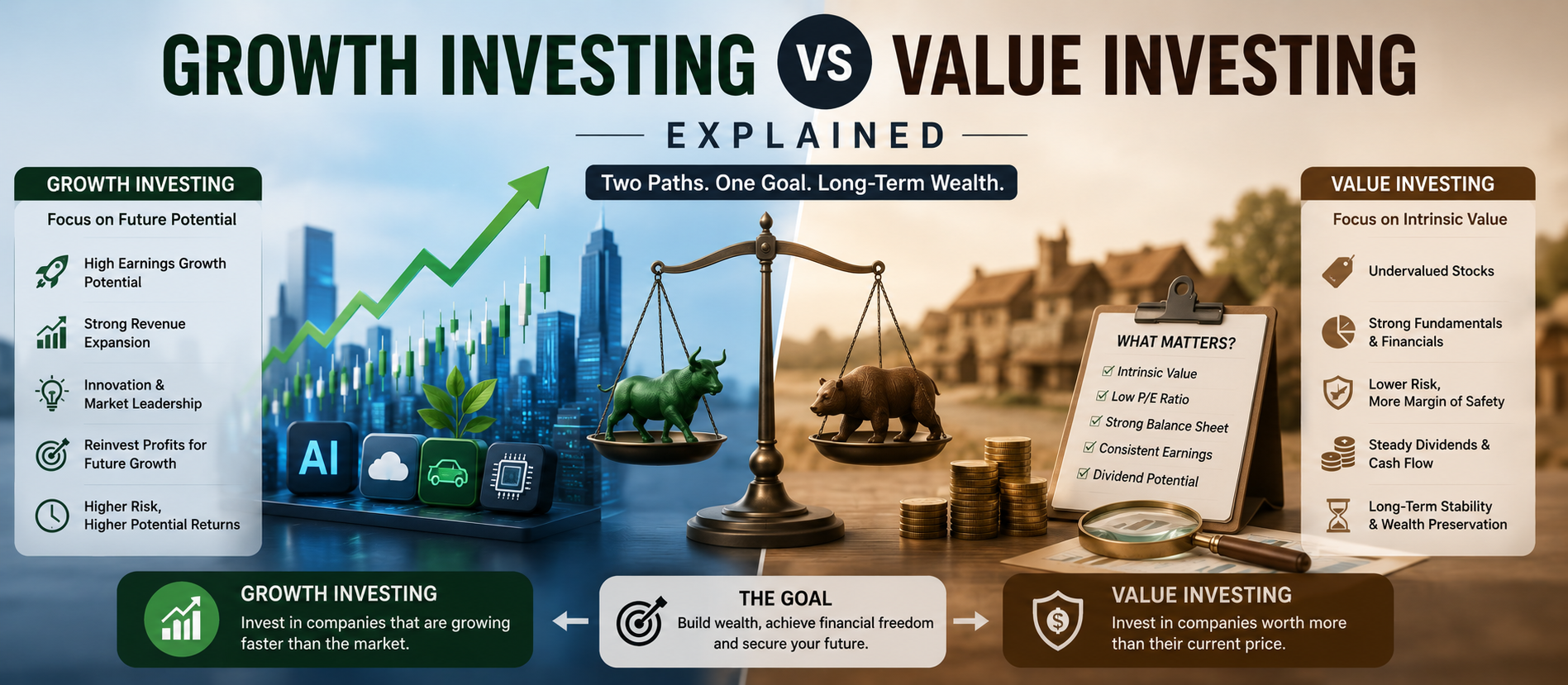
Growth investing is an investment strategy focused on companies expected to grow revenues, earnings, market share, or cash flow at rates significantly above average.
Growth investors seek businesses with strong expansion potential and are often willing to pay premium valuations in anticipation of future success.
Common characteristics of growth companies include:
- Rapid revenue growth
- Strong earnings expansion
- Innovative products or services
- Competitive advantages
- Large market opportunities
- Reinvestment of profits
Growth investing emphasizes future potential rather than current valuation.
What Is Value Investing?
Value investing focuses on identifying stocks trading below their estimated intrinsic value.
Value investors believe markets occasionally misprice companies, creating opportunities to purchase quality businesses at discounted prices.
Typical value stock characteristics include:
- Low price-to-earnings ratios
- Strong balance sheets
- Stable cash flows
- Established business models
- Dividend payments
- Temporary market pessimism
The strategy seeks long-term gains as market prices eventually reflect true business value.
The History of Growth and Value Investing
Value investing gained prominence through legendary investors such as Benjamin Graham and Warren Buffett, who emphasized buying undervalued businesses with strong fundamentals.
Growth investing became increasingly popular as technology companies and innovative industries demonstrated extraordinary expansion potential during various market cycles.
Both approaches have experienced periods of outperformance depending on economic conditions and investor sentiment.
Core Philosophy of Growth Investing
Growth investors focus primarily on future business potential.
Key beliefs include:
- Fast-growing companies can justify higher valuations.
- Innovation drives long-term success.
- Market leaders often continue expanding.
- Future earnings matter more than current profits.
Growth investing prioritizes opportunity and expansion over current market pricing.
Core Philosophy of Value Investing
Value investors focus on purchasing assets below their intrinsic worth.
Key principles include:
- Markets can be inefficient.
- Stock prices may not reflect true value.
- Patience creates opportunities.
- Risk decreases when purchasing at discounts.
Value investing emphasizes discipline, analysis, and margin of safety.
Key Differences Between Growth and Value Investing
Growth Investing
- Focuses on future growth.
- Often involves higher valuations.
- Lower dividend payouts.
- Higher earnings growth expectations.
- Greater market optimism.
Value Investing
- Focuses on intrinsic value.
- Typically lower valuations.
- Often includes dividends.
- More mature businesses.
- Greater emphasis on fundamentals.
Financial Metrics Used in Growth Investing
Growth investors frequently evaluate:
- Revenue growth rates
- Earnings growth
- Market share expansion
- Customer acquisition trends
- Innovation pipelines
- Future earnings projections
These metrics help identify companies capable of sustained expansion.
Financial Metrics Used in Value Investing
Value investors commonly analyze:
- Price-to-Earnings (P/E) ratios
- Price-to-Book (P/B) ratios
- Dividend yields
- Free cash flow
- Debt levels
- Intrinsic value estimates
These measures help determine whether a stock appears undervalued.
Advantages of Growth Investing
High Return Potential
Successful growth companies can generate exceptional long-term returns.
Exposure to Innovation
Growth investors often participate in transformative industries and technologies.
Capital Appreciation
Strong earnings growth frequently drives stock price appreciation.
Economic Expansion Benefits
Growth stocks often perform well during periods of economic growth.
Disadvantages of Growth Investing
- Higher volatility
- Premium valuations
- Greater sensitivity to interest rates
- Increased market expectations
- Potential overvaluation risks
If growth slows unexpectedly, stock prices may decline sharply.
Advantages of Value Investing
Lower Valuations
Buying undervalued stocks may reduce downside risk.
Margin of Safety
Investors purchase assets below estimated intrinsic value.
Dividend Income
Many value stocks provide regular dividend payments.
Long-Term Stability
Established companies often demonstrate consistent operations.
Disadvantages of Value Investing
- Long waiting periods
- Potential value traps
- Slower growth prospects
- Market sentiment challenges
- Underperformance during growth-driven markets
Not every undervalued stock eventually recovers.
Market Conditions Favoring Growth Investing
Growth investing often performs well during:
- Economic expansion
- Technological innovation cycles
- Low interest rate environments
- Strong consumer demand periods
Investor optimism typically supports growth stock valuations.
Market Conditions Favoring Value Investing
Value investing often performs well during:
- Economic recoveries
- Rising interest rate environments
- Market corrections
- Periods of valuation normalization
Value stocks may benefit when investors prioritize fundamentals.
Risk Considerations
Both strategies involve investment risks.
Growth investors face:
- Valuation risk
- Execution risk
- Market sentiment changes
Value investors face:
- Value traps
- Industry disruptions
- Extended undervaluation periods
Proper diversification helps manage these risks.
Can Growth and Value Investing Be Combined?
Many investors combine both approaches within a diversified portfolio.
Benefits include:
- Balanced risk exposure
- Greater diversification
- Improved market participation
- Reduced strategy dependence
A blended portfolio can provide exposure to both innovation and valuation opportunities.
Growth vs Value Investing for Beginners
Beginners should focus on:
- Long-term objectives
- Risk tolerance
- Investment knowledge
- Diversification
- Consistent investing habits
Many new investors benefit from diversified funds that include both growth and value holdings.
The Role of Technology in Modern Investing
Technology has made investment research more accessible than ever.
Modern tools provide:
- Stock screening platforms
- AI-powered analytics
- Portfolio tracking
- Financial modeling tools
- Real-time market data
Investors can now evaluate growth and value opportunities more efficiently.
Behavioral Factors in Investing
Investor psychology often affects decision-making.
Common behavioral challenges include:
- Fear of missing out (FOMO)
- Overconfidence
- Emotional trading
- Short-term thinking
- Confirmation bias
Successful investors maintain discipline regardless of strategy.
SEO, AEO, GEO, and AI Search Opportunities
SEO (Search Engine Optimization)
Create educational content comparing investment strategies, portfolio management techniques, and wealth-building approaches.
AEO (Answer Engine Optimization)
Use structured FAQs, concise explanations, and comparison-based content to improve answer engine visibility.
GEO (Generative Engine Optimization)
Provide comprehensive, balanced, and trustworthy information that AI systems can confidently reference.
AI Search Optimization
Focus on expertise, transparency, and investor education to improve discoverability across AI-powered search platforms.
Frequently Asked Questions (FAQ)
Which is better: growth investing or value investing?
Neither strategy is universally better. Performance depends on market conditions, investor goals, and risk tolerance.
Is growth investing riskier than value investing?
Growth investing often involves higher volatility due to elevated expectations and premium valuations.
Do value stocks pay dividends?
Many value stocks provide dividend income, though this varies by company.
Can investors combine both strategies?
Yes. Many successful portfolios include both growth and value investments.
What is a value trap?
A value trap is a stock that appears undervalued but remains weak due to fundamental business problems.
Conclusion
Growth Investing vs Value Investing Explained highlights two distinct yet highly effective approaches to wealth creation. Growth investing focuses on future expansion and innovation, while value investing emphasizes intrinsic worth and discounted opportunities.
Both strategies have strengths, weaknesses, and periods of market leadership. The most suitable approach depends on an investor's objectives, risk tolerance, time horizon, and investment philosophy. Many investors choose to combine both styles to create diversified portfolios capable of generating sustainable long-term returns.
Digiifrog
Website: www.digiifrog.com
Ready to Grow?
Talk to us about a strategy tailored to your brand — we will help you stand out in search, AI discovery and social.

Comments (0)
Log in to leave a comment.