📋 Quick Summary
In this article:
Introduction: Higher Education Is Changing
Quick Answer: What Are the Biggest Higher Education Trends in 2026?
1. Artificial Intelligence Is Becoming Part of Everyday Learning
How students can use AI responsibly
2. Personalized and Adaptive Learning Is Growing
3. Micro-Credentials and Short Courses Are Gaining Attention
How to evaluate a micro-credential
4. Hybrid Learning Is Becoming a Long-Term Model
5. Skills-Based Education Is Becoming More Important
Skills worth developing during a degree
6. Interdisciplinary Education Is Expanding
Introduction: Higher Education Is Changing
Higher education is changing quickly. Universities are no longer focused only on classroom lectures, textbooks and final examinations. Students now expect flexible learning, practical skills, digital support and clear career pathways. Employers also want graduates who can solve problems, communicate well and adapt to new technology.
In 2026, several forces are shaping colleges and universities. Artificial intelligence is changing how students research, practise and receive feedback. Short courses and micro-credentials are helping learners build specific skills. Hybrid learning is connecting online and campus experiences. Employers are asking for stronger practical knowledge, while students are paying more attention to affordability, mental well-being and career outcomes.
These changes do not mean that traditional degrees have lost their value. A recognized degree still provides academic depth, subject knowledge and a foundation for many careers. The change is that students increasingly need to combine formal education with practical experience and continuous learning.
This article explains the major higher education trends students should understand in 2026. It also offers practical steps to help students choose courses, develop useful skills and prepare for a changing job market. The focus is on clear information that students can use when planning their education.
Quick Answer: What Are the Biggest Higher Education Trends in 2026?
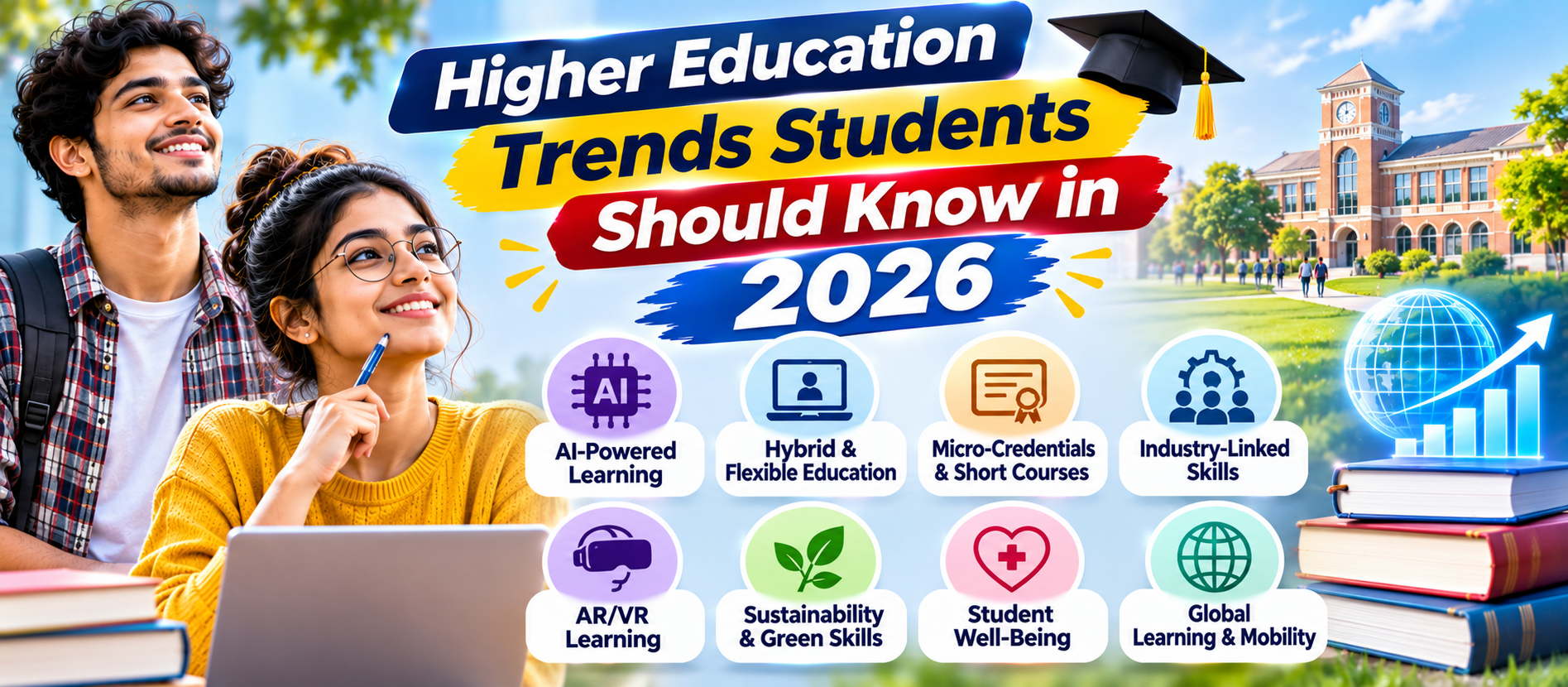
The major higher education trends in 2026 include wider use of artificial intelligence, personalized learning, micro-credentials, hybrid education, interdisciplinary courses, industry partnerships, experiential learning, digital credentials, stronger focus on student well-being, and lifelong upskilling. Students should also expect more attention to data privacy, responsible AI use, employability and measurable learning outcomes.
These trends are developing at different speeds. Their impact depends on the country, institution, subject and available resources. Students should use them as a guide, not as a promise that every university already offers every feature.
1. Artificial Intelligence Is Becoming Part of Everyday Learning
Artificial intelligence (AI) is one of the most visible changes in higher education. Students can use AI tools to explain difficult concepts, create practice questions, organize notes, explore examples and receive feedback on early drafts. Teachers and institutions can use AI to prepare learning materials, support administrative work and identify topics that need more attention.
Generative AI can produce text, images, summaries, code and other content from instructions. This creates new learning opportunities, but it also creates risks. AI systems can make mistakes, provide outdated information or produce convincing answers without reliable evidence. Students must learn to check facts and think independently.
How students can use AI responsibly
- Ask AI to explain a difficult topic in simpler language.
- Request practice questions and use them to test your understanding.
- Compare AI explanations with textbooks, lectures and trusted sources.
- Use AI feedback to improve your own writing rather than submitting unverified output.
- Check your institution's rules before using AI in assignments or examinations.
- Never share private student records, passwords or sensitive personal information with public AI tools.
The most valuable skill is not simply knowing how to write prompts. Students need to judge the quality of an answer, recognize bias, protect information and explain their own reasoning. AI should support learning, not replace it.
2. Personalized and Adaptive Learning Is Growing
Students do not all learn at the same speed. Some understand a concept quickly, while others need more examples and practice. Personalized learning aims to respond to these differences.
Digital learning platforms can use quiz results, progress records and learning activity to suggest revision topics or additional exercises. AI-supported systems may adjust the difficulty of practice questions or recommend resources based on a student's performance. Teachers can use this information to identify learning gaps and offer support.
Personalized learning does not mean that every student needs a separate teacher or a completely different syllabus. It means using information and flexible resources to make learning more relevant. Human guidance remains important. A teacher can understand context, motivation and personal challenges in ways that automated systems may not.
What students should look for
- Clear learning goals and progress indicators.
- Useful feedback that explains how to improve.
- Options to revisit lessons and practise weak areas.
- Access to teachers or academic advisers when support is needed.
- Transparent use of student data.
3. Micro-Credentials and Short Courses Are Gaining Attention
A degree provides broad academic knowledge. However, students may also need focused skills for a particular role. Micro-credentials are short learning programmes that assess a specific skill or group of related skills. They may cover areas such as data analysis, digital marketing, cybersecurity, project management, communication or AI literacy.
Micro-credentials can help students demonstrate recent learning. They may also allow working professionals to update their skills without joining a long programme. Some institutions are exploring ways to combine smaller credentials with larger qualifications. This is often described as stackable learning.
Not every certificate has the same value. A short course is useful only when its content is relevant, its assessment is meaningful and the provider is credible. Students should check who issues the certificate, what skills it verifies and whether employers or universities recognize it.
How to evaluate a micro-credential
- Check the course provider and instructor qualifications.
- Read the learning outcomes before paying.
- Look for practical assignments or a final assessment.
- Check whether the credential carries academic credit or industry recognition, if that matters to your goal.
- Compare the time and cost with the likely benefit.
Students should avoid collecting certificates without building real ability. One well-chosen course with a strong project can be more useful than many certificates with no practical work.
4. Hybrid Learning Is Becoming a Long-Term Model
Hybrid learning combines online education with face-to-face teaching. A student may attend some classes on campus, join other sessions online and use a digital platform for assignments or revision. The exact balance depends on the institution and course.
This model can provide flexibility while preserving direct interaction. Recorded lessons may help students review complex topics. Campus sessions can support discussion, laboratory work and group activities. Online tools can also make learning materials easier to access.
Good hybrid learning needs careful planning. A course should not simply place classroom notes online and call itself hybrid. Teachers need to design activities for both settings. Students should know when they must attend in person, how participation is assessed and where to get help.
When comparing programmes, ask about the timetable, attendance requirements, examination format, practical sessions and technology support. A flexible label does not always mean that a course offers a flexible schedule.
5. Skills-Based Education Is Becoming More Important
Employers want graduates who can apply what they know. Academic knowledge remains essential, but students also need to demonstrate practical skills. This is one reason universities are adding projects, internships, simulations, presentations and skill-based modules to degree programmes.
Skills-based education focuses on what a learner can do. A student studying business might analyze a real business problem. A computer science student might build and test an application. An economics student might work with data and explain the results. These activities connect theory with practice.
Skills worth developing during a degree
- Critical thinking and problem-solving.
- Written and spoken communication.
- Teamwork and collaboration.
- Digital and data literacy.
- Research and information evaluation.
- Project planning and time management.
- Ethical judgement and professional responsibility.
- Adaptability and willingness to learn.
Students should not wait until graduation to develop these abilities. They can practise through assignments, volunteering, student clubs, internships, competitions and personal projects.
6. Interdisciplinary Education Is Expanding
Many real-world problems do not fit within one academic subject. Climate change involves science, economics, public policy and engineering. Public health connects medicine, data, psychology and communication. Digital business requires technology, finance, design and management.
Interdisciplinary education helps students connect ideas from different fields. Universities may offer electives, combined programmes, cross-department projects or flexible course structures. This can help learners understand complex problems and work with people from different backgrounds.
Students should build a strong foundation in their main subject before adding too many unrelated courses. A useful combination has a clear purpose. For example, a commerce student may benefit from data analytics. A literature student may benefit from digital communication or research methods. An engineering student may benefit from project management and professional writing.
When selecting electives, ask how each subject supports your academic interests or career plan. The goal is not to study everything. It is to develop a meaningful combination of knowledge.
7. University-Industry Partnerships Are Becoming More Valuable
Universities and employers have different strengths. Universities provide academic knowledge, research and critical inquiry. Employers understand current workplace needs, professional standards and practical challenges. Partnerships can connect these strengths.
Examples include internships, guest lectures, industry-led projects, research partnerships, mentorship programmes, work placements and curriculum advice. These activities can help students understand how classroom concepts are used in real organizations.
Students should look beyond promotional claims about placement support. Ask what types of internships are available, whether projects involve real organizations, how career services operate and what evidence the institution provides about graduate outcomes.
An industry partnership is useful when it gives students meaningful learning opportunities. A company logo on a university website does not, by itself, prove that every student will receive an internship or a job offer.
8. Experiential Learning and Real-World Projects Are Growing
Experiential learning means learning through action and reflection. It may include laboratory work, field visits, case studies, simulations, community projects, research, internships and practical assignments.
These experiences help students test ideas, make decisions and learn from mistakes. They can also create examples that students discuss during job interviews. A project gives a student a chance to explain the problem, the process, the tools used and the result.
Not every subject uses the same type of practical learning. A history student may conduct archival research or prepare a local history project. A science student may complete laboratory experiments. A management student may analyze a business case. The important point is to apply knowledge in a meaningful context.
Build a record of your work
Keep a portfolio of suitable projects, reports, presentations, code, designs or research summaries. Do not upload confidential information or work that belongs to another person. Explain your own contribution clearly. A well-organized portfolio can help employers understand your abilities.
9. Digital Credentials and Verifiable Academic Records
Students increasingly need to share proof of qualifications and skills across institutions and employers. Digital credentials can make this process easier. Depending on the system, a digital certificate may include information about the issuing institution, the qualification, the date and a method to verify its authenticity.
Digital records can reduce manual document checks and help students share achievements online. They may also support the recognition of learning completed through different providers. However, a digital format does not automatically make a qualification recognized. The issuing body and the status of the programme still matter.
Students should store official transcripts, certificates and course records safely. Use the institution's official verification process when sharing documents. Be cautious about services that ask for unnecessary personal data or promise to convert an unrecognized certificate into an accredited qualification.
10. Data Privacy and Cybersecurity Are Essential
Universities now use digital platforms for admissions, examinations, attendance, payments, research and student support. These systems may contain personal details, academic records and financial information. Protecting this data is essential.
Students also use many online services. They may create accounts for learning platforms, cloud storage, video meetings and AI tools. Weak passwords, suspicious links and careless file sharing can expose personal information.
Simple steps students can take
- Use strong, unique passwords for important accounts.
- Enable multi-factor authentication where available.
- Check website addresses before entering login details.
- Avoid sharing passwords or one-time codes.
- Keep devices and software updated.
- Use official university channels for payments and documents.
- Read privacy settings before sharing personal information.
Institutions also have responsibilities. They should explain how student data is collected, used, stored and protected. Students should know how to report suspicious activity or a data incident.
11. Immersive Learning Through AR, VR and Simulation
Augmented reality (AR), virtual reality (VR) and simulation tools can create interactive learning experiences. A student may explore a virtual environment, practise a procedure or view a three-dimensional model. These tools can help explain subjects that are difficult to understand through text alone.
Potential uses include virtual science demonstrations, engineering design, medical training simulations, architecture visualization, historical environments and safety training. They can allow students to practise in a controlled setting before working with real equipment or situations.
These tools are not suitable for every lesson. They can be expensive and may require special devices, technical support and accessible design. A simulation should support clear learning goals. It should not be used only because it looks impressive.
Students can ask whether a programme uses simulations where they add real value, whether access is included in fees and whether alternative learning options are available.
12. Student Mental Health and Well-Being Are Receiving More Attention
Academic success depends on more than examination marks. Stress, financial pressure, isolation, uncertainty and heavy workloads can affect a student's ability to learn. Universities are paying more attention to counselling, peer support, inclusive teaching and student well-being.
Students should learn to recognize when pressure is becoming difficult to manage. Useful habits include maintaining a realistic timetable, taking breaks, sleeping regularly, staying connected with supportive people and seeking help early. Asking for support is a responsible step, not a sign of failure.
When comparing institutions, check whether they provide counselling, academic advising, disability support, anti-harassment policies and clear channels for raising concerns. Services may differ, so ask what is actually available and how students can access it.
Students should also avoid comparing their progress with carefully edited posts on social media. Each person has different responsibilities, resources and learning needs. A steady plan is more useful than constant comparison.
13. Lifelong Learning Is Becoming a Career Habit
Learning no longer ends when a student receives a degree. Technology, business models and professional expectations change over time. Workers may need to learn new tools, update technical knowledge or move into a different role.
Lifelong learning can include postgraduate study, professional qualifications, short courses, workplace training, independent projects, conferences and reading. The right option depends on the career goal. Not every new trend requires a paid certificate.
Students can prepare by developing the habit of learning independently. Follow reliable sources in your field. Practise new skills. Review job descriptions to understand changing requirements. Keep a record of projects and learning achievements.
The strongest approach is to combine deep knowledge with the ability to update that knowledge. A degree can provide the foundation. Continuous learning helps keep it relevant.
14. Sustainability and Social Responsibility Are Entering More Courses
Environmental and social challenges affect business, government, technology and everyday life. Universities are adding topics such as sustainability, climate risk, responsible production, public health, inclusion and ethical leadership to different areas of study.
This does not mean every student must become an environmental specialist. It means students should understand how decisions affect people, communities and natural resources. An engineering student may study energy efficiency. A business student may explore responsible supply chains. An economics student may examine inclusive growth and climate policy.
Students can look for courses that connect theory with local problems. Community research, campus sustainability projects and responsible innovation activities can make these ideas practical.
15. Career Guidance Is Becoming More Data-Informed
Students often choose courses without a clear understanding of the work they may lead to. Better career guidance can help learners compare job roles, required qualifications, skills and possible career paths.
Digital career platforms may provide job information, skill assessments, course suggestions and application support. Institutions can use graduate feedback and labor-market information to improve guidance. These tools should support discussion with career advisers, not make decisions for students.
How students can use career information
- Read job descriptions for several roles that interest you.
- Identify the qualifications and skills employers request.
- Compare those requirements with your course curriculum.
- Speak with professionals, teachers and alumni.
- Try a small project or internship to test your interest.
- Review your plan as your interests and the job market change.
Career planning should remain flexible. A degree may lead to several types of work, and students can discover new interests during their studies.
What These Trends Mean for Students in India
For students in India, higher education trends connect closely with flexibility, employability, digital access and the National Education Policy (NEP) 2020. The policy framework supports multidisciplinary learning, flexible academic pathways, skill development and stronger links between education and work.
Government information published in 2026 describes curriculum updates that include areas such as AI, data science, machine learning, cybersecurity, robotics and other emerging technologies. It also refers to the National Credit Framework, which provides a structure for connecting academic and skill-based learning. Students should read the current rules and institutional implementation details rather than assume every university offers the same options.
India's Academic Bank of Credits and multiple-entry and multiple-exit provisions are intended to support the accumulation and transfer of eligible learning credits within the applicable framework. Students should confirm how their institution uses these provisions, which courses are eligible and what conditions apply.
💡 Key Insight
Students in India should also check the recognition of universities and programmes through the relevant official authorities. This is especially important for online and distance education, regulated professions and qualifications used for government recruitment or further study.
Access remains an important issue. Reliable internet, suitable devices, language support and local learning facilities are not equally available to everyone. Students should consider the actual support they will receive, not only the technology described in a brochure.
How Students Can Prepare for the Future of Higher Education
Students do not need to follow every new technology or collect every certificate. A focused plan is more effective. Use these steps to make your education more valuable.
- Build strong subject knowledge. Understand the fundamentals of your degree. New tools are easier to use when you know the subject.
- Develop digital confidence. Learn the software, research tools and online systems used in your field.
- Learn to use AI responsibly. Practise checking facts, protecting data and explaining your own work.
- Choose targeted short courses. Select micro-credentials that fill a real skill gap or support a clear goal.
- Complete practical projects. Apply what you learn and keep examples of your work.
- Seek work experience. Consider internships, volunteering, research assistance or supervised projects.
- Improve communication. Practise writing, presentations, discussion and professional email.
- Build professional relationships. Connect with teachers, classmates, alumni and people in your field.
- Protect your well-being. Create a realistic routine and seek support when needed.
- Keep learning after graduation. Review your skills and update them as your work changes.
A Practical 12-Month Development Plan for Students
A year-long plan can turn broad goals into manageable actions. Adjust the steps to your academic calendar and available time.
| Period Suggested action Expected result | ||
| Months 1–2 | Review career interests and identify skill gaps. | A clear learning priority. |
| Months 3–4 | Complete one relevant short course or guided module. | A focused new skill. |
| Months 5–6 | Build a project connected to your subject. | Practical evidence of learning. |
| Months 7–8 | Seek an internship, volunteering role or research opportunity. | Exposure to real work. |
| Months 9–10 | Improve your CV, portfolio and professional communication. | Stronger career materials. |
| Months 11–12 | Review progress and plan the next learning goal. | A sustainable development routine. |
This plan is a guide, not a fixed rule. Students with examinations or financial responsibilities may need a slower pace. Consistent progress matters more than completing every activity quickly.
How to Choose a College or University in 2026
New technology and modern facilities can make an institution look attractive. Students should still begin with the basics. A good choice depends on the quality and recognition of the programme, the teaching team, student support and the fit with your goals.
- Recognition: Verify the institution and programme through official sources.
- Curriculum: Check whether subjects are current, balanced and relevant.
- Faculty: Review teacher qualifications and academic or professional experience.
- Practical learning: Ask about projects, laboratories, internships and fieldwork.
- Technology: Check the learning platform, accessibility and technical support.
- Career services: Ask what guidance and employer connections are available.
- Student support: Review academic advising, counselling and grievance processes.
- Total cost: Include fees, travel, accommodation, devices and other expenses.
- Graduate outcomes: Look for clear methods and credible evidence behind placement claims.
Speak with current students or alumni if possible. Ask specific questions about teaching, feedback, workload and support. A campus visit or a detailed online information session can help you understand the learning environment.
Challenges Students Should Not Ignore
New opportunities also bring challenges. Students may face information overload, unequal access to technology, pressure to keep learning, concerns about AI accuracy and uncertainty about the value of short credentials.
⚠ Watch Out
There is also a risk of focusing too much on trends. A student may feel that they must learn every new AI tool, take several certificates and follow every career prediction. This can waste time and money. Start with your subject and your goals. Choose new tools only when they solve a real learning or work problem.
Another challenge is the difference between access and quality. A course may be available online, but students still need good teaching, feedback, assessment and support. A digital platform is not a substitute for a well-designed academic programme.
Finally, students should be careful with exaggerated claims. No technology or certificate can guarantee a job. Strong career preparation requires knowledge, practice, communication, experience and persistence.
Conclusion: Build a Degree and a Learning Journey
Higher education in 2026 is becoming more flexible, connected and focused on skills. AI, personalized learning, micro-credentials, hybrid education, interdisciplinary study and industry partnerships are changing how students learn and prepare for work. Digital credentials, immersive tools and stronger attention to privacy and well-being are also shaping the student experience.
Students should welcome useful innovation while keeping academic quality at the center. Choose a recognized programme. Build strong knowledge in your subject. Practise real skills. Use AI carefully. Seek feedback and work experience. Continue learning as your interests and professional needs develop.
The best education is not simply the one with the newest technology or the longest list of certificates. It is the education that helps you think clearly, act responsibly, solve meaningful problems and keep growing throughout your life.
Frequently Asked Questions (FAQs)
1. What is the biggest higher education trend in 2026?
AI-supported learning is one of the most visible trends. Other major changes include skills-based education, micro-credentials, hybrid learning, interdisciplinary programmes and stronger university-industry partnerships.
2. How is AI changing higher education?
AI can support research, revision, practice questions, feedback and some administrative tasks. It also creates concerns about accuracy, bias, privacy and academic integrity. Students should follow institutional rules and verify AI-generated information.
3. What are micro-credentials?
Micro-credentials are short programmes that assess specific skills or knowledge. They can support professional development and may sometimes contribute to a larger qualification, depending on the provider and credit rules.
4. Is hybrid learning better than traditional classroom learning?
Neither approach is always better. Hybrid learning can offer flexibility and campus interaction. Traditional classroom learning can provide direct contact and a structured routine. The best option depends on the subject, course design and student's needs.
5. Which skills should students develop in 2026?
Useful skills include critical thinking, communication, problem-solving, digital literacy, data literacy, teamwork, adaptability, research and responsible use of AI. Technical skills should match the student's chosen field.
6. Are online certificates valuable for employment?
They can be useful when the provider is credible, the content is relevant and the assessment demonstrates real ability. Employers may value practical projects and experience alongside certificates. Recognition varies by role and industry.
7. Why are internships important in higher education?
Internships help students understand workplace expectations and apply academic knowledge. They can also build professional connections and provide examples of practical experience for future applications.
8. What should Indian students check before choosing a new online or hybrid programme?
Check the institution's recognition, the programme's approval for its delivery mode, current regulatory requirements, examination arrangements, practical components and eligibility for future study or employment. Use official sources.
9. Will AI replace university teachers?
AI can assist with explanations, practice and some routine tasks, but teachers provide context, mentorship, feedback, discussion and human judgement. Responsible use of AI is more useful than treating it as a replacement for educators.
10. How can students prepare for jobs that do not exist yet?
Build strong fundamentals, learn how to learn, practise problem-solving, improve communication and gain experience through projects. Stay curious and update your skills as industries change.
References and Further Reading
- TCS – Emerging Higher Education Tech Trends in 2026
- Press Information Bureau, Government of India – Strengthening Higher Education for Emerging Technologies (2026)
- Press Information Bureau, Government of India – Alignment of Academics with Employment Opportunities (2026)
- Press Information Bureau, Government of India – AI-Based Training and Skill Development Initiatives (2026)
- UNESCO – Global Higher Education Participation and Recognition of Qualifications
About Digiifrog
Digiifrog shares useful digital insights, educational resources and practical information to help readers make informed decisions. Explore more at www.digiifrog.com.
Editorial note: This article is for general educational information. Policies, programme approvals and institutional offerings can change. Students should confirm current details with the relevant official authority and institution before making admission or financial decisions.
Ready to Grow?
Talk to us about a strategy tailored to your brand — we will help you stand out in search, AI discovery and social.

Comments (0)
Log in to leave a comment.