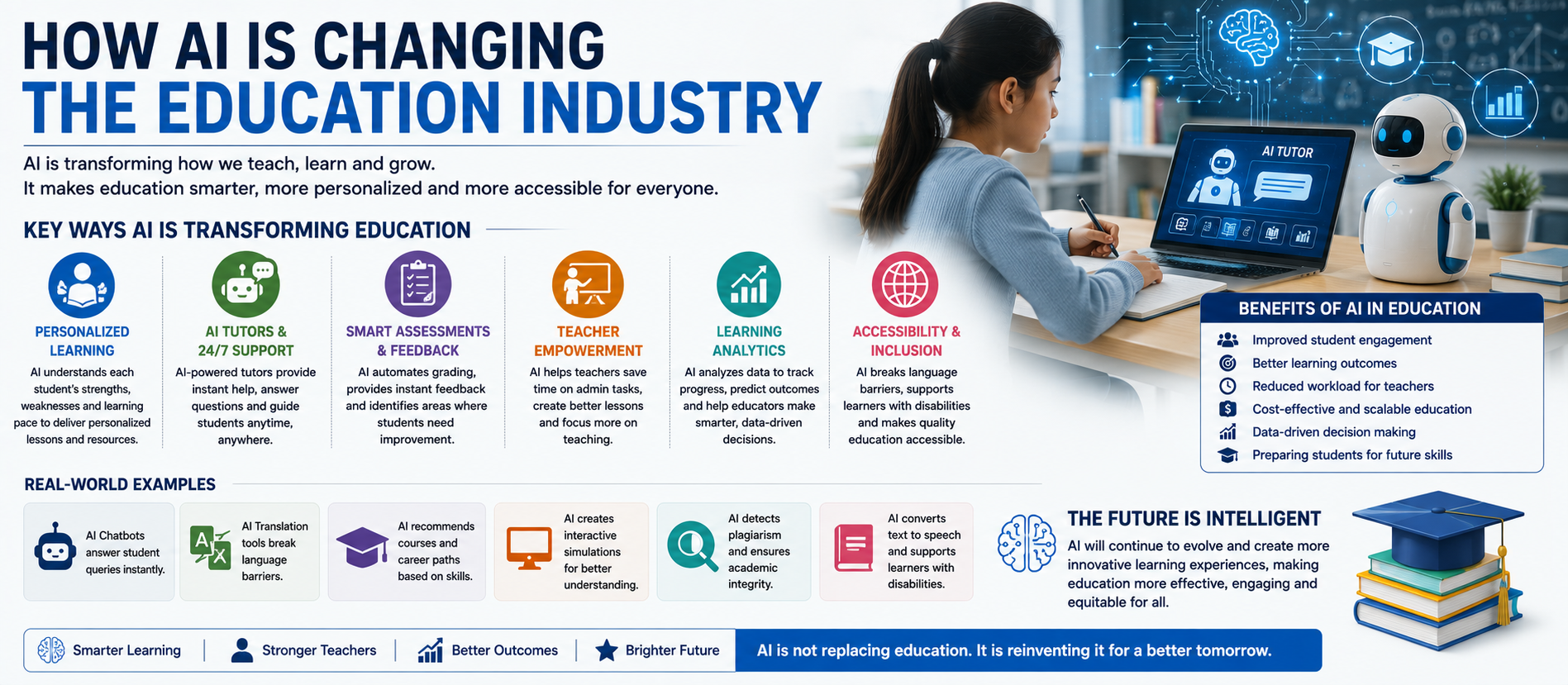
📋 Quick Summary
In this article:
What Does AI Mean in Education?
Quick Answer: How Is AI Changing Education?
1. Personalized Learning at Scale
2. AI Tutors and 24/7 Learning Support
3. Faster and More Useful Feedback
4. AI Is Changing the Role of Teachers
5. Smarter Assessment and Practice
7. AI Can Improve Accessibility
8. AI and Language Learning
9. AI Is Changing Educational Content Creation
10. Learning Analytics and Data-Driven Education
Artificial intelligence is changing the education industry in a major way. AI is now used to support personalized learning, tutoring, assessment, content creation, administration, accessibility, and data-driven decision-making.
The biggest change is not simply that students can ask an AI chatbot a question. AI is changing how students learn, how teachers prepare lessons, how schools manage information, and how education systems think about skills.
At the same time, AI creates serious challenges. Students can become dependent on generated answers. AI systems can produce incorrect information. Privacy, bias, unequal access, and academic integrity also require careful attention.
This guide explains how AI is changing the education industry in simple language. It covers the main benefits, practical uses, risks, future trends, and the steps schools and students can take to use AI responsibly.
Digiifrog creates clear, structured, and search-friendly content using SEO, AEO, GEO, and AI Search Optimization.
What Does AI Mean in Education?
AI in education refers to the use of artificial intelligence technologies to support teaching, learning, assessment, administration, and educational decision-making.
AI systems can analyze patterns, process language, generate content, recommend resources, and adapt responses based on information provided to them.
Common examples include:
- AI tutoring systems.
- Adaptive learning platforms.
- AI-powered chatbots.
- Automated feedback tools.
- Writing and language assistants.
- Learning analytics systems.
- AI tools for teachers and administrators.
- Speech recognition and translation tools.
- Accessibility technologies.
The goal should not be to remove teachers from education. The most effective approach is to use AI as a tool that supports human teaching and meaningful learning.
Quick Answer: How Is AI Changing Education?
AI is changing education by making learning more personalized, accessible, interactive, and data-informed. Students can receive explanations at different levels, practise through adaptive exercises, get faster feedback, and access learning support at more flexible times. Teachers can use AI to assist with lesson preparation, resource creation, administrative work, and identifying learning gaps.
However, AI does not automatically create better learning. Recent OECD analysis emphasizes that AI can improve learning when it is used with clear pedagogical goals, while simply outsourcing thinking to general-purpose AI can improve task performance without producing real learning gains.
1. Personalized Learning at Scale
Traditional classrooms often teach many students at the same time. Students may have different levels of knowledge, different learning speeds, and different areas of difficulty.
AI can help create more personalized learning experiences.
For example, an adaptive learning system may:
- Identify a student's weak topic.
- Recommend additional practice.
- Provide an easier explanation.
- Increase the difficulty when the student improves.
- Track progress over time.
This does not mean every student needs a completely separate curriculum. Instead, AI can help teachers provide additional support and more relevant practice.
2. AI Tutors and 24/7 Learning Support
Students often have questions outside school hours. They may need another explanation before understanding a concept.
AI tutoring systems can provide on-demand support. A student can ask for:
- A simpler explanation.
- A step-by-step example.
- Practice questions.
- A summary of a topic.
- Feedback on an answer.
- An explanation using a different example.
This can make learning support more available. However, students should not treat an AI response as automatically correct. Important facts should be checked against reliable learning materials and teacher guidance.
3. Faster and More Useful Feedback
Feedback is essential for learning. Students need to know what they understand and where they need improvement.
AI can help provide immediate feedback on many types of work. Depending on the tool and task, it may identify grammar issues, explain mistakes, suggest areas for revision, or generate additional practice.
Faster feedback can be useful because students can correct misunderstandings before they become long-term habits.
Teachers still play an important role. Human teachers understand classroom context, student emotions, long-term development, and the wider purpose of education in ways that automated feedback cannot fully replace.
4. AI Is Changing the Role of Teachers
AI is not simply replacing teachers. Instead, it is changing parts of the teaching workflow.
Teachers may use AI to support:
- Lesson planning.
- Creating practice questions.
- Generating examples at different difficulty levels.
- Summarizing teaching materials.
- Drafting classroom activities.
- Organizing educational resources.
- Reducing repetitive administrative work.
According to the OECD's 2026 Digital Education Outlook, 37% of lower-secondary teachers reported using AI for their job in 2024, and 57% agreed that AI helps them write or improve lesson plans.
The most useful model is often teacher plus AI, rather than teacher versus AI.
5. Smarter Assessment and Practice
AI can support educational assessment in several ways. It can help generate practice questions, classify learning content, identify patterns in student responses, and provide targeted exercises.
Adaptive practice systems can adjust question difficulty according to a student's performance.
This can help students spend more time on topics that need attention instead of repeatedly practising material they already understand.
Assessment must still be designed carefully. An AI-generated score or recommendation should not be treated as perfect. High-stakes decisions require appropriate human oversight.
6. AI and Academic Integrity
One of the biggest challenges created by generative AI is academic integrity.
A student can now generate essays, answers, summaries, and computer code quickly. This means schools and universities need to rethink how they assess genuine understanding.
The OECD reports that 72% of lower-secondary teachers believe AI can harm academic integrity by allowing students to present work as their own.
Possible responses include:
- Clear AI-use policies.
- More process-based assessment.
- Oral explanations and discussions.
- In-class problem solving.
- Project documentation.
- Teaching students how to use AI transparently and responsibly.
The goal should not always be to ban technology. Education systems need assessment methods that measure understanding even when AI tools are available.
7. AI Can Improve Accessibility
AI-powered technologies can make learning more accessible for many students.
Examples include:
- Speech-to-text tools.
- Text-to-speech tools.
- Automatic captions.
- Translation support.
- Simplified explanations.
- Alternative learning formats.
These tools can help reduce barriers, although accessibility should not depend only on AI. Educational content and digital platforms should be designed inclusively from the beginning.
8. AI and Language Learning
Language learning is another area where AI can provide useful support.
Students can use AI systems to practise vocabulary, grammar, writing, conversation, pronunciation support, and translation.
For example, an AI system can simulate a conversation and adapt the difficulty to the learner's level.
However, real communication remains important. Students should continue reading, listening, writing, and speaking with people and authentic materials.
9. AI Is Changing Educational Content Creation
Teachers, publishers, and education companies can use AI to create first drafts of learning resources more quickly.
AI can assist with:
- Lesson outlines.
- Practice worksheets.
- Question banks.
- Examples and case studies.
- Summaries.
- Translations.
- Alternative explanations.
💡 Key Insight
Speed is useful, but human review is essential. AI-generated educational content can contain errors, bias, outdated information, or unsuitable examples.
A strong workflow is: AI draft → expert review → factual checking → educational improvement → final publication.
10. Learning Analytics and Data-Driven Education
Digital learning systems generate information about how students interact with lessons and assessments.
When handled responsibly, learning analytics can help educators identify:
- Topics where many students struggle.
- Students who may need additional support.
- Patterns in engagement.
- Resources that are not working well.
- Changes in learning progress.
However, student data is sensitive. Schools and technology providers should use strong privacy and security practices. UNESCO and OECD both emphasize the importance of human-centred, trustworthy, equitable, and privacy-aware approaches to AI in education.
11. AI Is Transforming Education Administration
AI can also improve work outside the classroom.
Schools and colleges manage admissions, communication, scheduling, student support, records, and many repetitive processes.
AI and automation can support:
- Answering common questions.
- Sorting requests.
- Creating summaries.
- Organizing documents.
- Supporting scheduling.
- Classifying educational resources.
- Providing basic guidance.
Automation can save time, but institutions should avoid placing sensitive decisions entirely in the hands of automated systems.
12. AI in School Education
AI is becoming part of what students learn as well as how they learn.
In India, the National Education Policy 2020 recognizes the importance of contemporary subjects such as Artificial Intelligence. Government initiatives are also expanding AI and computational thinking in school education.
In 2026, the Ministry of Education stated that NCERT, working with CBSE, introduced a dedicated Computational Thinking and Artificial Intelligence curriculum for Classes III to VIII from the 2026–27 academic year, while curriculum work for Grades 9–12 in AI and related subjects has also been developed.
This shows that AI literacy is becoming an important educational skill. Students need to understand not only how to use AI, but also how to question it, evaluate it, and use it responsibly.
13. AI and Higher Education
Universities are also adapting to AI.
Students can use AI for research support, coding assistance, brainstorming, language improvement, and study planning. Faculty can explore AI-assisted teaching materials and feedback workflows.
At the same time, universities are rethinking assessment and academic integrity.
Future graduates may need stronger skills in:
- Critical thinking.
- Problem framing.
- Research and source evaluation.
- AI literacy.
- Ethical judgment.
- Communication.
- Creativity.
The ability to work effectively with AI may become important across many professions.
14. The Risks of AI in Education
AI creates opportunities, but responsible use requires attention to real risks.
Incorrect Information
AI can generate convincing but inaccurate answers. Students need verification skills.
Overdependence
If students allow AI to do all the thinking, they may complete tasks without developing knowledge or skills.
Bias
AI systems can reflect limitations or bias in data and design.
Privacy
Students may enter personal, confidential, or sensitive information into AI tools without understanding how that information is handled.
Unequal Access
Not every student has equal access to devices, connectivity, paid tools, or digital skills.
Academic Integrity
Schools need clear rules about acceptable and unacceptable uses of AI.
How Schools Can Use AI Responsibly
- Create a clear AI policy. Explain acceptable uses for students and teachers.
- Protect privacy. Review what data is shared with technology providers.
- Train teachers. Staff need practical guidance, not just a policy document.
- Teach AI literacy. Students should learn to question and verify outputs.
- Keep humans involved. Important educational decisions need appropriate human oversight.
- Test tools before large deployment. Pilot programs can identify problems.
- Measure learning outcomes. Do not assume that faster task completion means better learning.
How Students Should Use AI for Learning
Students can get more value from AI by using it as a learning partner instead of an answer machine.
Good Prompts for Learning
- Explain this concept as if I am a beginner.
- Give me three practice questions but do not show the answers yet.
- Ask me questions to test my understanding.
- Show me where my reasoning may be wrong.
- Give me another example using a real-life situation.
Less Effective Use
- Write my entire assignment.
- Give me the answer without explanation.
- Complete my project without my involvement.
OECD research highlights an important difference between using AI to support learning and using it simply to complete a task. Better performance on an AI-assisted task does not always create lasting knowledge.
The Future of AI in Education
The future education system will likely become more hybrid. Students will learn through teachers, peers, books, practical activities, digital platforms, and AI-powered systems.
Possible future developments include:
- More advanced AI tutors.
- Highly adaptive learning paths.
- AI-assisted career guidance.
- Real-time accessibility support.
- More intelligent assessment systems.
- AI-supported teacher workflows.
- Stronger AI literacy in school curricula.
- New forms of project-based and skills-based assessment.
UNESCO promotes a human-centred approach to generative AI in education. The technology should support human agency, inclusion, equity, and meaningful learning rather than weaken the human relationships and thinking that education depends on.
SEO, AEO, GEO, and AI Search Optimization for Education Content
Students, parents, teachers, and institutions increasingly ask direct questions through search engines and AI-powered systems.
- How is AI changing education?
- What are the benefits of AI in education?
- Can AI replace teachers?
- How can students use AI responsibly?
- What are the risks of AI in education?
SEO helps educational content become discoverable in traditional search.
AEO focuses on answering direct questions clearly.
GEO helps structure information for generative search experiences.
AI Search Optimization emphasizes clear language, logical headings, direct answers, useful examples, and trustworthy information.
How Digiifrog Supports Modern Educational Content
Digiifrog develops structured and readable content for businesses, education platforms, and digital audiences.
- SEO Content Strategy
- AEO and Answer-Focused Content
- GEO and Generative Search Optimization
- AI Search Optimization
- Educational and Technology Content Development
- Digital Branding Strategy
Frequently Asked Questions
How is AI changing the education industry?
AI is changing education through personalized learning, AI tutoring, faster feedback, adaptive practice, accessibility tools, learning analytics, and administrative automation.
Can AI replace teachers?
AI can automate or support some tasks, but it does not replace the human relationships, judgment, mentoring, classroom leadership, and contextual understanding provided by teachers.
What are the benefits of AI in education?
Potential benefits include personalized learning, immediate feedback, improved accessibility, flexible learning support, teacher assistance, and better analysis of learning patterns.
What are the risks of AI in education?
Major risks include incorrect information, overdependence, privacy concerns, bias, unequal access, and academic integrity problems.
How should students use AI?
Students should use AI to ask questions, practise, receive explanations, test understanding, and improve their work. They should verify important information and continue doing their own thinking.
Why is AI literacy important?
Students increasingly encounter AI in education and work. AI literacy helps them understand what AI can do, where it can fail, and how to use it responsibly.
Conclusion
AI is changing the education industry, but technology alone will not solve every educational problem.
The greatest opportunity comes from combining AI with good teaching, clear learning goals, strong privacy practices, equal access, and human judgment.
Students can use AI to learn more effectively. Teachers can use it to reduce repetitive work and create new learning experiences. Schools can use data and automation to improve services.
But the central purpose of education remains the same: helping people understand, think, create, communicate, and solve problems.
Use AI to support learning, not replace learning.
Disclaimer: This article is for general educational and informational purposes. AI tools, educational policies, regulations, and platform features continue to evolve. Schools and institutions should review current official guidance, privacy requirements, academic policies, and applicable laws before implementing AI systems.
Digiifrog
Website: www.digiifrog.com
Ready to Grow?
Talk to us about a strategy tailored to your brand — we will help you stand out in search, AI discovery and social.
Comments (0)
Log in to leave a comment.