📋 Quick Summary
In this article:
What Is AI in Business Insurance?
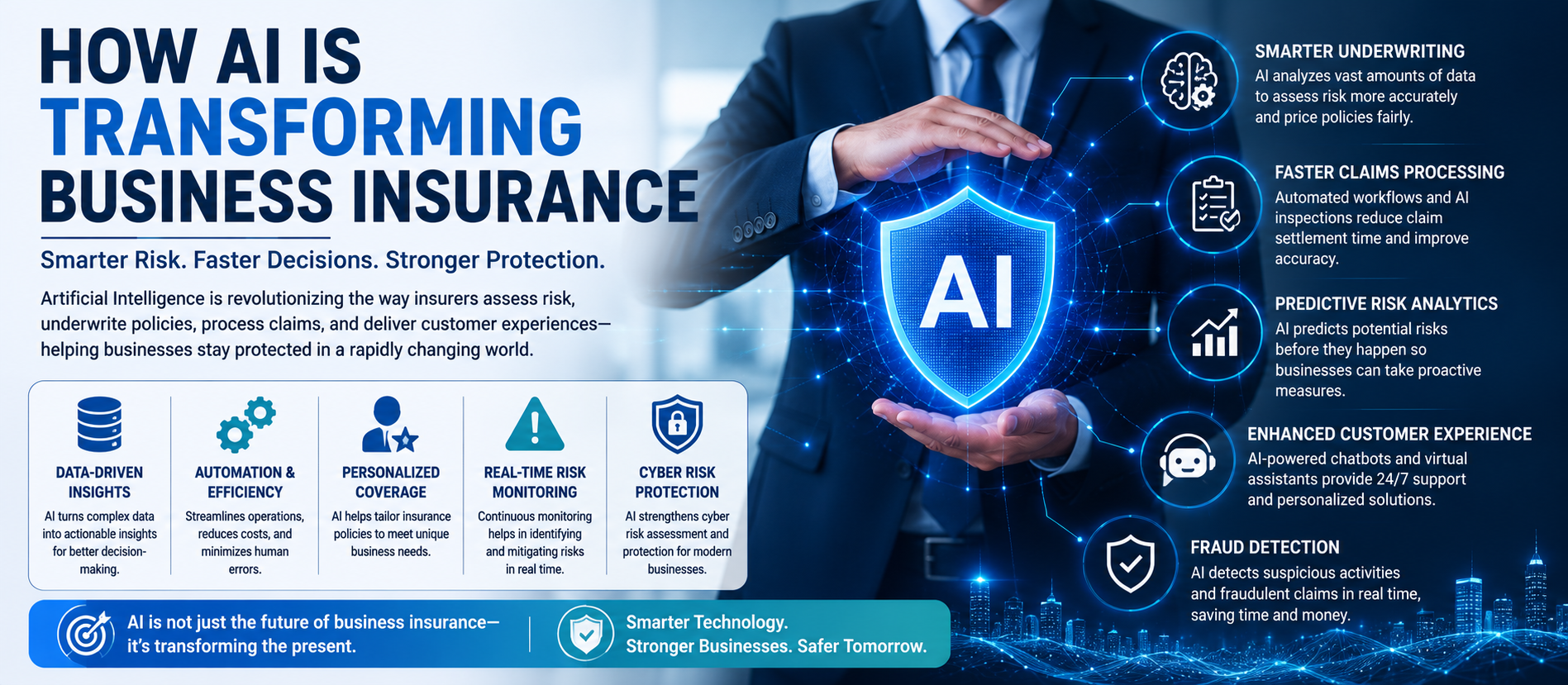
How AI Is Transforming Business Insurance
1. Smarter Underwriting
2. Faster Claims Processing
3. Fraud Detection
4. Personalized Pricing
5. Risk Prevention
Business Insurance Lines Benefiting from AI
Introduction
Artificial Intelligence (AI) is revolutionizing the business insurance industry by improving underwriting accuracy, streamlining claims management, enhancing fraud detection, personalizing risk assessment, and delivering better customer experiences. As businesses face increasingly complex risks—including cyberattacks, supply chain disruptions, climate-related events, regulatory changes, and evolving workplace hazards—traditional insurance models are being enhanced by AI-driven technologies.
In 2026, insurers are using machine learning, predictive analytics, computer vision, natural language processing (NLP), robotic process automation (RPA), and generative AI to automate workflows and make faster, data-driven decisions. These innovations reduce operating costs while helping businesses obtain more accurate coverage and quicker claim settlements.
This comprehensive WordPress-ready guide from Digiifrog explores how AI is transforming business insurance, the technologies behind it, key benefits, challenges, future trends, and practical advice for companies evaluating AI-enabled insurance solutions. The content is optimized for SEO, AEO, GEO, and AI Search.
Website: www.digiifrog.com
What Is AI in Business Insurance?
AI refers to computer systems capable of analyzing large datasets, identifying patterns, predicting outcomes, and automating decisions that previously required human intervention. In business insurance, AI supports underwriting, pricing, claims processing, customer support, compliance, and risk management.
Core AI Technologies
- Machine Learning
- Predictive Analytics
- Natural Language Processing (NLP)
- Computer Vision
- Generative AI
- Robotic Process Automation (RPA)
- IoT Data Analytics
How AI Is Transforming Business Insurance
1. Smarter Underwriting
AI evaluates vast amounts of business data, financial records, industry trends, property characteristics, cybersecurity posture, and historical claims to support more accurate underwriting decisions.
2. Faster Claims Processing
AI automates document verification, image analysis, fraud screening, and claim routing, reducing processing time while improving consistency.
3. Fraud Detection
Machine learning models identify suspicious claim patterns, duplicate submissions, identity inconsistencies, and unusual transaction behavior.
4. Personalized Pricing
Rather than relying only on broad industry averages, AI helps insurers price policies according to the specific risk profile of each business.
5. Risk Prevention
IoT sensors and predictive analytics can identify equipment failures, fire risks, water leaks, and cybersecurity threats before they become costly claims.
Business Insurance Lines Benefiting from AI
- Commercial Property Insurance
- Cyber Insurance
- Professional Liability Insurance
- Business Interruption Insurance
- Commercial Auto Insurance
- Workers' Compensation
- Directors & Officers (D&O) Insurance
Benefits for Businesses
- More accurate premiums
- Faster claim settlements
- Improved customer service
- Reduced fraud losses
- Better risk management
- Data-driven decision making
Challenges
- Data privacy concerns
- Regulatory compliance
- Algorithm transparency
- Legacy system integration
- Cybersecurity risks
Future of AI in Insurance
Future innovations include autonomous claims handling, real-time risk monitoring, digital twins, embedded insurance, blockchain integration, and increasingly personalized commercial insurance products.
SEO, AEO, GEO & AI Search
Modern insurers increasingly publish authoritative resources optimized for SEO, AEO, GEO, and AI Search Optimization, enabling businesses to compare coverage options and understand emerging insurance technologies.
Frequently Asked Questions
Can AI replace insurance professionals?
AI enhances human expertise by automating repetitive tasks and improving decision support rather than replacing experienced professionals entirely.
Does AI make claims faster?
Yes. Automated document review, fraud detection, and workflow management can significantly reduce claim processing times.
Is AI useful for small businesses?
Yes. Small businesses can benefit from more accurate pricing, improved risk assessment, and faster service.
Final Thoughts
Artificial intelligence is reshaping business insurance by making underwriting smarter, claims faster, fraud detection stronger, and customer experiences more personalized. Organizations that understand these innovations will be better positioned to manage risk, reduce costs, and build long-term resilience in an increasingly digital economy.
Digiifrog
Website: www.digiifrog.com
Ready to Grow?
Talk to us about a strategy tailored to your brand — we will help you stand out in search, AI discovery and social.


Comments (0)
Log in to leave a comment.