📋 Quick Summary
In this article:
Understanding Artificial Intelligence in Marketing
The Evolution of AI in Digital Marketing
AI-Powered Search Is Changing Everything
The Rise of Answer Engine Optimization (AEO)
Generative Engine Optimization (GEO)
AI Chatbots and Customer Support
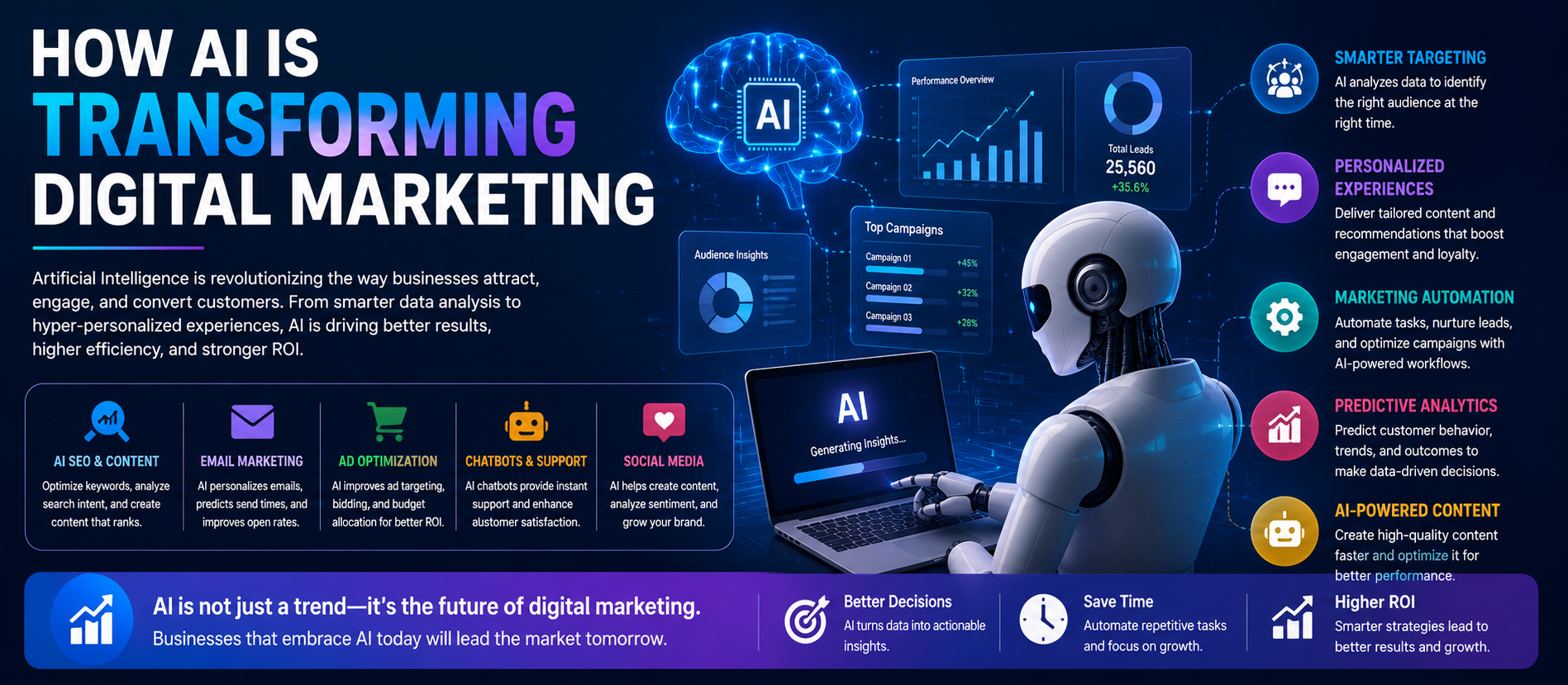
Artificial Intelligence (AI) is no longer a futuristic concept—it is now one of the most powerful forces shaping the digital marketing industry. In 2026, businesses of all sizes are leveraging AI to improve customer experiences, automate repetitive tasks, personalize marketing campaigns, optimize content, analyze data, and drive better business outcomes.
This comprehensive guide explores how AI is transforming digital marketing, why it matters in 2026, and how businesses can use AI to improve SEO, AEO, GEO, AI Search Optimization, customer engagement, lead generation, and long-term growth.
Understanding Artificial Intelligence in Marketing
Artificial Intelligence refers to computer systems capable of performing tasks that traditionally require human intelligence. These tasks include learning, reasoning, decision-making, language processing, pattern recognition, and predictive analysis.
In digital marketing, AI helps businesses analyze vast amounts of data, understand customer behavior, automate workflows, personalize experiences, and optimize campaigns more efficiently than ever before.
Modern AI-powered marketing solutions can process information at a scale impossible for human teams alone, enabling smarter and faster decision-making.
The Evolution of AI in Digital Marketing
Digital marketing has evolved significantly over the last decade. Initially, marketers relied heavily on manual keyword research, campaign management, audience segmentation, and reporting.
Today, AI systems automate many of these tasks while providing deeper insights and recommendations. Search engines, social media platforms, advertising networks, and marketing tools increasingly use artificial intelligence to improve performance and user experiences.
As AI technologies continue advancing, businesses are discovering new opportunities to improve efficiency, reduce costs, and achieve better marketing results.
AI-Powered Search Is Changing Everything
One of the most significant developments in 2026 is the growth of AI-powered search experiences.
Consumers are increasingly using conversational AI platforms and intelligent search assistants to find information, compare products, and make purchasing decisions. Instead of typing simple keywords, users now ask complete questions and expect detailed, personalized answers.
This shift requires businesses to rethink how they create content and optimize their online presence.
💡 Key Insight
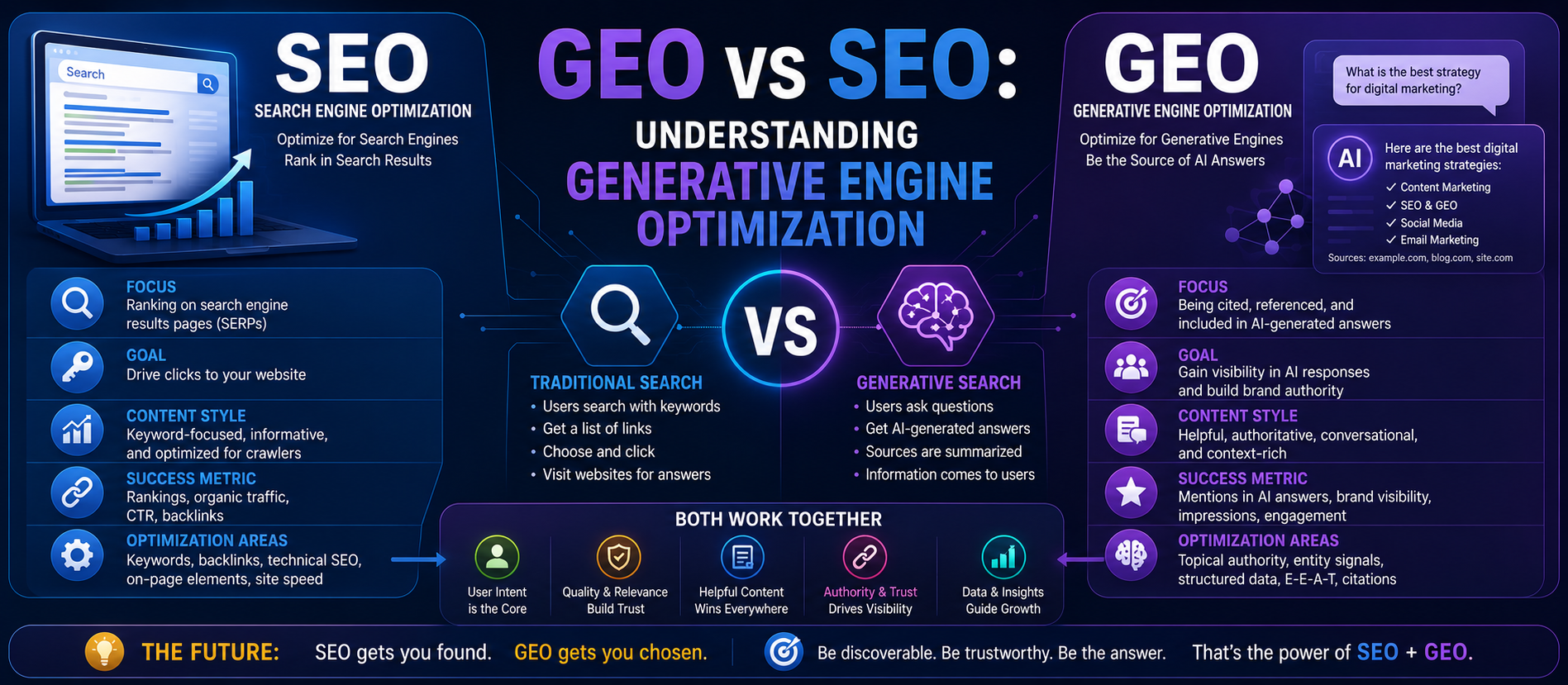
Traditional SEO remains important, but marketers must now consider AI Search Optimization, AEO, and GEO strategies to remain visible.
How AI Impacts SEO
Search Engine Optimization continues to be a critical marketing channel, but AI has significantly transformed how SEO works.
Modern search engines use advanced machine learning algorithms to understand user intent, evaluate content quality, and determine relevance.
AI supports SEO by helping marketers:
- Identify keyword opportunities
- Analyze competitors
- Optimize content structure
- Improve technical SEO
- Generate content ideas
- Monitor search performance
- Predict ranking opportunities
Businesses that combine AI-powered insights with human expertise can develop more effective SEO strategies.
The Rise of Answer Engine Optimization (AEO)
Consumers increasingly expect immediate answers to their questions. AI-powered assistants and search engines often provide direct responses instead of displaying traditional lists of links.
AEO focuses on structuring content so it can be easily understood, extracted, and displayed by answer engines.
Effective AEO strategies include:
- Creating FAQ sections
- Using clear headings
- Providing concise answers
- Implementing structured data
- Optimizing for voice search
AI systems reward content that is organized, accurate, and easy to interpret.
Generative Engine Optimization (GEO)
Generative Engine Optimization has emerged as a major digital marketing discipline.
AI systems increasingly generate responses by analyzing and synthesizing information from multiple sources. Businesses that want visibility in these AI-generated results must focus on GEO.
Successful GEO strategies emphasize:
- Authority
- Trustworthiness
- Expertise
- Comprehensive content
- Strong brand presence
- Reliable information
Brands that establish themselves as credible information sources are more likely to be referenced by AI-powered platforms.
Content Creation with AI
Content marketing remains one of the most important aspects of digital marketing, and AI is transforming how content is created.
AI tools help marketers generate ideas, research topics, create outlines, draft content, improve readability, and optimize articles for search engines.
However, successful content strategies still require human oversight, creativity, expertise, and authenticity.
The best results come from combining AI efficiency with human strategic thinking.
Personalization at Scale
Consumers expect personalized experiences across digital channels.
AI enables businesses to analyze customer data and deliver tailored content, product recommendations, advertisements, and communications.
Examples include:
- Personalized email campaigns
- Dynamic website content
- Product recommendations
- Customized advertisements
- Behavior-based messaging
Personalization improves customer satisfaction, engagement, and conversion rates.
Marketing Automation
Automation has become one of AI's most valuable contributions to digital marketing.
Businesses use AI-powered automation to manage repetitive tasks such as:
- Email sequences
- Lead nurturing
- Customer support
- Social media scheduling
- Audience segmentation
- Campaign optimization
Automation improves efficiency while allowing marketing teams to focus on strategy and creativity.
AI Chatbots and Customer Support
AI-powered chatbots have evolved dramatically in recent years.
Modern chatbots provide instant responses, answer customer questions, assist with purchases, schedule appointments, and collect lead information.
Benefits include:
- 24/7 availability
- Improved customer service
- Reduced support costs
- Faster response times
- Enhanced user experiences
Predictive Analytics
Predictive analytics uses AI to forecast future outcomes based on historical data.
Marketers can identify trends, anticipate customer behavior, estimate campaign performance, and make proactive decisions.
This capability helps businesses allocate resources more effectively and improve return on investment.
AI and Paid Advertising
Advertising platforms increasingly rely on AI algorithms to improve targeting, bidding, creative optimization, and campaign performance.
AI helps marketers:
- Identify high-value audiences
- Optimize budgets
- Improve ad relevance
- Increase conversion rates
- Reduce wasted spend
AI-powered advertising systems continuously learn and improve over time.
Social Media Marketing and AI
Social media platforms use artificial intelligence extensively.
AI helps businesses identify trends, optimize posting schedules, analyze engagement, discover influencers, and personalize content strategies.
Marketers can leverage AI insights to improve visibility and audience engagement across platforms.
Voice Search and Conversational Marketing
Voice search continues growing as consumers interact with smart devices and AI assistants.
Businesses must optimize content for conversational queries and natural language patterns.
Voice search optimization is becoming an essential component of modern digital marketing strategies.
Data-Driven Decision Making
One of AI's greatest strengths is its ability to process large volumes of data quickly.
Marketers can gain valuable insights into customer behavior, campaign performance, market trends, and business opportunities.
Data-driven strategies reduce guesswork and improve marketing effectiveness.
Challenges of AI in Marketing
Despite its benefits, AI also presents challenges.
Businesses must address issues such as:
- Data privacy concerns
- Content authenticity
- Algorithm transparency
- Ethical considerations
- Human oversight requirements
Responsible AI adoption requires balancing automation with human judgment.
The Future of AI Marketing
The future of digital marketing will be increasingly influenced by artificial intelligence, machine learning, predictive analytics, automation, and conversational experiences.
AI will continue enhancing personalization, improving efficiency, and helping businesses better understand their audiences.
Organizations that embrace innovation while maintaining customer trust will be best positioned for success.
Conclusion
Artificial Intelligence is transforming digital marketing at every level—from SEO and content creation to advertising, personalization, customer support, and predictive analytics.
As AI Search, AEO, GEO, and advanced automation technologies become increasingly important, businesses must adapt their strategies to remain competitive.
The most successful organizations will combine AI-powered tools with human expertise to create meaningful customer experiences and sustainable growth.
Digiifrog helps businesses harness the power of AI through advanced SEO, AEO, GEO, AI Search Optimization, content marketing, automation strategies, and performance-driven digital growth solutions.
Website: www.digiifrog.com
Whether you are a startup, local business, or enterprise organization, Digiifrog can help you leverage AI to improve visibility, generate leads, and achieve measurable success in 2026 and beyond.
Ready to Grow?
Talk to us about a strategy tailored to your brand — we will help you stand out in search, AI discovery and social.

Comments (0)
Log in to leave a comment.