📋 Quick Summary
In this article:
Quick Answer: How Is AI Transforming Procurement?
Why Procurement Is a Strong Use Case for AI
1. AI Automates Repetitive Procurement Tasks
2. AI Improves Spend Analysis
3. AI Makes Supplier Discovery Faster
4. AI Supports Supplier Risk Management
5. AI Transforms Strategic Sourcing
Focus Keyword: How AI Is Transforming Procurement Services
Artificial intelligence is changing procurement from a transaction-focused function into a more intelligent and strategic business capability.
Procurement teams have always managed large amounts of information. They compare suppliers, review spending, process purchase requests, analyze contracts, monitor risks, negotiate terms, and work with finance, operations, and business teams.
Much of this work can be repetitive. It can also be difficult when data is spread across spreadsheets, emails, ERP systems, supplier portals, contracts, and other business tools.
AI can help procurement teams process information faster, identify patterns, automate routine work, and support better decisions. Modern AI can combine machine learning, document intelligence, large language models, analytics, and AI agents across the source-to-pay lifecycle.
However, successful AI adoption is not simply about adding a chatbot to procurement. The strongest results usually require clear workflows, reliable data, system integration, human oversight, and appropriate governance.
Recent procurement research from McKinsey and BCG shows that agentic AI and advanced automation are pushing procurement toward a more strategic role, while process redesign, capability building, data quality, and governance remain critical for successful scaling.
This guide explains how AI is transforming procurement services in clear and simple language. It is structured for SEO, AEO, GEO, and AI Search Optimization.
Digiifrog creates clear, structured, and search-friendly content for businesses, technology companies, service providers, and digital growth strategies.
Quick Answer: How Is AI Transforming Procurement?
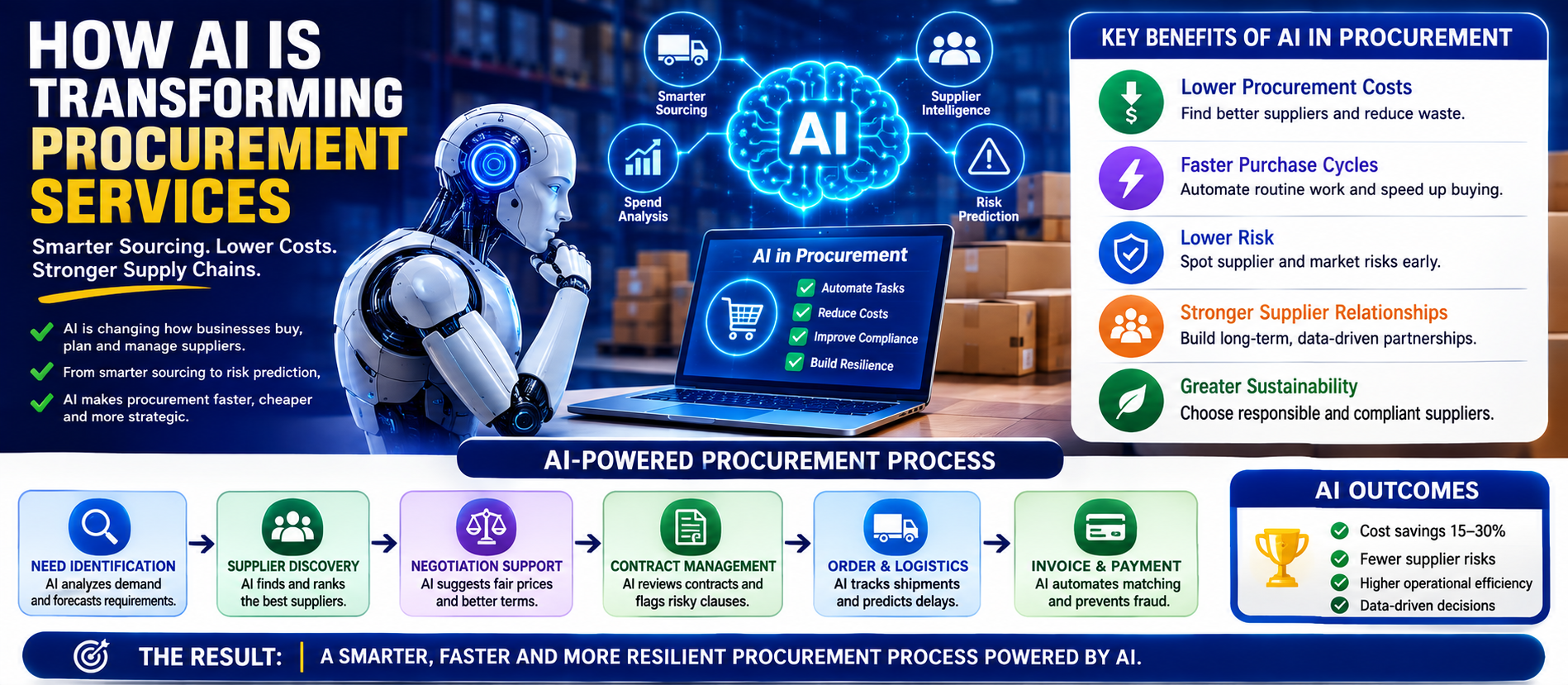
AI is transforming procurement by automating repetitive tasks, analyzing spend, improving supplier intelligence, extracting information from documents, supporting sourcing decisions, monitoring risk, forecasting demand, reviewing contracts, and helping procurement teams act faster.
The biggest change is not simply automation. AI allows procurement professionals to spend less time searching for information and completing repetitive administrative work, and more time on supplier relationships, negotiations, strategy, resilience, and value creation.
What Is AI in Procurement?
AI in procurement is the use of technologies such as machine learning, natural language processing, optical character recognition, predictive analytics, generative AI, and AI agents to improve procurement processes and decisions.
AI can support the complete procurement lifecycle, including:
- Spend analysis.
- Supplier discovery and evaluation.
- Source-to-pay workflows.
- Request and purchase processing.
- Contract analysis.
- Supplier risk monitoring.
- Demand forecasting.
- Invoice and document processing.
- Procurement reporting.
Recent 2026 procurement analysis notes that modern procurement AI increasingly combines OCR, machine learning, large language models, and AI agents to support source-to-pay processes while keeping human judgment central to relationships, negotiations, governance, and strategic decisions.
Why Procurement Is a Strong Use Case for AI
Procurement processes often involve high volumes of structured and unstructured data.
A single sourcing project may include supplier information, specifications, proposals, contracts, emails, pricing files, compliance documents, and historical spending data.
AI is useful because it can help organize and analyze large volumes of information.
For example, instead of manually reviewing hundreds of supplier documents, an AI system may help extract relevant information, compare responses, identify missing data, and create a structured summary for human review.
This does not mean AI should make every decision. It means AI can reduce the time required to prepare information for better decisions.
1. AI Automates Repetitive Procurement Tasks
Procurement professionals often spend significant time on repetitive administrative activities.
AI and automation can support tasks such as:
- Classifying purchase requests.
- Extracting data from invoices and documents.
- Routing approvals.
- Answering common procurement questions.
- Creating first drafts of routine communications.
- Summarizing supplier documents.
- Checking information for completeness.
The objective is not automation for its own sake. The goal is to reduce low-value manual work while maintaining the controls required for purchasing, finance, compliance, and risk management.
2. AI Improves Spend Analysis
Spend analysis helps businesses understand where money is being spent, with which suppliers, and across which categories.
This work can be difficult when supplier names are inconsistent or transactions are stored across multiple systems.
AI can help classify transactions, identify similar suppliers, detect patterns, and highlight potential areas for review.
Procurement teams may use AI to explore questions such as:
- Are we buying the same product from multiple suppliers?
- Where is spending increasing?
- Which categories have fragmented purchasing?
- Are there opportunities for supplier consolidation?
- Are contracts being used as expected?
Human review remains important because data patterns require business context.
3. AI Makes Supplier Discovery Faster
Finding suitable suppliers can require extensive research.
AI can assist by organizing supplier information from approved data sources, internal records, market intelligence, and sourcing documents.
Potential benefits include:
- Faster supplier research.
- Improved comparison of supplier capabilities.
- Better identification of relevant qualifications.
- Structured supplier profiles.
- Faster preparation for sourcing events.
Procurement professionals should still validate important information before making decisions or awarding contracts.
4. AI Supports Supplier Risk Management
Supplier risk can involve financial, operational, geographic, cybersecurity, compliance, and capacity concerns.
AI can help procurement teams monitor large volumes of relevant information and identify changes that may require attention.
Examples include:
- Changes in supplier performance.
- Financial warning signals.
- Delivery delays.
- Quality issues.
- Geographic disruptions.
- Cybersecurity concerns.
The value of AI is often in earlier visibility. Procurement teams can investigate potential problems before they become major disruptions.
5. AI Transforms Strategic Sourcing
Strategic sourcing requires analysis of requirements, suppliers, pricing, capabilities, and risks.
AI can support different stages of the sourcing process.
Requirement Analysis
AI can help summarize requirements, identify missing information, and organize technical or commercial specifications.
Supplier Comparison
AI can assist in structuring supplier responses and comparing them against defined criteria.
Market Intelligence
Analytics and AI tools can help teams organize market information and identify relevant trends.
Sourcing Documentation
Generative AI can help prepare first drafts of RFIs, RFPs, summaries, and internal reports.
Final sourcing decisions should remain subject to appropriate human review and organizational controls.
6. AI Speeds Up Contract Analysis
Procurement teams often manage large numbers of contracts containing complex language.
AI-assisted contract analysis can help identify:
- Key obligations.
- Renewal dates.
- Payment terms.
- Termination clauses.
- Risk-related provisions.
- Missing or unusual language.
This can reduce the time needed to locate information across large contract portfolios.
AI output should not automatically replace legal or professional review, particularly for high-value or high-risk agreements.
7. AI Improves Purchase-to-Pay Operations
Procure-to-pay processes involve many steps, from a purchasing need to supplier payment.
AI can support:
- Purchase request classification.
- Guided buying.
- Policy questions.
- Approval routing.
- Invoice extraction.
- Exception detection.
- Supplier inquiry handling.
Modern procurement platforms can use AI to make purchasing processes easier for employees while helping procurement maintain visibility and policy controls.
8. AI Helps Detect Procurement Anomalies
Large transaction volumes can make unusual patterns difficult to identify manually.
AI and advanced analytics can help flag potential anomalies for review.
Examples may include:
- Unusual purchasing patterns.
- Unexpected price changes.
- Duplicate transactions.
- Purchases outside normal categories.
- Changes in supplier behavior.
A flagged transaction is not automatically an error or violation. It is a signal that may deserve human investigation.
9. AI Supports Better Demand and Inventory Decisions
Procurement decisions are closely connected to demand planning and inventory.
Machine learning models can help identify patterns in historical demand and support forecasting.
Better forecasting may help organizations:
- Plan purchasing earlier.
- Reduce avoidable shortages.
- Improve inventory decisions.
- Prepare for changing demand.
Forecast quality depends heavily on the quality and relevance of the underlying data.
10. Generative AI Changes How Procurement Teams Access Knowledge
Procurement knowledge is often spread across policies, contracts, supplier records, category strategies, and internal documents.
Generative AI can help users search and summarize approved information using natural language.
For example, an employee may ask:
- What is the approval process for this purchase?
- Which supplier is approved for this category?
- What does the procurement policy say about competitive bidding?
For reliable use, organizations should carefully control which information the AI can access and provide mechanisms for users to verify important answers.
11. AI Agents Can Coordinate Multi-Step Procurement Work
AI agents represent a newer stage of procurement automation.
Instead of performing only one task, an AI agent may be designed to complete a sequence of approved actions.
A procurement workflow might involve:
- Receiving a request.
- Checking required information.
- Reviewing policy rules.
- Finding approved suppliers.
- Preparing a comparison.
- Routing the request to the correct person.
McKinsey's 2026 analysis describes agentic AI as helping shift procurement from transaction-heavy activity toward broader contributions to growth, resilience, sustainability, and innovation.
However, autonomous actions should be carefully controlled. High-impact commitments, supplier awards, contract decisions, and sensitive exceptions may require human approval.
12. AI Can Improve Supplier Communication
Procurement teams manage regular communication with suppliers and internal stakeholders.
Generative AI can help create drafts for:
- Supplier follow-ups.
- Meeting summaries.
- RFIs and RFPs.
- Status updates.
- Internal reports.
The final communication should be reviewed when accuracy, commercial terms, or relationships are important.
13. AI Helps Procurement Become More Strategic
One of the most important changes is the shift in how procurement professionals spend their time.
When repetitive work is reduced, procurement teams can focus more on:
- Supplier relationships.
- Negotiation.
- Category strategy.
- Risk management.
- Innovation.
- Sustainability.
- Business partnership.
Recent BCG research on agentic AI in procurement found that the strongest outcomes come from combining technology deployment with capability building, process redesign, data and integration foundations, and governance.
AI Procurement Use Cases by Business Value
| Use Case Main Value Human Oversight | ||
| Document Processing | Reduce manual data entry | Exception review |
| Spend Analysis | Improve visibility | Validate findings |
| Supplier Intelligence | Support research and evaluation | Verify critical information |
| Contract Analysis | Find important clauses faster | Legal and commercial review |
| Demand Forecasting | Support planning | Business context and approval |
| Risk Monitoring | Identify potential disruptions | Investigate alerts |
| AI Agents | Coordinate approved workflows | Controls for high-impact actions |
How to Implement AI in Procurement Services
Step 1: Start With a Real Procurement Problem
Do not begin with the question, “Where can we use AI?”
Start with a measurable business problem, such as slow contract review, poor spend visibility, excessive manual processing, or limited supplier risk monitoring.
Step 2: Map the Current Workflow
Understand how the work is performed today.
Identify manual tasks, delays, duplicate work, approval bottlenecks, and important control points.
Step 3: Assess Data Readiness
AI systems need relevant and accessible information.
Review:
- Data quality.
- Supplier master data.
- Spend categories.
- Document quality.
- Access permissions.
- Data ownership.
Step 4: Select the Right Technology
Different problems require different tools. A simple workflow may only require automation and rules. A complex analysis problem may require machine learning or generative AI.
Step 5: Define Human Oversight
Decide which actions AI can perform automatically and which require approval.
Step 6: Build Governance Before Scaling
Define acceptable use, data controls, security requirements, testing procedures, accountability, and monitoring.
NIST's AI Risk Management Framework provides a useful structure for managing AI risks and trustworthiness. Its core functions are Govern, Map, Measure, and Manage, and NIST's Generative AI Profile provides additional guidance for generative AI risks.
Step 7: Pilot and Measure Results
Start with a focused use case. Measure time saved, accuracy, user adoption, process performance, risk reduction, and business value.
Step 8: Scale What Works
Successful pilots should be expanded carefully with integration, training, governance, and change management.
Data Security and Privacy in AI Procurement
Procurement data can contain sensitive information, including pricing, supplier details, contracts, intellectual property, and financial information.
Organizations should consider:
- Who can access procurement data.
- Where data is processed.
- Whether AI providers use submitted data for training.
- How long information is retained.
- How outputs are logged and reviewed.
- How sensitive information is protected.
NIST's Generative AI Profile specifically includes guidance related to third-party assessment, procurement, data privacy, information security, intellectual property, and value-chain risks.
Common Challenges of AI in Procurement
Poor Data Quality
Inconsistent supplier records and fragmented systems can reduce AI reliability.
Legacy System Integration
AI tools need practical connections to procurement, ERP, finance, and document systems.
Hallucinations and Incorrect Output
Generative AI can produce incorrect or unsupported information. Important outputs should be verified.
Lack of Governance
Unclear rules can create security, privacy, compliance, and accountability problems.
Resistance to Change
Employees need training and a clear understanding of how AI will support their work.
Measuring ROI
Businesses should measure actual operational and commercial results rather than relying only on technology demonstrations.
Best Practices for AI Procurement Transformation
- Start with high-value, clearly defined problems.
- Improve data quality continuously.
- Redesign workflows instead of only adding AI to old processes.
- Keep humans involved in high-impact decisions.
- Integrate AI with existing business systems.
- Train procurement teams to use and evaluate AI.
- Monitor accuracy, security, and business outcomes.
- Build governance before broad deployment.
SEO, AEO, GEO, and AI Search Optimization for Procurement Businesses
Procurement consultants, sourcing companies, supply chain providers, software companies, and B2B service firms can improve online visibility by publishing clear answers to real procurement questions.
SEO helps content rank for traditional search queries.
AEO focuses on direct answers to questions such as:
- How is AI used in procurement?
- What are the benefits of AI in sourcing?
- Can AI analyze procurement contracts?
- How do AI agents automate procurement?
GEO helps generative AI systems understand a company's expertise, services, products, and industry context.
AI Search Optimization benefits from direct answers, structured headings, practical examples, consistent terminology, credible sources, and clearly explained expertise.
Frequently Asked Questions
How is AI changing procurement?
AI is changing procurement by automating repetitive work, improving spend analysis, supporting supplier research, analyzing contracts, monitoring risk, forecasting demand, and coordinating multi-step workflows.
Can AI replace procurement professionals?
AI can automate and support many tasks, but procurement professionals remain important for supplier relationships, negotiation, strategy, governance, judgment, and high-impact decisions.
What is the best AI use case for procurement?
The best use case depends on the business. Common starting points include document processing, spend analysis, contract analysis, supplier intelligence, and procurement knowledge assistants.
What are AI agents in procurement?
AI agents can be designed to perform a sequence of approved tasks, such as gathering information, checking rules, preparing comparisons, and routing work. Their actions should be governed according to business risk.
What are the risks of using generative AI in procurement?
Risks can include incorrect output, data leakage, privacy issues, intellectual property concerns, bias, weak third-party controls, and overreliance on AI-generated recommendations.
How should a business start using AI in procurement?
Start with a specific business problem, map the workflow, assess data readiness, select the appropriate technology, define human oversight, establish governance, pilot the solution, and measure results before scaling.
Conclusion
AI is transforming procurement services by making information easier to process, routine work easier to automate, and procurement decisions faster to support.
The greatest opportunity is not simply doing the same work faster. AI can help procurement move beyond transaction processing toward supplier strategy, resilience, risk management, innovation, and broader business value.
Successful transformation requires more than an AI tool. Businesses need reliable data, redesigned workflows, integrated systems, trained teams, human oversight, and responsible governance.
The future of procurement is likely to be collaborative: AI handles more of the repetitive and information-intensive work, while people focus on judgment, relationships, negotiation, strategy, and accountability.
Disclaimer: This article is for general educational and informational purposes only. Procurement, data protection, AI governance, contractual, and regulatory requirements vary by organization, industry, and jurisdiction. Businesses should consult appropriate procurement, legal, security, privacy, and technology professionals before implementing high-impact AI systems.
Digiifrog
Website: www.digiifrog.com
Ready to Grow?
Talk to us about a strategy tailored to your brand — we will help you stand out in search, AI discovery and social.
Comments (0)
Log in to leave a comment.