📋 Quick Summary
In this article:
1. Why Traditional Claims Processing Can Be Slow
2. AI Makes Claim Intake Faster
3. Intelligent Document Processing Reduces Manual Data Entry
4. AI Can Classify and Route Claims
5. Image Analysis Can Support Damage Assessment
6. Automated Policy and Coverage Checks Save Time
7. AI Helps Detect Fraud and Unusual Patterns
8. Straight-Through Processing for Suitable Claims
9. AI Improves Customer Communication
10. AI Can Help Claims Professionals Work More Efficiently
11. Better Data Can Improve Consistency
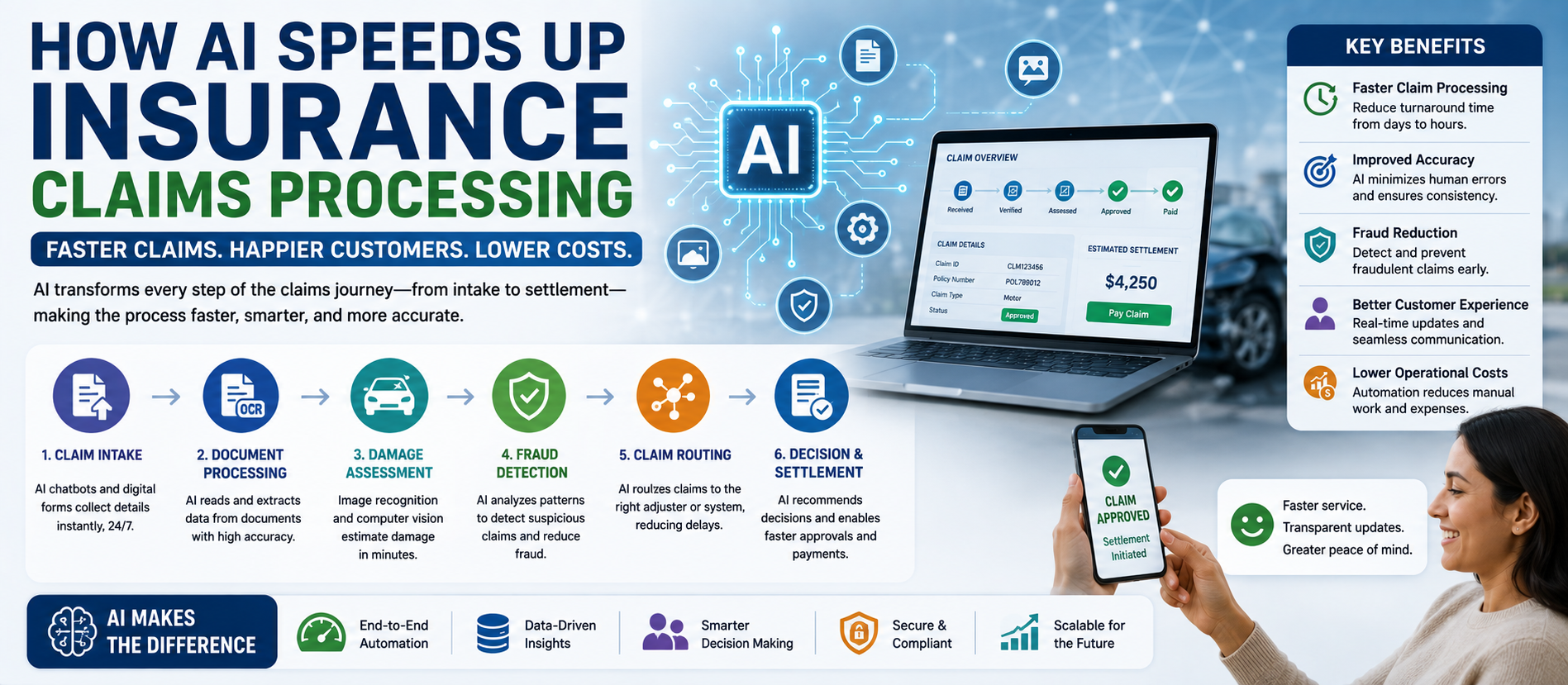
12. A Typical AI-Powered Claims Workflow
Focus Keyword: How AI Speeds Up Insurance Claims Processing
Insurance claims can involve forms, photographs, invoices, medical records, repair estimates, policy documents, and communication between many people. When these tasks are handled manually, the process can become slow and difficult to scale.
Artificial intelligence is changing this workflow. AI can read documents, extract information, classify claims, analyze images, identify unusual patterns, and help route cases to the right people. This does not mean that every claim should be approved automatically. Instead, AI can handle repetitive work and support human claims professionals when judgment is required.
How AI speeds up insurance claims processing is simple: it reduces manual data entry, makes information easier to find, automates routine checks, and helps insurers focus human attention on complex or high-risk cases.
💡 Key Insight
This guide explains how AI-powered claims processing works, where it creates value, what limitations remain, and why human oversight, security, and fairness are still essential.
Digiifrog creates practical content designed for SEO, AEO, GEO, and AI Search optimization. Visit www.digiifrog.com for more information.
1. Why Traditional Claims Processing Can Be Slow
A traditional claim may move through several stages. The customer reports a loss, submits documents, waits for the information to be reviewed, and may be asked for additional details. A claims professional then checks policy coverage, supporting evidence, estimates, and other relevant information.
Each handoff can create delays. Documents may arrive in different formats. Important details may need to be typed into internal systems. Missing information can require follow-up. Large claim volumes can also create backlogs.
AI helps reduce these bottlenecks by processing large amounts of structured and unstructured information quickly. It can support the claims team from the first notice of loss through review, investigation, communication, and settlement.
2. AI Makes Claim Intake Faster
The first stage of a claim is often called claim intake or the first notice of loss. Customers may submit information through a website, mobile application, email, call center, or chatbot.
AI can help organize this information immediately. Natural language systems can identify important details from a written description. Automated workflows can recognize the policy number, date of loss, location, type of incident, and supporting documents.
The system can also check whether required information appears to be missing. Instead of waiting for a manual review, the customer may receive an immediate request for the next document or detail.
This creates a cleaner starting point for the claims process and reduces unnecessary delays caused by incomplete submissions.
3. Intelligent Document Processing Reduces Manual Data Entry
Insurance claims are often document-heavy. A single claim may contain scanned forms, PDFs, photographs, receipts, police reports, medical bills, discharge summaries, invoices, and repair estimates.
AI-powered document processing combines technologies such as optical character recognition, document classification, and information extraction. The system can convert readable documents into usable data and identify important fields.
For example, an AI system may extract names, dates, policy numbers, invoice amounts, diagnosis information, or repair details. It can then send the information to the appropriate claims workflow.
Human reviewers still need to handle uncertain or unusual cases. However, reducing routine typing allows them to spend more time on analysis and customer service.
4. AI Can Classify and Route Claims
Not every claim requires the same level of review. A simple, low-value claim with complete information may follow a different path from a complex claim involving serious injuries, conflicting evidence, or possible fraud.
Machine learning and rule-based systems can help classify incoming claims. Based on defined criteria and available information, the system can route a case to a suitable queue, specialist, or workflow.
Intelligent routing can reduce the time claims spend waiting in the wrong queue. It can also help organizations reserve experienced human reviewers for the cases where their expertise has the greatest value.
5. Image Analysis Can Support Damage Assessment
Computer vision allows AI systems to analyze photographs and other visual information. In insurance, this can support the assessment of vehicle damage, property damage, and other visible losses.
An image analysis system may identify the type of object shown, detect visible damage, compare images with historical examples, or help create an estimate for further review.
Image analysis does not replace every inspection. Poor image quality, hidden damage, unusual circumstances, or safety concerns may require a human inspection.
The main advantage is speed. When suitable claims include clear digital images, AI can help organize the evidence and provide information to the claims professional much faster than a fully manual process.
6. Automated Policy and Coverage Checks Save Time
Before a claim can move toward settlement, the insurer may need to confirm policy details and applicable coverage. Manual review can require employees to search through policy records and compare them with the reported event.
AI-assisted systems can retrieve relevant policy information and compare claim data with defined rules. They can flag possible mismatches, missing information, or issues that require closer review.
These tools should support, not blindly replace, professional judgment. Policy language can be complex, and claim decisions may depend on facts that an automated system cannot fully understand.
7. AI Helps Detect Fraud and Unusual Patterns
Fraud detection is another important use of AI in insurance claims. Large claim volumes can make it difficult for people to identify every unusual pattern.
Machine learning models can compare a claim with historical patterns and look for signals that may require further investigation. These signals can include inconsistent information, unusual timing, repeated behavior, document anomalies, or patterns across related claims.
A fraud score is not the same as proof of fraud. The best use of AI is often to prioritize cases for investigation rather than make unsupported accusations automatically.
This approach can help investigators focus their time while allowing ordinary claims to continue through the process more efficiently.
8. Straight-Through Processing for Suitable Claims
Some simple claims may be suitable for a highly automated workflow. This is often described as straight-through processing.
In a controlled workflow, the system can receive the claim, validate required information, perform policy checks, apply approved rules, and move eligible claims toward payment or final review.
Not every claim should use this path. Insurers need clear thresholds and escalation rules. A complex or high-risk claim should be routed to a qualified human professional.
The goal is not maximum automation at any cost. The goal is to automate predictable, low-complexity work while maintaining appropriate controls.
9. AI Improves Customer Communication
Customers often feel frustrated when they do not know what is happening with a claim. AI-powered communication tools can provide status updates, answer common questions, and explain what information is still needed.
Chatbots and virtual assistants can provide basic support at any time of day. Language technologies can also help summarize case information for employees, making customer conversations faster and more consistent.
Complex complaints, emotional situations, coverage disputes, and sensitive decisions should still have a clear path to human support.
10. AI Can Help Claims Professionals Work More Efficiently
One of the strongest uses of AI is augmentation. Instead of replacing the claims professional, the system acts as an assistant.
An AI claims assistant can summarize a long file, identify important documents, highlight missing information, suggest relevant workflow steps, and bring related policy information together.
This can reduce the time spent searching through pages of records. The claims professional remains responsible for reviewing the evidence and making decisions according to company procedures and applicable requirements.
AI is especially useful when the volume of information is high but human judgment is still necessary.
11. Better Data Can Improve Consistency
Manual processes can vary between employees, teams, and locations. Structured workflows can help insurers apply the same basic checks consistently.
AI can support standardization by organizing information and applying approved models or rules. However, consistency should not mean rigid decision-making. Real claims can involve unique facts, and systems need escalation paths for exceptions.
Regular monitoring is also necessary. A model can become less reliable when customer behavior, claim patterns, regulations, products, or external conditions change.
12. A Typical AI-Powered Claims Workflow
- Claim submission: The customer submits a claim and supporting information digitally.
- Document intake: AI identifies document types and extracts relevant data.
- Data validation: The system checks for missing fields, inconsistencies, or basic errors.
- Policy review: Relevant policy information is retrieved for comparison.
- Assessment: AI may analyze documents, images, estimates, or other available evidence.
- Risk screening: Fraud or anomaly tools flag claims that need further investigation.
- Routing: Simple cases follow an approved automated workflow while complex cases move to specialists.
- Human review: Claims requiring judgment, investigation, or exception handling receive expert attention.
- Communication and settlement: The customer receives updates and the claim moves toward an appropriate outcome.
13. The Benefits of Faster Claims Processing
Faster claims processing can create benefits for both insurers and customers.
- Less manual data entry.
- Faster document review.
- Quicker routing of claims.
- Reduced administrative backlogs.
- More time for complex investigations.
- Better claim status communication.
- More consistent workflows.
- Improved fraud and anomaly screening.
- Potentially faster settlement for eligible claims.
However, speed alone should never be the only performance measure. A fast but inaccurate system can create customer harm, regulatory problems, and financial losses.
14. Accuracy, Fairness, and Human Oversight Matter
AI systems can make mistakes. They may receive incomplete data, misread poor-quality documents, or produce unreliable results when used outside their intended purpose.
Insurance decisions can have important consequences for customers. For this reason, insurers need clear governance, testing, monitoring, documentation, and escalation procedures.
Human oversight is particularly important for high-impact decisions, disputed claims, unusual cases, and situations where the AI system shows low confidence.
Organizations should also monitor models for unfair outcomes and ensure that automated tools are used consistently with applicable laws and internal policies.
15. Data Security and Privacy Cannot Be Ignored
Claims data may contain sensitive personal, financial, health, or property information. AI systems need strong data protection practices.
Important controls may include access management, encryption, secure data storage, vendor assessment, audit logs, data minimization, and clear retention procedures.
Before using an external AI provider, insurers should understand how information is processed, where it is stored, who can access it, and whether it may be used for other purposes.
16. Common Challenges When Implementing AI
AI projects can fail when organizations focus only on technology. Common problems include poor data quality, disconnected legacy systems, unclear business goals, weak governance, insufficient testing, and unrealistic expectations.
A better approach is to begin with a specific problem. For example, an insurer may start by reducing manual document classification or improving the routing of incomplete claims.
Measure the results. Review accuracy, processing time, escalation rates, customer experience, and error patterns. Then improve the system before expanding it to additional workflows.
17. How Insurers Can Implement AI Responsibly
- Choose a clear business problem.
- Define the role of AI and the role of human reviewers.
- Use reliable and relevant data.
- Test the system before broad deployment.
- Set confidence thresholds and escalation rules.
- Monitor accuracy and unexpected outcomes.
- Protect sensitive information.
- Document important decisions and workflows.
- Train employees to use AI outputs correctly.
- Review vendors and third-party systems carefully.
18. The Future of AI in Insurance Claims
AI is likely to become more deeply integrated into claims operations. Systems will continue to improve in document understanding, image analysis, multilingual communication, anomaly detection, and workflow automation.
Generative AI may also help employees summarize complex files, search internal knowledge, draft routine communications, and prepare case information for review.
The most effective future model is likely to combine automation with human expertise. Routine work can move faster, while experienced professionals focus on complex, sensitive, or high-impact decisions.
SEO, AEO, GEO, and AI Search Optimization
People increasingly search for direct answers about insurance technology. Clear headings, short explanations, structured lists, and question-based content make information easier for search engines, answer engines, and AI systems to understand.
SEO helps content appear in traditional search results. AEO focuses on answering specific questions directly. GEO and AI Search optimization help content remain useful when generative AI systems retrieve and summarize information.
Useful search questions include:
- How does AI speed up insurance claims?
- Can AI process insurance documents automatically?
- How does AI detect insurance fraud?
- What is AI claims automation?
- Can AI analyze vehicle or property damage?
- Does AI replace insurance claims adjusters?
- What are the risks of AI in insurance claims?
Frequently Asked Questions
How does AI speed up insurance claims processing?
AI can reduce manual work by extracting information from documents, classifying claims, analyzing images, checking for missing information, detecting unusual patterns, and routing cases to the appropriate workflow or reviewer.
Can AI approve an insurance claim automatically?
Some simple claims may be suitable for controlled automated processing. Complex, disputed, unusual, or high-risk claims should be escalated for appropriate human review.
How does AI help detect insurance fraud?
AI can analyze claim data and identify patterns or anomalies that may require investigation. A suspicious score should normally be treated as a signal for review, not automatic proof of fraud.
Does AI replace insurance claims professionals?
AI can automate repetitive tasks and support employees, but human expertise remains important for judgment, investigation, customer support, exceptions, and high-impact decisions.
What is the biggest benefit of AI in claims processing?
The main benefit is faster and more efficient handling of routine information. This can reduce administrative work and allow claims professionals to focus on complex cases.
Final Thoughts
AI speeds up insurance claims processing by turning slow, repetitive information tasks into faster digital workflows. It can read documents, organize data, analyze images, identify unusual patterns, route claims intelligently, and support better communication.
The best results come from combining automation with human expertise. Insurers should not measure success only by speed. Accuracy, fairness, privacy, security, transparency, and customer experience are equally important.
When implemented responsibly, AI can help insurers handle higher claim volumes, reduce routine delays, and give experienced professionals more time to focus on the cases that truly need human judgment.
For practical SEO, AEO, GEO, and AI Search optimized content, visit Digiifrog at www.digiifrog.com.
Disclaimer: This article is for general educational and informational purposes only. It is not insurance, legal, regulatory, technology, or financial advice. AI capabilities, insurance rules, privacy requirements, and claims practices vary by insurer, jurisdiction, product, and use case. Always review applicable laws, policy terms, governance requirements, and professional guidance before implementing AI in an insurance workflow.
Ready to Grow?
Talk to us about a strategy tailored to your brand — we will help you stand out in search, AI discovery and social.


Comments (0)
Log in to leave a comment.