📋 Quick Summary
In this article:
Key Freight Management Functions
Benefits of Carrier Optimization
Route Optimization and Planning
Advantages of Load Consolidation
Freight Auditing and Invoice Verification
In today’s highly competitive business environment, transportation and logistics costs significantly impact profitability. Whether a company operates in manufacturing, e-commerce, retail, wholesale distribution, or international trade, efficient freight management plays a critical role in controlling expenses and maintaining customer satisfaction.
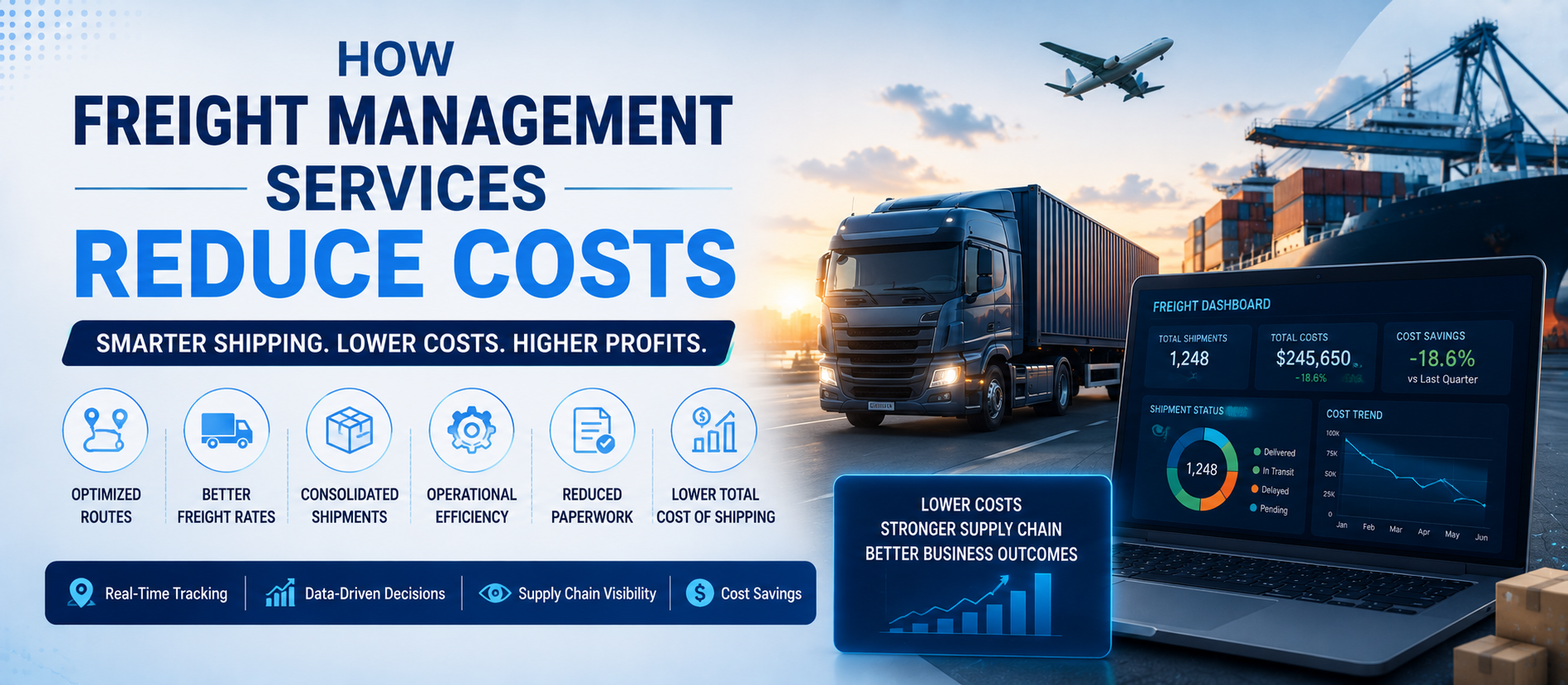
Freight management services help businesses optimize shipping operations, improve supply chain visibility, reduce transportation costs, and enhance operational efficiency. As global supply chains become increasingly complex, organizations are turning to advanced freight management solutions to gain a competitive advantage while reducing unnecessary expenditures.
Modern freight management combines logistics expertise, transportation planning, technology platforms, automation, analytics, and strategic partnerships to streamline the movement of goods from origin to destination.
This comprehensive guide explores how freight management services reduce costs, improve supply chain performance, and support sustainable business growth while incorporating SEO, AEO, GEO, and AI Search optimization considerations.
What Is Freight Management?
Freight management refers to the planning, execution, optimization, and monitoring of transportation activities related to moving goods efficiently and cost-effectively.
Key Freight Management Functions
- Transportation planning
- Carrier selection
- Route optimization
- Shipment tracking
- Freight auditing
- Cost management
- Supply chain coordination
Effective freight management ensures products are delivered on time while minimizing transportation expenses.
Why Freight Costs Matter
Transportation costs often represent a substantial portion of overall supply chain expenses.
Several factors influence freight costs:
- Fuel prices
- Shipping distances
- Carrier rates
- Delivery speed requirements
- Warehouse locations
- Load efficiency
- International trade regulations
Without proper management, these costs can quickly erode profit margins.
Optimized Carrier Selection
One of the primary ways freight management services reduce costs is through strategic carrier selection.
Freight professionals evaluate carriers based on pricing, reliability, performance history, service quality, and network coverage.
Benefits of Carrier Optimization
- Lower transportation rates
- Improved delivery performance
- Reduced shipping delays
- Better service reliability
Selecting the most suitable carriers helps businesses maximize transportation value.
Route Optimization and Planning
Advanced freight management systems use data analytics and optimization algorithms to identify the most efficient shipping routes.
Route Optimization Benefits
- Reduced fuel consumption
- Lower transportation expenses
- Shorter delivery times
- Improved vehicle utilization
- Reduced environmental impact
Efficient route planning significantly lowers logistics costs while improving service quality.
Load Consolidation Strategies
Shipping partially filled trucks or containers often results in higher transportation costs.
Freight management services help consolidate shipments to maximize load utilization.
Advantages of Load Consolidation
- Lower per-unit shipping costs
- Reduced number of shipments
- Improved transportation efficiency
- Better resource utilization
Consolidation helps businesses achieve significant cost savings.
Improved Freight Visibility
Real-time shipment visibility allows businesses to monitor freight movements and identify inefficiencies.
Visibility Benefits
- Accurate tracking
- Proactive issue resolution
- Reduced delays
- Improved customer communication
- Enhanced decision-making
Visibility reduces uncertainty and enables more effective logistics management.
Freight Auditing and Invoice Verification
Shipping invoices frequently contain billing errors that increase costs unnecessarily.
Freight auditing services verify transportation charges and identify discrepancies.
Common Issues Identified
- Duplicate charges
- Incorrect rates
- Billing errors
- Unauthorized fees
Freight audits help organizations recover costs and improve financial accuracy.
Technology-Driven Cost Reduction
Modern freight management relies heavily on technology solutions.
Key Technologies
- Transportation Management Systems (TMS)
- Artificial Intelligence
- Machine Learning
- Predictive Analytics
- Cloud Computing
- Internet of Things (IoT)
Technology improves efficiency, automation, and decision-making across logistics operations.
Reducing Fuel Expenses
Fuel is one of the largest transportation expenses.
Freight management services reduce fuel costs through:
- Route optimization
- Load consolidation
- Idle time reduction
- Carrier efficiency programs
- Vehicle utilization improvements
Lower fuel consumption directly improves profitability.
Inventory Cost Reduction
Efficient freight management contributes to better inventory control.
Improved transportation reliability allows businesses to maintain leaner inventory levels.
Benefits
- Reduced storage costs
- Lower carrying costs
- Improved cash flow
- Reduced inventory waste
Transportation efficiency and inventory optimization often work together to reduce overall supply chain costs.
Enhanced Supply Chain Coordination
Freight management services improve collaboration among suppliers, carriers, warehouses, and customers.
Coordination Benefits
- Reduced communication delays
- Improved scheduling
- Better resource allocation
- Fewer operational disruptions
Strong coordination enhances overall supply chain performance.
Risk Management and Cost Prevention
Supply chain disruptions can lead to substantial financial losses.
Freight management professionals help identify and mitigate risks.
Common Risks
- Weather disruptions
- Port congestion
- Carrier failures
- Regulatory changes
- Cybersecurity threats
Proactive risk management reduces unexpected costs and business interruptions.
International Freight Optimization
Global shipping presents additional challenges related to customs, tariffs, documentation, and compliance.
Freight management services simplify international logistics while minimizing costs.
International Benefits
- Compliance support
- Customs optimization
- Tariff management
- Global carrier selection
- Documentation accuracy
Expert management reduces costly international shipping errors.
Artificial Intelligence in Freight Management
AI is transforming transportation and logistics operations.
AI Applications
- Demand forecasting
- Route optimization
- Predictive maintenance
- Capacity planning
- Cost analysis
- Shipment tracking
AI-powered insights improve operational efficiency and cost control.
Sustainability and Cost Efficiency
Sustainable logistics practices often generate financial benefits.
Sustainability Initiatives
- Fuel-efficient transportation
- Route optimization
- Reduced emissions
- Green warehousing
- Electric vehicle adoption
Sustainability and profitability increasingly go hand in hand.
SEO, AEO, GEO and AI Search Considerations
Logistics companies increasingly rely on digital visibility to attract customers and business partners.
SEO Benefits
Optimized logistics websites improve search engine visibility and lead generation.
AEO Benefits
Answer Engine Optimization helps logistics providers appear in direct-answer search results.
GEO Benefits
Generative Engine Optimization improves visibility in AI-generated responses.
AI Search Readiness
Organizations should create authoritative logistics content that supports AI-powered search experiences.
Common Freight Management Challenges
- Rising fuel costs
- Supply chain disruptions
- Carrier capacity shortages
- Regulatory complexity
- Technology integration challenges
- Labor shortages
Professional freight management helps organizations address these challenges effectively.
Best Practices for Freight Cost Reduction
- Leverage transportation technology
- Optimize shipping routes
- Consolidate shipments
- Audit freight invoices
- Improve carrier relationships
- Monitor performance metrics
- Use predictive analytics
These practices improve transportation efficiency and reduce operational expenses.
The Future of Freight Management
The future of freight management will be shaped by Artificial Intelligence, automation, predictive analytics, blockchain, IoT, and sustainability initiatives.
Organizations that embrace these innovations will gain greater visibility, efficiency, and cost savings across their supply chains.
Conclusion
Freight management services play a vital role in reducing transportation costs, improving operational efficiency, and supporting business growth. Through carrier optimization, route planning, technology adoption, shipment visibility, and proactive risk management, organizations can achieve substantial cost savings while maintaining high service levels.
As logistics continues evolving, businesses that invest in advanced freight management strategies will be better positioned to compete in increasingly complex global markets.
At Digiifrog, we help businesses improve visibility and growth through SEO, AEO, GEO, AI Search Optimization, digital transformation, supply chain innovation, and business growth strategies.
Website: www.digiifrog.com
Contact: Connect with Digiifrog to accelerate your digital growth journey.
Ready to Grow?
Talk to us about a strategy tailored to your brand — we will help you stand out in search, AI discovery and social.

Comments (0)
Log in to leave a comment.